

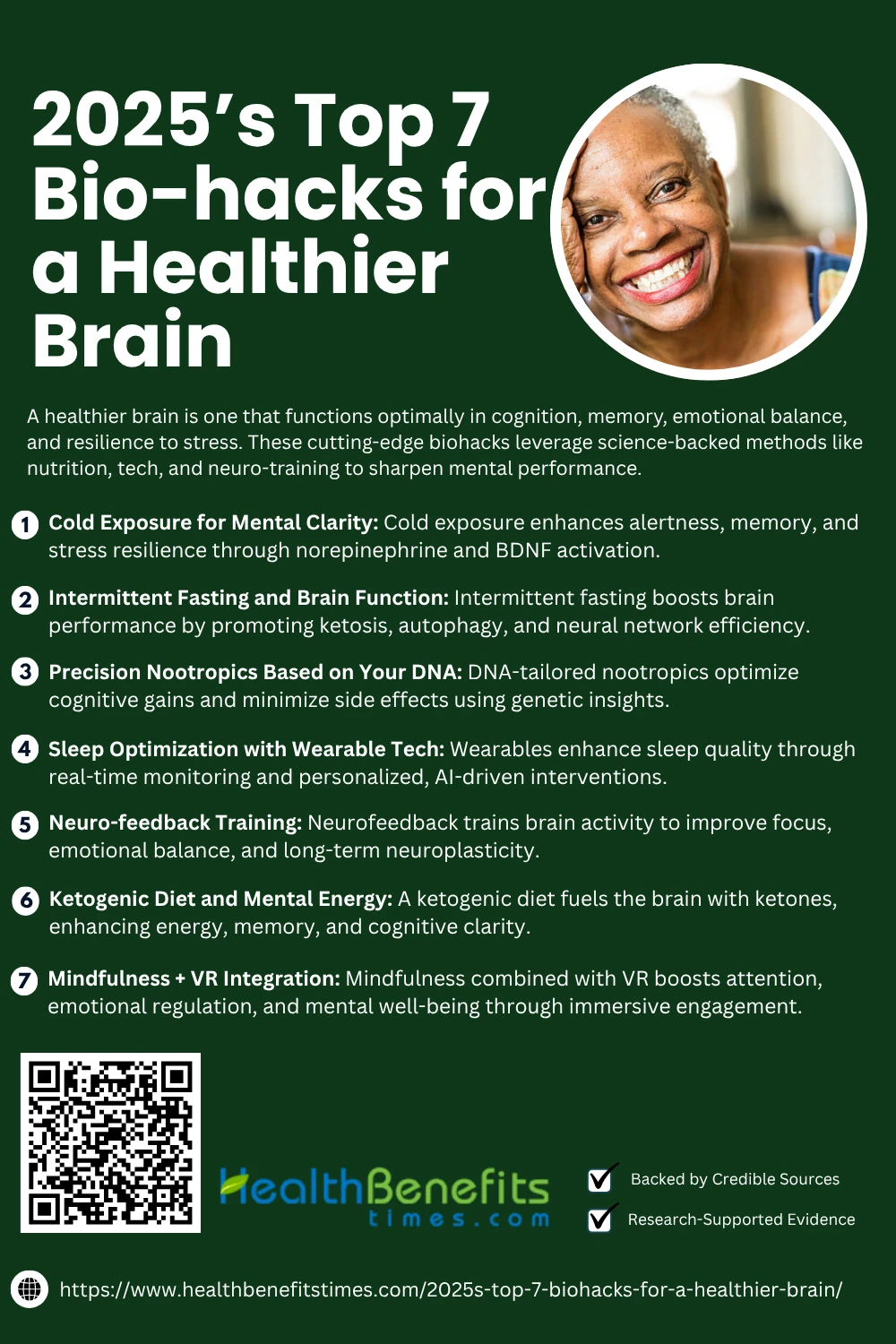
- A healthier brain is one that functions optimally in cognition, memory, emotional balance, and resilience to stress.
- These cutting-edge biohacks leverage science-backed methods like nutrition, tech, and neurotraining to sharpen mental performance.
- From cold exposure to VR mindfulness, each hack enhances focus, energy, and neuroplasticity for long-term cognitive health.
 A healthier brain is one that maintains optimal cognitive, emotional, and functional capacity across the lifespan, supported by structural integrity and dynamic neuroplasticity mechanisms. In a world increasingly driven by information overload and cognitive demands, enhancing brain health is no longer a luxury—it’s a necessity. The year 2025 marks a pivotal moment in neuroscience and biohacking, where cutting-edge technologies and personalized health insights are reshaping how we optimize our cognitive well-being. From gene-tailored nootropics to wearable neurotech and gut-brain modulation, modern science is validating and expanding the toolkit for enhancing mental clarity, memory, and mood. This evolution reflects a broader shift toward health neuroscience, which focuses on the interplay between biological brain function and behavioral health outcomes. Backed by real-time neuroimaging, longitudinal aging studies, and interventions targeting inflammation and neurogenesis, 2025’s top brain biohacks offer evidence-based strategies to support long-term cognitive vitality.
2025’s Top 7 Bio hacks for a Healthier Brain
Discover the top 7 brain-boosting biohacks of 2025 that sharpen focus, enhance memory, and elevate mental clarity—backed by science and easy to integrate into your daily routine.
 1. Cold Exposure for Mental Clarity
Cold exposure can significantly enhance cognitive performance by stimulating norepinephrine release, which boosts alertness and attention Harvard Health. Regular cold showers improve mood by activating dopamine pathways Nature Neuroscience. (1) Cold water immersion also promotes resilience to stress PubMed Study. (2) Exposure to cold can increase brain-derived neurotrophic factor (BDNF), improving learning Frontiers in Neuroscience. Enhanced mitochondrial efficiency and reduced neuroinflammation have also been observed Cell Metabolism. Even short-term cold stress improves working memory and mental clarity Journal of Physiology. (3)
2. Intermittent Fasting and Brain Function
Intermittent fasting (IF) supports brain health by inducing ketosis, which enhances mitochondrial function and cognitive resilience Cell Metabolism. IF promotes autophagy, clearing damaged neurons and improving brain plasticity Nature Reviews Neuroscience. (4) Human trials show IF improves verbal memory and executive function Journal of Nutrition, Health & Aging. It also reduces inflammation and oxidative stress Free Radical Biology and Medicine. IF increases BDNF levels, supporting memory formation Neuroscience Letters. (5) Neuroimaging reveals IF enhances neural network efficiency Journal of Cerebral Blood Flow & Metabolism.
3. Precision Nootropics Based on Your DNA
Genetically tailored nootropics represent the future of cognitive enhancement, optimizing compounds like L-theanine and citicoline based on individual polymorphisms Nature Biotechnology. (6) Variants in COMT affect dopamine metabolism and response to cognitive enhancers Science Translational Medicine. DNA-guided nutrigenomics enhances memory via targeted micronutrients Frontiers in Genetics. Personalized nootropic stacks minimize side effects Journal of Clinical Pharmacology. (7) Studies link APOE variants to differing responses to omega-3s American Journal of Clinical Nutrition. Advances in pharmacogenomics now enable precise brain biohacking Trends in Pharmacological Sciences.
4. Sleep Optimization with Wearable Tech
Wearable tech improves sleep by tracking biometrics like HRV and REM cycles in real-time Journal of Clinical Sleep Medicine. Devices like Oura and WHOOP detect disruptions and optimize circadian alignment Nature and Science of Sleep. Wearables enhance sleep hygiene via AI-guided interventions npj Digital Medicine. Smartwatches can predict insomnia patterns Sleep Health Journal. Sleep scoring via EEG-integrated headbands improves sleep architecture Frontiers in Neuroscience. Biofeedback from wearables has also been linked to improved melatonin cycles Chronobiology International.
5. Neuro-feedback Training
Neurofeedback training uses real-time EEG to enhance cognitive functions like attention, memory, and emotional regulation NeuroImage. It effectively improves ADHD symptoms by promoting self-regulation of brain waves Journal of Attention Disorders. Athletes and executives now use neurofeedback to boost peak performance Psychology of Sport and Exercise. Training enhances alpha-theta rhythms linked to creativity and flow Consciousness and Cognition. Research shows improved anxiety and depression outcomes Biological Psychology. Long-term neuroplasticity effects support learning and memory enhancement Frontiers in Human Neuroscience.
6. Ketogenic Diet and Mental Energy
The ketogenic diet boosts mental energy by shifting the brain’s fuel source to ketones, improving mitochondrial efficiency Nature Reviews Neuroscience. (8) Clinical trials show cognitive enhancement in aging populations and those with mild cognitive impairment Neurobiology of Aging. Ketosis also reduces neuroinflammation, which is linked to fatigue and brain fog Cell Reports. It stabilizes blood glucose, reducing energy crashes Journal of Clinical Investigation. The diet increases levels of BDNF, aiding in learning and memory Frontiers in Molecular Neuroscience. Athletes and professionals report sharper focus and sustained attention Nutrients.
7. Mindfulness + VR Integration
Integrating mindfulness with virtual reality (VR) boosts focus and emotional regulation through immersive, multisensory engagement Journal of Medical Internet Research. VR-enhanced meditation increases alpha brainwave activity, improving relaxation and attention Frontiers in Psychology. Clinical trials show reduced anxiety and burnout in VR mindfulness users Nature Scientific Reports. It improves self-awareness and reduces default mode network overactivity Human Brain Mapping. (9) VR training also enhances compassion and emotional intelligence PLOS ONE. Applications extend to PTSD and neurorehabilitation Journal of NeuroEngineering and Rehabilitation.
Conclusion
In 2025, enhancing brain health is more accessible and innovative than ever. These top 7 biohacks offer practical, science-backed strategies to improve mental clarity, focus, memory, and overall cognitive performance. From cold exposure and fasting to cutting-edge nootropics and VR-enhanced mindfulness, each approach empowers you to take charge of your brain’s well-being naturally and effectively. The key is consistency—adopt what aligns with your lifestyle, monitor your progress, and refine your routine as needed. By integrating these biohacks mindfully, you’re not just boosting brain function today—you’re investing in long-term mental resilience and a sharper, healthier future.