Health Benefits
    Facebook Twitter Instagram
    Friday, December 5
    Facebook Twitter Pinterest
    Health Benefits
    • Home
    • Dental Health
    • Mental Health
    • Weight Loss
    • Health Wiki
    • Nutrition
    • Healthy Recipe
    • BMI Calculator
    Health Benefits
    Home»Herbs and Spices»Facts about Hogvine
    Herbs and Spices

    Facts about Hogvine

    By SylviaSeptember 10, 2019Updated:September 10, 2019No Comments4 Mins Read
    Facebook Twitter Pinterest LinkedIn Tumblr Email

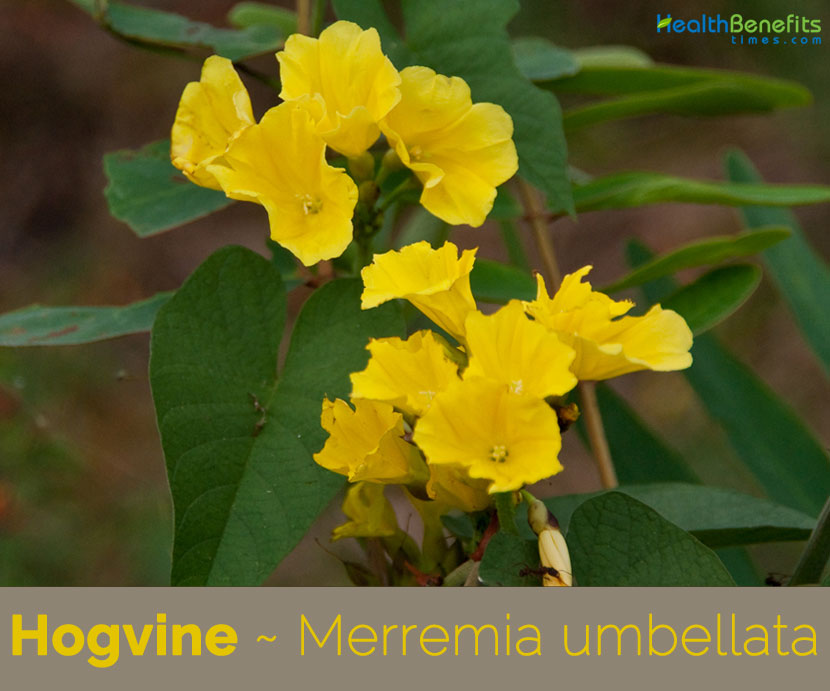
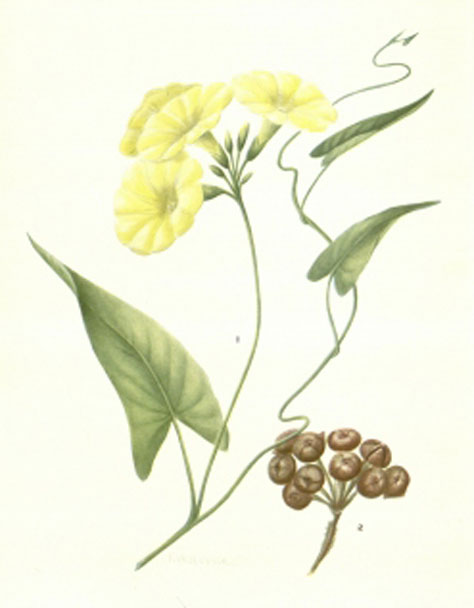
    Hogvine, also referred to as Yellow merremia, Yellow wood rose has the scientific name Merremia umbellata is a twining, herbaceous plant belonging to Convolvulaceae family. The plant is native to Tropical East Africa, Seychelles, India, and Sri Lanka eastwards to China, Indo-China, Thailand, and southwards through Malesia to northern Australia. It occurs in America from Mexico to Paraguay, in the West Indies and in tropical West Africa. Hogvine, greater bindweed, Hog vine, yellow hog vine, yellow merremia, yellow morning glory and yellow wood rose are few of the popular common names of the plant.

    Plant description

    Hogvine is a twining, herbaceous, vigorous perennial climbing vine that may grows about 1-3 m tall. The plant is found growing in edges of forests, in grasslands, roadsides and waterways, clearings, deforested areas, vacant land in villages, mixed deciduous forest, evergreen hill forest, swamp margins, secondary scrub, thickets, hedges, along fields, in teak forests and on river-banks. The plant prefers well drained fertile soil.

    Leaves

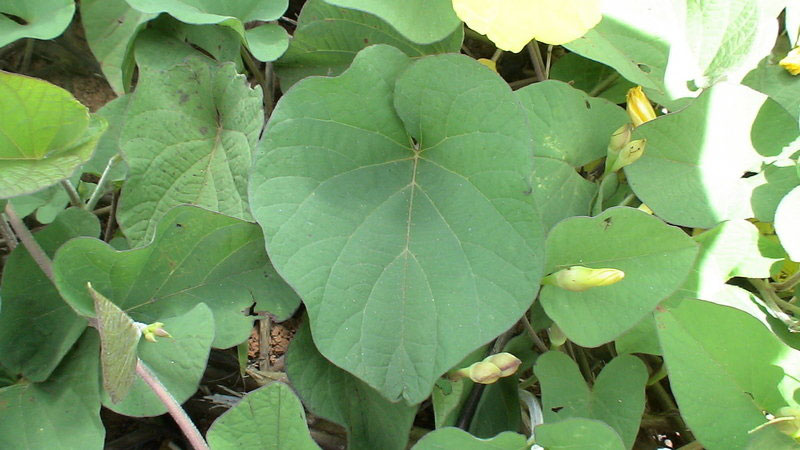
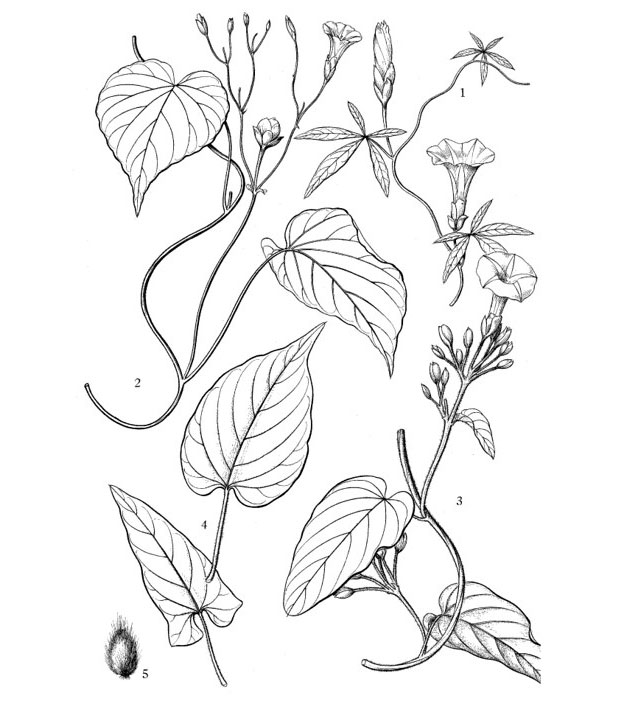
    Leaves are ovate to oblong in shape, with a size of measuring about 4-16 cm long and 1-9 cm wide, cordate base and rounded or truncate in shape. The basal lobes are rounded or angular, acuminate apex where both sides are sparsely to densely hairy. Petiole is measuring about 1.5-6 cm long.

    Flower

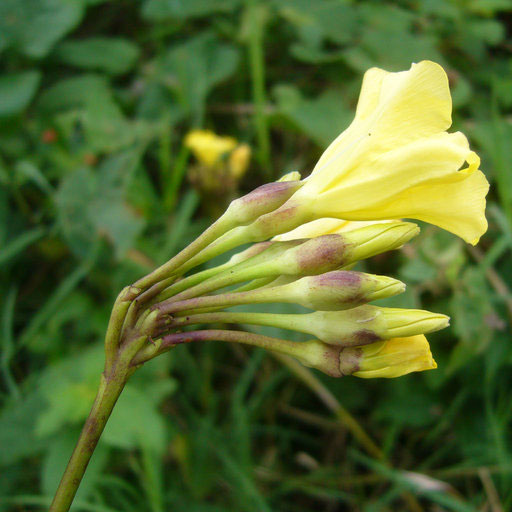
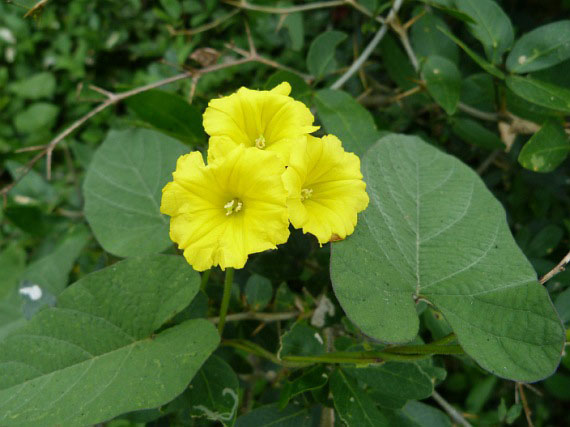
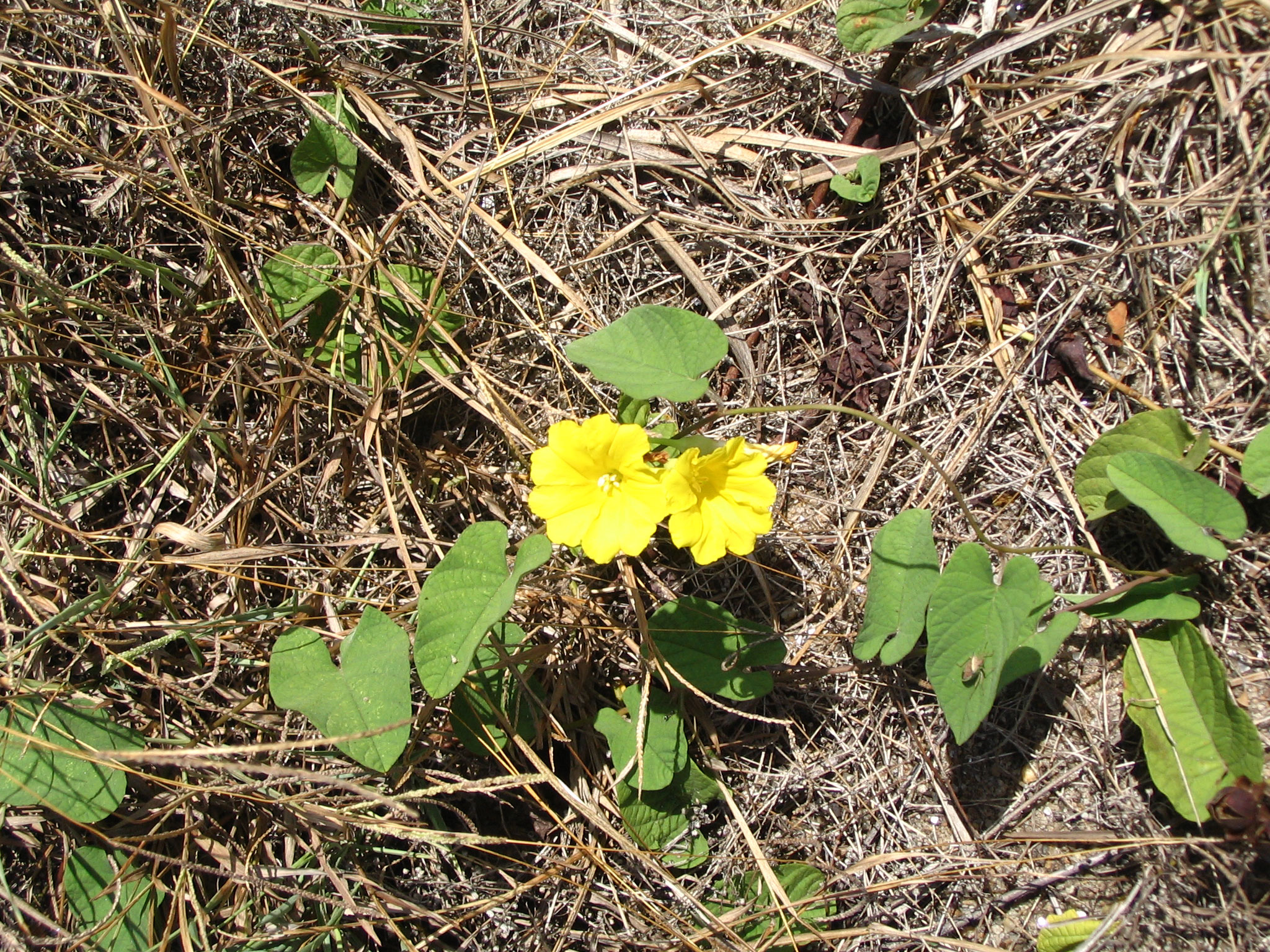
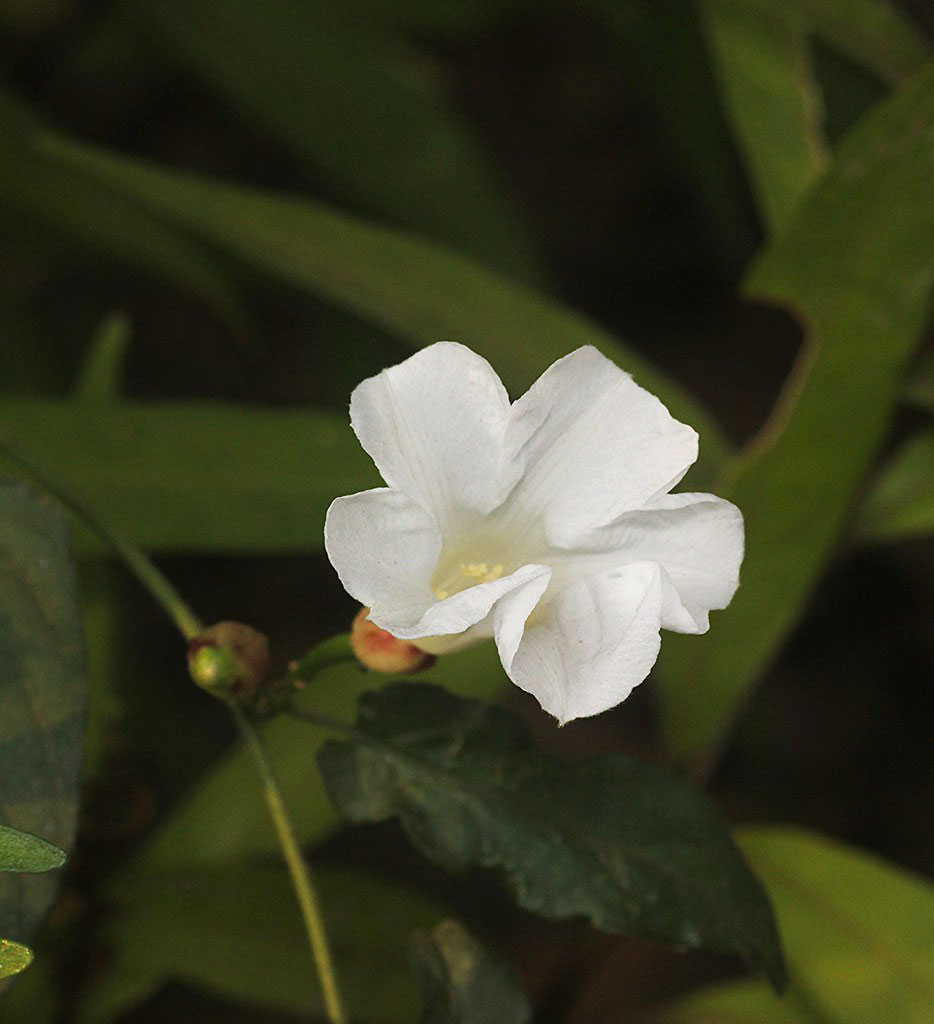
    Cymes are few to many flowered, umbelliform, with measuring about 1-7 cm long peduncle, minute bracts and caduceus. Flower-buds are ovoid in shape, with a size of measuring about 5-9 mm long pedicel. Sepals are strongly concave, slightly unequal. Outer 2 sepals are broadly elliptic or nearly circular, 8–14 mm, abaxial surface pubescent, rounded or emarginated. Inner sepals are usually slightly longer, margin scarious. Corolla is white or yellow, funnel form, 2.5–5.5 cm, mid petaline bands with a strip of whitish pubescence apically; limb slightly lobed. Stamens included; anthers not twisted. Ovary is glabrous or sparsely pubescent apically. Flowering normally takes place from January—March and October—December.

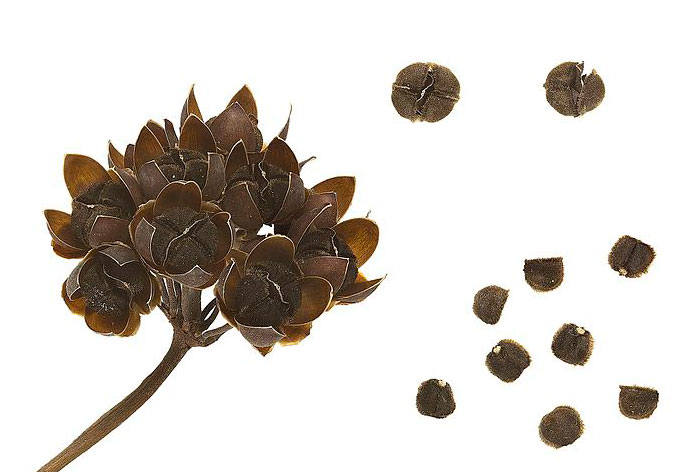
    Dried-fruits-and-seeds-of-Hogvine Flower-and-flowering-buds-of-Hogvine Flowers-of-Hogvine Fruits-of-Hogvine Hogvine-plant Leaves-of-Hogvine Other-Variety-of-Hogvine Plant-Illustration-of-Hogvine Sketch-of-Hogvine
    [Show thumbnails]
    Fruit

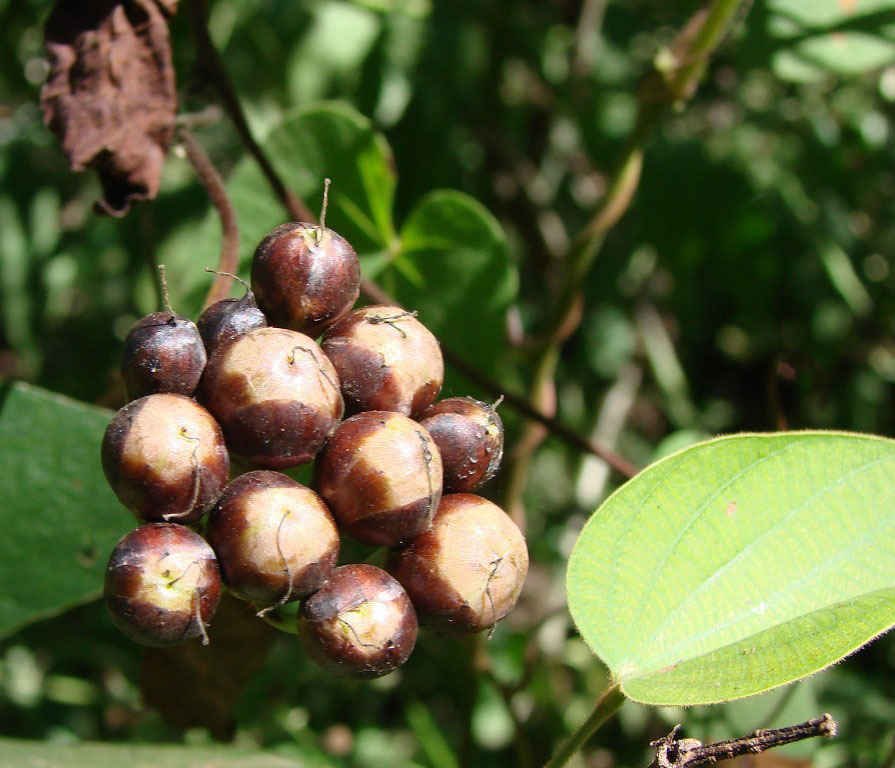
    Fertile flowers are followed by capsule that is ovoid to conical in shape, measuring about 10-12 mm long, mucronate by style-base and hairless or sparsely hairy at the top. Seeds are truncate apically, brown, 5-6 mm long, densely pubescent with short, erect trichomes. They are covered with spreading, black or brown hairs.

    Traditional uses and benefits of Hogvine

    • Pounded leaves are used as a poultice for wounds, burns and sores in Asia.
    • Poultice of leaves mixed with curcuma powder is used to heal cracks in the soles of the feet.
    • Infusion of young leaves is applied to clean wounds and ulcers.
    • Roots are used as a laxative/purgative, and the flowers are used to treat eye diseases.
    • Decoction of the plant is used as diuretic, and to treat rheumatism and headaches in India.
    • Powder of leaves is sniffed to treat epilepsy, and a paste made of root powder mixed with “Java flour” (coffee flour) is applied to swellings.
    • Mucilage obtained from the seeds soaked in water is used in cutaneous diseases.
    • umbellata has been used to treat paralyses, spasms and convulsions in West Africa.
    • This species has been used for fever in Palau.
    • It is used also for dropping into the ear in cases of auricular ulcers, abscesses, etc.
    • Dried, powdered leaves are sniffed up the nose as a treatment for epilepsy.
    • Pounded leaves are used to poultice burns, abscesses, ulcers, sores and scalds.
    • Poultice of the leaves, combined with Curcuma powder is applied on cracks on the hands and in the soles of the feet.
    • Seeds, when soaked in water, yield mucilage that is used as an aperient and alterative in the treatment of cutaneous diseases in Bengal.
    • Tubers are mildly laxative and are widely taken as a remedy for dysentery.
    • Decoction of the roots is drunk as a remedy for hematuria.
    • Paste or powder made of the root, often mixed with Java flour and water, is applied as a poultice to swellings.
    • An infusion of the plant is drunk as a treatment for high fever.
    • An infusion of the stem is used internally and externally in the treatment of malaria and smallpox.
    • Root is eaten raw as a stomachic.
    • Decoction of the plant is said to act as a deobstruent, a diuretic, and an alterative, being useful in rheumatism, neuralgia, headache, etc.
    • It is used also for dropping into the ear in cases of auricular ulcers, abscesses, etc.
    • Powder of the leaves is sniff up in epilepsy.
    • Paste or powder made of the root, mixed with Java flour and water, is applied to swellings.
    • Leaves are used in the Moluccas as an emollient for abscesses and ulcers.

    References:

    https://www.itis.gov/servlet/SingleRpt/SingleRpt?search_topic=TSN&search_value=30872#null

    https://davesgarden.com/guides/pf/go/53227/

    https://www.cabi.org/isc/datasheet/33477

    https://plants.usda.gov/core/profile?symbol=MEUM

    http://convolvulaceae.myspecies.info/node/16226

    http://tropical.theferns.info/viewtropical.php?id=Merremia+vitifolia

    http://www.stuartxchange.org/Kalamitmit

    http://www.theplantlist.org/tpl/record/tro-8500797

    https://en.wikipedia.org/wiki/Merremia_umbellata

    http://www.flowersofindia.net/catalog/slides/Hogvine.html

    https://gd.eppo.int/taxon/MRRUM

    https://indiabiodiversity.org/species/show/230398

    https://plants.jstor.org/stable/10.5555/al.ap.upwta.1_1133

    75%
    75%
    Awesome

    Comments

    comments

    H Herbs and Spices
    Share. Facebook Twitter Pinterest LinkedIn Tumblr Email
    Previous ArticleFacts and Benefits of Sweet cicely
    Next Article Facts and Benefits of Cotula

    Related Posts

    Uses of Monkey Pitcher plant

    April 16, 2024

    Traditional uses and benefits of Wild Marigold

    March 21, 2024

    Traditional uses and benefits of Drooping fig

    March 12, 2024

    Comments are closed.


    Hogvine Facts

    Hogvine Quick Facts
    Name: Hogvine
    Scientific Name: Merremia umbellata
    Origin Tropical East Africa, Seychelles, India, Sri Lanka eastwards to China, Indo-China, Thailand, and southwards through Malesia to northern Australia
    Shapes Capsule ovoid to conical 10-15 mm long, splitting into four
    Health benefits Beneficial for rheumatism, headaches, burns, abscesses, ulcers, sores, scalds, dysentery, hematuria, malaria, smallpox
    Name Hogvine
    Scientific Name Merremia umbellata
    Native Tropical East Africa, Seychelles, India, Sri Lanka eastwards to China, Indo-China, Thailand, and southwards through Malesia to northern Australia. It occurs in America from Mexico to Paraguay, in the West Indies and in tropical West Africa
    Common Names Hogvine, greater bindweed, Hog vine, yellow hog vine, yellow merremia, yellow morning glory, yellow wood rose
    Name in Other Languages American Samoa: Fue lautetele
    Assamese: Goria loti, Kolia lota
    Bengali: Sapussunda
    Bodo: Guna bendung
    Chinese: Shan zhu cai
    Costa Rica: Churristate
    Cuba:  Aguinaldo Amarillo, bajuco jaibero, bejuco ahorca colono
    Dominican Republic: Bejuco de Tabaco, campana amarilla
    El Salvador: Cuelga˗tabaco, jícama cimarrona
    English: Hog vine, yellow hog vine, yellow merremia, yellow morning glory, yellow wood rose
    Fiji: Sovivi
    Guatemala: Cajete, quilamulillo
    Gujarati: Tumaisa
    India: Goria loti, kolavara valli, motia, sapussunda, turnaisa, vawkte˗sen˗til, vayaravalli, voktesentil
    Indonesia: Akabulu, akar biabak, akar slemang, areuj gereung, areuj kidang, baji seluang, daun bisul, lawatan kebo, rawatan
    Lesser Antilles: Fleur patate jaune, liane à berceau, liane à malingers, liane à tonnelle, liane douce jaune, liane˗berceau, liann berceau, lyann beso, lyann dou jon, sweet liane, sweet William, yellow hogvine, yellow morning glory
    Malaysia: Akar ulan betina, andur nasi, greater Malayan bindweed, pelandok, ulan tapak
    Malayalam: Kolavara valli (കൊലാവര വല്ലീ), Vayaravalli (വയാര വല്ലീ), Ulan tapak pelandok
    Mali: Ulou nin tulu
    Marathi: Motia (मोतीया)
    Mexico: Amole de venado, bejuco manzo
    Mishing: Bongki ripuk
    Myanmar: Kya˗hin, zizaw
    Nigeria: Epírí kọ̀rị̀
    Mizo: Voktesentil
    Palau: Kebias
    Panama: Batatilla amarilla
    Philippines: Bangbangau, kalamitmit, kamokamotihan, malakamote
    Sierra Leone: A˗gbungabo, kpokpo, liti, soriondibi
    Spanish: Jicama, batatilla amarilla, cajete, campanilla amarilla, campanilla bellisima, campanitas, churristate Amarillo, cimarrona, taranta amarilla, tripa de gallina
    Sri Lanka: Kiri˗madu, maha˗madu
    Thailand: Chingcho khaao, thao dok baan tuum
    Vietnam: Bìm bắc bộ, bìm tán
    Plant Growth Habit Twining, herbaceous, vigorous perennial climbing vine
    Growing Climates Edges of forests, in grasslands, roadsides and waterways, clearings, deforested areas, vacant land in villages, mixed deciduous forest, evergreen hill forest, swamp margins, secondary scrub Open grasslands, thickets, hedges, along fields, in teak forests, along edges of secondary forests, on river-banks
    Plant Size 1-3 m long
    Stem Climbing or trailing stems up to 3 m or more in length, glabrous or softly hairy. Young stems have a milky sap; older stems may be woody
    Leaf Alternate, long-petiolate, narrowly to broadly ovate with cordate base, occasionally lobed, about 10 cm long (but sometimes up to 15 cm long)
    Flowering season January—March, October—December
    Flower Sepals strongly concave, slightly unequal; outer 2 sepals broadly elliptic or nearly circular, 8–14 mm, abaxial surface pubescent, rounded or emarginate; inner sepals usually slightly longer, margin scarious. Corolla white or yellow, funnelform, 2.5–5.5 cm, midpetaline bands with a strip of whitish pubescence apicall
    Fruit Shape & Size Capsule ovoid to conical 10-15 mm long, splitting into four
    Seed Seeds truncate apically, brown, 5-6 mm long, densely pubescent with short, erect trichomes. They are covered with spreading, black or brown hairs
    Propagation By seeds and cuttings
    Plant Parts Used Root, leaves, seed, whole plant
    Season January, February, October, December
    Culinary Uses
    • The young leaves may be eaten as a vegetable.
    • The flexible, tough stems have been used in Central America to hang tobacco for drying.
    Other facts
    • In the Yucatán Península of Mexico, M. umbellata is used as forage for cattle, goats and horses.
    • The sap has been used for coagulating Castilla rubber latex.
    Precautions
    • The hairs on the leaves can cause irritation.

    Hogvine Scientific Classification

    Scientific Name: Merremia umbellata

    Rank Scientific Name & (Common Name)
    Kingdom Plantae (Plants)
    Subkingdom Tracheobionta (Vascular plants)
    Infrakingdom Streptophyta  (land plants)
    Superdivision Spermatophyta (Seed plants)
    Division Magnoliophyta (Flowering plants)
    Subdivision Spermatophytina  (spermatophytes, seed plants, phanérogames)
    Class Magnoliopsida (Dicotyledons)
    Subclass Asteridae
    Superorder Asteranae
    Order Solanales
    Family Convolvulaceae (Morning-glory family)
    Genus Merremia Dennst. ex Endl. (woodrose)
    Species Merremia umbellata (L.) Hallier f. (hogvine)
    Synonyms
    •  
    • Convolvulus aristolochiifolius Mill
    • Convolvulus caracassanus Willd. ex Roem. & Schult
    • Convolvulus cymosus Desr
    • Convolvulus luteus M. Martens & Galeotti
    • Convolvulus multiflorus Mill
    • Convolvulus sagittifer Kunth
    • Convolvulus umbellatus Sessé & Moc
    • Convolvulus umbellatus L
    • Ipomoea cymosa (Desr.) Roem. & Schult
    • Ipomoea mollicoma Miq
    • Ipomoea polyanthes Willd. ex Roem. & Schult
    • Ipomoea portobellensis Beurl
    • Ipomoea sagittifer (Kunth) G. Don
    • Ipomoea umbellata (L.) G. Mey
    • Merremia umbellata var. occidentalis Hallier f
    Categories
    • Beverages (78)
    • Dairy (28)
    • Dental Health (15)
    • Equipment (5)
    • Essential OIls (196)
    • Facts (2,939)
    • Foods (255)
    • Fruits (516)
    • Giveaway (1)
    • Grains and Cereals (36)
    • Health & Beauty (763)
    • Herbs and Spices (1,249)
    • Medicines (9)
    • Mental Health (19)
    • Nutritional value (27)
    • Nuts and seeds (73)
    • Oils (81)
    • Pets (4)
    • Poultry & Seafoods (67)
    • Pulses and Beans (16)
    • Reviews (25)
    • supplement (2)
    • Vegetables (304)
    • Weight Loss (22)

    What is Lupin Bean Flour?

    Science Backed Health Benefits of Durian (Durio zibethinus)

    Science Backed Health Benefits of Feijoa (Pineapple Guava) (Acca sellowiana)

    Science Backed Health Benefits of Gac Fruit (Momordica cochinchinensis)

    Science Backed Health Benefits of Amaranth Leaves (Amaranthus spp)

    Science Backed Health Benefits of Arrowhead (Sagittaria sagittifolia)

    ABOUT
    Home
    About us
    Contact us
    Privacy Policy
    Terms & conditions
    Disclaimer
    Direct Communication
    e-mail: [email protected]
    Gmail: [email protected]
    Whatsapp: +977-9841146511
    Viber: +977-9841146511
    Useful
    Health Wiki
    Nutrition
    Facebook Twitter Pinterest
    © 2025 www.healthbenefitstimes.com All rights reserved.

    Type above and press Enter to search. Press Esc to cancel.

    ×

    Log In

    Forgot Password?

    Not registered yet? Create an Account