| Horsetail Quick Facts |
| Name: |
Horsetail |
| Scientific Name: |
Equisetum arvense |
| Origin |
North America, Europe, the Middle East, and parts of Asia |
| Taste |
Sweet, bitter |
| Health benefits |
Beneficial for Rheumatoid Arthritis and Osteoarthritis,Treat Heart Disease, Improves Wound Healing, Reduces Swelling, Strengthen Hair and Nails, Treat Ulcers and Hemorrhoids, Fights Cancer, Reduce Cellulite, Boost Weight Loss, Treat Herpes and HIV, Eliminate Kidney Stones, Relieve Diarrhea, Reduce Inflammation, Improve Digestion, Relieve Asthma, Improve Bone Health, Treat Varicose Veins, Skin Care, treat gout, Treats Diabetes, Reduces Pain, Cures Respiratory Conditions, Hemorrhoids, Excellent Nail Health, Urinary Tract Health |
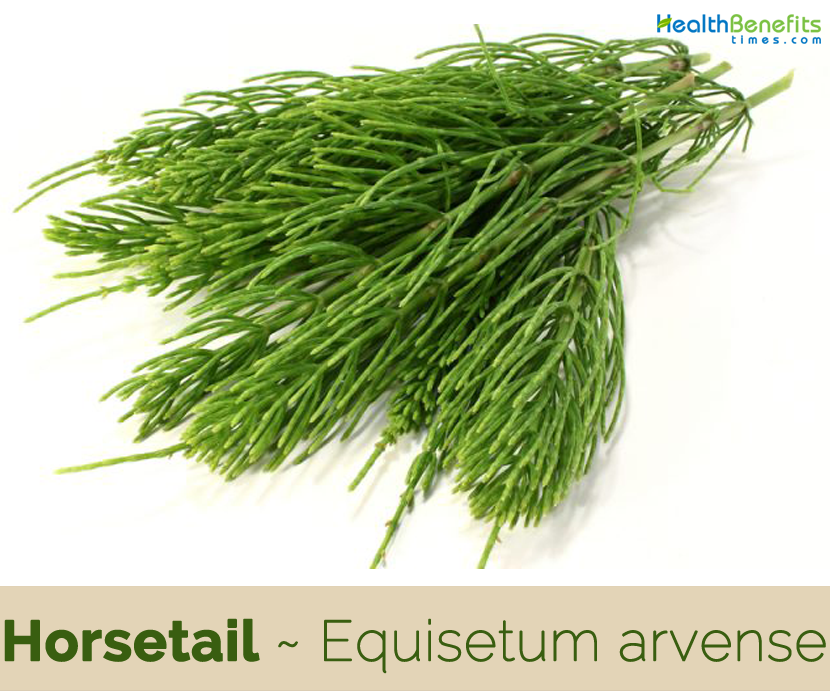
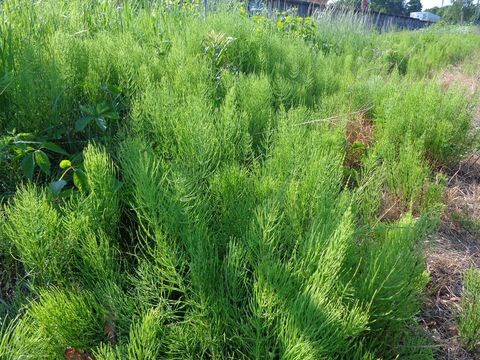
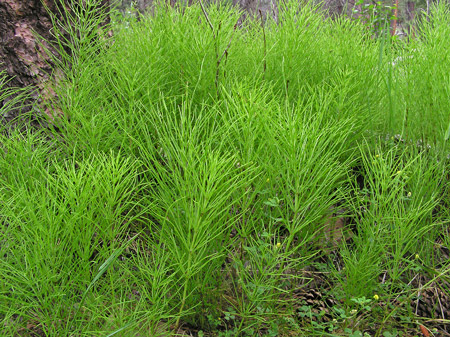
Equisetum arvense also known as field horsetail or common horsetail is an herbaceous perennial plant in the Equisetaceae (Horsetail family). The plant is native throughout the arctic and temperate regions of the northern hemisphere mostly North America, Europe, the Middle East, and parts of Asia. There are around 20 species of horsetail that can be found almost everywhere in the world, except in Australia, New Zealand, on several islands in the Pacific Ocean and on Antarctica. Some of the popular common names of the plant are bottle brush, bottlebrush, bull pipes, common horsetail, corn horsetail, field horsetail, foxtail, foxtail rush, foxtail-rush, horse pipes, horsetail, horsetail fern, joint grass, joint weed, mare’s tail, meadow pine, meadowpine, paddock-pipes, pine grass, pine-grass, rush, scouring rush, shave grass, shavegrass, snake grass, snake-grass and western horsetail. Horsetail got its name due to its resemblance to the tail of a horse.
The scientific name Equisetum is derived from the Latin equus meaning horse and seta meaning animal hair and describes the stiff stalks of the horsetail. The species name arvense comes from the Latin word arva which means field. The English name Field Horsetail is thus a direct translation from the Latin. It is a vascular plant that is closely related with ferns. Horsetail does not have flowers and does not produce seed. It reproduces via spores that are produced in the sporangium (cone shaped organ), located on the top of the plant.
Plant Description
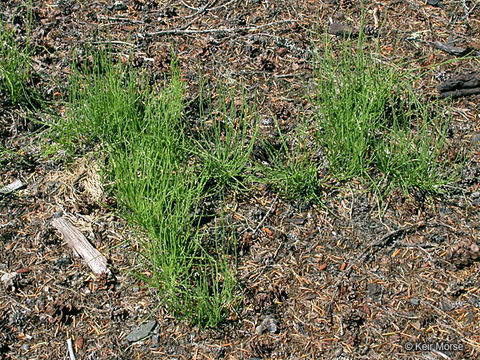
Horsetail is an herbaceous perennial plant that grows about 1-2 feet tall. Largest species of horsetail can reach 6 feet in height. The plant is found growing in non-sandy savannas and sandy savannas, black soil prairies, sand prairies, gravel prairies, dolomite prairies, prairie remnants along railroads, thickets, fens, seeps, ditches, roadsides, open areas along railroads (including the gravel ballast), old fields, and waste areas. The plant prefers neutral or slightly basic clay loams that are sandy or silty, particularly where the water table is high, though it can occur occasionally on slightly acid soils. The plant has a deep root system.
Stems and Leaves
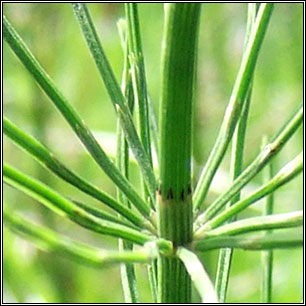
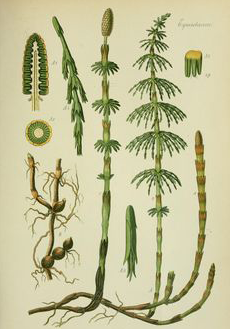
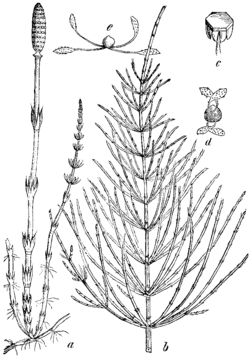
The stems are mostly upright (i.e. erect or ascending) but can occasionally trail along the ground at first before turning upwards (i.e. occasionally decumbent). These stems are noticeably jointed and are of two distinct types. Most of the stems are “vegetative” (i.e. sterile). These are green in color and are about 5-60 cm tall and 1.5-5 mm thick with small cup-shaped sheaths at their joints (i.e. nodes). They are hollow, grooved lengthwise (i.e. longitudinally), and produce groups (i.e. whorls) of thin branches (8-15 cm long and about 5 mm thick) that are sometimes mistaken for leaves. These branches are four-angled and usually emanate from each of the stem joints (i.e. nodes). The sheaths are actually the reduced, scale-like, leaves. They are green to dark-brown in color, borne in clusters of 6-18, and are fused together to form a small cylindrical or cup-shaped structure (5-8 mm long) topped with teeth that are 2-3 mm long.
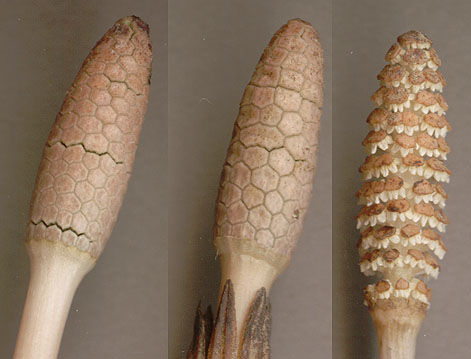
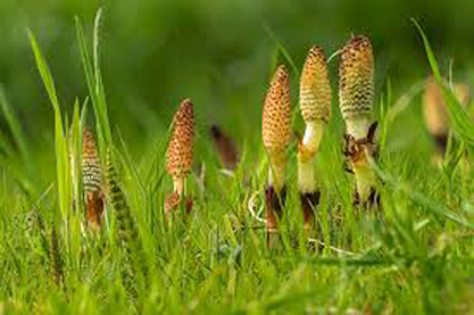
The second type of stem is whitish or pale brown in color, shorter and somewhat thicker up to 30 cm tall and 8 mm thick. These are known as “fertile” stems and bear reproductive structures at their tips. They are jointed and sheathed like the vegetative stems but lack the whorls of green branches.
Flowers and Fruit
Being closely related to the ferns, this plant does not produce true flowers or seeds. Instead it produces spores in a cone-like structure known as a strobilus. These structures (i.e. strobili) are borne at the tips of the ‘fertile’ stems and commonly appear during early spring, before the ‘vegetative’ (i.e. sterile) stems. They are greenish, whitish or brownish in color about 1-4 cm long with numerous stalked scale-like structures (i.e. sporangiophores) which bear the spores. The masses of minute spores are pale greenish to yellow in color.
Types/Varieties
Horsetail is commonly available in nurseries and is often grouped with the wetland and aquatic species. In addition to the common horsetail species described above, nurseries often stock the following varieties:
- Field horsetail (Equisetum arvense): A variety with stringy leaf-like appendages arranged symmetrically around the stem; USDA zones 2 to 9
- Dwarf horsetail (Equisetum scirpoides): Similar to the full-sized variety but grows just 6 to 8 inches tall; USDA zones 5 to 11
Health Benefits of Horsetail
It is an amazing medicinal herb that offers numerous health benefits. The herb is popular for its cognitive boosting function, protecting bone health, alleviating respiratory issues and promoting good oral health. It also supports immunity and acts as a detoxifying agent in the body. Listed below are few of the health benefits of horsetail
1. Rheumatoid Arthritis and Osteoarthritis
Horsetail is an effective, safe, and reliable treatment of rheumatoid arthritis. It improved symptoms and regulated the immune response in most patients with rheumatoid arthritis (RCT). Horsetail reduced inflammation, which may be crucial for treating this disease.
Giant horsetail extracts help to reduce pain, inflammation, and an autoimmune response in a mouse model of rheumatoid arthritis and osteoarthritis. Medicinal benefits of the compounds in horsetail could be a promising new therapy with no toxic effects.(1), (2)
2. Treat Heart Disease
Horsetail relaxes blood vessels, and reduced blood pressure in people with heart disease. Dicaffeoyl-meso-tartaric acid is the active ingredient in this process. It helps to reduce fat oxidation, which is often the fundamental cause of heart disease.
Phytosterols and flavonoids present in horsetail may be able to alleviate this. Phytosterols reduced LDL cholesterol and antioxidants decreased inflammation in cells. High LDL cholesterol and inflammation can cause hardening of the blood vessels and heart problems.(3), (4), (5), (6), (7), (8), (9), (10)
3. Improves Wound Healing
Horsetail has been used to help heal wounds faster. Horsetail ointment is commonly applied directly to the wound.
Horsetail ointment helps to improve wound healing in a research that had surgery to induce childbirth. Half of the women used horsetail ointment on the wound for 10 days, which reduced pain and healed wounds faster, without any side effects. Silica helps to seal the wound, while flavonoids prevent infections.(11), (12), (13)
4. Reduces Swelling
Diuretics are often used to reduce blood pressure and swelling. They work by flushing unnecessary fluids from the body. Horsetail extract attained an effect similar to the standard diuretic in 36 healthy male volunteers, without disrupting the electrolyte balance (RCT). Different horsetail species had a strong diuretic effect. (14), (15)
5. Strengthen Hair and Nails
Horsetail consists of high silicon and antioxidant content, but its beneficial use for hair and nails is not adequately backed up by research. Hair loss in women may be caused by different factors than in men, such as stress, fever, surgery, thyroid problems, and childbirth. Horsetail together with other ingredients increased hair growth, volume, and thickness in one research conducted in 15 women with thinning hair. (16), (17), (18)
6. Treat Ulcers and Hemorrhoids
Excessive bleeding is common to heavy menstrual periods, hemorrhoids, and ulcers. Horsetail helps to treat wounds and shrink their size and may help to treat these conditions too.
Research showed that horsetail extract treated stomach ulcers. It improved symptoms, protected the stomach, and prevented further damage.(19), (20), (21), (22)
7. Fights Cancer
Horsetail displays potential for treating skin, blood, and lung cancer based on cell studies.
Horsetail reduced growth, inflammation, and damage in human cancer cells. Antioxidants in horsetail are the main components in fighting cancer, while zinc in horsetail can boost the anti-tumor effect.
Group of human cells with cancer (melanoma) were treated with horsetail extract. Horsetail extract helps to protect melanoma and cell oxidation. Similarly, horsetail was beneficial for lung cancer in human cells by causing cancer cell death.(23), (24), (25), (26), (27)
8. Reduce Cellulite
One approach for reducing cellulite is to eliminate built-up fluids from the target area. Horsetail could help fight cellulite by cleansing fluids from the body and toning the skin. Though horsetail products are formulated in Spain for reducing cellulite, no clinical studies have yet confirmed the benefits.(28), (29), (30)
9. Boost Weight Loss
Giant horsetail is considered one of the popular weight loss supplements in Latin America. Horsetail acts as a proven diuretic and reduces fat. It may supplement a weight loss regime by flushing excessive fluids, decreasing inflammation, bloating, and fat. Horsetail also increases IL-10, which may boost weight loss. But how horsetail affects body weight on its own is still unknown.(31), (32), (33), (34), (35)
10. Treat Herpes and HIV
Women from Amazonian tribes traditionally used giant horsetail for genital infections and hygiene. When tested on virally infected cells, giant horsetail was powerful against the herpes simplex virus type 2 (genital herpes) and improved symptoms. In another research on cells, Horsetail stopped the HIV virus from damaging cells.(36), (37)
11. Eliminate Kidney Stones
Horsetail in combination with other herbs helps to prevents kidney stones and kidney damage. It also helped to break down and eliminate kidney stones.(38), (39)
12. Relieve Diarrhea
Active compounds in horsetail slow down bowel movements during diarrhea. Compounds in horsetail block acetylcholine, which is a neurotransmitter that promotes bowel movements. Horsetail relaxed stomach muscles and reduced cramps in diarrhea.(40)
13. Reduce Inflammation
Horsetail reduced an overactive immune response in human cells. Horsetail causes cells to produce less inflammatory molecules and the silica balances the immune effect in these cells. Higher concentrations of the herb have a stronger effect.(41)
14. Improve Digestion
Horsetail liquor or tea is used as a folk remedy to improve digestion in many countries around the world. Flavonoids found in horsetail may help with digestion, reduce bloating, nausea, and stomach pain. (42)
15. Relieve Asthma
Histamine presents in horsetail helps to narrows airways in asthma, causing difficulty breathing and mucus buildup. In a research Horsetail blocks the effects of histamine and relaxes airways. Higher doses of horsetail had a stronger effect.(43)
16. Improve Bone Health
Silicon is important for forming and maintaining healthy bones. It helps to absorb calcium and improves bone mineralization and structure. Horsetail has a long history of traditional use for bone healing. Horsetail increased the activity of human bone cells, crucial for bone regeneration. Horsetail extracts increased bone cell growth while killing the bacteria that can cause bone infection.(44), (45), (46)
17. Treat Varicose Veins
Herbal combinations along with horsetail have been used to treat varicose veins. It’s unknown exactly how horsetail acts on varicose veins. Its anti-inflammatory and skin healing properties could be beneficial when used as a cream, lotion, or ointment on affected areas. (47)
18. Treat Gout
Horsetail has been traditionally used to treat gout, due to its anti-inflammatory properties. Gout is a form of inflammatory arthritis. The beneficial effects of horsetail for rheumatoid arthritis could be important for treating gout. Still, no clinical studies have looked at horsetail in gout disease models.(48), (49)
19. Skin Care
Horsetail extract can be commonly found in various creams and organic beauty products, as the unique and complex mixture of antioxidant, anti-inflammatory, silica, and other compounds, which are powerful skin care agents. If you want to reduce the redness of boils or acne, eliminate eczema or psoriasis, or prevent premature aging, horsetail extract consists of all of the necessary components to do that.(50)
20. Treats Diabetes
Research has connected the use of horsetail supplements and tea to more balanced insulin levels in the body, namely in the rapid lowering of blood sugar when necessary. While this is an effective method of diabetes management, it should only be used for a short time, or when absolutely necessary. It can have long-term impacts if consumed for longer than two months in succession.(51)
21. Reduces Pain
Horsetail ointment helps to reduce pain in a research with 108 healthy women shortly after giving birth. Half of them used horsetail ointment on a surgical wound for 10 days. Horsetail extracts reduced pain and inflammation.
22. Cures Respiratory Conditions
Horsetail tea is a proven way of relieving many respiratory conditions such as a cold or flu. People who frequently suffer from congestion or experience breathing discomfort should frequently consume horsetail tea. Since the herb is rich with expectorant properties; the use of horsetails clears out mucus and phlegm to promote a good respiratory function. It is also effective in relieving inflammation and cures a persistent cough.
23. Hemorrhoids
Hemorrhoids are painful and cause significant discomfort. To relieve your symptoms and to cure hemorrhoids the natural way, use horsetail supplements in the form of liquid or tea before every meal guarantees improved results. However, make sure you include a good amount of fiber in each meal.
24. Excellent Nail Health
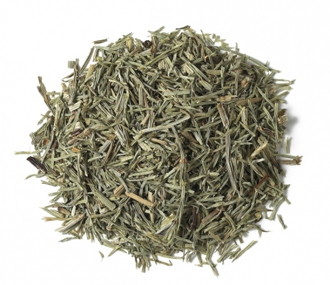
Horsetail helps to maintain good nail health. Regular use of horsetail guarantees stronger and longer nails. Just add two teaspoons of dried horsetail in boiling water. Let it cool for 10 minutes and soak your nails in this solution for at least half an hour. Use this remedy at least 3-4 times a week to observe noticeable differences.
25. Urinary Tract Health
Horsetail extract is commonly used to treat a weak bladder. Hence, it is a common remedy that is helpful in treating bladder incontinence along with many kinds of urinary tract infections. To naturally treat a UTI infection, consume one capsule of horsetail extract twice a day. It is also used to support good health and proper functioning of the kidney to prevent kidney stones. Moreover, it is also helpful in preventing the formation of gallbladder stones.
https://www.youtube.com/watch?v=lZ5pAcDSaDM
Traditional uses and benefits of horsetail
- Native Americans and early settlers used tea made from field horsetail as a diuretic.
- Field horsetail was used as a cough medicine for horses.
- Externally it was traditionally used for chilblains and wounds.
- It has been used in traditional Austrian medicine internally as tea, or externally as baths or compresses, for treatment of disorders of the skin, locomotor system, kidneys and urinary tract, rheumatism and gout.
- It is very astringent and makes an excellent clotting agent, staunching wounds, stopping nosebleeds and reducing the coughing up of blood.
- It helps speed the repair of damaged connective tissue, improving its strength and elasticity.
- Plant is anodyne, anti-hemorrhagic, antiseptic, astringent, carminative, diaphoretic, diuretic, galactogogue, haemostatic and vulnerary.
- Plant is a useful diuretic when taken internally and is used in the treatment of kidney and bladder problems, cystitis, urethritis, prostate disease and internal bleeding, proving especially useful when there is bleeding in the urinary tract.
- Decoction applied externally will stop the bleeding of wounds and promote healing.
- It is especially effective on nose bleeds.
- Decoction of the herb added to bath benefits slow-healing sprains and fractures, as well as certain irritable skin conditions such as eczema.
- It is used in the treatment of cystitis and other complaints of the urinary system.
- Fresh herb can be bruised and applied to wounds to stop bleeding.
- It has also been used to treat deep-seated lung damage such as that caused by tuberculosis or emphysema.
- It encourages calcium absorption and helps fight against plaque deposits in the arteries.
- Ashes of the plant are considered very valuable in acidity of the stomach, dyspepsia, etc.
- It is of efficacy for hemorrhage, cystic ulceration and ulcers in the urinary passages.
- Decoction applied externally will stop the bleeding of wounds and quickly heal them, and will also reduce the swelling of eyelids.
- Decoction taken in wine helps stone and strangury.
- Distilled water drunk two or three times a day eases and strengthens the intestines and is effectual in a cough that comes by distillation from the head.
- Juice or distilled water used as a warm fomentation is of service in inflammations and breakings-out in the skin.’
- It is also used for balding, tuberculosis, jaundice, hepatitis, brittle fingernails, joint diseases, gout, osteoarthritis, osteoporosis, frostbite, weight loss, heavy menstrual periods and hemorrhage of the nose, lung, or stomach.
- Horsetail is applied directly to the skin to treat wounds and burns.
Ayurvedic Health benefits of Horsetail
- Cystorrhea: Prepare a decoction of the aerial part of Field Horsetail. Strain. Drink two cup two times a day
- Blood Clots: Mix two tablespoon of Horsetail juice in water. Have it once a day.
- Pericarditis: Boil half teaspoon dried Horsetail in a cup of water. Strain. Have thrice a day. OR Boil 100 gram of dried Horsetail in 3 liter of water. Mix it in your bathing tub. Soak yourself in tub for 15 minutes daily.
- Brittle Nails: Grind the dried Horsetail. Put one tablespoon of powdered Horsetail in a cup of hot water. Let it steep for 15 minutes. Soak the nails in lukewarm solution for 15 to 20 minutes. Repeat the process daily and do not forget to apply good carrier oil over the nails.
- Gluten allergy: Prepare a tea, made of dried Horsetail herb and one cup of hot water. Drink it once a day.
- Interstitial Cystitis: Boil half teaspoon of dried Horsetail herb in one cup of water. Have it twice a day.
- Ricket: Take 1 teaspoon of dried Horsetail and boil it in water for 10 min. Drink this tea once in a day. It enhances the strength of the Bones.
- Frozen Shoulder: Boil 1 tablespoon of dried Horsetail in water. Drink this tea 2 times a day.
- Endometriosis: It improves blood circulation and heals the damaged tissues. Take dried Horsetail herb and make a tea. Drink this once in a day
- Aphrodisiac: It improves blood circulation and heals the damaged tissues. Take dried Horsetail herb and make a tea. Drink this once in a day
- Aphthous Ulcers: It improves blood circulation and heals the damaged tissues. Take dried Horsetail herb and make a tea. Drink this once in a day
- Fracture: With this cup of tea calcium supplement is also needed. Prepare a decoction of 4 table spoon of Horse tail grass, 3 tablespoon of comfrey root, 2 parts of oat and 1 part of lobelia. Have two cups two times a day.
- Brittle nails: Take powdered Horsetail. Put a tablespoon of powder in a cup of hot water. Cover the cup and leave it for 15 minutes. Let it lukewarm. Soak the affected nails in the solution for 15 minutes. Pat dry the nails. Now, take a tablespoon of Olive Oil and slightly warm it. Add half tablespoon juice of Lemon in the oil. Apply the mixture on nails and wrap the nails with soft cloth or cotton. Leave it overnight. Repeat the process daily to get over from Brittle Nails.
In this formula:
- Horsetail provides adequate amount of Silica which builds the nail health.
- Olive Oil improves the thickness of the nails.
- Lemon fights with free radicals and also prevents the future damage.
Culinary Uses
- Young shoots were eaten either cooked or raw.
- Buds are eaten as a vegetable in Japan and Korea in spring time.
- Strobil (the fertile shoots in spring) is cooked and used as an asparagus
- Some native tribes liked to eat the young vegetative shoots, picked before they had branched out, and would often collect them in great quantity then hold a feast to eat them.
- Leaf sheaths were peeled off and the stems eaten raw.
- Black nodules attached to the roots are edible.
- Peeled stems, base of the plant, root and tubers were eaten raw by the N. American Indians.
Other facts
- Field horsetail is a common food item consumed by grizzly bears.
- Dyes for clothing, lodges, and porcupine quills were made from field horsetail.
- It was used for scouring and polishing objects.
- It was also once used to polish pewter and wood and to strengthen fingernails.
- It was used by hurdy-gurdy players to dress the wheels of their instruments by removing resin build up.
- Stems contain 10% silica and are used for scouring metal and as fine sandpaper.
- They can also be used as a polish for brass, hardwood etc.
- Infused stem is an effective fungicide against mildew, mint rust and black spot on roses.
- Light pink dye is obtained from the stem.
- Plant has been used for making whistles.
- Dried stems were used to polish pewter and other metals.
Precautions
- Excessive amounts (more than 20 percent) in hay can cause scours, paralysis, and death in horses.
- Large quantities of the plant can be toxic.
- Avoid in patients with edema due to heart failure or impaired kidney function.
- Plant contains irritant substances and should only be used for a short period (two months at max in one go).
- Pregnant, lactating moms and kids below the age of six should totally avoid horsetail because of its high nicotine content.
- Long term use may cause kidney Irritation.
- If you are on any other supplements or medication, it is better you consult your doctor before using Horsetail.
- Those having a vitamin B deficiency or alcoholics should completely avoid Horsetail because of the presence of thiaminase enzyme, whose overdose destroys thiamine.
- People with high blood pressure or heart problems should not take horsetail.
- Horsetail shouldn’t be taken internally for more than three days.
- Mild side effects include diarrhea, upset stomach, and increased urination.
- Severe side effects that may require medical attention are kidney pain, lower back pain, pain while urinating, nausea, or vomiting.
- Heart palpitations can occur if horsetail is overused.
References:
https://www.itis.gov/servlet/SingleRpt/SingleRpt?search_topic=TSN&search_value=17152#null
https://davesgarden.com/guides/pf/go/58185/
https://pfaf.org/user/Plant.aspx?LatinName=Equisetum+arvense
https://www.cabi.org/ISC/datasheet/21621
http://www.floracatalana.net/equisetum-arvense-l-
https://www.botanical.com/botanical/mgmh/h/hortai39.html
https://medlineplus.gov/druginfo/natural/843.html
https://plants.usda.gov/core/profile?symbol=eqar
http://www.theplantlist.org/tpl1.1/record/tro-26602003
https://en.wikipedia.org/wiki/Equisetum
https://en.wikipedia.org/wiki/Equisetum_arvense
Comments
comments