Health Benefits
    Facebook Twitter Instagram
    Friday, December 5
    Facebook Twitter Pinterest
    Health Benefits
    • Home
    • Dental Health
    • Mental Health
    • Weight Loss
    • Health Wiki
    • Nutrition
    • Healthy Recipe
    • BMI Calculator
    Health Benefits
    Home»Herbs and Spices»Indigo Bush-Amorpha fruticosa
    Herbs and Spices

    Indigo Bush-Amorpha fruticosa

    By s mOctober 14, 2019Updated:October 14, 2019No Comments4 Mins Read
    Facebook Twitter Pinterest LinkedIn Tumblr Email

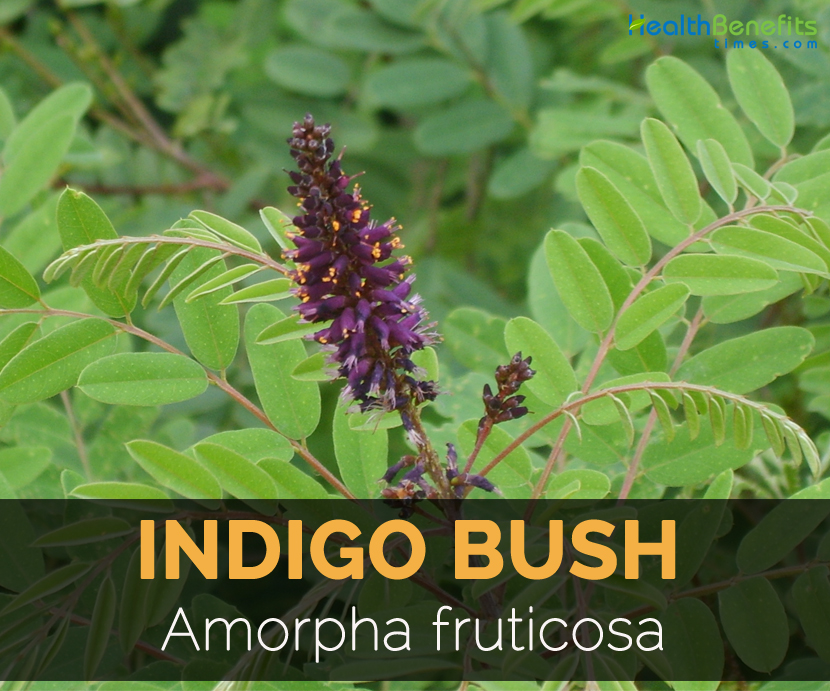
    False indigo bush also called Amorpha fruticosa, is an endemic legume with medium sized shrub that measures 10 feet high. General shape is an open canopy having bulk of foliage and twigs in upper 1/3 of the crown. Leaves are pinnately compounds and alternate. Leaflet is about 2 inches long and over 1 inch wide having small and bristly like point at the rounded tip. Flowers form in dense spikes on upper part of the plant. Flowers have dark indigo to purple petals having yellow tipped stamens. The plant blooms from late spring to mid-summer. Twigs are glabrous, rigid and redbrown or gray. Fruits are small, pod of warty kidney shaped measuring 1/2 inch long having large glandular dots in a crowded cylindrical cluster.

    Native to eastern United states, it is found in all adjacent states and considered intrusive in the Western states. This perennial species of legume reproduces by seeds. The shrub has firm woody branches which terminate in the current season’s growth of hairy and green twigs. Medicinally, it is used for treating various health ailments such as nervous disorders, epilepsy, bronchitis, asthma, stomach pain, fever, kidney and spleen diseases, liver diseases, wounds, sores, skin conditions, gonorrhea, hemorrhoids, snake bites and syphilis. The plant is used as a green manure and cover crop. The plant seeks for full sun to partial shade having medium to dry soil and does not blooms in acidic soil.

    Indigo Bush Image Gallery
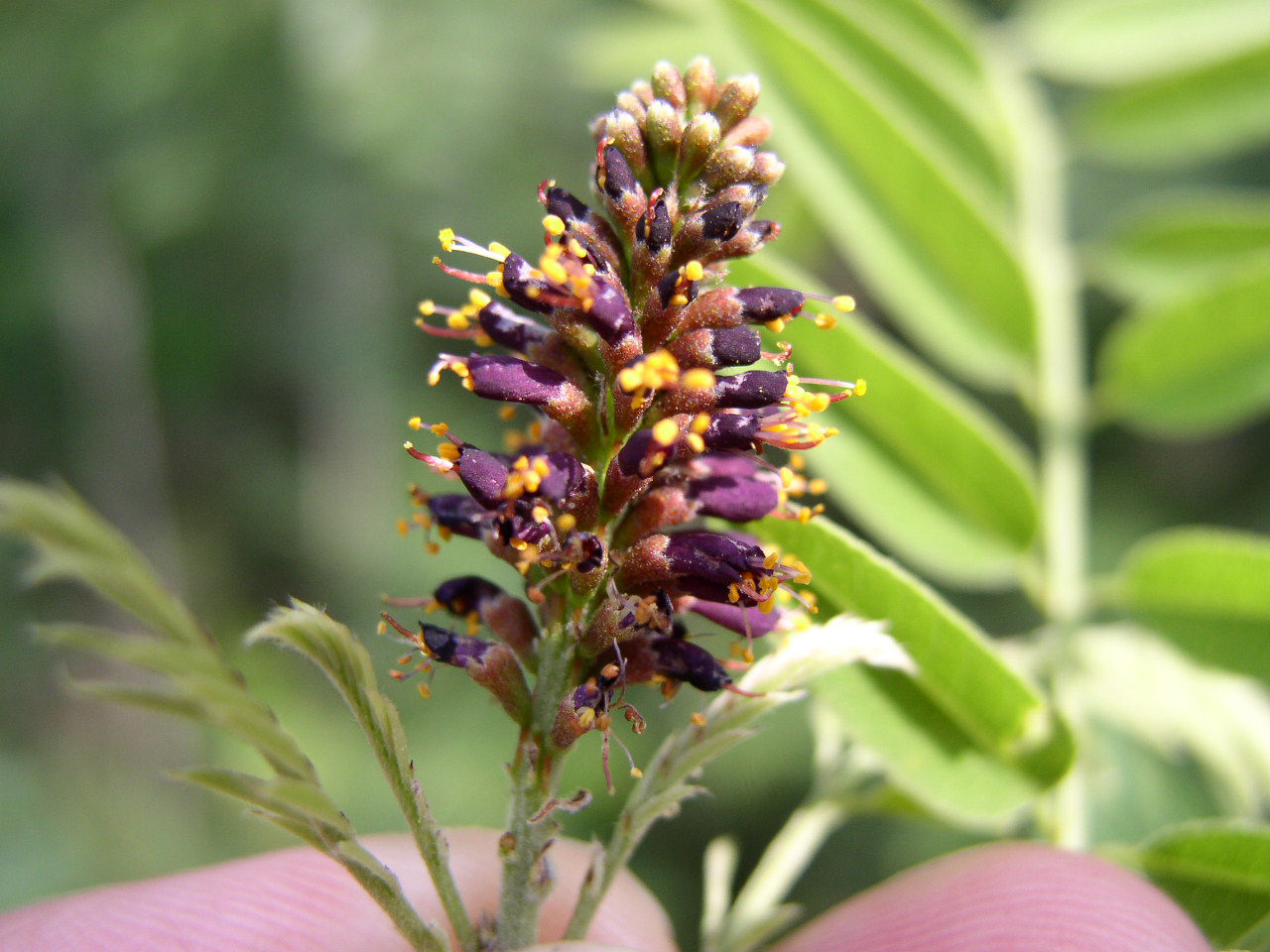
    Close-view-of-Indigo-Bush-flower Close-view-of-Indigo-Bush-flower
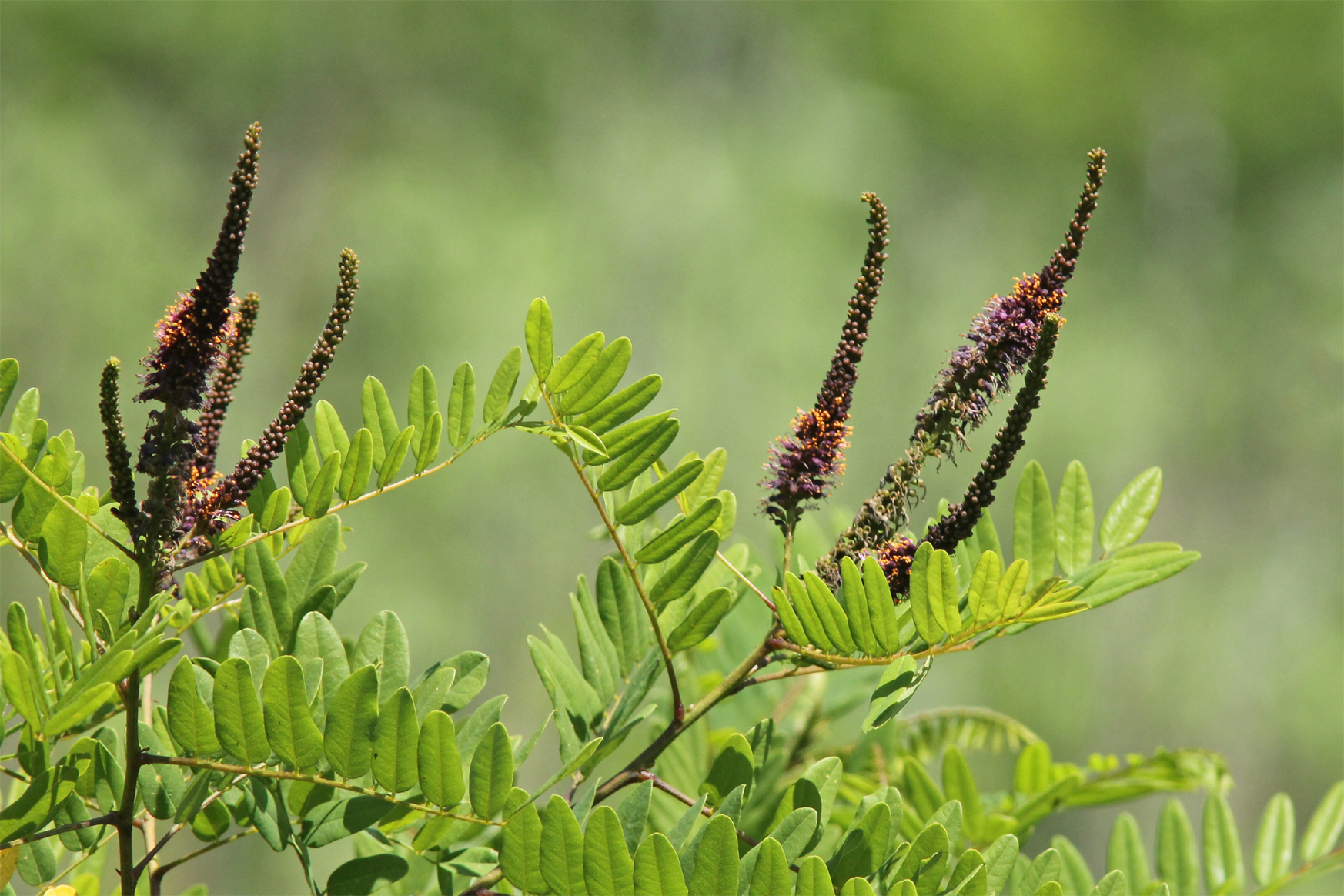
    Indigo-Bush-flower Indigo-Bush-flower
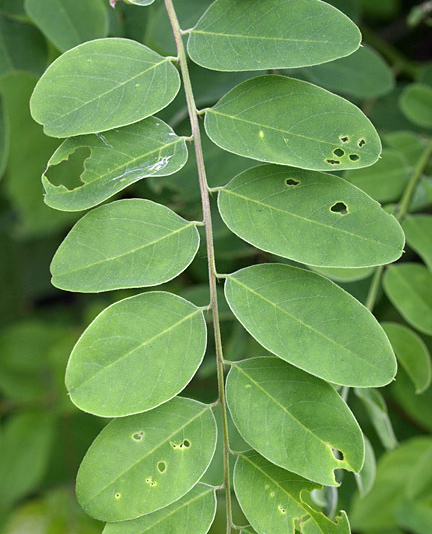
    Indigo-Bush-leaves Indigo-Bush-leaves
    Roots

    It has extensive root system and grows from proliferating lateral root sprouts. Roots have symbiotic relationship with soil bacteria that forms nodules on roots and has ability to fix atmospheric nitrogen.

    Stems

    Shrubs have erect, multiple which grows 3.3 to 13 feet high and are commonly branched near the tips. It has open crown of many stems which are unarmed.

    Leaves

    Leaves are compound, deciduous and arranged alternately on stems. Leaves occur primarily on upper third of the stems. The petioles are 2 to 5 cm long. Leaves are finely hairy or almost hairless, gland dotted. Leaves are 7 to 20 cm long and leaflets are apiculate, oblong to elliptic and green to gray-green. Midrib of leaflet ends in a thin hair like projection which is 0.5 to 1.5 mm long. 

    Flowers

    Flowers form in dense racemes, solitary or in clusters. Calyx is gland dotted and about 2.5 to 4 mm long. Flowers have one petal, lacks wings and a keel. Petal curves around a single pistil and 10 stamens, violet-blue to purple and about 0.2 to 0.24 inches (5 to 6 mm) long.  An inflorescence is a raceme of spike shaped of many flowers with a single purple petal and ten protruding stamens with yellow anthers. Fruit is a legume pod that contains one or two seeds.

    Fruit

    Fruit is a pod which is gland doted, glabrous and short pubescent. Pods are incurved distally measuring 0.2 to 0.4 inches long by 0.06 to 0.16 inches wide and contain one to two seeds.

    Medicinal uses

    • It is used to treat nervous disorders, epilepsy, bronchitis, asthma, liver diseases, stomach pain, fever, kidney or spleen diseases, wounds, sores, skin conditions, syphilis, gonorrhea, hemorrhoids and snake bites.
    • Infusion made from leaves is helpful for nervous disorders, epilepsy, bronchitis, asthma, fever, stomach complaints, kidney and spleen.
    • Apply the leaves externally (as an ointment) for treating skin diseases, sores, wounds, hemorrhoids and ulcers.
    • In India, seed tincture is used to kill lice.
    • Apply the root preparation to provide relief from syphilis, toothache, kidney stones and gonorrhea.
    • Use the root infusion as antidote for snakebites and for treating insect and scorpion stings.
    • Ingest in form of cold tea to halt vomiting.
    • Chew the root to soothe toothaches.
    • Use the stem as a wash for treating small pox and other skin problems.

    References:

    https://www.nrcs.usda.gov/Internet/FSE_PLANTMATERIALS/publications/mopmcfs5865.pdf

    https://pfaf.org/user/Plant.aspx?LatinName=Indigofera+tinctoria

    http://heritagegarden.uic.edu/false-indigo

    https://www.nwcb.wa.gov/images/weeds/Indigo_bush.pdf

    http://www.herbgarden.co.za/mountainherb/herbinfo.php?id=427

    80%
    80%
    Awesome

    Comments

    comments

    Herbs and Spices I
    Share. Facebook Twitter Pinterest LinkedIn Tumblr Email
    Previous ArticleAlternative Back Pain Treatments You Can Try
    Next Article Top 5 Hobbies for Good Mental Health

    Related Posts

    Uses of Monkey Pitcher plant

    April 16, 2024

    Traditional uses and benefits of Wild Marigold

    March 21, 2024

    Traditional uses and benefits of Drooping fig

    March 12, 2024

    Comments are closed.


    Indigo Bush Quick Facts
    Name: Indigo Bush
    Scientific Name: Amorpha fruticosa
    Origin Native to the Great Plains
    Shapes Small, warty kidney shaped pod
    Name Indigo Bush
    Scientific Name Amorpha fruticosa
    Native Native to the Great Plains
    Common/English Name River-locust, False indigo, Indigobush, Indigobush amorpha, False indigo bush, Desert false indigo, Dullleaf indigo, Leadplant
    Plant Growth Habit Deciduous perennial shrub
    Soil Well-drained
    Plant Size 1-6 m tall
    Stem Ascending, woody, to 2 m, branched, multiple, glabrous, or young branches pubescent
    Leaf Ovate to oblong, 4-8 inches long
    Flowering Season Late spring to mid-summer
    Flower Showy, lavender colored, ¼ inch long
    Fruit shape & size Small, warty kidney shaped pod, 1/2 inch long
    Seed Smooth brownish

    Indigo Bush Scientific Classification

    Scientific Name: Amorpha fruticosa

    Rank Scientific Name & (Common Name)
    Kingdom Plantae (Plants)
    Subkingdom Viridiplantae  (Green plants)
    Infrakingdom Streptophyta  (Land plants)
    Superdivision Embryophyta
    Division Tracheophyta  (Vascular plants, tracheophytes)
    Class Magnoliopsida
    Order Fabales
    Family Fabaceae  (Peas, legumes)
    Genus Amorpha L. (False indigo, indigobush)
    Species Amorpha fruticosa L. (Desert false indigo, dullleaf indigo, false indigobush, leadplant, desert indigobush, indigobush, false indigo)
    Synonyms
    • Amorpha angustifolia F.E.Boynton
    • Amorpha arizonica Rydb.
    • Amorpha bushii Rydb.
    • Amorpha caroliniana Croom
    • Amorpha croceolanata Watson
    • Amorpha curtissii Rydb.
    • Amorpha dewinkeleri Small
    • Amorpha elata Hayne
    • Amorpha emarginata Eastw.
    • Amorpha emarginata Sweet
    • Amorpha fragrans Sweet
    • Amorpha fruticosa f. albiflora E.Sheld.
    • Amorpha fruticosa f. aureo-variegata Schwer.
    • Amorpha fruticosa f. coerulea E.J.Palmer
    • Amorpha fruticosa f. crispa (G.Kirchn.) C.K.Schneid.
    • Amorpha fruticosa f. glabrata E.J.Palmer
    • Amorpha fruticosa f. humilis (Tausch) E.J.Palmer
    • Amorpha fruticosa f. latior Fassett
    • Amorpha fruticosa f. pendula (Carrière) C.K.Schneid.
    • Amorpha fruticosa var. angustifolia Pursh
    • Amorpha fruticosa var. caroliniana (Croom) S.Watson
    • Amorpha fruticosa var. coerulea Loudon
    • Amorpha fruticosa var. crispa G.Kirchn.
    • Amorpha fruticosa var. croceolanata (Watson) Mouill.
    • Amorpha fruticosa var. emarginata Pursh
    • Amorpha fruticosa var. fruticosa
    • Amorpha fruticosa var. humilis (Tausch) C.K.Schneid.
    • Amorpha fruticosa var. lewisii Loudon
    • Amorpha fruticosa var. oblongifolia E.J.Palmer
    • Amorpha fruticosa var. occidentalis (Abrams) Kearney & Peebles
    • Amorpha fruticosa var. pendula (Carriere) Dippel
    • Amorpha fruticosa var. tennesseensis (Kunze) E.J.Palmer
    • Amorpha fruticosa var. vulgaris Pursh
    • Amorpha humilis Tausch
    • Amorpha occidentalis Abrams
    • Amorpha occidentalis var. arizonica (Rydb.) E.J.Palmer
    • Amorpha occidentalis var. emarginata E.J.Palmer
    • Amorpha pendula Carriere
    • Amorpha pubescens Schltdl., 1851
    • Amorpha tennesseensis Kunze
    • Amorpha tennesseensis Shuttleworth
    • Amorpha virgata Small
    Categories
    • Beverages (78)
    • Dairy (28)
    • Dental Health (15)
    • Equipment (5)
    • Essential OIls (196)
    • Facts (2,939)
    • Foods (255)
    • Fruits (516)
    • Giveaway (1)
    • Grains and Cereals (36)
    • Health & Beauty (763)
    • Herbs and Spices (1,249)
    • Medicines (9)
    • Mental Health (19)
    • Nutritional value (27)
    • Nuts and seeds (73)
    • Oils (81)
    • Pets (4)
    • Poultry & Seafoods (67)
    • Pulses and Beans (16)
    • Reviews (25)
    • supplement (2)
    • Vegetables (304)
    • Weight Loss (22)

    What is Lupin Bean Flour?

    Science Backed Health Benefits of Durian (Durio zibethinus)

    Science Backed Health Benefits of Feijoa (Pineapple Guava) (Acca sellowiana)

    Science Backed Health Benefits of Gac Fruit (Momordica cochinchinensis)

    Science Backed Health Benefits of Amaranth Leaves (Amaranthus spp)

    Science Backed Health Benefits of Arrowhead (Sagittaria sagittifolia)

    ABOUT
    Home
    About us
    Contact us
    Privacy Policy
    Terms & conditions
    Disclaimer
    Direct Communication
    e-mail: [email protected]
    Gmail: [email protected]
    Whatsapp: +977-9841146511
    Viber: +977-9841146511
    Useful
    Health Wiki
    Nutrition
    Facebook Twitter Pinterest
    © 2025 www.healthbenefitstimes.com All rights reserved.

    Type above and press Enter to search. Press Esc to cancel.

    ×

    Log In

    Forgot Password?

    Not registered yet? Create an Account