

| Kumbhi Tree Quick Facts | ||
|---|---|---|
| Name: | Kumbhi Tree | |
| Scientific Name: | Careya Arborea | |
| Origin | Indian subcontinent, Afghanistan, and Indochina | |
| Colors | Green | |
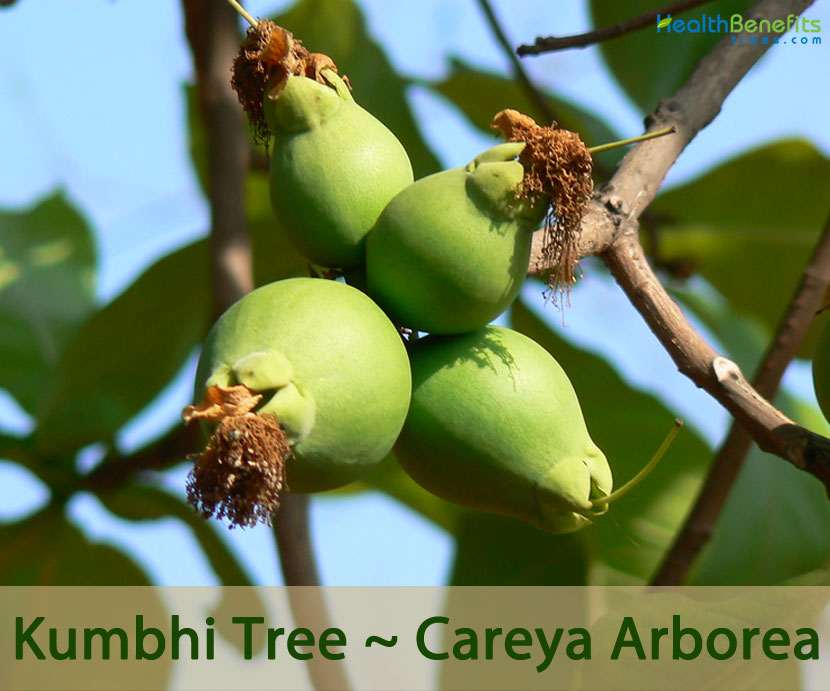
| Shapes | Large, many-seeded drupe 6.3 - 7.5 cm in diameter, globose to depressed globose, crowned by the persistent sepals | |
| Taste | Acrid, bitter, sweet | |
| Health benefits | Good for body pain, fever, cold, cough, leucoderma, tumors, bronchitis, digestion, anorexia, ringworm, eczema, filarial and colic | |
| Name | Kumbhi Tree |
|---|---|
| Scientific Name | Careya Arborea |
| Native | Indian Subcontinent, Afghanistan, and Indochina |
| Common Names | Kumbi, Slow match tree, Wild guava, Patana oak, ceylon oak, tummy wood |
| Name in Other Languages | Assamese: Pani-bhela, Kumari, Kumbhi, Kumrega, Kum Kumari, Panibhela, Godhajam, Kuma (কুম), kumari, Kumbhi (কুম্ভী), Kumrega Bengali: Kāmbēra (কাংবের), Kumbhi, Vakamba, Kumhi, Kumbhi (কুম্ভি) Burma: ban bwe (ဘန့်ပွေး) Central Khmer: Kandaol (កណ្ដោល) Chinese: Dà hú guǒ (大壺果) English: Kumbi, Slow match tree, Wild guava, Patana oak, ceylon oak, tummy wood Garo: Dimbil bol Gujarati: Gangethi (ગંગેઠિ), Kumbhi (કુંભી), Kumbh (કુંભ), Hindi: Pilu (पीलू), Kumbhi (कूम्भी), Sthala Kumbhi, kamba, vakamba, kumbhi tree, kumbee (कुंबी) Kannada: Kavala (ಕವಳ), Daddala (ದಡ್ಡಾಲ), Gudda, Daddippe, alagavvele (ಅಲಗವ್ವೆಲೆ), daddal, koulu mara, Kavalu mara (ಕವಲು ಮರ), Kavulu (ಕವುಲು), Kaval (ಕಾವಲ್), Gonji (ಗೊಂಜಿ), Gaujal (ಗೌಜಲ್) Karbi: Koring Khasi: Ka Mahir, Soh Kundur Khmer: Kandaol (កណ្ដោល) Konkani: Kumbhiyo Malayalam: Aalam, Pezhu, Peru, pēḻ (പേഴ്) Peezh, Alasoo, Pezuntol, Peelam, Pela, Paer, Alam Malaysia: Putat-kedang Marathi: Kumbhi (कुंभी), Kumbhaa, Kumbha (कुम्भा) Munda: Asanda-daru, Kumbhi Myanmar: Sangawn-gmawt Nepali: Kumbhi (कूम्भी) Oriya: Kumbhi, Kumbh, କୁମ୍ଭି Sanskrit: Kumbhi (कूम्भी), Kumbha (कुम्भः), Katabhi (कटभि), Bhadrendrani, Girikarnika (गिरिकर्णिका), Kaidarya, Kalindi (कालिंदी) Sinhalese: Kahata Tamil: Kampi (கம்பி), Kumpi (கும்பி), Pelaimaram (பேழைமரம்), Avima (ஆவிமா), Pēḻai (பேழை), Peezhai, Aima, Karekku, Puta-tanni-maram Telugu: Kumbhū (కుమ్భూ), Kumbhi, Dudippi, araya, budatadadimma, budatanevadi, buddaburija, Govadi Thai: Kradone (กระโดน), careya; kradon; tummy Tulu: Daddaal Vietnamese: Vừng (sometimes Vừng xoan) |
| Plant Growth Habit | Deciduous, small to medium-sized tree |
| Growing Climates | Scattered but locally common in primary or secondary, evergreen or deciduous, slightly seasonal forest, sometimes in more open country and along forest edges. It is absent from perhumid rain forest |
| Soil | Prefers a well-drained, sandy or even rocky soil. Requires a sunny position |
| Plant Size | About 20 meters |
| Bark | 10-12 mm thick, brownish, rough, exfoliates in small thin strips, more or less triangular, fibrous, blaze reddish-brown, stratified, branchlets pubescent |
| Leaf | Simple, alternate, estipulate, 15 – 30 cm long and 7.5 -15 cm wide, broadly obovate or oblong-ovate, apex rounded, obtuse or shortly acuminate. Margins are crenate – denticular, rather membranous, glabrous, 10 – 12 pairs of lateral leaves |
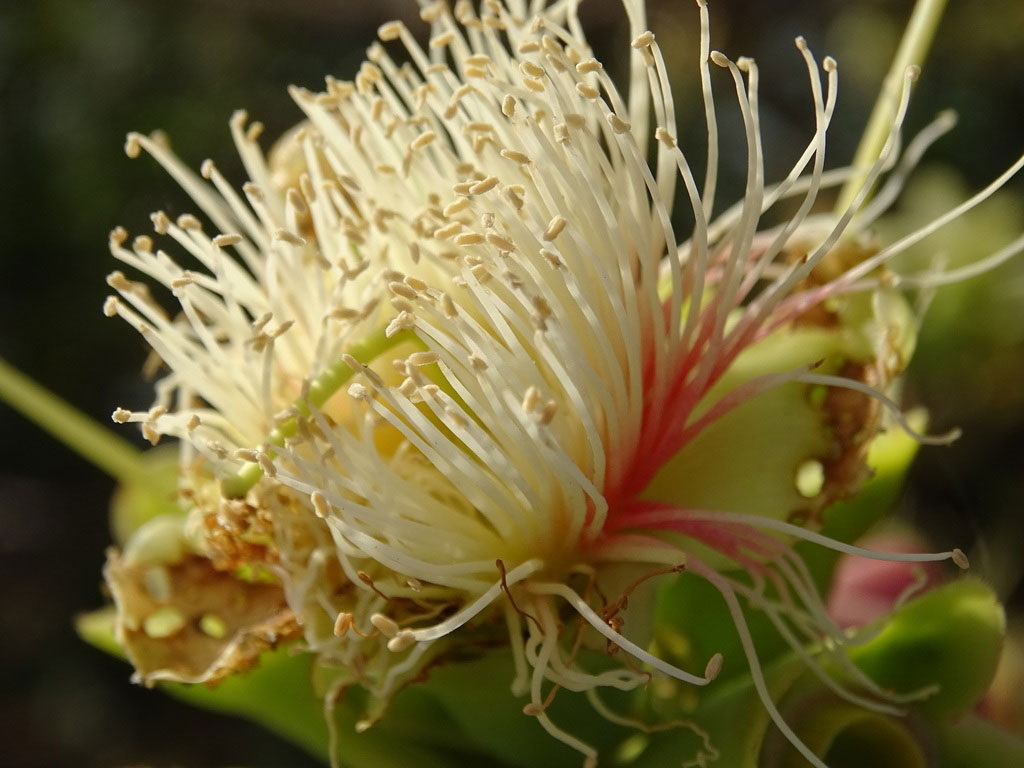
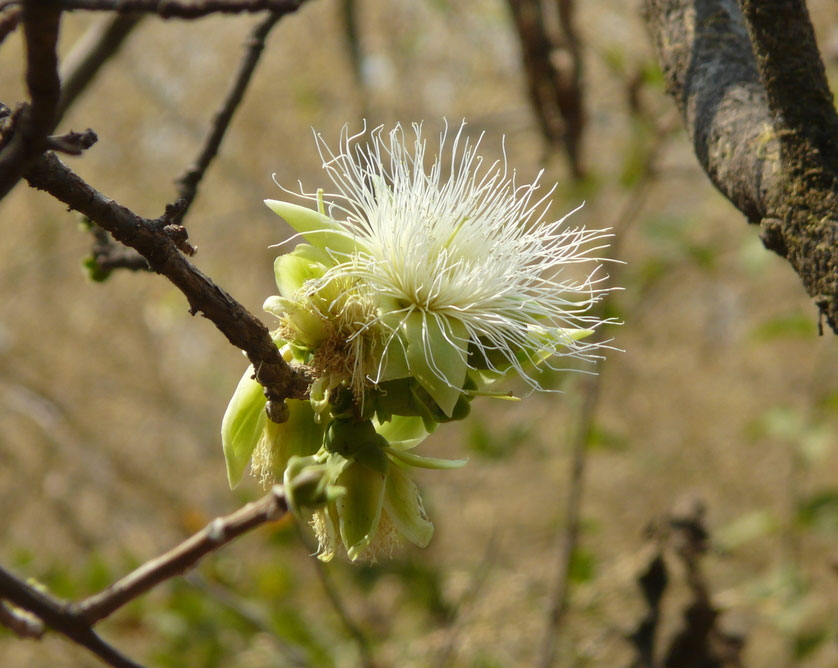
| Flower | Flowers are large, bisexual and handsome, in racemes or interrupted spikes, white-pink or yellowish white, 6.3 – 9 cm across, fetid, born in thick swollen hard terminal spikes each with a central elliptic bract and two linear lateral ones, showy, crowned with persistent calyx, ill smelling and sessile |
| Fruit Shape & Size | Large, many-seeded drupe 6.3 – 7.5 cm in diameter, globose to depressed globose, crowned by the persistent sepals |
| Fruit Color | Green |
| Fruit skin | Leathery |
| Seed | Exalbuminous, dark brown in colour, oval, ellipsoid, 1.5 to 2 cm long, indehiscent; testa hard and wrinkled |
| Taste | Acrid, bitter, sweet |
| Plant Parts Used | Bark, Flower, Fruit, Leaves, Seed, juice, calyx |
| Propagation | By Seed |
| Season | June |
| Varieties |
|
| Culinary Uses |
|
| Precautions |
|
Plant Description
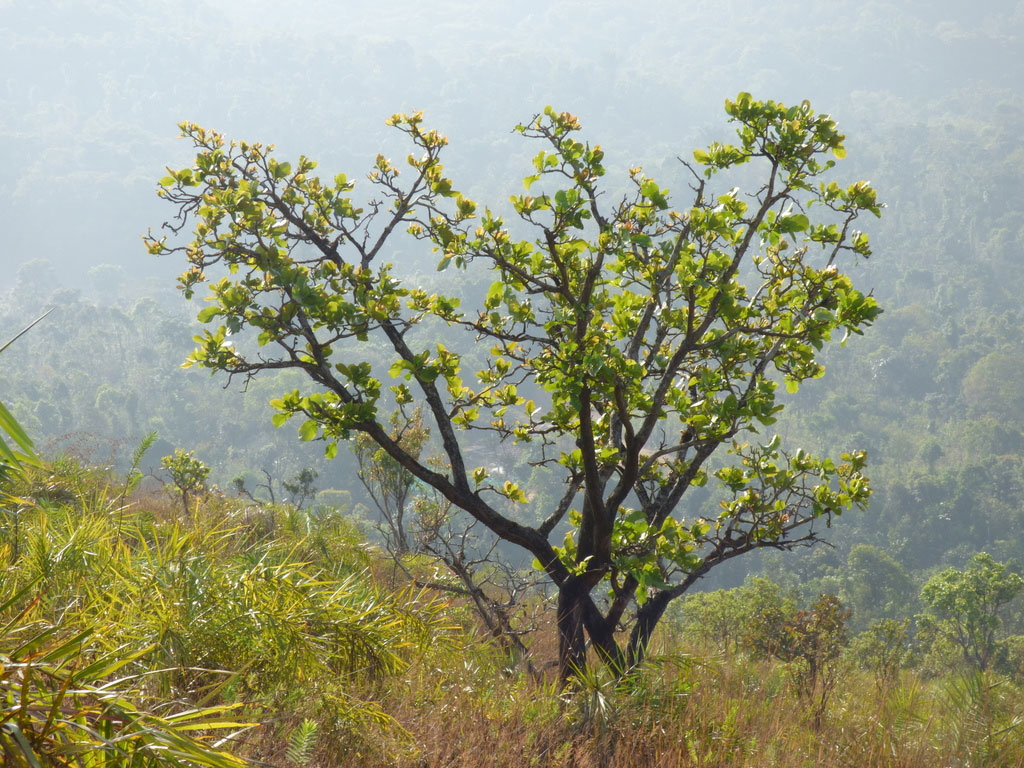
Kumbhi Tree is a deciduous, small to medium-sized tree that normally grows up to 15 – 20 meters (49 – 65 ft.) tall. The bole can be straight when the tree is growing in good conditions, but is often stunted in poor sites. The plant is found growing scattered but locally common in primary or secondary, evergreen or deciduous, slightly seasonal forest, sometimes in more open country and along forest edges. It is absent from per humid rain forest. The plant prefers a well-drained, sandy or even rocky soil. It requires a sunny position. Bark is 10-12 mm thick, brownish, rough and exfoliates in small thin strips, more or less triangular, fibrous, blaze reddish-brown, stratified, branchlets pubescent. In colonial times in India, the fibrous bark of this tree was found to be an ideal substitute for Beech bark as matches for matchlocks. Wood is dull red to reddish brown moderately hard even grained, strong elastic, takes good polish; seasons well under water.
Leaves
leaves are simple, alternate, estipulate, 15 – 30 cm long and 7.5 -15 cm wide, broadly obovate or oblong-ovate, apex rounded, obtuse or shortly acuminate. Margins are crenate – denticular, rather membranous, glabrous, 10 – 12 pairs of lateral leaves. Petiole is 0-1.8 cm, long, stout and margined, crowded at the ends of the branches, penni-nerved, not dotted and is red when young.
Flower
Flowers are large, bisexual and handsome, in racemes or interrupted spikes, white-pink or yellowish white, 6.3 – 9 cm across, fetid, born in thick swollen hard terminal spikes each with a central elliptic bract and two linear lateral ones, showy, crowned with persistent calyx, ill smelling and sessile. Petals 4, elliptic-oblong, revolute along margin, cauducous; disc annular; stamens numerous in several rows, slightly connate at base, inserted on the top of calyx; filaments are subulate, purple, exserted, inner and outer rows without anthers; ovary is inferior, 4-5-celled, ovules many in each cell; style is long, filiform; stigma is capitate. Flowering normally takes place in between March to April when trees are without leaves.
Fruit
Fertile flowers are followed by large, many-seeded drupe 6.3 – 7.5 cm in diameter, globose to depressed globose, crowned by the persistent sepals. It has thick rind and weighs about 100 g. Outermost layer of fruit is epidermis with a waxy covering. Inside epidermis there is collenchymatous hypodermis, inside which loosely packed parenchymatous cells are present having scattered vascular bundles. Seedling with hypogeal germination; cotyledons absent (seed containing a swollen hypocotyl); shoot with scales at the first few nodes. Seeds are ex-albuminous, dark brown in color, oval, ellipsoid, 1.5 to 2 cm long and indehiscent. Testa is hard and wrinkled.
 Half-cut-fruit-and-seeds-of-Kumbhi-Tree
 Immature-fruits-of-Kumbhi-Tree
 Bark-of-Kumbhi-Tree
 Closer-view-of-flower-of-Kumbhi-Tree
 Kumbhi-Tree-growing-wild
 Flower-of-Kumbhi-Tree
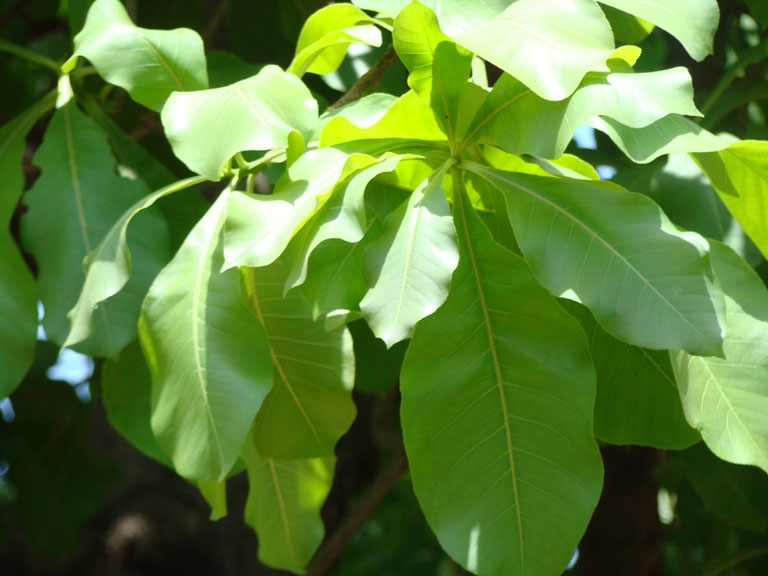 Leaves-of-Kumbhi-Tree
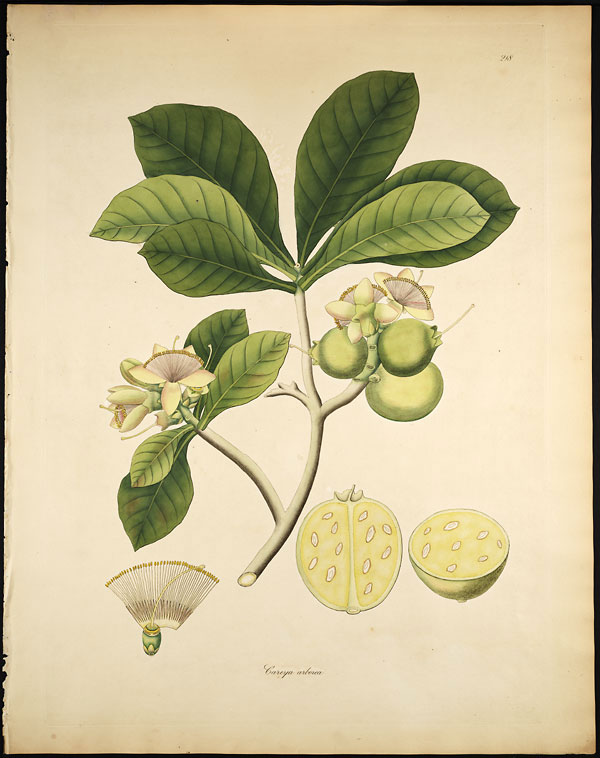 Plant-illustration-of-Kumbhi-Tree
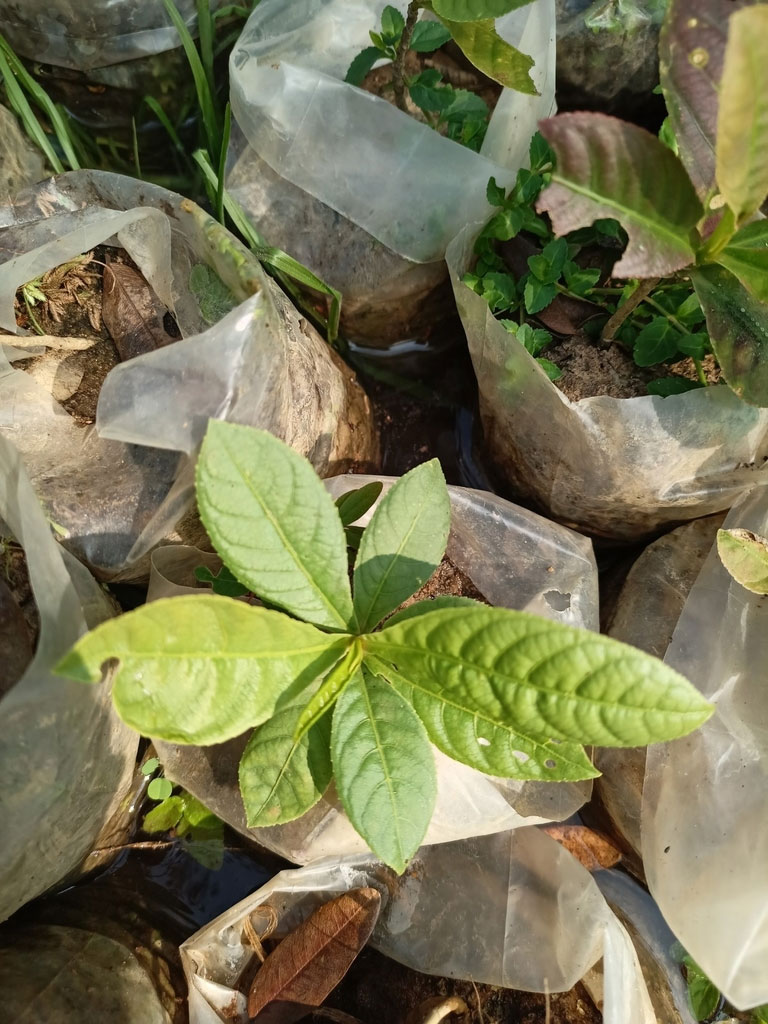 Sapling-of-Kumbhi-Tree
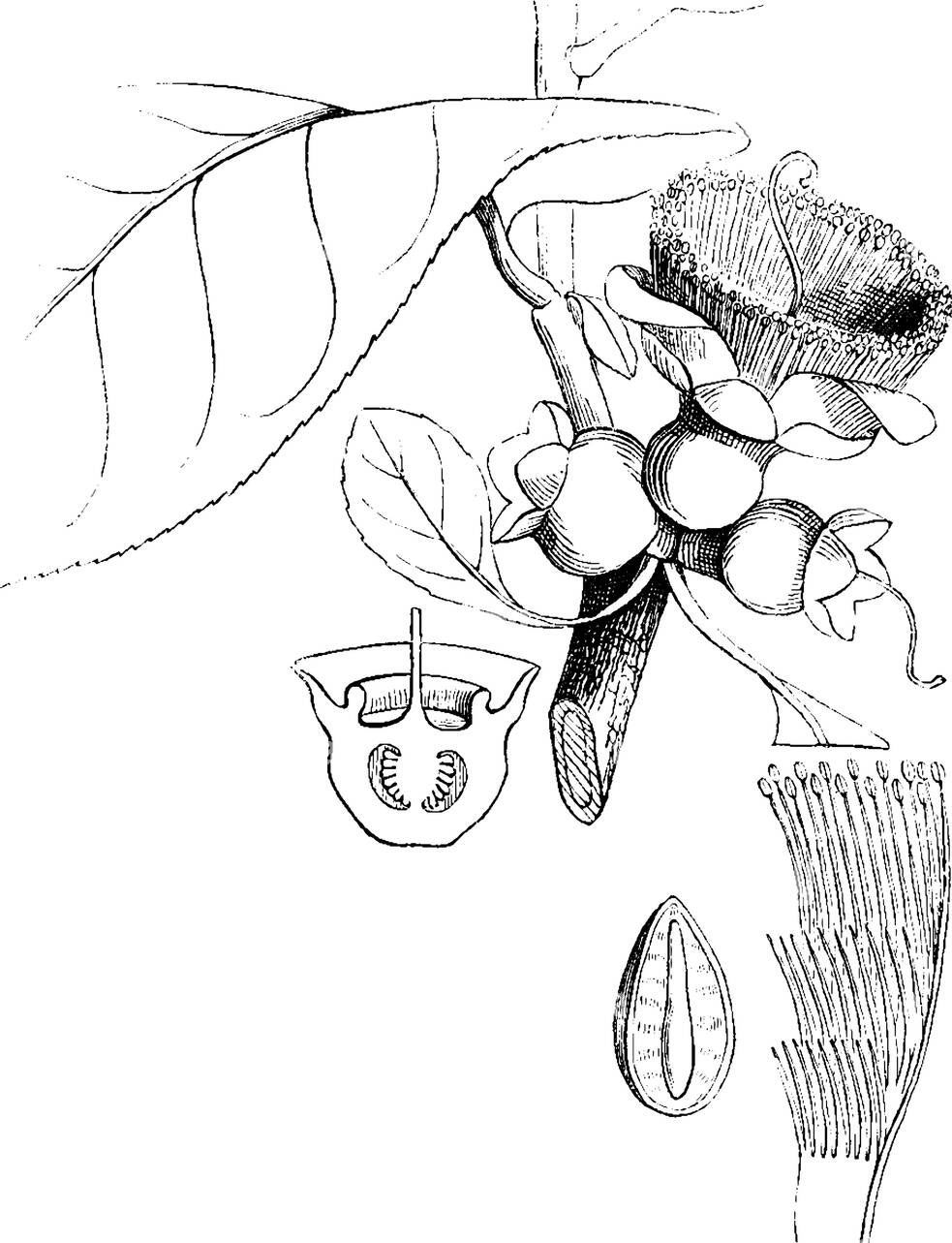 Sketch-of-Kumbhi-Tree
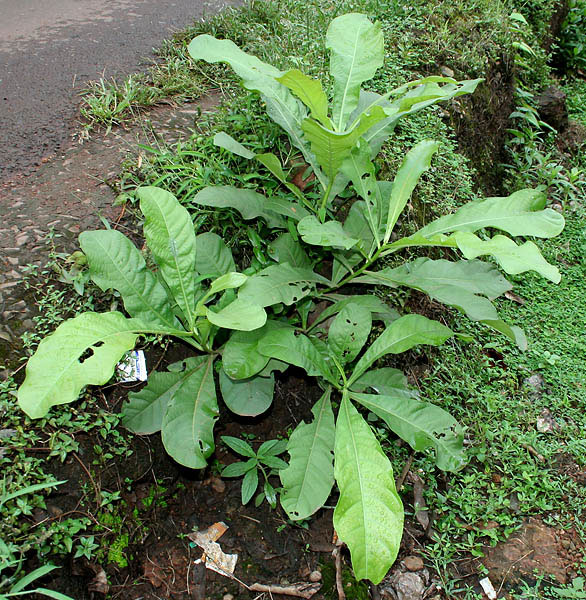 Small-Kumbhi-Tree
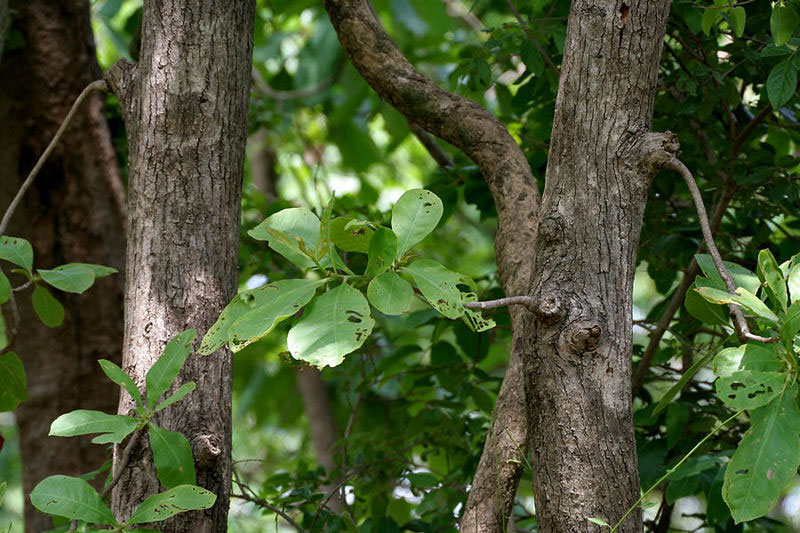 Trunk-of-Kumbhi-Tree
Traditional uses of Kumbhi Tree
| No | Plant Part used | Uses |
| 1. | Whole plant | · Astringent, demulcent, antipyretic, antipruritic, in cough, cold and eruptive fevers, Smallpox · Snake bite |
| 2. | Fruits | · Cold and cough
· Digestion promoter |
| 3. | Flowers | · Aphrodisiac
· Acrid, cures ‘Kapha’, demulcent in cough and cold Tonic, Vaginal ruptures · Fever, Colic and loose motions, Cold and Cough |
| 4. | Calyx | · Filaria |
| 5. | Seeds | · Colic and loose motions |
| 6. | Leaves | · Fever and swellings
· Ulcers and skin diseases |
| 7. | Twig | · Leech repellent |
| 8. | Gum exudates | · Jaundice after delivery
· Tongue ulcers |
| 9. | Stem bark | · Constipation
· Diarrhea · Skin diseases · Dysentery · In asthma, dental diseases and snake bite |
| 10. | Stem sap | · Menorrhegic |
| 11. | Root | · Astringent |
| 12. | Bark |
· Washing and cleaning abscesses, boils, ulcers and diarrhea Ear pain · Skin diseases · Antipyretic, antipruritic and eruptive fever · Smallpox and stomach disorders · Wound healing and body pain · Astringent and demulcent Cough and ColdAlexiteric, anthelminthic and in urinary discharges Rheumatic pain and diarrhea · Eye complaints Abortifacient · Asthma, dental diseases and snake bite · Tumors, dyspepsia, bronchitis and colic · Coarse fiber for cordage ropes, cloth sacking and saddle making |
Traditional uses and benefits of Kumbhi Tree
- It is used for treating snakebite (fruit and bark), in treating body pain, fever, cold, cough, and leucoderma.
- Plant parts are used to treat snakebite, ulcers, healing wound, cough, cold, abscesses and dysentery.
- Juice of the bark, and the calices of the flowers, are astringent and mucilaginous. They are often used internally in India for treating coughs and colds, and are applied externally as an embrocation.
- The pulped leaves are used as a poultice.
- The root paste is used in body ache.
- It is taken in the morning in empty stomach against joint pain for five days.
- Root-bark decoction (with long pepper) is used in fever.
- Stem-bark powder (paste with honey) is given to children in cold and cough.
- Stem-bark (paste with margosa) heals leucoderma.
- The stem bark of C. arborea is traditionally used in the treatment of tumors, bronchitis, skin disease, epileptic fits, astringent antidote to snake venom, abscesses, boil and ulcer.
- The fibrous bark has been applied medicinally for relieving body swellings.
- Decoction prepared from the bark of Kumbhi Tree is given in a dose of 30-40 ml in conditions of snake bite poisoning and scorpion bite.
- Cold infusion of the bark of Kumbhi Tree is given in a dose of 30-40 ml to treat cough and fever.
- Powder of the bark of tree is sprinkled over the wounds for quick healing.
- Leaves of Kumbhi Tree is made into poultice and applied over wounds and ulcers for quick healing.
- Flowers of the tree is made into cold infusion and added with honey or sugar candy and given in a dose of 40-50 ml to woman after delivery for quick healing of the wound occurred during delivery.
- Decoction or cold infusion of the fruit is given in a dose of 30-40 ml to promote digestion and cure cases of anorexia.
- Powder of the bark of Kumbhi Tree is mixed with water and made into paste and is applied over the skin area having ringworm, eczema.
- Leaves are used in filaria, colic, loose motions and ulcers.
- Bark is used as an antipyretic, abortifacient, antipruritic and in smallpox, urinary discharges and rheumatic pain.
- Stem bark is used in the treatment of tumors, bronchitis, epileptic fits and skin diseases.
- It is also used as a remedy for diarrhea, dysentery with bloody stools and ear pain.
- Leaf paste is used as poultice to heal obstinate ulcers.
- Decoction of fruits is digestive.
Ayurvedic health benefits of Kumbhi Tree
- Abdominal pain: Grind the bark of Kumbhi Tree with the bark of Madei tree into paste. Soak the paste in water. After two to three days filter with cloth and take the filtrate orally.
- Body pain: Grind 20 g root of Kumbhi Tree into paste. Boil the paste with cow’s milk. Take 50 ml of the mixture as a dose twice a day for one day only.
- Cold / Fever: Boil the bark of Careya arborea for 15 minutes. Take 25 ml of this decoction with honey as a single dose twice a day for three to four days.
- Cuts/ Wounds: Grind the sun-dried bark of Careya arborea into powder. Sprinkle the powder over the wounds.
- Liquid purging: Grind the dried bark of Careya arborea with water to make paste. Prepare pills of 5 g each from the paste. Take one pill as a dose three times a day with water until cured.
- Myalgia: Grind the bark of Careya arborea and the root of Bauhinia variegate into paste. Take 10 g of this paste as a dose twice a day for 7 days.
- Pain due to injury: Boil a long bark of Careya arborea in water for 15 minutes. Use the long boiled bark as bandage on the injured part.
- Poultry lice: Keep the flowers of Careya arborea inside the poultry house to get rid of lice in poultry.
- Rabies: Grind the root of a small tree of Careya arborea. Make a pudding by mixing the paste with broken rice. Administer the pudding to the patient and advise patient to sit under the sun for a while. This will cause vomiting and cure the patient.
Other Facts
- The tree is highly fire resistant and coppices well.
- The plant is a popular herbal remedy in India, where it is often harvested from the wild for local use and trade.
- In colonial times in India, the fibrous bark of this tree was found to be an ideal substitute for Beech bark as matches for matchlocks.
- The wood is used, mainly in India and Myanmar, for general construction (house posts, planking), furniture and cabinet work, carts, moldings, turnery, piling and agricultural implements.
- Lodhas use fresh stem bark decoction for washing septic wounds of cattle, and keep a dry fruit in a room as snake repellant.
- Oraons use powdered stem, root and leaf for poisoning fish.
- The fibrous bark contains a brown dye.
- The bark yields a good fiber that is used locally for coarse cordage.
- It is also suitable for making brown paper and is used as a slow match to ignite gunpowder.
- A gum is obtained from the tree.
References:
https://biodiversity.bt/species/show/5539
https://tropical.theferns.info/viewtropical.php?id=Careya+arborea
http://yamm.finance/wiki/Careya_arborea.html
http://www.theplantlist.org/tpl/record/kew-313601
https://en.wikipedia.org/wiki/Careya_arborea
https://indiabiodiversity.org/species/show/229071#brief
https://www.easyayurveda.com/2017/10/05/kumbhi-tree-careya-abrorea-ceylon-oak/
https://gd.eppo.int/taxon/CBRAR
http://www.flowersofindia.net/catalog/slides/Wild%20Guava.html
https://www.cabi.org/isc/datasheet/16018