

In the world of healthy snacking and culinary tradition, few ingredients possess the distinctive charm of the pistachio. Botanically classified as Pistacia vera and a member of the cashew family, this edible seed is instantly recognizable by its hard, beige shell that naturally splits to reveal a vibrant green kernel wrapped in purple-hued skin.
Native to the arid regions of Central Asia and the Middle East, the pistachio carries a rich history back thousands of years, once serving as a favored delicacy among ancient royalty.
Today, it remains a beloved staple globally, adding texture and flavor to everything from roasted snack mixes to sweet treats like baklava and ice cream.
Beyond its versatile taste, the pistachio is widely celebrated as a nutritional powerhouse, revered for its heart-healthy fats and dense profile of essential vitamins.
Nutritional Profile of Pistachios
Serving Size: 3 tbsp (30 g)
| Nutrients | Amount | DV%* |
| Energy | 159 kcal | 8% |
| Protein | 5.73 g | 11% |
| Total lipid (fat) | 12.8 g | 16% |
| Carbohydrate | 7.71 g | 3% |
| Fiber, total dietary | 3 g | 11% |
| Total Sugars | 2.17 g | — |
| Water | 1.24 g | — |
| Potassium, K | 289 mg | 6% |
| Phosphorus, P | 139 mg | 11% |
| Magnesium, Mg | 34.3 mg | 8% |
| Calcium, Ca | 29.8 mg | 2% |
| Iron, Fe | 1.11 mg | 6% |
| Vitamin B-6 | 0.482 mg | 28% |
| Copper, Cu | 0.369 mg | 41% |
| Manganese, Mn | 0.34 mg | 15% |
| Thiamin (B1) | 0.247 mg | 21% |
Percent Daily Values (%DV) are based on a 2,000-calorie diet. Individual nutritional needs may vary depending on age, gender, activity level, and overall health.
Source: usda.gov
Science Backed Health Benefits of Pistachios (Pistacia vera)
#1. Lower Cholesterol and Triglycerides
Snacking on pistachios can actually help bring down bad cholesterol and fats in the blood by cutting down on cholesterol absorption. A study showed that eating pistachios can help lower total cholesterol, LDL (bad) cholesterol, and triglycerides, improving heart health. This is due to the healthy fats, fiber, and phytosterols (like stigmasterol) found in pistachios. Additionally, antioxidants like polyphenols and carotenoids help protect the blood vessels by preventing LDL oxidation. These nutrients also work in the body by influencing genes that control fat processing, supporting overall cholesterol balance and cardiovascular health. 1 2
What Research Says:
- Research from Pennsylvania State University showed that eating pistachios improved blood fat levels in adults with high cholesterol and type 2 diabetes. 3 4
- Animal studies at the University of Palermo found that pistachios help prevent high triglycerides and affect genes involved in fat metabolism. 2
- In a 12-week weight loss program, people who ate pistachios saw bigger drops in triglycerides compared to those who ate refined carbs. 5
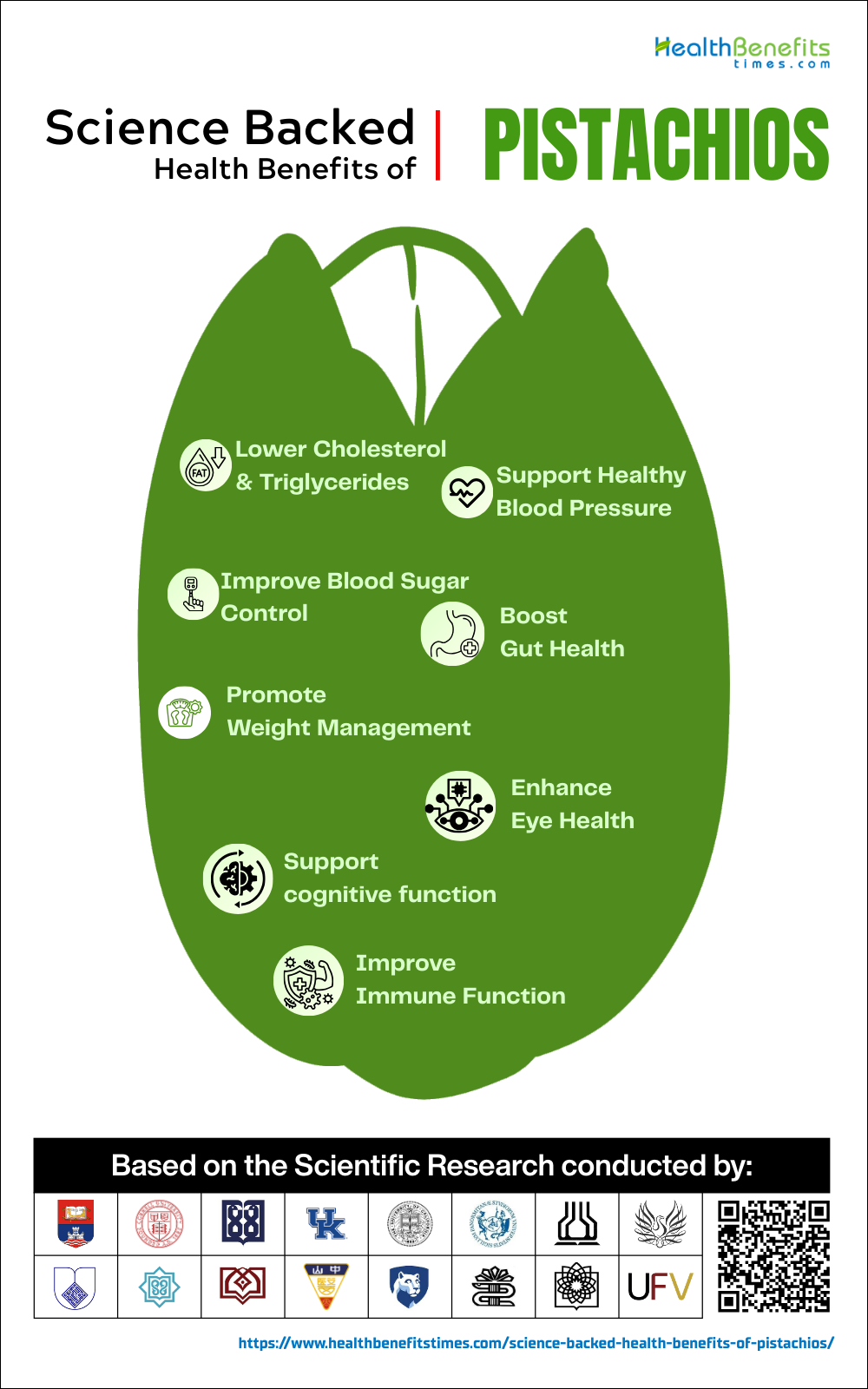
#2. Support Healthy Blood Pressure
Keeping blood pressure in check gets a little easier with pistachios since they are packed with unsaturated fats, phytosterols, arginine, lutein, fiber, and potassium.6 These nutrients help relax blood vessels, reduce inflammation, and improve blood flow, which can lower blood pressure. 7 Potassium in pistachios also helps balance sodium levels, which is important for controlling blood pressure. Regularly eating pistachios may reduce the risk of heart disease and stroke.
What Research Says:
- A review of several studies by Omid Asbaghi and others, which looked at 13 clinical trials with 563 people, found that eating pistachios helps lower systolic blood pressure (SBP) without affecting diastolic blood pressure (DBP) or blood vessel function. 6 7
- In a study by Sheila G. West, 28 adults with high cholesterol ate pistachios daily. This helped lower their systolic blood pressure and improved their body’s response to stress, mainly by reducing heart rate and blood vessel resistance. 4 8
- Another review from Matin Ghanavati’s team, looking at 11 trials with 506 participants, showed that pistachios not only lowered systolic blood pressure but also helped control blood sugar, which is good for heart and metabolic health, as supported by PubMed and Cochrane. 9
#3. Improve Blood Sugar Control
Managing blood sugar becomes simpler with pistachios thanks to their load of nutrients like monounsaturated fats, polyunsaturated fats, fiber, and polyphenols such as anthocyanins and carotenoids. 10 These nutrients work together to slow down how quickly your body breaks down and absorbs carbohydrates, which helps reduce blood sugar spikes after meals and makes insulin work better. This is especially helpful for people with prediabetes or type 2 diabetes. 11 Eating pistachios regularly can lower fasting blood sugar and improve insulin resistance without affecting long-term blood sugar markers like HbA1c. 12
What Research Says:
- Another study found that eating pistachios regularly improved fasting blood sugar, insulin, and fructosamine levels. These improvements were linked to compounds in pistachios that help manage insulin sensitivity. 10
- Research published in the British Journal of Nutrition also showed that pistachios can reduce blood sugar and insulin levels in people at risk for heart disease. A separate trial found that pistachios improved cholesterol levels and reduced oxidative stress in people with type 2 diabetes. 13 14
#4. Boost Gut Health
Pistachios are actually great for keeping the digestive system happy because they provide rich nutrients, including dietary fiber, monounsaturated fatty acids, and polyphenols. 15 These nutrients act as prebiotics, encouraging the growth of good bacteria such as Lactobacillus and Bifidobacterium, which are important for gut health and reducing inflammation. 16 17 Eating pistachios regularly can help prevent or reduce problems linked to an imbalance of gut bacteria, like metabolic syndrome, type 1 diabetes, and obesity-related inflammation, by improving gut flora and strengthening the gut barrier. 17 18 The polyphenols in pistachios, after being broken down by gut bacteria, form bioactive compounds that help reduce inflammation and protect cells, promoting overall digestive health. 19
- What Research Says:
Studies show that pistachios can positively affect gut health by changing the types of bacteria in the gut. Research from the Andalusian Institute of Agricultural and Fisheries Research found that pistachio polyphenols (plant compounds) are broken down in the colon, creating helpful compounds like 3-(3′-hydroxyphenyl)propanoic acid. 19 - In animal studies, scientists found that pistachios reduced harmful bacteria and increased beneficial ones, like Parabacteroides and Lactobacillus, in mice on a high-fat diet, which helped lower inflammation. 17
- In a human study, pistachios increased bacteria that produce butyrate (a beneficial fatty acid) more than almonds did. 18
- Another study on diabetic rats found that pistachios helped restore a healthy gut balance and boosted levels of Bifidobacterium. 16
#5. Promote Weight Management
When it comes to weight management, pistachios are a helpful ally mainly because of their protein, fiber, and unsaturated fats. These nutrients help you feel full, which can reduce calorie intake in later meals, and they improve metabolic health by boosting lipid levels and lowering triglycerides. 20 5 Pistachios also contain potassium, copper, vitamin B6, and carotenoids like lutein and beta-carotene, which help protect heart health and may prevent obesity-related conditions such as type 2 diabetes and metabolic syndrome. 21 22 These nutrients help control hunger and balance energy.
What Research Says:
- Studies show that eating pistachios doesn’t cause weight gain and can actually help with weight loss when included in a calorie-controlled diet. A review of 11 studies found that pistachios can lower BMI without increasing body weight or waist size. 23
- Clinical research from the University of California, San Diego, showed that eating 42g of pistachios daily in a weight-loss program helped people lose weight, improved their diet, and lowered both systolic and diastolic blood pressure. 20 22
- Another small study found that having pistachios as a snack in the afternoon boosted essential nutrient intake without affecting overall calorie intake or body fat. 24
- A 12-week study also showed that pistachios helped lower BMI and triglyceride levels more than snacks made of refined carbs. 5
#6. Enhance Eye Health
Pistachios can give eye health a nice boost thanks to their high levels of carotenoids, specifically lutein and zeaxanthin. 25 These nutrients are essential for the macular pigment in the retina, which acts as a natural filter for blue light and serves as an antioxidant to protect retinal cells. Higher levels of macular pigment optical density (MPOD) are linked to a lower risk of age-related macular degeneration (AMD), a major cause of vision loss. 25 When consumed, these fat-soluble carotenoids are absorbed into the bloodstream and stored in the eye, enhancing its protective capabilities.
What Research Says:
- A study done by researchers at Tufts University showed that eating 2 ounces of pistachios every day for 12 weeks helped increase the macular pigment in the eyes of healthy adults who initially had low levels. 26
- The study, partly funded by American Pistachio Growers, found that this diet nearly doubled the amount of lutein participants got daily and raised lutein levels in their blood after just six weeks. The effects lasted throughout the study. 25
#7. Support cognitive function
It turns out that adding pistachios to a diet might do wonders to improve brain function. These nuts are packed with bioactive compounds like polyunsaturated fatty acids, phenolic compounds, and antioxidants such as lutein. 27 These nutrients work together to reduce oxidative stress and inflammation in the brain, protect mitochondria, and support healthy fat metabolism factors that are important for preventing brain damage. 28 Regularly eating pistachios can help prevent nerve cell death, reduce the buildup of harmful proteins linked to Alzheimer’s and Parkinson’s diseases, and improve mood and brain function. 27 Pistachios also boost brain health through their nutrients, and studies have shown that extracts from pistachios may even help improve brain markers in animal models. 28 27
What Research Says:
- Research in Italy found that giving pistachios to mice on a high-fat diet helped reduce fat buildup in the brain, reduced stress and damage in cells, and improved cell function, while also lowering the number of dying brain cells. 28
- Another study by Landaverde-Mejia and others found that eating 28 grams of pistachios per day for 28 days helped young adults improve their focus, decision-making, mood, and attention, while also improving their cholesterol levels. 29 30
- Also, a review of plants from the Pistacia family showed that they have brain-protecting qualities, helping to fight stress and inflammation in the body. 27
#8. Improve Immune Function
Because they are loaded with bioactive compounds like polyphenols, flavonoids, and unsaturated fatty acids, pistachios can really help improve immune function by cutting down on inflammation and oxidative stress. These nutrients help lower harmful inflammatory markers like TNF-α and IL-6, while increasing the activity of antioxidant enzymes like SOD and CAT, which protect the body’s cells. 31 Regularly eating pistachios or using pistachio-based products can help manage immune-related issues like chronic inflammation, skin problems, and some types of cancer, by boosting the body’s natural defense system and maintaining immune balance. 32 33
What Research Says:
- Scientific studies have shown that pistachios can help improve immune function. Research found that pistachio leaf extract reduced harmful markers and inflammation in breast cancer models, suggesting it might help prevent cancer. 34
- Another study in fish showed that pistachio hull polysaccharides increased anti-inflammatory effects and helped reduce oxidative stress caused by bacteria. 32
- Additionally, research from Italy found that pistachio stalk extracts, in special formulations, lowered inflammation and oxidative stress by affecting certain cell pathways. 33
How to Eat Pistachios
- Crack the Shell: Hold the pistachio between your thumb and index finger. If the shell is already split (which is common), pry it open further using your thumbnails. This most common and healthy way to eat Pistachio.
- Salad Toppers: Sprinkle chopped roasted pistachios over salads (especially those with goat cheese, beets, or arugula) for added texture.
- Crusts for Proteins: Crush them finely and use them as a crust for chicken, salmon, or lamb chops before searing or baking.
- Yogurt & Oatmeal: Stir them into Greek yogurt or morning oats for a protein boost.
Potential precautions and side effects of Pistachios
- Tree Nut Allergy (Risk of Anaphylaxis)
- Irritable Bowel Syndrome (IBS) (Due to high fructan/FODMAP content)
- Chronic Kidney Disease (CKD) (Due to high potassium and phosphorus levels)
- Hyperkalemia (Elevated blood potassium levels)
- Hypertension (Risk associated with high sodium in salted varieties)
Based on scientific research conducted by:
Università di Palermo, Palermo, Italy: https://www.unipa.it/dipartimenti/stebicef
Mashhad University of Medical Sciences (MUMS): https://www.mums.ac.ir/en
The Pennsylvania State University (Penn State), USA: https://harrisburg.psu.edu/behavioral-sciences-education/applied-behavior-analysis-ma?gad_campaignid=15085180518&gad_source=1&gbraid=0AAAAAD-fbQuLfdWhitVhh0bUgjnZ3RLy_
Universitat Rovira i Virgili (URV), Reus, Spain: https://www.urv.cat/en/
Universidade Federal de Viçosa, Viçosa, Minas Gerais, Brazil: https://www.ufv.br/
Yunnan University: http://english.ynu.edu.cn/
Tufts University: https://www.tufts.edu/
College of Applied Medical Sciences, King Khalid University, Abha, Saudi Arabia: https://www.iau.edu.sa/en/colleges/college-of-applied-medical-sciences
University of Basilicata, Potenza, Italy: https://portale.unibas.it/site/en/home.html
National Research Council (CNR), Avellino, Italy: https://www.cnr.it/en
Assiut University, Egypt: https://www.aun.edu.eg/main/
University of Tehran: https://ut.ac.ir/en
Kafrelsheikh University, Egypt: https://kfs.edu.eg/engkfs/
Comments
This article is based on Scientific Research Conducted by following Research Organization:
- Consumption of pistachio nuts positively affects lipid profiles–Cornell University, USA, University of Belgrade, Serbia, Isfahan University of Medical Sciences, Iran, University of Medical Sciences, Iran, Qazvin University of Medical Sciences, Iran, Tehran University of Medical Sciences, Iran, Kerman University of Medical Sciences, Iran
- Pistachio Consumption Prevents and Improves Lipid Dysmetabolism by Reducing the Lipid Metabolizing Gene Expression in Diet-Induced Obese Mice–Università di Palermo, Italy, Istituto Zooprofilattico Sperimentale della Sicilia “A. Mirri”, Italy
- Effects of pistachios on the lipid/lipoprotein profile, glycemic control, inflammation, and endothelial function in type 2 diabetes–Pennsylvania State University
- Diets Containing Pistachios Reduce Systolic Blood Pressure and Peripheral Vascular Responses to Stress in Adults With Dyslipidemia–Pennsylvania State University,USA
- Pistachio Nuts Reduce Triglycerides and Body Weight by Comparison to Refined Carbohydrate Snack in Obese Subjects on a 12-Week Weight Loss Program–University of California, Los Angeles
- Effects of pistachios on anthropometric indices, inflammatory markers, endothelial function and blood pressure in adults–Lorestan University of Medical Sciences, Iran, Isfahan University of Medical Sciences, Iran, University of Kentucky, USA, Chung Shan Medical University, Taiwan, Tehran University of Medical Sciences, Iran
- Effects of pistachios on anthropometric indices, inflammatory markers, endothelial function and blood pressure in adults–Lorestan University of Medical Sciences, Iran, Isfahan University of Medical Sciences, Iran, University of Kentucky, USA, Chung Shan Medical University, Taiwan, Tehran University of Medical Sciences, Iran, Tehran University of Medical Sciences, Iran
- Diets containing pistachios reduce systolic blood pressure and peripheral vascular responses to stress in adults with dyslipidemia–Pennsylvania State University, USA
- Pistachios and cardiometabolic risk factors–Shahid Beheshti University of Medical Sciences, Iran, Coventry University, United Kingdom, Ahvaz Jundishapur University of Medical Sciences, Iran
- Effect of chronic consumption of pistachios (Pistacia vera L.) on glucose metabolism in pre-diabetics and type 2 diabetics–Universidade Federal de Viçosa, Brazil.
- Beneficial effect of pistachio consumption on glucose metabolism, insulin resistance, inflammation, and related metabolic risk markers–Universitat Rovira i Virgili, Spain, Instituto de Salud Carlos III, Spain
- The effectiveness of pistachio on glycemic control and insulin sensitivity in patients with type 2 diabetes, prediabetes and metabolic syndrome–Lorestan University of Medical Sciences, Iran, Guilan University of Medical Sciences, Iran
- Effects of pistachios on glycaemic control: a systematic review and meta-analysis of randomised controlled trials–Halal Research Center of IRI, Iran, Shahid Beheshti University of Medical Sciences, Iran, Icahn School of Medicine at Mount Sinai, NY, USA, Qazvin University of Medical Sciences, Iran, Tehran University of Medical Sciences, Iran
- Effects of pistachios on the lipid/lipoprotein profile, glycemic control, inflammation, and endothelial function in type 2 diabetes–The Pennsylvania State University, University Park, USA
- Effect of In Vitro Gastrointestinal Digestion and Colonic Fermentation on the Stability of Polyphenols in Pistachio (Pistacia Vera L.)–Andalusian Institute of Agricultural and Fisheries Research and Training, Spain, Universidad de Córdoba, Spain, Instituto Maimónides de Investigación Biomédica de Córdoba, Spain
- Pistachio Consumption Alleviates Inflammation and Improves Gut Microbiota Composition in Mice Fed a High-Fat Diet–University of Palermo, Italy, Istituto Zooprofilattico Sperimentale della Sicilia “A. Mirri”, Italy
- Effect of In Vitro Gastrointestinal Digestion and Colonic Fermentation on the Stability of Polyphenols in Pistachio (Pistacia Vera L.)–Andalusian Institute of Agricultural and Fisheries Research and Training, Spain, Universidad de Córdoba, Spain, Instituto Maimónides de Investigación Biomédica de Córdoba, Spain
- Effects of Pistachio Consumption in a Behavioral Weight Loss Intervention on Weight Change, Cardiometabolic Factors, and Dietary Intake–University of California, USA, Yunnan University, China, Second Affiliated Hospital of Kunming Medical University, China
- Effects of Pistachio Consumption in a Behavioral Weight Loss Intervention on Weight Change, Cardiometabolic Factors, and Dietary Intake–University of California, USA
- The relationship between pistachio (Pistacia vera L) intake and adiposity–Yunnan University, China, Second Affiliated Hospital of Kunming Medical University, China
- A Randomized Controlled Pilot Study to Assess Effects of a Daily Pistachio (Pistacia Vera) Afternoon Snack on Next-Meal Energy Intake, Satiety, and Anthropometry in French Women–Institut Paul Bocuse Research Centre, France
- Pistachio Consumption Increases Macular Pigment Optical Density in Healthy Adults–Tufts University, Boston, USA
- Pistachios may help improve eye health, new study finds–Tufts University, Boston, USA
- Pistacia Genus as a Potential Source of Neuroprotective Natural Products–Babol University of Medical Sciences, Iran, Tehran University of Medical Sciences, Iran
- Regular Intake of Pistachio Mitigates the Deleterious Effects of a High Fat-Diet in the Brain of Obese Mice–Istituto per la Ricerca e l’Innovazione Biomedica, Italy, Università di Palermo, Italy, Università degli Studi di Palermo, Italy
- Pistachio (Pistacia vera L.) consumption improves cognitive performance and mood in overweight young adults–Universidad Autónoma de Querétaro, Mexico, Universidad Autónoma de Baja California, Mexico, Universidad de Antioquia, Colombia
- Pistachio (Pistacia vera L.) consumption improves cognitive performance and mood in overweight young adults–Universidad Autónoma de Querétaro, Mexico, Universidad Autónoma de Baja California, Mexico, Universidad de Antioquia, Colombia
- Pistachio hull polysaccharide protects Nile tilapia against LPS-induced excessive inflammatory responses and oxidative stress, possibly via TLR2 and Nrf2 signaling pathways–Iranian Fisheries Science Research Institute, Iran, University of Tehran, Karaj, Iran
- Immunometabolism Modulation by Extracts from Pistachio Stalks Formulated in Phospholipid Vesicles–University of Cagliari, Italy, University of Basilicata, Italy
- Chemopreventive effect of Pistacia vera leaf extract against mammary carcinoma induced by dimethyl-benz(a)anthracene in vivo and in vitro–King Khalid University, Saudi Arabia, Genetic Engineering and Biotechnology Research Institute, Egypt, Northern Border University, Saudi Arabia, Al-Azhar University, Egypt, Benghazi University, Libya