

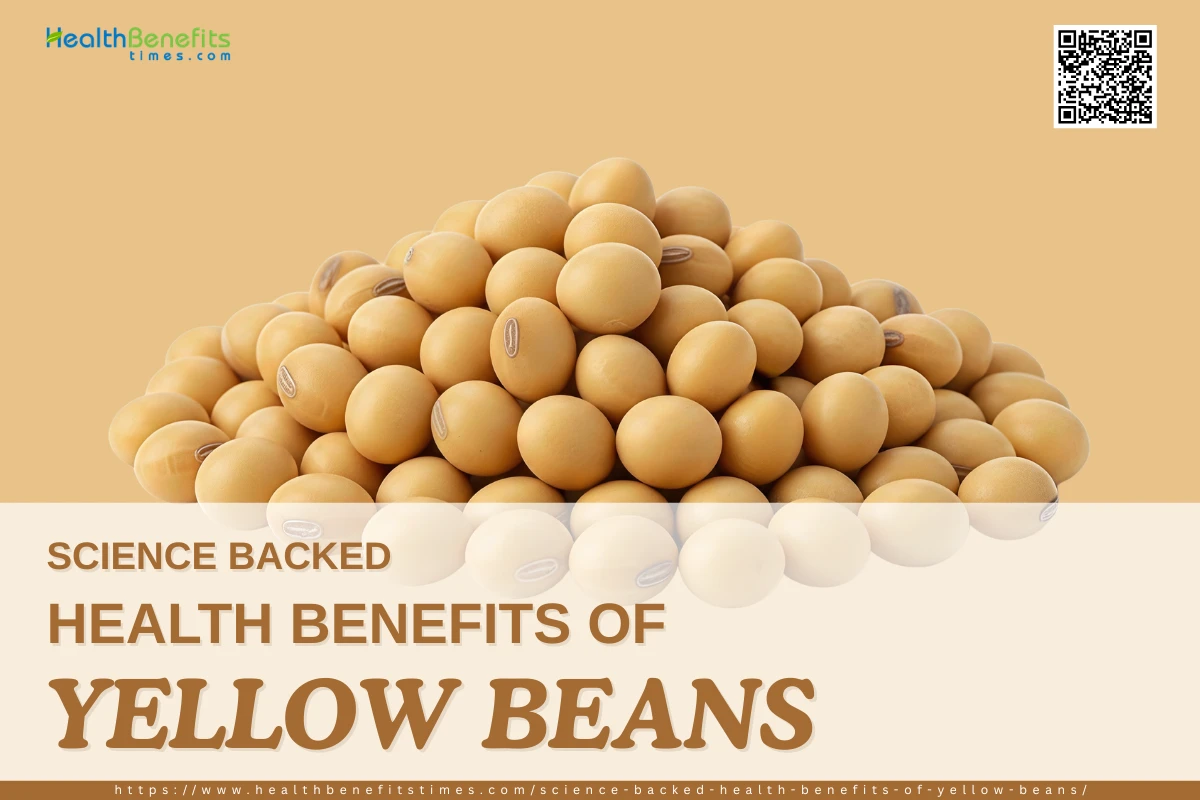
Yellow beans, also widely recognized as wax beans, are a vibrant and nutritious alternative to the common green bean. When you incorporate them into your culinary repertoire, you will notice their distinct, pale-yellow hue and a slightly milder, more buttery flavor profile compared to their green cousins. As you handle these legumes, you will find they possess a crisp, succulent texture that holds up remarkably well whether you choose to steam, sauté, or toss them raw into a summer salad. Beyond their aesthetic appeal, yellow beans offer you a wealth of essential nutrients, including fiber, vitamin C, and potassium, which support your overall digestive health and immune function. Because they lack the chlorophyll found in green beans, they provide a unique splash of color to your plate without sacrificing that classic “snap” you expect. Whether you are a home cook or a professional chef, yellow beans provide you with a versatile, low-calorie ingredient that elevates the visual and nutritional quality of any meal.
Nutritional Profile of Yellow Beans
Based on the provided PDF, here are the top 16 nutritional values for Yellow Beans (mature seeds, cooked, boiled, without salt).
Serving Size: 100 g 1
| Nutrients | Amount | DV%* |
| Water | 63 g 2 | – |
| Energy | 144 kcal 3 | – |
| Protein | 9.16 g 4 | 18% |
| Fiber, total dietary | 10.4 g 5 | 37% |
| Carbohydrate, by difference | 25.3 g 6 | 9% |
| Total lipid (fat) | 1.08 g 7 | 1% |
| Total Sugars | 0.34 g 8 | – |
| Copper, Cu | 0.186 mg 9 | 21% |
| Folate, total | 81 µg 10 | 20% |
| Manganese, Mn | 0.455 mg 11 | 20% |
| Magnesium, Mg | 74 mg 12 | 18% |
| Phosphorus, P | 183 mg 13 | 15% |
| Thiamin (Vitamin B1) | 0.187 mg 14 | 15% |
| Iron, Fe | 2.48 mg 15 | 14% |
| Zinc, Zn | 1.06 mg 16 | 10% |
| Potassium, K | 325 mg 17 | 7% |
Source: usda.gov
* Percent Daily Values (%DV) are based on a 2,000-calorie diet. Individual nutritional needs may vary depending on age, gender, activity level, and overall health. (Note: %DV is calculated based on standard FDA Dietary Guidelines, as they are not explicitly listed in the source document).
Science Backed Health Benefits of Yellow Beans
#1. Support Digestive Health
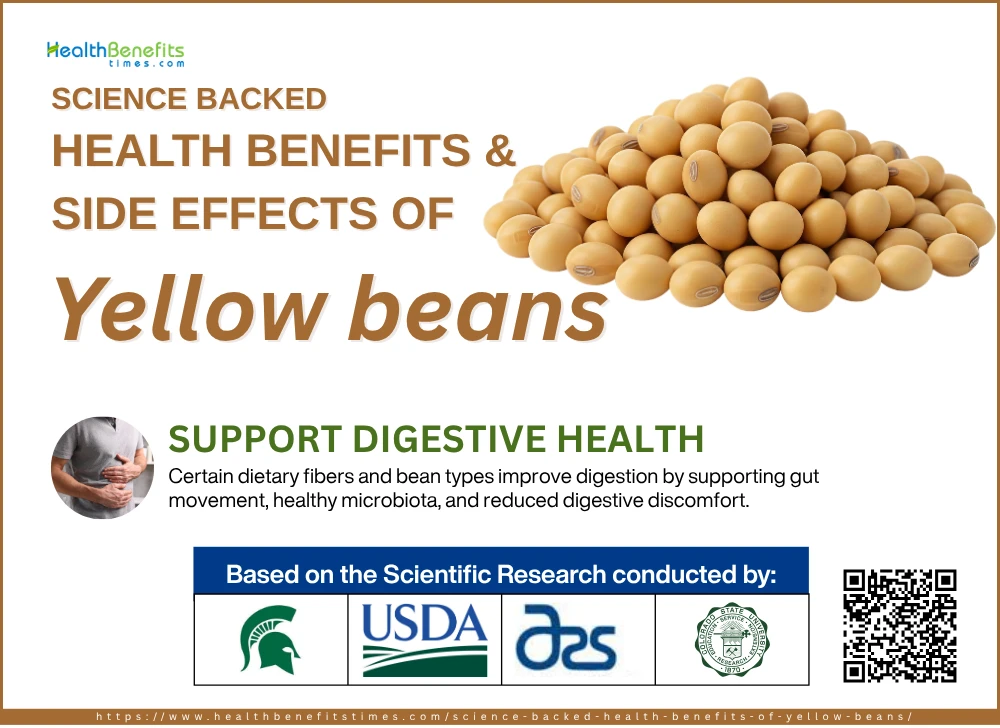
Digestive disorders often stem from sluggish gastric motility and microbiome dysbiosis, which can precipitate chronic inflammation and irregularity. To mitigate these pathologies, the gastrointestinal tract requires a synergy of insoluble dietary fiber (IDF) and soluble dietary fiber (SDF); the former increases fecal bulk to accelerate colonic transit time, while the latter undergoes fermentation by gut microbiota. 1 This fermentation process, particularly of non-digestible oligosaccharides, yields short-chain fatty acids that are critical for maintaining colonic homeostasis and preventing cardiometabolic diseases and specific forms of cancer. 2 Although certain fermentable components are historically linked to flatulence, these prebiotics are fundamental for mucosal health. Consuming varieties with optimized fiber profiles allows these bioactive compounds to support digestive function and nutrient absorption without triggering excessive gastrointestinal distress. 1
What Research Says:
- According to collaborative research by Michigan State University and the USDA Agricultural Research Service, evaluations using the AOAC 2011.25 analytical method demonstrate that fast-cooking yellow bean genotypes possess significantly lower Insoluble Dietary Fiber (IDF) and Total Dietary Fiber (TDF) compared to slower-cooking counterparts, directly influencing digestibility. 2
- The study highlights that while Soluble Dietary Fiber (SDF) levels are generally stable across cooking classes, larger-seeded Andean varieties contain higher SDF concentrations than Middle American types, corroborating traditional observations in Chile and Africa that specific Manteca market classes are exceptionally “easy-to-digest”. 1
- Furthermore, researchers identified distinct Mayocoba breeding lines, such as PR1146-124, which contain 42% fewer oligosaccharides than average; this genetic variance suggests that specific cultivars can be selected to minimize flatulence while preserving the essential prebiotic benefits necessary for gut flora health. 2
 Health Risks and Precautions of Yellow Beans
Side Effects
1. The primary known adverse effect associated with consuming yellow beans is digestive discomfort, specifically flatulence. This is attributed to the presence of non-digestible oligosaccharides (OLIGOs), which escape digestion in the small intestine and are fermented by gut microflora. Consequently, beans with higher concentrations of these compounds may cause flatulence, particularly in individuals whose diets do not routinely include pulses. 1 2 3
Food Incompatibilities
N/A
Timing & Conditions
N/A
Contraindications
N/A
Drug Interactions
N/A
External Pesticides and Mold
N/A
Comments
This article is based on Scientific Research Conducted by following Research Organization:
- Yellow bean (Phaseolus vulgaris L.) germplasm with less dietary fiber have shorter cooking times and more bioavailable iron
- Yellow bean (Phaseolus vulgaris L.) germplasm with less dietary fiber have shorter cooking times and more bioavailable iron–Michigan State University, United States, USDA-ARS Robert W. Holley Center for Agriculture and Health, United States, USDA-ARS Sugarbeet and Bean Research Unit, United States, Colorado State University, United States
- Yellow bean (Phaseolus vulgaris L.) germplasm with less dietary fiber have shorter cooking times and more bioavailable iron–Michigan State University, United States, USDA-ARS Robert W. Holley Center for Agriculture and Health, United States, Colorado State University, United States