

Imagine breaking out in painful, burning hives every single time you step into the shower, get caught in the rain, or even cry. That is the daily reality for people living with aquagenic urticaria a rare condition medically defined as a physical urticaria triggered by direct skin contact with water, regardless of its temperature, source, or mineral content. 1 The term “aquagenic” comes from the Latin aqua (water) and Greek gen (producing), and urticaria is the medical term for hives raised, itchy welts on the skin. 2
When your skin is exposed to water, it sets off a cascade inside your body: mast cells in the skin degranulate and release histamine and other inflammatory chemicals, causing small 1–3 mm wheals (welts) surrounded by a red flare to form on the skin surface. 3 These hives usually appear within 20 to 30 minutes of water contact and resolve on their own within 30 to 60 minutes after you dry off. 4 In very severe cases, some people also experience wheezing, difficulty swallowing, or low blood pressure making this far more than a cosmetic problem. 5
Aquagenic urticaria was first formally described by Shelley and Rawnsley in 1964, and since then, fewer than a few hundred confirmed cases have been published in the global medical literature, making it one of the rarest dermatological conditions known to science. 6 There is currently no permanent cure, but a combination of medical treatment, lifestyle changes, and targeted home remedies can significantly reduce your discomfort and help you maintain a reasonable quality of life.
Causes of Water Allergies
Scientists have puzzled over the exact cause of aquagenic urticaria for decades, and to be honest, the answer is still not fully settled. The most widely accepted hypothesis today is that water interacts with a substance in your sebum the oily secretion on your skin’s surface to form a toxic compound or water-soluble antigen. 7 This antigen is then thought to diffuse through the outer layer of your skin (the stratum corneum), reach the mast cells below, and trigger them to release histamine, setting off the visible allergic response you experience. 8
Interestingly, researchers have noted that not all patients show elevated serum histamine levels after water challenge testing, which suggests that other chemical pathways possibly involving acetylcholine, serotonin, or bradykinin may also be at play in some individuals. 9 This makes aquagenic urticaria particularly tricky to treat, because the same antihistamine that works for one person may do very little for another.
Hormones appear to be a contributing factor as well. The condition most commonly appears during puberty, and several documented cases have had their onset coincide directly with a patient’s first menstrual cycle, pointing to a possible hormonal trigger linked to estrogen or progesterone fluctuations. 10 Some researchers have also noted that symptoms tend to worsen around menstruation in female patients, lending further support to this hormonal connection. 11
Genetics may also load the gun, even if the trigger is environmental. Familial cases of aquagenic urticaria have been reported across multiple generations and in identical twins, suggesting that a heritable vulnerability can exist though no specific gene mutation has been identified to date. 12 Some familial cases have been associated with other conditions, including Bernard-Soulier syndrome and lactose intolerance, though the nature of these links is not yet clear. 13
Water Allergy Facts
| Symptoms | • Small 1–3 mm hives (wheals) surrounded by redness
• Intense itching or burning • Stinging sensation on skin • Swelling of the affected area • In severe cases: wheezing, throat tightness, difficulty breathing |
| Causes 14 | • Unknown; leading theory involves water activating a skin-based allergen
• Mast cell degranulation and histamine release • Possible hormonal, genetic, or immune dysregulation factors |
| Types of Water Allergies | • Classic aquagenic urticaria (most common) • Salt-dependent aquagenic urticaria (reaction requires dissolved salts) • Localized aquagenic urticaria (only specific body areas react) • Familial vs. sporadic (acquired) forms |
| How it spreads | • It does NOT spread from person to person this is a physical, non-contagious skin condition |
| Water triggers 16 | • Tap water, rain, ocean water, sweat, tears, saliva, and snow can all trigger reactions |
| Age group affected 17 | • Most cases emerge in adolescence and young adulthood
• Onset linked to puberty in many cases • Rare pediatric cases also documented |
| Higher risk groups 18 | • Females are more commonly affected than males • People with a family history of inducible urticaria • Individuals with other allergic or autoimmune conditions |
| How doctors diagnose it | • Water challenge test: a wet cloth or wet compress at approximately 35°C placed on the upper body for 20–30 minutes
• Cold urticaria and cholinergic urticaria must be ruled out • Allergy skin prick testing is typically negative |
| Natural remedies | • Barrier creams, OTC antihistamines, colloidal oatmeal baths, aloe vera, virgin coconut oil, capsaicin cream, vitamin D, low-histamine diet, stress reduction |
| Prognosis | • Chronic condition with no known cure
• Symptoms rarely worsen over time • Spontaneous improvement has been reported in some patients |
| Emotional impact 19 | • Significantly impacts quality of life
• Associated with social isolation, anxiety, and depression • Psychosocial support is a recommended component of care |
| Additional fact 20 | • Drinking water is usually tolerated without symptoms because the reaction is primarily triggered by external skin contact, not internal consumption |
Home Remedies for Water Allergies
Managing aquagenic urticaria at home is not about curing it, it is about reducing how often and how severely you react, and soothing your skin when reactions do occur. Here are 11 evidence-backed home strategies that can meaningfully help.
1. Apply a Barrier Cream or Petroleum Jelly Before Water Contact
Before you shower, swim, or step out in the rain, coating your skin in a thick physical barrier is one of the most effective things you can do. Petroleum jelly (Vaseline) and oil-in-water emulsions create a film on the skin’s surface that slows water penetration into the epidermis and if water cannot reach your mast cells, the allergic cascade is interrupted before it even begins. 21 Case reports have documented patients achieving complete or near-complete suppression of their reaction simply by applying petroleum jelly before bathing. 22 This approach carries no risk, costs almost nothing, and is the single most recommended first step for anyone newly diagnosed.
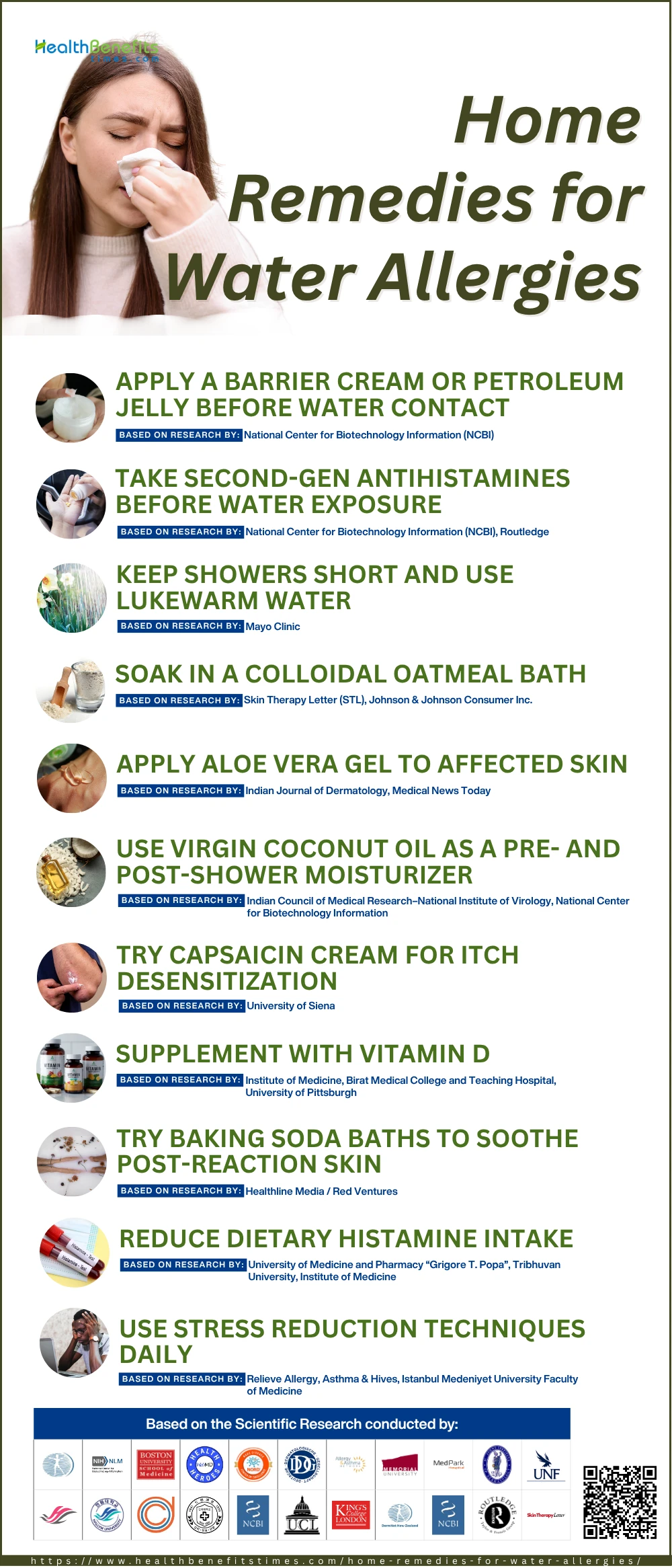 2. Take Second-Generation Antihistamines Before Water Exposure
Over-the-counter antihistamines work by blocking H1 histamine receptors in your skin, essentially putting a padlock on the door that histamine would normally push open to cause hives. Cetirizine (Zyrtec), loratadine (Claritin), and fexofenadine (Allegra) are the most commonly used options, and unlike older antihistamines such as diphenhydramine, they do not cause significant drowsiness. 23 Current international guidelines for chronic urticaria recommend starting at standard doses and escalating up to four times the labeled dose when needed, always under medical supervision. 24 Taking your antihistamine 30 to 60 minutes before planned water exposure gives the medication time to reach peak effectiveness in your bloodstream before your skin is challenged.
3. Keep Showers Short and Use Lukewarm Water
Hot water is a double enemy for your skin, it dilates blood vessels, intensifies itching, strips away your skin’s natural oils, and reduces the effectiveness of your barrier. 25 Limiting your shower to three to five minutes at the coolest comfortable temperature drastically reduces your total water exposure time and the inflammatory response that follows. After you step out, gently pat (never rub) your skin dry with a soft towel, and immediately apply your preferred barrier moisturizer or emollient to lock in hydration before the skin dries completely.
4. Soak in a Colloidal Oatmeal Bath
Oatmeal has been soothing irritated human skin for thousands of years, and modern dermatology has confirmed exactly why it works so well. Colloidal oatmeal is recognized by the U.S. FDA as a skin protectant, and it contains avenanthramides, unique phenolic compounds that inhibit the inflammatory NF-κB pathway and suppress pro-inflammatory cytokines, offering anti-itch effects comparable to 1% hydrocortisone cream. 26 When dissolved in bathwater, it also forms an occlusive film on the skin surface that reduces transepidermal water loss and soothes nerve endings responsible for the itch sensation. 27 For aquagenic urticaria, apply a barrier cream beforehand, keep the bath brief and lukewarm, and use oatmeal primarily as a post-reaction soother rather than a full preventive soak.
5. Apply Aloe Vera Gel to Affected Skin
Right after a reaction, your skin needs something cooling, anti-inflammatory, and non-irritating, and aloe vera delivers all three. The gel extracted from the Aloe barbadensis plant contains active compounds including acemannan, anthraquinones, and polysaccharides that together suppress prostaglandin synthesis, reduce mast cell activation, and calm redness and burning. 28 Applying a generous layer of 100% pure aloe vera gel (free of alcohol, fragrance, and dyes) to hive-affected skin up to three times daily can provide meaningful itch and inflammation relief. 29 Keep your aloe vera in the refrigerator, a cold gel application adds extra soothing benefit via mild vasoconstriction.
6. Use Virgin Coconut Oil as a Pre- and Post-Shower Moisturizer
Virgin coconut oil has earned serious scientific credibility as a skin-care ingredient in recent years. In laboratory studies, it has been shown to suppress key inflammatory markers, including TNF-α, IL-1β, IL-6, and IL-8, by inhibiting lipopolysaccharide-induced inflammation, while simultaneously strengthening the skin’s barrier by increasing the expression of filaggrin and involucrin proteins. 30 A randomized controlled trial comparing virgin coconut oil to mineral oil in pediatric atopic dermatitis found that coconut oil reduced disease severity by 68% versus 38% for mineral oil over an 8-week period, with no adverse events. 31 Apply it as a pre-shower barrier and again immediately after drying off, focusing on areas most prone to reacting.
7. Try Capsaicin Cream for Itch Desensitization
Here is a remedy that sounds counterintuitive but has solid science behind it. Capsaicin, the active compound in chili peppers, works by depleting substance P, the key neuropeptide responsible for transmitting itch and pain signals from your skin’s C-fiber nerve endings to your brain. 32 With repeated topical application, capsaicin eventually desensitizes those nerve fibers so thoroughly that they stop responding to itch triggers. A published study specifically involving five patients with aquagenic pruritus used capsaicin cream at concentrations of 0.025% to 1.0% applied three times daily for four weeks; water contact no longer provoked itching after the treatment period in all five patients. Expect an initial burning sensation for the first few applications, this is normal and decreases over time. Start with the lowest available concentration (0.025%) and always patch-test first.
8. Supplement with Vitamin D
The connection between vitamin D and urticaria is stronger than most people realize. A systematic review and meta-analysis published in a peer-reviewed dermatology journal found that patients with chronic urticaria had a 5.7-fold higher prevalence of vitamin D deficiency compared to healthy controls, and that vitamin D supplementation produced statistically significant reductions in urticaria activity scores. 33 Vitamin D plays a direct role in regulating mast cell function, it promotes mast cell maturation while simultaneously reducing their sensitivity to IgE-mediated activation, essentially turning down the dial on allergic responsiveness. 34 Doses used in clinical trials have typically ranged from 4,000 IU daily to 60,000 IU weekly; however, always get your blood levels tested before supplementing, as both deficiency and toxicity carry health risks.
9. Try Baking Soda Baths to Soothe Post-Reaction Skin
Sodium bicarbonate, plain baking soda, is an alkaline substance that, when added to bathwater, can help neutralize surface pH imbalances on the skin and reduce the burning, itching sensation that follows a water-triggered flare. 35 The Mayo Clinic specifically recommends baking soda baths as a home remedy for itchy hives, suggesting adding half a cup to a lukewarm bath and soaking for 10 to 15 minutes. For aquagenic urticaria, apply your barrier cream before the bath to minimize the reaction, use baking soda to soothe afterward, and always pat dry gently before applying a moisturizer or emollient.
10. Reduce Dietary Histamine Intake
Your body has a total histamine load, the cumulative amount of histamine circulating in your system at any given time. When that load is already high because of the foods you are eating, even a modest additional histamine release from your skin’s mast cells can push you over the threshold into a visible reaction. A low-histamine diet removes or limits aged cheeses, fermented foods (yogurt, sauerkraut, kombucha), cured meats, alcohol, vinegar, and certain fish like tuna and mackerel. 36 A review published in the Journal of the Academy of Nutrition and Dietetics found that reducing dietary histamine lowered overall urticaria activity scores in a subset of patients who had not responded fully to antihistamines alone. 37 Adding quercetin-rich foods, onions, apples, and capers, may offer additional benefit, as quercetin acts as a natural mast cell stabilizer. 38
11. Use Stress Reduction Techniques Daily
Psychological stress does not merely make you feel worse, it biochemically worsens your skin’s reactivity. Stress activates the hypothalamic-pituitary-adrenal (HPA) axis and triggers the release of corticotropin-releasing hormone (CRH), which directly stimulates mast cells to release histamine and other inflammatory mediators, priming your skin for a stronger reaction to water. 39 Clinical research has shown that mindfulness-based stress reduction (MBSR) programs significantly reduce inflammatory cytokine levels and can decrease urticaria severity scores over time. 40 Practices worth integrating into your daily life include yoga, diaphragmatic breathing, progressive muscle relaxation, journaling, and guided meditation, even 15 to 20 minutes per day can create measurable improvements.
Precautions Before Using Natural Remedies
Before you begin applying anything new to your already-sensitive skin, a few protective steps can prevent you from accidentally making your condition worse.
Always patch-test first. Apply a small amount of any new topical remedy, coconut oil, aloe vera, capsaicin cream, colloidal oatmeal, to a discreet area like the inside of your forearm or behind your ear. Wait 24 to 72 hours and monitor carefully for redness, swelling, itching, or any new rash. 41 People with aquagenic urticaria are hyperreactive by nature, and adding a contact allergen on top of an existing condition will only complicate your management.
Check ingredients carefully. Many commercial products labeled as “natural” or “soothing” still contain hidden irritants, alcohol, synthetic fragrance, parabens, and sulfates can all trigger additional skin reactions. Always read the full ingredient list and choose fragrance-free, dye-free, and alcohol-free versions of whatever you apply. 42
Special guidance for children. In pediatric cases, topical barrier creams should always be tried before any oral medication. First-generation antihistamines like diphenhydramine (Benadryl) should be avoided in children under six due to the risk of significant sedation, paradoxical hyperactivity, and respiratory depression. 43 Never give any OTC antihistamine to a baby or child under four without a pediatrician’s explicit guidance on dosing.
Special guidance for pregnant women. Managing urticaria during pregnancy requires particular care because most medications have limited safety data in pregnancy. While second-generation antihistamines like cetirizine and loratadine are generally considered relatively safe based on accumulated clinical experience, no oral antihistamine carries a full safety guarantee for use during the first trimester. 44 The safest strategy during pregnancy is to rely primarily on topical interventions, barrier creams, petroleum jelly, gentle emollients, and discuss any oral medication with your obstetrician before starting. 45
Watch out for “natural but harmful” remedies. Not everything labeled natural is safe. Some probiotic strains actually produce histamine and can worsen urticaria. Certain essential oils, including tea tree oil, lavender in high concentrations, and citrus-based oils, have been documented to cause allergic contact dermatitis, which would compound your existing skin issues. 46 If a remedy worsens your symptoms within 24 hours, discontinue it immediately and note the product for future avoidance.
When You Need to See a Doctor
Home remedies have an important place in managing aquagenic urticaria, but they also have real limits. Knowing when to step beyond home management and seek professional care is critical to your safety.
Seek emergency help immediately if you experience swelling of the tongue, lips, or throat; difficulty breathing; wheezing; dizziness; or a sudden drop in blood pressure after water contact. These are signs of anaphylaxis, a life-threatening systemic allergic reaction that requires epinephrine injection and emergency care. 47 Though anaphylaxis from aquagenic urticaria is rare, it has been reported, and your allergist should evaluate whether you need a prescription epinephrine auto-injector (EpiPen) to carry at all times.
Schedule an appointment with a dermatologist or allergist if antihistamines and barrier creams are no longer providing adequate relief, if your reactions are worsening in frequency or severity, or if your symptoms are significantly interfering with your daily life and mental wellbeing. Prescription options include omalizumab (Xolair), an injectable anti-IgE biologic that has produced complete remission in some aquagenic urticaria patients, and narrowband UVB or PUVA phototherapy, which thickens the stratum corneum and reduces water penetration into the skin over a course of sessions.
Living with a Water Allergy, Practical Day-to-Day Tips
Aquagenic urticaria forces a fundamental rethinking of activities most people take for granted. But with smart planning, many people with this condition live full, active lives.
Keep a waterproof jacket and compact umbrella accessible at all times, especially during rainy seasons. On outdoor exercise days, sweat can trigger reactions in many patients, so choose indoor, climate-controlled environments where possible, take frequent breaks to wipe away sweat, and apply a barrier cream before any vigorous activity. 48
In the kitchen, waterproof gloves worn during dishwashing and food preparation can prevent hand reactions. Some patients also find it helpful to use a straw when drinking to minimize lip exposure to liquids. For facial washing, using micellar water on cotton pads, rather than splashing water directly, can help cleanse the face with minimal triggering. 49
Emotionally, the condition’s impact should never be minimized. The constant need to plan around water exposure creates chronic background anxiety, and many patients experience feelings of social isolation and embarrassment. 50 Seek support through online patient communities, your healthcare provider, or organizations like the National Organization for Rare Disorders (NORD) and the Allergy & Asthma Network, both of which maintain resources specifically for rare urticaria conditions.
Frequently Asked Questions
Can you drink water if you have aquagenic urticaria? Most people with aquagenic urticaria can drink water normally without triggering systemic hives, because the reaction is primarily caused by external skin contact rather than ingestion. That said, a small number of patients do report swelling or tingling inside the mouth or throat after drinking, and using a straw can help minimize lip contact. 51
Is aquagenic urticaria hereditary? While most cases are sporadic with no family history, familial aquagenic urticaria has been documented in case reports involving twins and multi-generational families. No specific genetic mutation has been identified, but a hereditary predisposition may exist in some patients. 52
Can the condition get better on its own? It is possible but not predictable. Aquagenic urticaria tends to be chronic and persistent, though it generally does not worsen progressively over time. Spontaneous remission has been reported in isolated cases, but most patients require long-term management strategies to keep symptoms under control. 53
Are all types of water equally triggering? Generally yes, distilled water, tap water, seawater, and sweat can all provoke reactions. However, in the rarer salt-dependent subtype, reactions only occur when water contains dissolved minerals or salts, meaning distilled water does not trigger a response. 54
Living with a water allergy challenges you in ways most people cannot imagine, but it does not have to take over your life. By layering physical barriers, antihistamines, skin-soothing remedies, and thoughtful daily habits, you can carve out meaningful control over this condition. Stay closely connected with your healthcare team, stay open to new treatment options like biologics, and never underestimate the power of community support in helping you manage what is genuinely one of medicine’s most unusual conditions.
Comments
This article is based on Scientific Research Conducted by following Research Organization:
- Aquagenic urticaria–DermNet, New Zealand
- Herpes Simplex Type 2–National Center for Biotechnology Information (NCBI), United States.
- Aquagenic urticaria: diagnostic and management challenges–Boston University School of Medicine, United States
- What Is Aquagenic Urticaria?–WebMD, United States.
- Aquagenic Urticaria–National Organization for Rare Disorders (NORD), United States.
- Aquagenic urticaria: report of a case and review of the literature
- Aquagenic urticaria: diagnostic and management challenges–Boston University School of Medicine, United States
- Aquagenic cutaneous disorders–German Society of Dermatology (Deutsche Dermatologische Gesellschaft, DDG), Germany
- Aquagenic Urticaria–Allergy & Asthma Network, United States.
- Aquagenic urticaria: presentation, diagnosis and management–Memorial University of Newfoundland Faculty of Medicine, Canada.
- Aquagenic urticaria: Causes, Symptoms, Treatments–MedPark Hospital, Thailand.
- Aquagenic urticaria in twins–St John’s Institute of Dermatology, United Kingdom
- Treatment of aquagenic urticaria with PUVA and astemizole–Dermatology Department, Hospital Virgen de la Arrixaca, Spain
- Can You Be Allergic to Drinking Water?–Institute for Environmental Research and Education, United States
- Aquagenic Urticaria: A Report of Two Cases–Department of Dermatology, South Korea, Kangnam Sacred Heart Hospital, South Korea, Hallym University College of Medicine, South Korea
- 12 Natural Remedies for Hives: When to Seek Help from Urgent Care in Bridgeport, CT–Docs Medical Group, United States
- Aquagenic Urticaria Diagnosed by the Water Provocation Test and the Results of Histopathologic Examination–Inje University College of Medicine, South Korea
- Is a Life Without Water Possible? Aquagenic Urticaria: Report of a Case and Review of the Literature–National Center for Biotechnology Information, United States
- Reinventing the wheal: A review of online misinformation and conspiracy theories in urticaria–University College London (UCL), United Kingdom, King’s College London, United Kingdom
- Aquagenic Urticaria - Diagnosis and Ways to Treat–DermNet New Zealand Trust, New Zealand
- Localized aquagenic urticaria: efficacy of a barrier cream–National Center for Biotechnology Information, United States
- Loratadine–National Center for Biotechnology Information (NCBI), United States
- Loratadine–National Center for Biotechnology Information (NCBI), United States
- An update on the use of antihistamines in managing chronic urticaria–Routledge, United Kingdom
- Home Remedies: Help with itchy hives–Mayo Clinic, United States
- Colloidal Oatmeal use in Dermatology–Skin Therapy Letter (STL), Canada
- Colloidal Oatmeal in the Treatment of Atopic Dermatitis–Johnson & Johnson Consumer Inc., United States
- ALOE VERA: A SHORT REVIEW–Indian Journal of Dermatology, India
- What are the benefits of aloe vera?–Indian Journal of Dermatology, Medical News Today (Healthline Media / Red Ventures), United States
- In vitro anti-inflammatory and skin protective properties of Virgin coconut oil–Indian Council of Medical Research–National Institute of Virology, India
- The effect of topical virgin coconut oil on SCORAD index, transepidermal water loss, and skin capacitance in mild to moderate pediatric atopic dermatitis: a randomized, double-blind, clinical trial–National Center for Biotechnology Information, United States
- Treatment of aquagenic pruritus with topical capsaicin cream–University of Siena, Italy
- Chronic urticaria and vitamin D supplementations: a systematic review–Institute of Medicine, Birat Medical College and Teaching Hospital, Nepal
- Association of Socioeconomic Status with Mortality in Type 1 Diabetes: The Pittsburgh Epidemiology of Diabetes Complications (EDC) Study–University of Pittsburgh, United States
- What are the benefits of a baking soda bath and how to do it–Healthline Media / Red Ventures, United States
- Histamine Intolerance, The More We Know the Less We Know. A Review–University of Medicine and Pharmacy “Grigore T. Popa”, Romania
- Mechanisms of Action of trans Fatty Acids–Tribhuvan University, Institute of Medicine, Nepal
- Overviews of Biological Importance of Quercetin: A Bioactive Flavonoid–National Institute of Agricultural Biotechnology (ICAR-NABI), India
- Can Stress Cause Hives? Understanding the Mind-Skin Connection–Relieve Allergy, Asthma & Hives, United States
- Diagnosis and treatment of urticaria in primary care–Istanbul Medeniyet University Faculty of Medicine, Turkey
- The importance of patch testing skin care products–Medical News Today (Healthline Media / Red Ventures), United Kingdom
- How to test skin care products–American Academy of Dermatology, United States
- Urticaria–Royal Children’s Hospital Melbourne, Australia
- Safety of antihistamines during pregnancy and lactation–Indian Journal of Dermatology, Venereology and Leprology, India
- The relation between antihistamine medication during early pregnancy & birth defects–Elsevier, Netherlands
- Psychological Stress and Chronic Urticaria: A Neuro-immuno-cutaneous Crosstalk. A Systematic Review of the Existing Evidence–Tribhuvan University Institute of Medicine, Nepal
- Anaphylaxis–Mayo Clinic, United States
- What is Aquagenic Urticaria: The Allergy to Water?–MBCP Team, United States
- Can You Be Allergic to Drinking Water?–Institute for Environmental Research and Education, United States
- Antidepressants in paediatric depression: do not look back in anger but around in awareness–National Center for Biotechnology Information, United States
- What to know about aquagenic urticaria–Healthline Media / Red Ventures, United States
- Aquagenic urticaria: What gives you relief?–Mayo Clinic, United States
- What Is Aquagenic Urticaria?–Internet Brands (WebMD Health Corp.), United States
- Aquagenic urticaria: Water, friend, or foe?