| Safflower oil uses and health benefits Quick Facts |
| Name: |
Safflower oil uses and health benefits |
| Origin |
The plant of Safflower is native to India, Mediterranean, Africa and Asia. Its use was recorded before 4000 years. It is introduced as an oil crop in Australia, Turkey, United States and Canada. |
| Colors |
Golden yellow |
| Taste |
Bland |
| Calories |
1927 Kcal./cup |
| Major nutrients |
Total Fat (622.86%)
Vitamin E (495.60%)
Vitamin K (12.92%)
Choline (0.07%)
|
| Health benefits |
Prevent heart problem, Reduce body fat, Treat diabetes, Prevent obesity, Healthy hair |
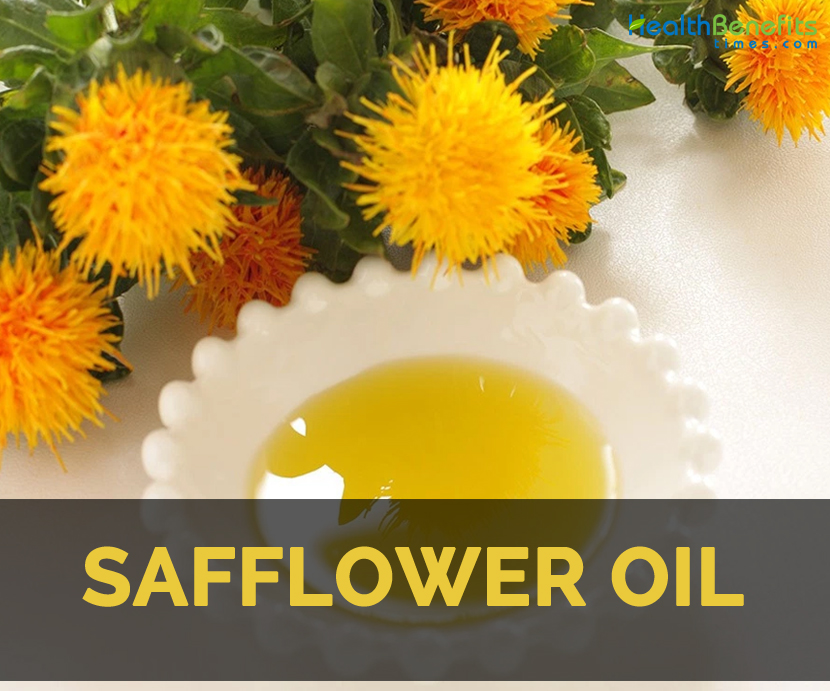
Safflower oil is the oil compressed from the seeds of safflower (Carthamus tinctorius). Safflower is an herbaceous and thistle likes plant which is usually planted to extract the oil from its seeds. Safflower oil is commonly used for frying as well as cosmetic purposes. The world’s largest safflower oil producer is India. The expressed oil is of golden yellow color with slightly nutty and earthy flavor. This oil is colorless and flavorless having nutrients similar to sunflower oil. In recent years, this crop is cultivated in approximately 60 countries around the world and overall yield is about 600000 tons in a year. This oil is a perfect replacement or substitute for other vegetable oil that are less healthy. The safflower oil could be found in two types such as one is high monounsaturated fatty acid and other is high in polyunsaturated fatty acid. Other common names for safflower oil are Alazor, Bastard Saffron, American Saffron, Benibana Oil, Benibana, Benibana Flower, Carthame, Cártamo, Carthame des Teinturiers, Chardon Panaché, Carthamus tinctorius, Dyer’s Saffron, Fake Saffron, Hing Hua, False Saffron, Honghua, Huile de Carthame, Kusumbha, Safflower Nut Oil, Kusum Phool, Safflower Oil, Safranon, Safran Bâtard, Zafran and Zaffer.
History
The plant of Safflower is native to India, Mediterranean, Africa and Asia. Its use was recorded before 4000 years. It is introduced as an oil crop in Australia, Turkey, United States and Canada.
Types of Safflower oil
- Polyunsaturated
The polyunsaturated safflower oil consists of linoleic fatty acids. It is used cold. Due to rich in nutrient content it is considered to be the heart healthy oil.
- Monounsaturated
It is comprised of oleic fatty acids which are usually used for cooking purposes due to high smoking point. It is shelf stable and not healthy as polyunsaturated safflower oil.
Nutritional value
One cup measuring 218 grams of Safflower oil offers 1927 calories and 218 g of total lipid fat. We could also find 0.4 mg of choline, 74.34 mg of Vitamin E, 15.5 µg of Vitamin K, 16.439 g of total saturated fatty acids, 0.203 g of capric acid, 10.595 g of palmitic acid, 4.175 g of stearic acid, 0.837 g of arachidic acid, 0.63 g of behenic acid, 163.982 g of total monounsaturated fatty acids, 0.207 g of palmitoleic acid, 27.948 g of total polyunsaturated fatty acids, 27.738 g of linolenic acid, 0.209 g of total trans-fat, 0.209 g of total trans-monoenoic fat and 968 mg of phytosterols.
Health Benefits of Safflower oil
Safflower oil is loaded with numerous health benefits. It eliminates excess fat, lowers cholesterol level, promotes immunity, regulate menstruation, enhance hair growth and skin health. It is also helpful for the people with diabetes as it lowers the level of blood sugar and eliminates excess fat from the body. In Chinese medicine, it is used for traumatic injuries, pain and amenorrhea. Moreover, it has high content of omega-6 and omega-3 in comparison to other oil. Other health benefits are discussed below in detail:
- Prevent heart problems
Safflower oil helps to improve health conditions such as blood sugar, cholesterol, inflammation and sensitivity of insulin in diabetic patients. It lowers abdominal fat and raise muscle tissues with the daily intake. Safflower oil is related with lowering metabolic syndrome which increases the chances of diabetes and cardiovascular problems. It has linoleic acid which is a polyunsaturated fatty acid. (1)
- Reduce body fat
Safflower oil has conjugated linoleic acid which helps to lower weight in people. The study shows that safflower oil lowered fat in the trunk area, increase muscle tissue and reduce blood sugar. It lowers total body fat and body mass index. The supplement of safflower oil increase lean tissue or muscle and lowered weight of trunk fat tissue. (2)
- Treat diabetes
Safflower has omega-6 fatty acid which helps to manage the level of blood sugar by helping the people with diabetes to maintain their blood sugar. It prevents the chances of diabetes in people. (3)
- Prevent obesity
It is a perfect choice for people who are trying to lose weight. It is rich in omega-6 fatty acids that help to burn fat in the body. It is used for cooking purposes and mostly used by the people with obesity. (4)
- Healthy hair
Safflower oil has high content of oleic acid that is helpful for the hair as well as scalp. It increases the circulation on scalp, strengthens follicles and stimulates hair growth. It makes the hair shiny and vibrant. It is also used in cosmetics. (5)
- Skin health
Safflower oil has high content of linoleic acid that helps to promote the appearance and quality of skin. It unclogs the pores and lowers blackheads and acne in the skin. Moreover, linoleic acid enhances the regeneration of skin cells that clears scars and blemishes of the skin. (6)
- Treat PMS
Menstruation could be uncomfortable and painful. Linoleic acid in Safflower’s oil helps to regulate prostaglandins in body which causes dramatic hormonal symptoms and fluctuations during menstruation. It reduces the severity of PMS symptoms and regulates menstrual cycles. (7)
- Strengthen immunity
Safflower oil regulates prostaglandins functions by supplying omega-6 fatty acids which form prostaglandins. It assists the body for the normal functions such as immune system and prevention of body. (8)
Traditional uses
- It helps to prevent heart disease, stroke and atherosclerosis.
- It is a treatment for tumors, fever, breathing problems, coughs, pain, chest pain, heart disease and traumatic injuries.
- It helps to induce sweating and also loosens phlegm.
- It cures painful menstrual periods.
- It maintains skin, eye health and also lowers inflammation.
- Massage scalp with safflower oil to get shiny and healthy hair.
- The mixture of safflower plant juice and sweetened water provides relief from respiratory problems and constipation.
- It promotes blood circulation, heal fractures and lower phlegm.
- It is used to eliminate whiteheads, blackheads and acne.
- Massage safflower oil to ease muscle and joint pain caused due to arthritis and traumatic injuries.
- It is also used as purgative.
Precautions
- The use of safflower oil by pregnant women could result in miscarriages.
- It could slow down blood clotting.
- People sensitive to ragweed, marigolds, chrysanthemums and daisies might get an allergic reaction with the use of this oil.
- It increases the blood sugar in diabetic people.
- It could cause minor side effects such as nausea, diarrhea, dizziness, vomiting, headaches and loss of appetite.
- Serious side effects such as dyspnea, hyperthermia, chest pain, thrombocytopenia and hyperlipemia might be experienced.
- Overuse of Safflower oil results in diabetes, obesity and cardiovascular problems.
- It might cause gastrointestinal maladies.
- It lowers blood pressure in hypotension patients.
- The excessive use of Safflower oil causes kidney problems.
How to Eat
- It is used for deep frying and dressing salads.
- It could be used in making cakes, cookie and pancakes.
Other Facts
- India is the largest producer of safflower oil commercially.
- It is used as a drying oil in printing.
- It is also used to produce margarine.
- It is used as massage oil, paint solvent and varnish.
- It is used as a dye in cosmetics.
Safflower oil facts
The oil which is made from safflower seeds is called safflower oil. It is clear oil which is used in cooking and salad dressings. It is tolerable to both low and high temperatures. It is used as cooking oil and also for beauty purposes due to healthy fat content. It is rich in linoleic acid which is an omega-6 fats. This oil acts as a potent hydrator and effective for dry and sensitive skin. The hydrating properties in Safflower oil promotes elasticity, glows and lowers the appearance of wrinkles.
| Name |
Safflower oil uses and health benefits |
| Native |
The plant of Safflower is native to India, Mediterranean, Africa and Asia. Its use was recorded before 4000 years. It is introduced as an oil crop in Australia, Turkey, United States and Canada. |
| Common/English Name |
Alazor, Bastard Saffron, American Saffron, Benibana Oil, Benibana, Benibana Flower, Carthame, Cártamo, Carthame des Teinturiers, Chardon Panaché, Carthamus tinctorius, Dyer’s Saffron, Fake Saffron, Hing Hua, False Saffron, Honghua, Huile de Carthame, Kusumbha, Safflower Nut Oil, Kusum Phool, Safflower Oil, Safranon, Safran Bâtard, Zafran, Zaffer |
| Color |
Golden yellow |
| Flavor/aroma |
Slightly nutty, earthy |
| Taste |
Bland |
| Varieties/Types |
- Polyunsaturated
- Monounsaturated
|
| Major Nutritions |
Total Fat (lipid) 218 g (622.86%)
Vitamin E (alpha-tocopherol) 74.34 mg (495.60%)
Vitamin K (phylloquinone) 15.5 µg (12.92%)
Choline 0.4 mg (0.07%) |
| Health Benefits |
- Prevent heart problem
- Reduce body fat
- Treat diabetes
- Prevent obesity
- Healthy hair
- Skin health
- Treat PMS
- Strengthen immunity
|
| Calories in 1 cup (108 gm) |
1927 Kcal. |
| Traditional uses |
- It prevents the risk of heart disease, stroke and atherosclerosis.
- It treats tumors, fever, breathing problems, coughs, pain, chest pain, heart disease and traumatic injuries.
- It loosens phlegm.
- It cures pain during menstrual periods.
- It enhances blood circulation, heals fractures and also lowers phlegm.
- It eliminates whiteheads, blackheads and acne.
- It is also used as purgative.
|
| Precautions |
- The use of safflower oil during pregnancy results in miscarriages.
- It slows down blood clotting.
- Sensitive people might get an allergic reaction.
- It increases the blood sugar.
- Minor side effects such as nausea, diarrhea, dizziness, vomiting, headaches and loss of appetite could be experienced.
- Serious side effects such as dyspnea, hyperthermia, chest pain, thrombocytopenia and hyperlipemia might occur.
- Excessive use results in diabetes, obesity and cardiovascular problems.
- It might cause gastrointestinal maladies.
- It lowers blood pressure.
|
| How to Eat |
- It is used for deep frying and dressing salads.
- It could be used in cakes, cookie and pancake.
|
| Other Facts |
- India is the largest producer of safflower oil.
- It is used as a drying oil for printing.
- It is also used in margarine and cosmetics.
- It is used as massage oil, paint solvent and varnish.
|
References:
http://articles.mercola.com/herbal-oils/safflower-oil.aspx
http://www.livestrong.com/article/169440-what-is-safflower-oil/
http://superhumancoach.com/negative-effects-of-safflower-oil/
http://www.webmd.com/vitamins-supplements/ingredientmono-96-safflower.aspx?activeingredientid=96&
http://www.livestrong.com/article/119366-safflower-oil/
https://funflowerfacts.com/2013/04/10/18-uses-for-safflower/
Comments
comments