Health Benefits
    Facebook Twitter Instagram
    Friday, December 5
    Facebook Twitter Pinterest
    Health Benefits
    • Home
    • Dental Health
    • Mental Health
    • Weight Loss
    • Health Wiki
    • Nutrition
    • Healthy Recipe
    • BMI Calculator
    Health Benefits
    Home»Herbs and Spices»Know about Whiteweed
    Herbs and Spices

    Know about Whiteweed

    By SylviaMarch 7, 2018Updated:March 8, 2018No Comments10 Mins Read
    Facebook Twitter Pinterest LinkedIn Tumblr Email

    Know about Whiteweed

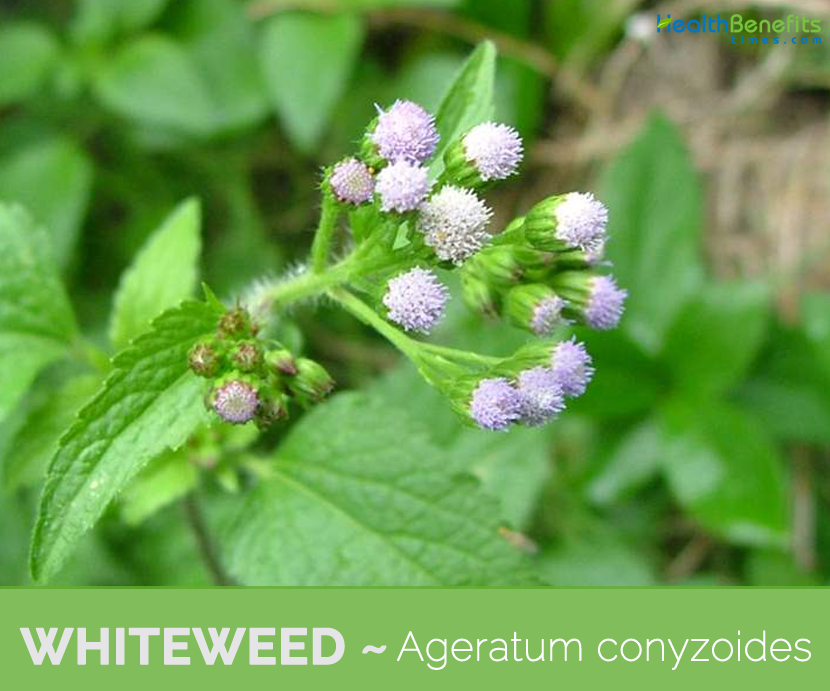
    Whiteweed scientifically known as Ageratum conyzoides is a weed plant belonging to the family Asteraceae and tribe Eupatoriae. The plant is native to Southeastern North America to Central America, but the center of origin is in Central America and the Caribbean. Most taxa are found in Mexico, Central America, the Caribbean, and Florida. Ageratum conyzoides now is found in several countries in tropical and sub-tropical regions, including Brazil.  Other common names of the plant are Ageratum, Appa Grass, Bastard Agrimony, Billygoat-Weed, Blue Top, Chick Weed, Cocks Sticks Plant, Conyzoid Floss Flower, Floss Flower, Goatweed, Mother Brinkly, Tropic Ageratum and Winter Weed. Ageratum is derived from the Greek words ‘a geras’, meaning non-aging, referring to the longevity of the whole plant. Conyzoides on the other hand is derived from ‘konyz’ the Greek name of Inula helenium which the plant resembles. In Vietnamese, the plant is called cứt lợn due to its growth in dirty areas. This family is well marked in their characteristics and cannot be confused with any other.

    Plant Description

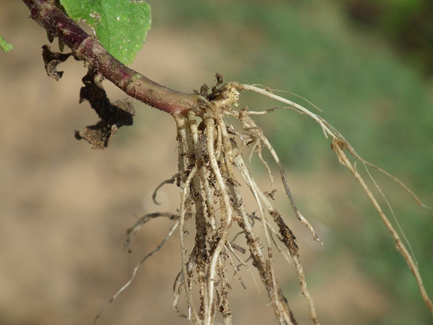
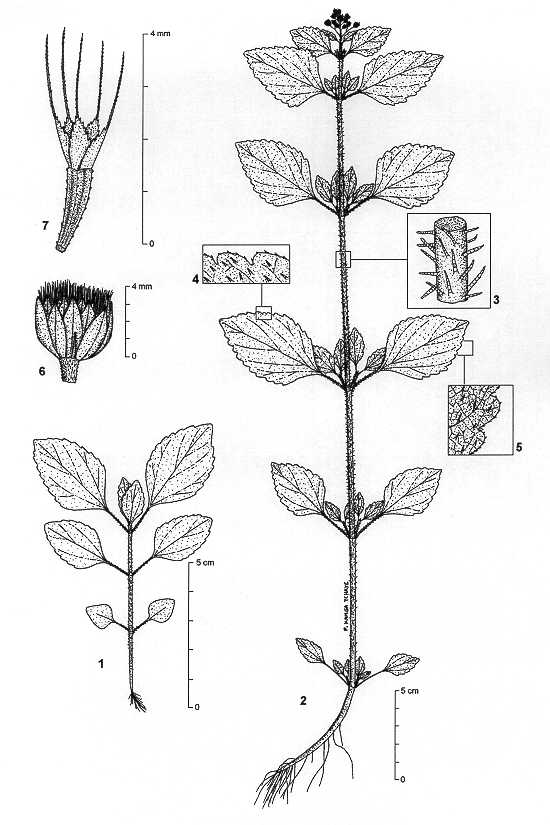
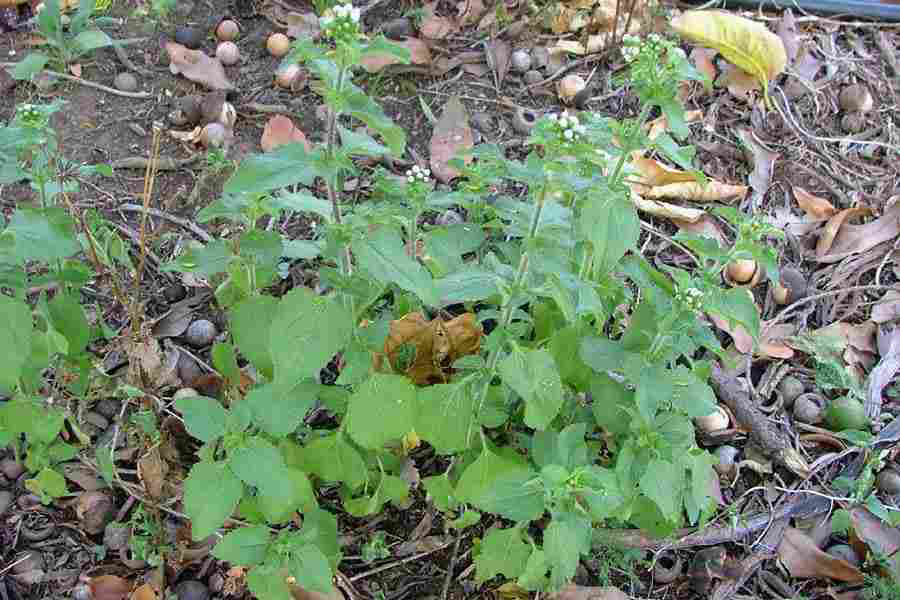
    Whiteweed is an erect, pubescent, aromatic, slender, annual herb that grows about 15–100 cm high. The plant is found growing in grasslands, forests, wastelands, clearings, roadsides, riparian zones, wetlands, coastal dunes, degraded pastures and rapidly colonizes cultivated areas. The plant thrives best in rich, moist, mineral soils in areas with high air humidity and tolerates shade. The plant has shallow, fibrous roots.

    Leaves

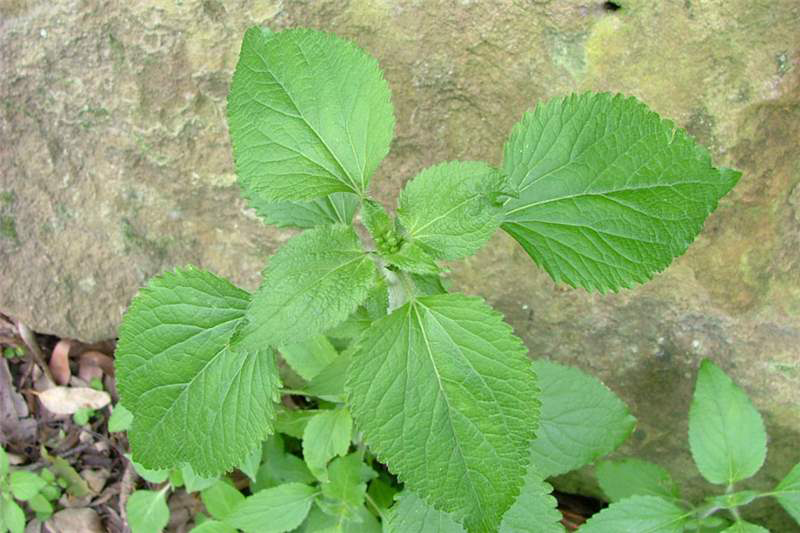
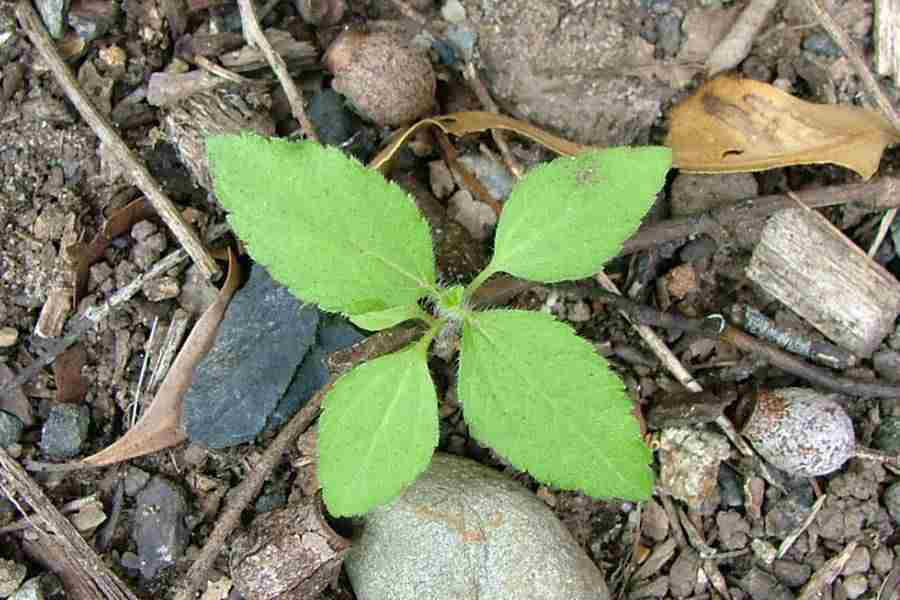
    Leaves are opposite, 20-100 mm long, 5-50 mm wide, on hairy petioles 5-75 mm long, broadly ovate, with a rounded or narrowed acute base and an acute or obtuse or sometimes acuminate tip and toothed margins. Both leaf surfaces are sparsely hairy, rough with prominent veins and when crushed the leaves have a characteristic odor which is reminiscent of the male goat.

    Flower & Fruit

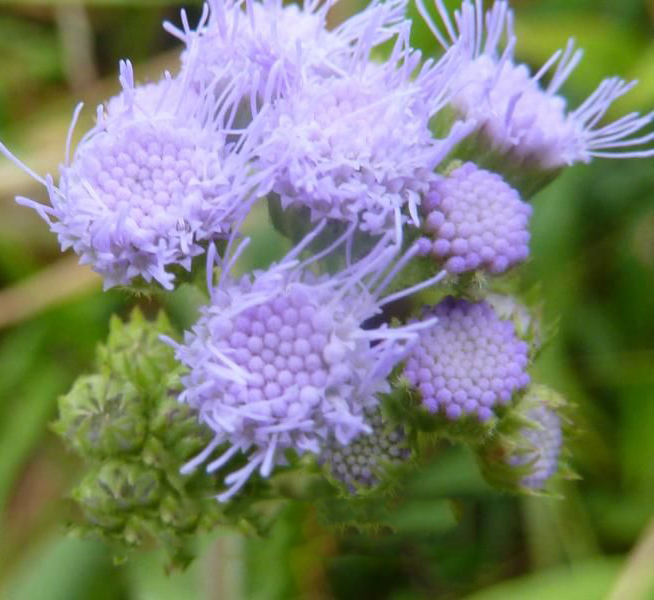
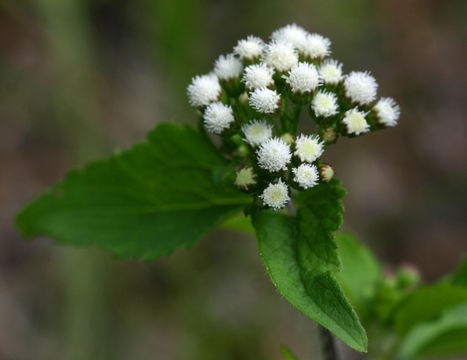
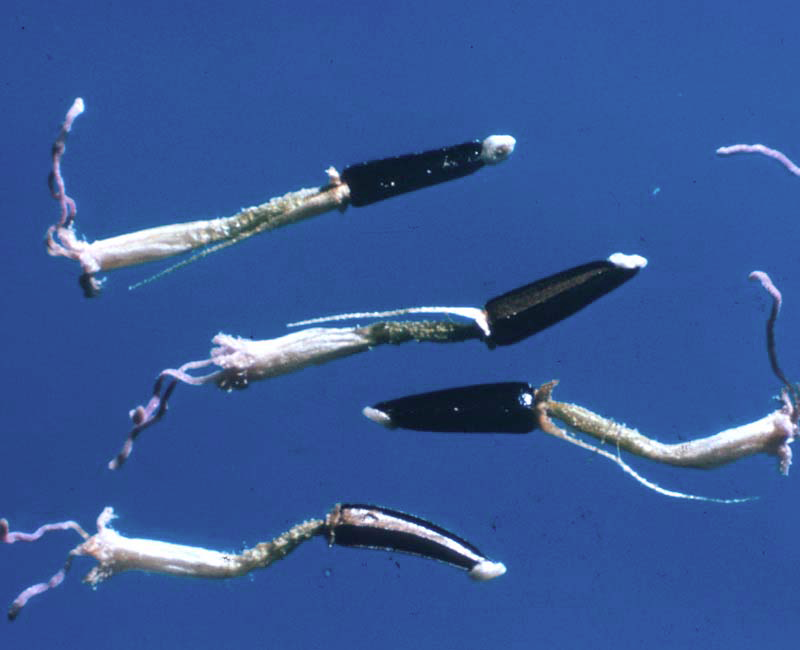
    The plant has branched; terminal or axillary inflorescence bears 4-18 flower heads arranged in showy, flat-topped clusters. Individual flower heads are light blue, white or violet, are carried on 50-150 mm long peduncles and are 5 mm across, 4-6 mm long with 60-75 tubular flowers. The flower head is surrounded by two or three rows of oblong bracts which are green with pale or reddish-violet tops. The bracts are 3-5 mm high, outer ones 0.5-1.75 mm wide, sparsely hairy, evenly toothed in the upper part, with an abruptly acuminate, acute tip. Flowers are 1.5-3 mm long and scarcely protrude above the bracts. Flowering normally takes place from Jul to September. Flowers are followed by ribbed or angled, black achene, 1.25-2 mm long, roughly hairy, with a pappus of 5, rarely 6, rough bristles, 1.5-3 mm long with upward turning spines. A large majority of the plants in the family are herbaceous while trees and shrubs are comparatively rare. Different parts of the plant are used in several traditional medicines.

    Whiteweed Image Gallery
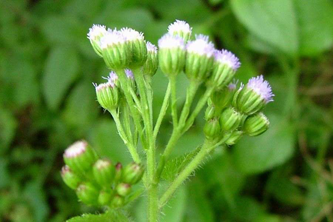
    Buds-of-Whiteweed Buds-of-Whiteweed
    Closer-view-of-Whiteweed-flower Closer-view-of-Whiteweed-flower
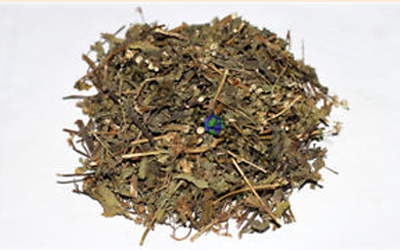
    Dried-Whiteweed-plant Dried-Whiteweed-plant

    Flower-of-Whiteweed-plant Flower-of-Whiteweed-plant
    Leaves-of-Whiteweed Leaves-of-Whiteweed
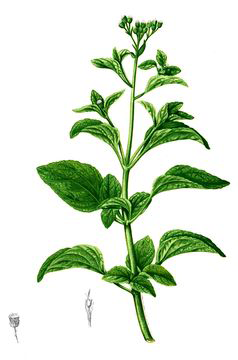
    Plant-Illustration-of-Whiteweed Plant-Illustration-of-Whiteweed

    Roots-of-Whiteweed-plant Roots-of-Whiteweed-plant
    Sketch-of-Whiteweed-plant Sketch-of-Whiteweed-plant
    Small-Whiteweed-plant Small-Whiteweed-plant

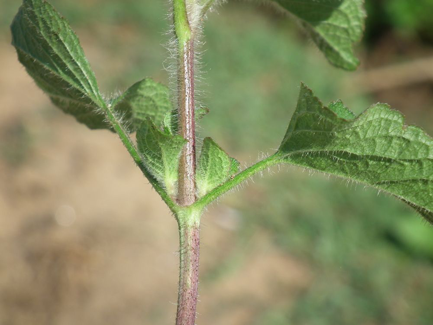
    Stem-of-Whiteweed-plant Stem-of-Whiteweed-plant
    Whiteweed-Plant-growing-wild Whiteweed-Plant-growing-wild
    Whiteweed-seed-close-up Whiteweed-seed-close-up

    Traditional uses and benefits of Whiteweed

    • Infusion is used for treating sore throats, colic, atony of the digestive tract, and as a tonic.
    • Infusion are also used for reducing a high temperature.
    • Mucilaginous leaves are mashed and the juice used to calm a sore throat and for colds; concentrated decoction for chiggers; infusion is diuretic and anti-diarrheic; emollient.
    • Leaves are put in water and the liquid is drunk for body itches, the so-called “faja skin” or “fafa skieng”.
    • Leaves are crushed and applied to heal open wounds.
    • Whole plant is anti-inflammatory and anti-allergic.
    • Juice of the fresh plant, or an extract of the dried plant, is used in the treatment of allergic rhinitis and sinusitis.
    • Juice of the fresh plant is also useful in treating post-partum uterine hemorrhage.
    • Juice of the root is antilithic.
    • Paste of the root, mixed with the bark of Schinus wallichii, is applied to set dislocated bones.
    • Leaves are dried and applied as a powder to cuts, sores and the ruptures caused by leprosy.
    • An effective cure for most cuts and sores, though it does not affect a complete cure for leprosy.
    • Leaves are also used externally in the treatment of ague.
    • Juice of the plant is used to treat cuts, wounds and bruises.
    • Paste of the leaves is used as a poultice to remove thorns from the skin.
    • Paste made of the leaves mixed with equal amounts of Bidens pilosa, Drymaria cordata, Galinsoga parviflora and the rhizome of Zingiber officinale is used to treat snakebites.
    • Juice of the flower heads is used externally to treat scabies, whilst a paste of them is used to treat rheumatism.
    • Tea made from the flower heads mixed with Ocimum tenuifolium is used to treat coughs and colds.
    • Decoction of the fresh plant is used as a hair wash, leaving the hair soft, fragrant and dandruff free.
    • Ageratum conyzoides was reported as one of several plant species used for prostate problems in folkloric ethno medicine in Trinidad and Tobago.
    • Ageratum conyzoides is a plant used in traditional medicine for mental and infection diseases, cephalgia, dyspnea, enteralgia and fever.
    • conyzoides leaves were reported to be used externally to heal wounds, cuts, scratches or itches and internally, decoctions of roots are taken for treating coughs by the Temuan tribe in Ulu Langat, Selangor, Malaysia.
    • Decoctions obtained from boiling whole plant parts were used to treat asthma, while leaves obtained from white-flowered types of this species were used to alleviate toothache.
    • In Peninsular Malaysia, the Malays poultice wounds externally with the leaves, which have been heated and oiled.
    • For itch, a poultice of the leaves mixed with those of Phyllanthus pulcher or Justicia is used.
    • Pounded plant material is applied to the abdomen of children for severe diarrhea.
    • Plant decoction is used for fever and dysentery.
    • Plant has also been reported to be used for urinary disorders.
    • In Java, the leaves are used as a paste mixed with chalk for wounds and a paste of the roots rubbed on the body for fever in Java.
    • Crevost and Petelot reported that the Annamites apply a poultice of the leaves to the hair.
    • Ageratum conyzoides is used to treat inflammation of the nose, dropsy, wound pimples, eczema and postpartum hemorrhage and to regulate menses allergic sinusitis in Vietnam.
    • Juice of the fresh leaves is pounded, mixed with salt and used as vulnerary in Philippines.
    • Sometimes the leaves are cooked in coconut oil and the medicated oil is applied to wounds.
    • Boiled decoction of stem, roots and flowers are used for stomach disorders.
    • Plant decoction is used for cough, colds, fever, skin disease and high blood pressure.
    • Plant is used for bleeding due to external wounds, furuncle, eczema, carbuncle and as poultices for headaches.
    • Plant juice is dropped into the ear to treat otitis media.
    • Masango people eat the leaves with cola fruit and salt to treat pain in Gabon.
    • Leaves are used to treat cuts and wound, fever, painful menstruation.
    • Leaves cooked in palm oil are taken as remedy for sexually transmitted diseases.
    • conyzoides is used to treat fever, measles, postpartum hemorrhage and snake bites in Benin.
    • It is used for skin diseases; wound healing, diarrhea and pain associated with navel in children in Nigeria.
    • Leaf decoction is used to treat human immunodeficiency virus (HIV)/AIDS in Nigeria.
    • Leaves juice/extract/decoction are used to treat headache, rib pain, intercostal pain, body side pain, asthma and inflammatory disorders like rheumatism and arthritis and macerated whole plant is used for treating dyspnea in republic of Congo.
    • Plant is used to treat abdominal pain in Ivory Coast.
    • Ageratum conyzoides was used to treat epilepsy by traditional healers in Tanzania.
    • Leaves are used as a diuretic in urinary diseases, and in Mauritius, the leaves are used to treat diarrhea, skin infection and gas in the stomach in Mauritius and Rodrigues.
    • Leaves are used for Candida body infection and grounded leaves mixed with Shea butter as an ointment are used to massage inflamed painful area in the neck in Kwara State, central Nigeria.
    • Plants were commonly used for dermal or digestive problems and fever/malaria.
    • Tribals of Bangangte in Western Cameroon employed the juice from the plant for peptic ulcer.
    • Leaves are used in tea for diarrhea and the leaf sap is used as a coagulant in Madagascar.
    • Plant is used to treat wounds and burns in India and Central Africa.
    • Leaf juice is used to treat eye diseases, macerated leaves used as antiseptic for wounds to stop bleeding and hemorrhagic diarrhea, mycotic skin infection, furuncle, eczema, and carbuncle in Kenya.
    • Leaf and root decoctions are used for coughs; and root decoctions used for chest pains.
    • Leaves and roots are used for headache; leaves are used for intercostal rib pain and side-body pain, asthma and anti-inflammatory problems in Republic of Congo.
    • Macerated plant is used for dyspnea.
    • Grounded leaves are used for infectious diarrhea, fever, malaria and nausea; aerial plant parts are used for giddiness and postpartum hemorrhage in Benin.
    • Plant extract is drank as a remedy for cough in Northwest Argentina.
    • Aerial plant part infusion is used in the treatment of diabetes in Mexico.
    • It has been used in Brazilian folk medicine to treat various ailments such as Metrorrhagia, fevers, dermatitis, inflammation, arthritis, rheumatism, diarrhea and diuretics.
    • Flowers and leaves are used in the form of an infusion for their analgesic and anti-inflammatory properties.
    • Plant is used as an analgesic and anti- inflammatory in Brazil.
    • Leaves are used to treat malaria and yellow fever.
    • Aerial parts are used as a tonic, stimulant and emenagogue.
    • Plant is used to treat leprosy and the essential oil is sued as lotion for purulent ophthalmia in India.
    • In India, the tribals of Sonaghati of Sonbhadra district, Uttar Pradesh, used the plant to treat tumour and swelling and as an antidote to snakebite and stings.
    • Leaf sap is applied on fresh cuts in Nepal.
    • Leaves are applied to cuts and wounds for anti-hemorrhagic and antiseptic properties.
    • Leaves and aerial parts for cuts, wounds and to treat stomach upset.
    • Juice of the fresh plant or an extract of the dried plant is used in the treatment of Sinusitis.
    • Juice also treats post-partum uterine hemorrhage.
    • Paste of flower heads treats rheumatism.

    Ayurvedic health benefits of Whiteweed

    • Epilepsy: Extract the juice from the leaves of Goat weed. Add ¼ tbsp of common salt. Put a drop in both the nostrils once a day.
    • Wounds: Extract the juice of Goat weed leaves and apply at wounds.
    • Jaundice: Extract the juice of fresh goat weed leaves. Have it two times a day.
    • Erectile Dysfunction: Make a decoction of Goat weed plant. Drink 5 ml of it twice a day.

    Culinary Uses

    • Fragrant flowers and foliage are used for scenting edible coconut oil in the southeastern Polynesia.
    • Leaves are eaten in a soup called ‘olulu-ogwai’ by the Igbo communities in Nigeria.

    Other Facts

    • Stems and leaves covered with fine white hairs.
    • In Hawaii and Polynesia, the fragrant flowers are used for leis, scent and medicine.
    • Plant has potential to be used as a biocontrol agent to control weeds, agricultural and veterinary insect pests and plant diseases.
    • Leaves and the flowers yield 0.2% essential oil with a powerful nauseating odor.
    • Decoction of the fresh plant is used as a hair wash, leaving the hair soft, fragrant and dandruff free.
    • Tannin extracts of goatweed showed insecticidal activity against flour beetles.

    Precautions

    • Ingesting A. conyzoides can cause liver lesions and tumors.
    • Essential oil of the plant was toxic to the adults of the cowpea weevil.
    • Pregnant and breast feeding women should avoid using Whiteweed.

    References:

    https://www.itis.gov/servlet/SingleRpt/SingleRpt?search_topic=TSN&search_value=36481#null

    https://davesgarden.com/guides/pf/go/54661/

    http://www.hear.org/pier/species/ageratum_conyzoides.htm

    https://npgsweb.ars-grin.gov/gringlobal/taxonomydetail.aspx?id=103793

    https://www.pfaf.org/user/Plant.aspx?LatinName=Ageratum+conyzoides

    https://www.cabi.org/isc/datasheet/3572

    https://plants.usda.gov/core/profile?symbol=AGCO

    http://www.theplantlist.org/tpl1.1/record/gcc-114457

    https://herbpathy.com/Uses-and-Benefits-of-Ageratum-Conyzoides-Cid2690

    https://en.wikipedia.org/wiki/Ageratum_conyzoides

    http://www.iucngisd.org/gisd/species.php?sc=1493

    http://issg.org/database/species/ecology.asp?si=1493&fr=1&sts=&%20ang=EN&ver=print&prtflag=false

    https://www.hort.purdue.edu/newcrop/proceedings1999/v4-469.html

    74%
    74%
    Awesome

    Comments

    comments

    Herbs and Spices W
    Share. Facebook Twitter Pinterest LinkedIn Tumblr Email
    Previous ArticleKnow about the Daisy
    Next Article Know about the Cornflower

    Related Posts

    Uses of Monkey Pitcher plant

    April 16, 2024

    Traditional uses and benefits of Wild Marigold

    March 21, 2024

    Traditional uses and benefits of Drooping fig

    March 12, 2024

    Comments are closed.


    Whiteweed Facts

    Whiteweed Quick Facts
    Name: Whiteweed
    Scientific Name: Ageratum conyzoides
    Origin Tropical Central and South America especially Brazil
    Colors Black
    Shapes Ribbed or angled, black achene, 1.25-2 mm long, roughly hairy, with a pappus of 5, rarely 6, rough bristles, 1.5-3 mm long with upward turning spines
    Taste Bitter, pungent
    Health benefits Treat rheumatism, fever, dysentery, inflammation of the nose, dropsy, wound pimples, eczema and postpartum hemorrhage
    Name Whiteweed
    Scientific Name Ageratum conyzoides
    Native Tropical Central and South America especially Brazil
    Common Names Ageratum, Appa Grass, Bastard Agrimony, Billygoat-Weed, Blue Top, Chick Weed, Cocks Sticks Plant, Conyzoid Floss Flower, Floss Flower, Goatweed, Mother Brinkly, Tropic Ageratum, Whiteweed, Winter Weed
    Name in Other Languages Arabic: Borgoman, birujman (burjman) (برجمان (بُرجمان), ruqan ( burqan) (رقان ( بُرقانْ), burkan (birkan) (بركان (بِركان), karanak (kurink) (كرنك (كُرِنْك), Berquam, Korink               
    Afrikaans: Indringer ageratum
    Bangladesh : Oochunti, Dochunti, Fulkuri, Monipuizza Kher, Achunai, Chunachu Appa, Submenum
    Benin : Kourotoko, Serekpèki, Azongbiwa, Ewé Arougbo, Olokopla, Olokokpè
    Bikol: Kulong-kogong-babae
    Bontoc: Budbuda, kakalding
    Brazil: Agerato, camará apeba, camará iapó, camará jape, camara opela, catinga de barao, catingo do bode, erva de Santa Lucia, erva de Santa Maria, erva de Sao Joao, erva de Sao Jose, macela francesa, maria preta, mentrasto, pica roxo
    Cameroon : Nyada Elog
    Colombia: Yerba Hemostatica, manrubio
    Chamorro: Mhéguefa, Tchounamo, Ghé Guefa, Ntotoo, Mumutung, Nyada Eleog
    Chinese: Sheng Hong Ji (胜红蓟), 藿香蓟, huo xiang ji
    Chuukese: Amshiip, olloowaisiip, ololopon, omusiip, opolopon, oponupon
    Cuba: Celestina azul; celestina blanca; lora; moratoria
    Czech : Nestařec Hnidákovitý
    Dominican Republic: Rompezaragüey; yerba de chivo
    East Africa: Adwolo, gathenge (Kikuyu), kimavi cha kuku (Kiswahili)
    El Salvador: Hierba de perro, mejorana, Sunsumpate
    English: Billygoat-plant, Billygoat-weed, Bluebonnet, Bluetop, Goatweed, Appa grass, Bastard agrimony, Floss Flower, Flossflower, Invading ageratum, tropical whiteweed, White weed, Yerba de Cabrio, Ageratum, Mother Brinkly, tropic ageratum, whiteweed, winter weed
    Fijian: Botebotekoro, mata mothemothe, mbotembotekoro, sogovanua, songovanua
    Filipino: Bahu-bahu, bahug-bahug
    French: Ageratum fausse conyze, Azier François, Bouton, baume, baume blanc, baume mauve, herbe de bouc, bouton blan, bouton ble, eupatoire bleue, herbe a femme, herbe a pisser, herbe a sorcier, pain doux, petit pain doux, zerisson blanc, Agérate, Agerate Conyzoid, Célestine
    French Guiana: Azier francois, ponclit, radie francois, raguet-francois
    French Polynesia: Maire vaihi, miri
    Gabon : Komba, Misi-Ma-Mbya, Nya-Mésidè, Pôta-Mbwandi, Gimbu-Gya-Mukunga, Mambi- Ma- Taba, Kumba, Mondjili- Ndjili, Marufi -Ma-Taba, Fumele, Kéngé-Kengé, Misi-Mè-Mbwè, Kumba-Djuma, Burungu, Okè-Kông, Mékwa-Me- Kông, Mekwè-Me-Kông, Tombi-Djoro, Komba-A-Gévindji, Fumangha, Komba-A-Gévindji, Aludo-Féya, Tombi- Djoro, Tombé-Djoro, Tombi-Djoro
    Gambia: Gobu, jambo-serila
    Germany: Leberbalsam, Dürrwurzähnlicher, Mexikanischer Leberbalsam
    Ghana: Efoe momoe
    Guam: Mumutung
    Guatemala: Flor noble, mejoran chaparro, mejorana
    Hawaiian: Maile hohono, maile honohono, maile kula, Meie Parari, Mei Rore
    Hindi: Visadodi
    Honduras: Cola de alacrán, flor azul, garrapata, hierba de pollo, mozotillo, verbena
    Hungarian : Agerátum, Kisfészkű Bojtocska
    Ibatan: Kamabuag
    India:

    • Assamese: Gendelabon
    • Bengali: Dochunti, Dochunty, Uchunti
    • Hindi: Bhakumbar, Dochuntry, Gha Buti, Jangli Pudina, Semandulu,
    • Uchauty, Visadodi
    • Kannada: Helukasa, Naayi Thulasi, Oorala Gida, Ooralada Gida
    • Malayalam: Appa, Kattappa, Muriyan Pacca
    • Manipuri: Khongjai Napi
    • Marathi: Ghanera Osaadi, Ghaneraosadi, Osaadi, Vosadi
    • Mizoram: Vaihlenhlo, Vailenhlo, Voilenhlo
    • Oriya: Vaihlenhlo, Voilenhlo, Pokasunga
    • Sanskrit: Visamustih
    • Tamil: Appakkoti, Pumpillu, Pumppillu, Pumpul
    • Telegu: Pokabanthi, Pokapanthi Povu

    Indonesia: Babadota, bandotan, berokan, dus-bedusan, wedusan, Jukut Bau, Ki Bau
    Italy: Agerato, celestina
    Japan: Kakkoazami
    Kenya : Mucuki Wa Ngigi, Ilusa, Ilusa, Oluoro-Chieng, Orianyacha, Nasirundu, Kundambara
    Kwara‘ae: Belohanua
    Laos : Nia Kee Lo
    Mangarevan: Miri
    Malayalam: Appa, Kattappa, Kumminnipacha, Murianpacha, Pokasunga
    Malaysia: Herbe de bouc, Ara Batu, Bunga Lebeh Tikus, Daun Misai Kucing, Rumput Jalang, Rumput Pereh Jarang, Rumput Sekedok, Rumput Tahi Ayam, Selasih Dandi, Senorang Kambing, Si Anggit,
    Tahi Anjing, Tahi Asu, Tambok- Tambok Jantan, Uda Buda
    Mauritius: herbe de bouc
    Mexico : Hierba Dulce
    Micronesia, Federated states of: Amshiip, olloowaisiip, ololopon, omusiip, opolopon, oponupon, pokaniko, pwisehnkou, uárong nga lípesedj
    Nauruan: Bwiyat tsige, bwiyat ziege
    Niuean: Sekose sea, tekote tea
    Netherlands: Ageratum
    Nigeria: Imiesu, Tamasondji bata, Akwokwo-Nwaosi, Niaika, Ufu Opioko, Otogo, Imi-Esu, Imi-Ewure
    Other: Uárong nga lípesedj
    Peru: Huarmi
    Philippines: Asipukpuk, bahu-bahu, bahug-bahug, budbuda, bulak-manok, kakalding, kamabuag, kolokong-kabanyo, kulong-kogong-babae, singilan, Pagpagai, Taindikaldi, Budbuda, Siñgilan , Kamumnuag, Asipukpuk, Damong-Pallas, Kolong-Kabayo
    Puerto Rico: Mentastro, yerba de cabrío
    Palauan: Agmak, agmakk, ngmak
    Pangasinan: Asipukpuk
    Pingelapan: Pokaniko
    Pohnpeian: Pusen-koh, pwisehnkou
    Polish : Żeniszek
    Polynesia : Meie Parari
    Portuguese: Mentrasto, catinga-de-bode, erva-de-São-José, picão-roxo
    Quichua: Huarmi
    Republic of Congo : Mudiadianga, Founkou Mpala, Konko, Lounvouvou, Tsouampari
    Republic of Guinea : Furu-Furu Kungbèlen, Kiikala Purèl, Nyoge Nyaakhi
    Samoan: Lau tae‘oti, lau tae‘oti, tae‘oti, A’Amia
    Spanish: Chuva, hierba de dolor, huarmi, hierba de chucho, hierbe de perro, barba de chivo; catinga de bode; hierba del perro; hierba del zorro; hierbe de chivo
    South Africa: Bokkruid, indringer-ageratum, invading ageratum
    Suriname: Bokkeruid, bokki boontje, boko-boko-wiwiri, weti hedem, wetie ete, wit ede
    Swahili : Kimavi Cha Khuku, Kundambara
    Swedish: Läkeageratum, Maile Kula
    Tamil: Pampillu
    Tagalog: Bulak-manok, kolokong-kabayo
    Tahitian: Maire vaihi
    Taiwan: Hwo-hsiang-ji
    Tanzania : Kyabakiriao, Matawana
    Thailand: Saapkaa, thiam mae hang, ya-sap-raeng, ya-tabsua, Saap Raeng Saap Kaa, Yaa Saap Haeng, Thiam Mae Haang, Yaa Saap Raeng, Tapsuea Lek
    Tongan: Te‘ehosi
    Uganda: Nnamirembe, Otikidiel
    USA: Kamabuag, tropic ageratum
    USA/Hawaii: Maile hohono, maile honohono, maile kula
    Vietnam: Bạch Hoa Hương Thảo, Bông Thúi, Bù Xích, Bù Xít, Cây Cứt Lợn, Cây Ngũ Sắc, Cây Ngũ Vị, Cỏ Cứt Heo, Cỏ Cứt Lợn, Cỏ Hôi
    West Africa : Nri-Ewu, Imieshu, Kianzi,
    Yarnigbei ( Yoruba )
    Yapese: Lamër ne pan ni pin
    Zaire : Kikongo Mpota Ka Saku, Nkaya Bekia Kwa Nsey
    Zambia: Kabalakila, kafwaya, nthongola, ntongola
    Zimbabwe: Jerimani, nyani

    Plant Growth Habit Erect, pubescent, aromatic, slender, annual herb
    Growing Climate Grasslands, forests, wastelands, clearings, roadsides, riparian zones, wetlands, coastal dunes, degraded pastures and rapidly colonizes cultivated areas
    Soil Thrives best in rich, moist, mineral soils in areas with high air humidity and tolerates shade
    Plant Size 15–100 cm high
    Root Shallow, fibrous roots
    Leaf Opposite, 20-100 mm long, 5-50 mm wide, on hairy petioles 5-75 mm long, broadly ovate, with a rounded or narrowed acute base
    Flowering Periods Jul to September
    Flower Individual flower heads are light blue, white or violet, are carried on 50-150 mm long peduncles and are 5 mm across, 4-6 mm long with 60-75 tubular flowers.
    Fruit Shape & Size Ribbed or angled, black achene, 1.25-2 mm long, roughly hairy, with a pappus of 5, rarely 6, rough bristles, 1.5-3 mm long with upward turning spines.
    Fruit Color Black
    Taste Bitter, pungent
    Plant Parts Used Whole Plant

    Whiteweed Scientific Classification

    Scientific Name: Ageratum conyzoides

    Rank Scientific Name & (Common Name)
    Kingdom Plantae (Plants)
    Subkingdom Tracheobionta (Vascular plants)
    Infrakingdom Streptophyta  (land plants)
    Superdivision Embryophyta
    Division Tracheophyta  (vascular plants, tracheophytes)
    Subdivision Spermatophytina  (spermatophytes, seed plants, phanérogames)
    Class Magnoliopsida
    Superorder Asteranae
    Order Asterales
    Family Asteraceae  (sunflowers, tournesols)
    Genus Ageratum L. (whiteweed, ageratum)
    Species Ageratum conyzoides L. (tropical whiteweed)
    Synonyms
    • Ageratum album Hort.Berol.
    • Ageratum album Hort.Berol. ex Hornem.
    • Ageratum album Steudel
    • Ageratum album sp. steudel
    • Ageratum arsenei B.L.Rob.
    • Ageratum brachystephanum Regel
    • Ageratum ciliare Lour.
    • Ageratum coeruleum Desf.
    • Ageratum conyzoides f. album (Willd.) B.L.Rob.
    • Ageratum conyzoides f. conyzoides
    • Ageratum conyzoides f. obtusifolia (Lam.) Miq.
    • Ageratum conyzoides subsp. latifolium (Cav.) M.F.Johnson
    • Ageratum conyzoides var. conyzoides
    • Ageratum conyzoides var. hirtum (Lam.) DC.
    • Ageratum conyzoides var. inaequipaleaceum Hieron.
    • Ageratum conyzoides var. obtusifolium (Lam.) DC.
    • Ageratum conyzoides var. pilosum Blume
    • Ageratum cordifolium Roxb.
    • Ageratum hirsutum Lam.
    • Ageratum hirsutum Poir.
    • Ageratum hirtum Lam.
    • Ageratum humile Larran.
    • Ageratum humile Salisb.
    • Ageratum latifolium Cav.
    • Ageratum latifolium var. galapageium B.L.Rob.
    • Ageratum latifolium var. latifolium
    • Ageratum muticum Griseb.
    • Ageratum nanum Sch.Bip.
    • Ageratum obtusifolium Lam.
    • Ageratum odoratum Bailly
    • Ageratum odoratum Vilm.
    • Ageratum pinetorum (L.O.Williams) R.King & H.Rob.
    • Ageratum sandwicense H.Lév.
    • Ageratum suffruticosum Regel
    • Alomia coelestina (Regel) B.L.Rob.
    • Alomia microcarpa f. torresii Standl.
    • Alomia pinetorum L.O.Williams
    • Cacalia mentrasto Vell.Conc.
    • Caelestina microcarpa Benth. ex Benth.
    • Caelestina suffruticosa Sw.
    • Caelestina suffruticosa Sweet
    • Carelia brachystephana (Regel) Kuntze
    • Carelia conyzoides (L.) Kuntze
    • Carelia conyzoides var. alba Kuntze
    • Carelia conyzoides var. coerulea Kuntze
    • Carelia conyzoides var. robusta Kuntze
    • Carelia mutica (Griseb.) Kuntze
    • Eupatorium conyzoides (L.) E.H.Krause
    • Eupatorium paleaceum Sesse & Mocino
    • Phalacraea coelestina Regel
    • Piqueria coelestina (Regel) Hieron.
    • Sparganophorus obtusifolius Lag.
    Categories
    • Beverages (78)
    • Dairy (28)
    • Dental Health (15)
    • Equipment (5)
    • Essential OIls (196)
    • Facts (2,939)
    • Foods (255)
    • Fruits (516)
    • Giveaway (1)
    • Grains and Cereals (36)
    • Health & Beauty (763)
    • Herbs and Spices (1,249)
    • Medicines (9)
    • Mental Health (19)
    • Nutritional value (27)
    • Nuts and seeds (73)
    • Oils (81)
    • Pets (4)
    • Poultry & Seafoods (67)
    • Pulses and Beans (16)
    • Reviews (25)
    • supplement (2)
    • Vegetables (304)
    • Weight Loss (22)

    What is Lupin Bean Flour?

    Science Backed Health Benefits of Durian (Durio zibethinus)

    Science Backed Health Benefits of Feijoa (Pineapple Guava) (Acca sellowiana)

    Science Backed Health Benefits of Gac Fruit (Momordica cochinchinensis)

    Science Backed Health Benefits of Amaranth Leaves (Amaranthus spp)

    Science Backed Health Benefits of Arrowhead (Sagittaria sagittifolia)

    ABOUT
    Home
    About us
    Contact us
    Privacy Policy
    Terms & conditions
    Disclaimer
    Direct Communication
    e-mail: [email protected]
    Gmail: [email protected]
    Whatsapp: +977-9841146511
    Viber: +977-9841146511
    Useful
    Health Wiki
    Nutrition
    Facebook Twitter Pinterest
    © 2025 www.healthbenefitstimes.com All rights reserved.

    Type above and press Enter to search. Press Esc to cancel.

    ×

    Log In

    Forgot Password?

    Not registered yet? Create an Account