Health Benefits
    Facebook Twitter Instagram
    Friday, December 5
    Facebook Twitter Pinterest
    Health Benefits
    • Home
    • Dental Health
    • Mental Health
    • Weight Loss
    • Health Wiki
    • Nutrition
    • Healthy Recipe
    • BMI Calculator
    Health Benefits
    Home»Herbs and Spices»Facts about Ceriman
    Herbs and Spices

    Facts about Ceriman

    By SylviaJuly 4, 2019Updated:July 5, 2019No Comments7 Mins Read
    Facebook Twitter Pinterest LinkedIn Tumblr Email

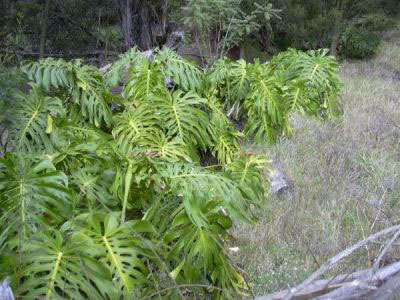
    Monstera deliciosa, also known as ceriman, is a species of flowering plant belonging to Monstera Adans. (monster) and Araceae (Arum family). The plant is native to southern Mexico, south to Panama. It has been introduced to many tropical areas, and has become a mildly invasive species in Hawaii, Seychelles, Ascension Island and the Society Islands. Monstera deliciosa may be confused with Philodendron bipinnatifidum as they have similar leaves and growing habits however, the ingestion of Philodendron bipinnatifidum may cause irritation to the digestive tract and will induce internal swelling. The sap is also known to irritate the skin.

    The specific epithet deliciosa means delicious, referring to the edible fruit, while monstera means monstrous, in reference to the size that this plant can grow to over 9 m (30 ft.) in many cases. Few of the popular common names of the plants are Ceriman, Windowleaf, Split-leaf Philodendron, Mexican Breadfruit, Balaco, Balazos, Banana de macaco, Costila de Adan, Cut leafed Philodendron, Fensterblatt, Fruit Salad Plant, Gui bei zhu, Harpon, Mexican breadfruit, Monstera, Monsutera derishioosa, Pinanona monstera, Pinanona, Swiss-cheese plant, Breadfruit-Vine, Delicious Monster, hurricane-plant, Monster Fruit, Locust and Wild Honey, Pine Fruit Tree,  fruit salad tree, monsterio delicio, monstereo, balazo, Penglai banana, Cheese Plant and Monstereo.

    Plant Description

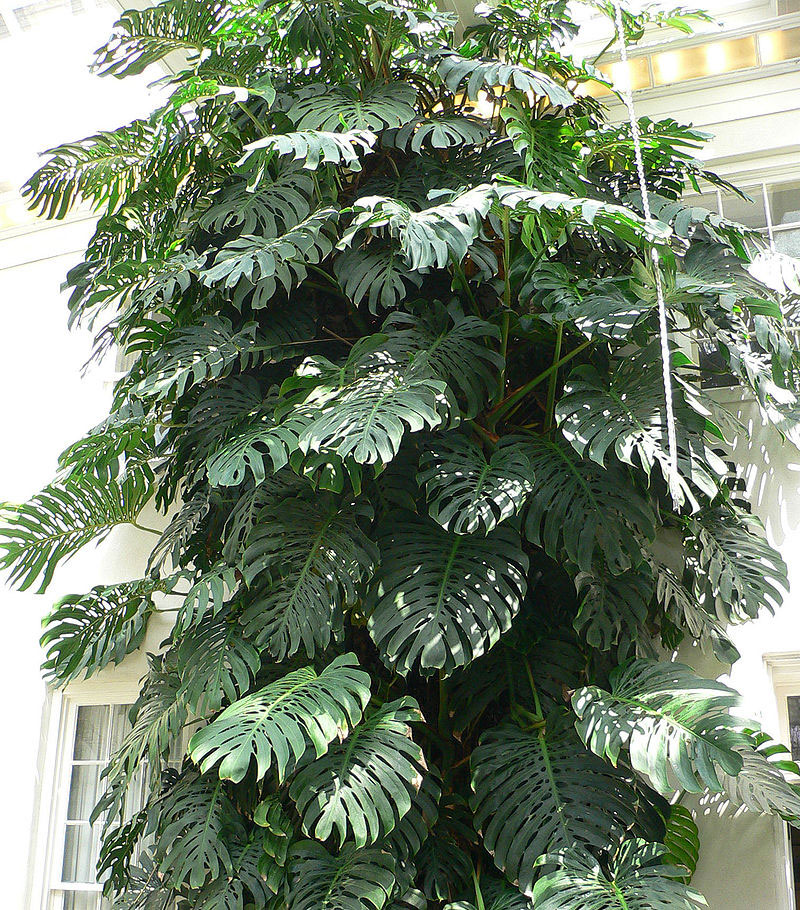
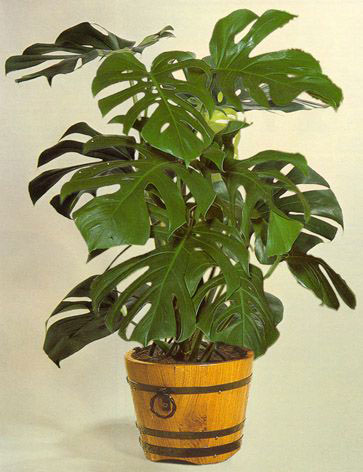
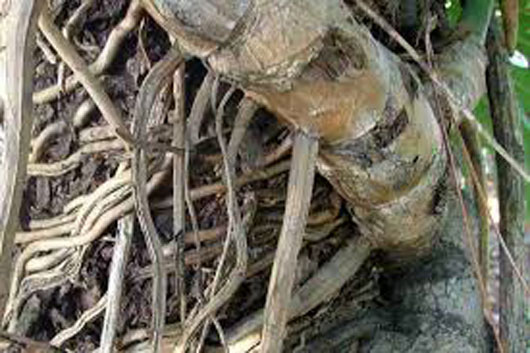
    Ceriman is a robust, fast growing, stout, herbaceous or woody, epiphytic, scrambling or climbing vine that grows about 20 m (66 ft.) tall. Indoor plants more typically are grown in the 6-8 feet range. The plant is found growing in the branches of trees in moist or wet, mountain forests. The plant grows vigorously in almost any soil, including calcareous but flourishes best in well-drained, loamy soils rich in organic matter. It is intolerant of saline conditions. Stem is cylindrical, heavy, 6.0–7.5 cm diameter, thick rough with leaf scars, and producing numerous, long, tough, fibrous aerial roots.

    Leaves

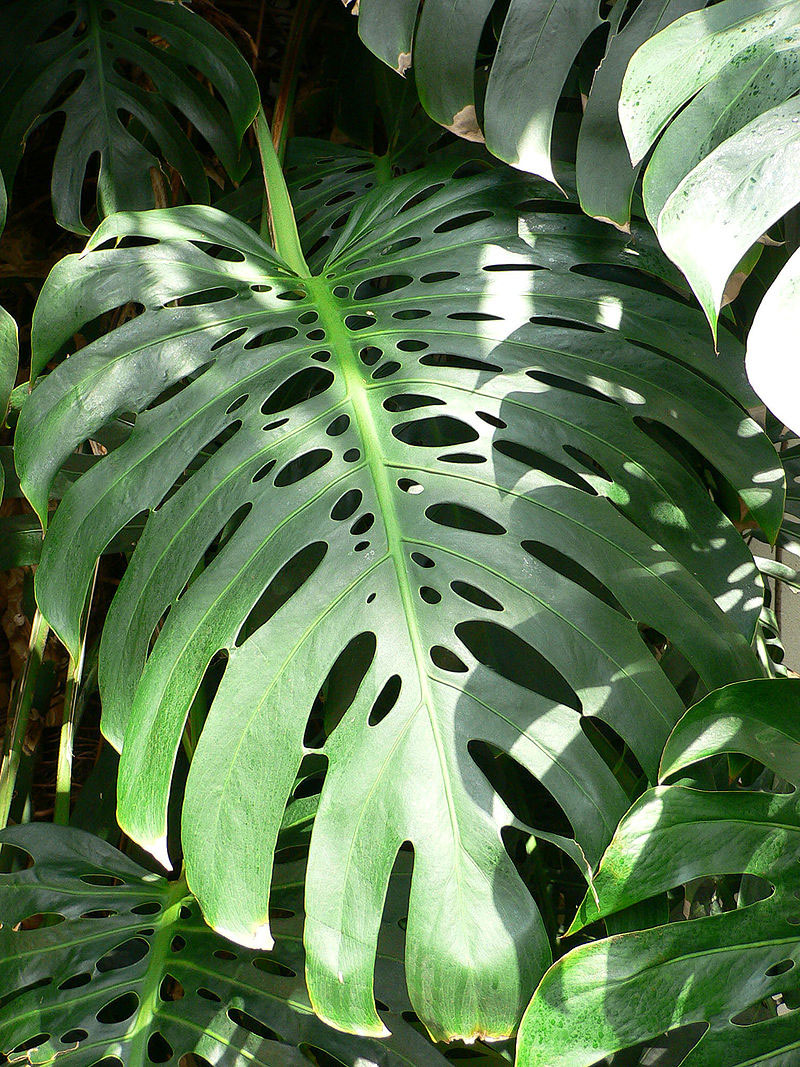
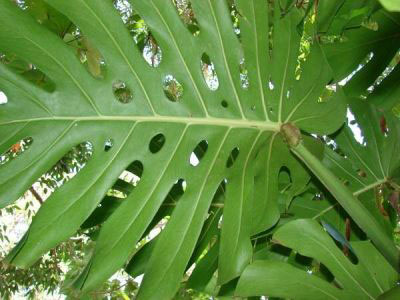
    Leaves are large, leathery, glossy, heart-shaped leaves 25–90 cm (10–35.5 in) long and 25–75 cm (10–29.5 in) broad. Young plants have leaves that are smaller and entire with no lobes or holes, but soon produce lobed and fenestrate leaves as they grow. Although it can grow very tall in nature, it only measures between 2 and 3 m (6.6 and 9.8 ft.) when grown indoors. The older the plant, the more the leaves are covered with large perforations which earned the name of “swiss cheese plant” in English.

    Flowers

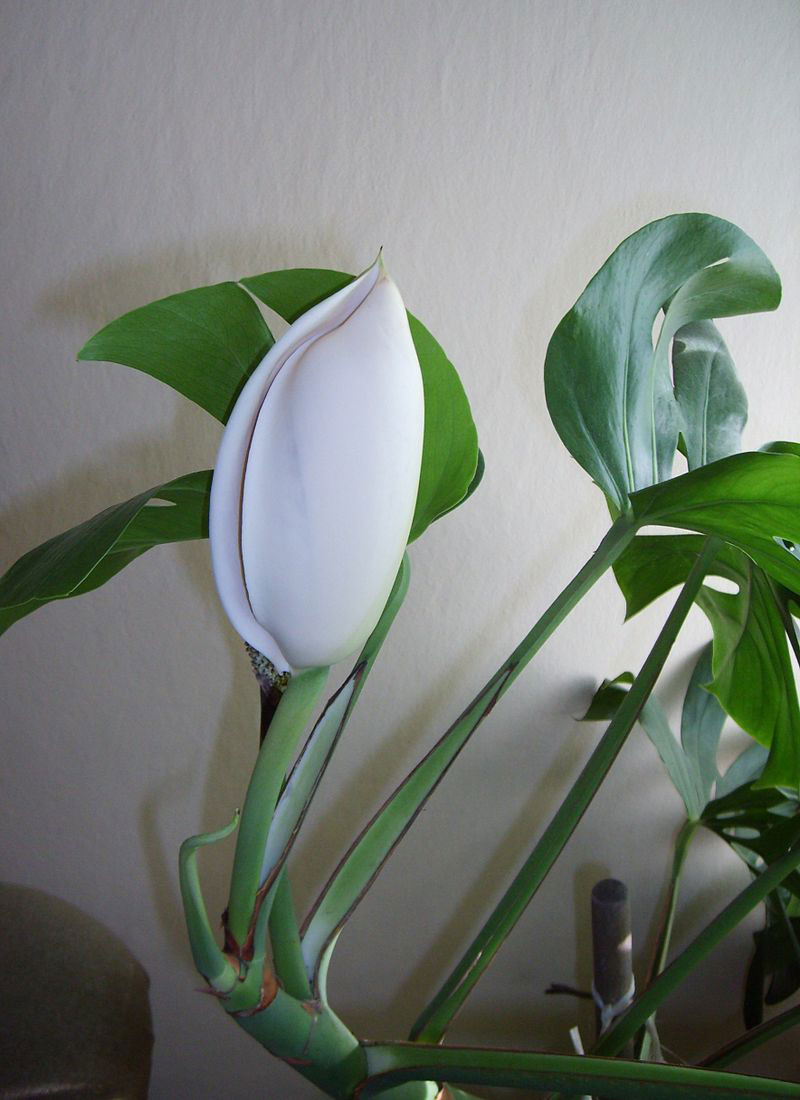
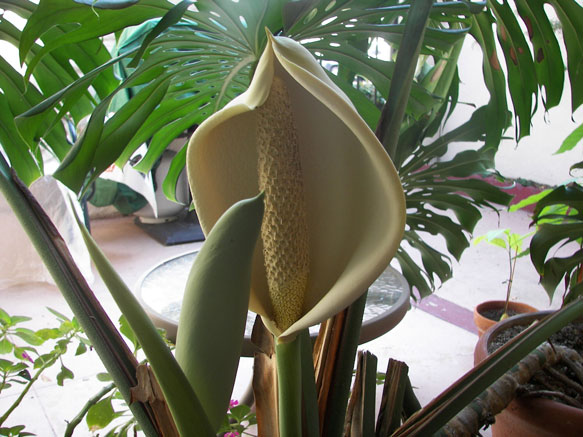
    Flower of Monstera deliciosa is composed of a special bract called a spathe enclosing a spadix and the inflorescence is adorned with a cream-white spathe uniform, velvety appearance, covering, like a hood, a yellowish white spike 10 to 15 cm (3.9 to 5.9 in) high and about 3 cm (1.2 in) in diameter. These flowers are bisexual, meaning they contain both androecium and gynoecium. Since they contain both structures, this plant is able to self-pollinate.

    Fruit

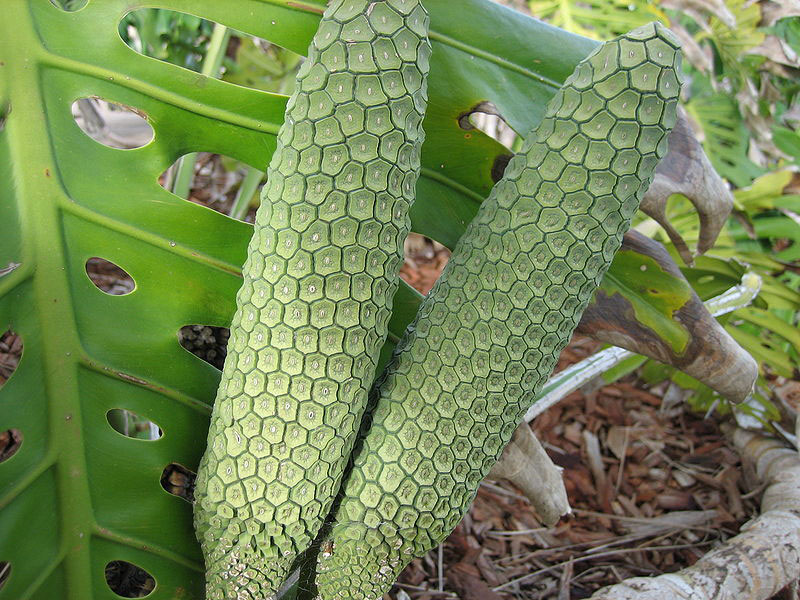
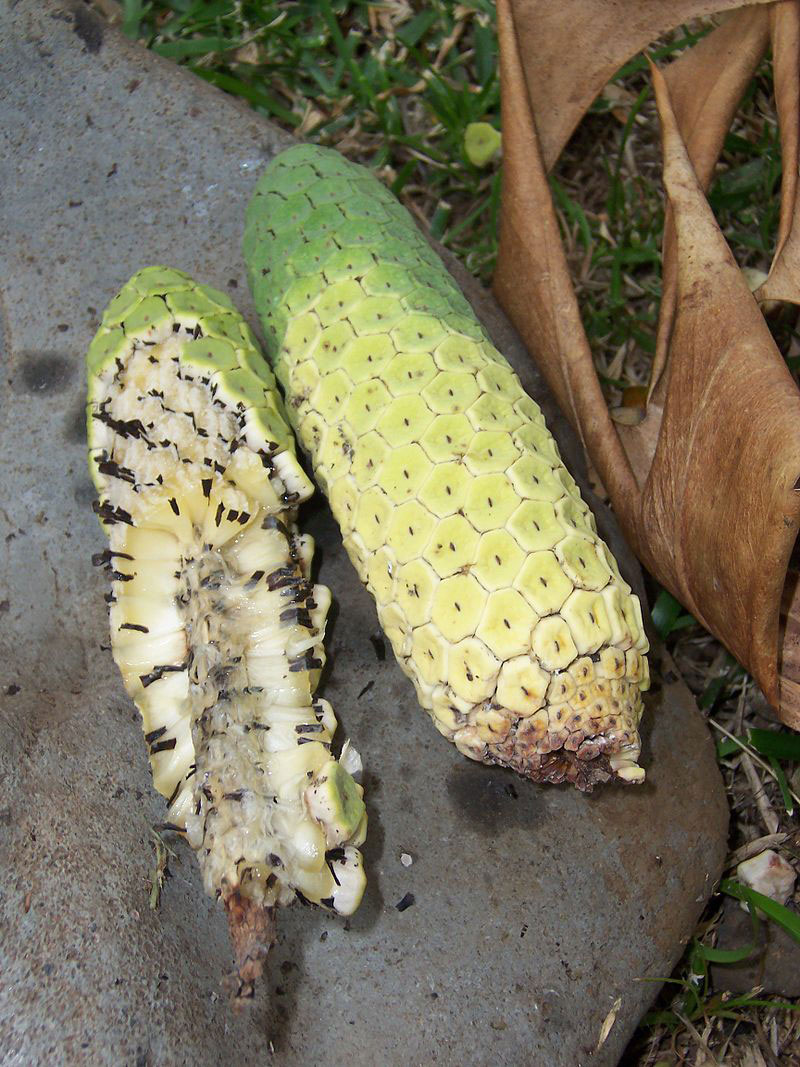
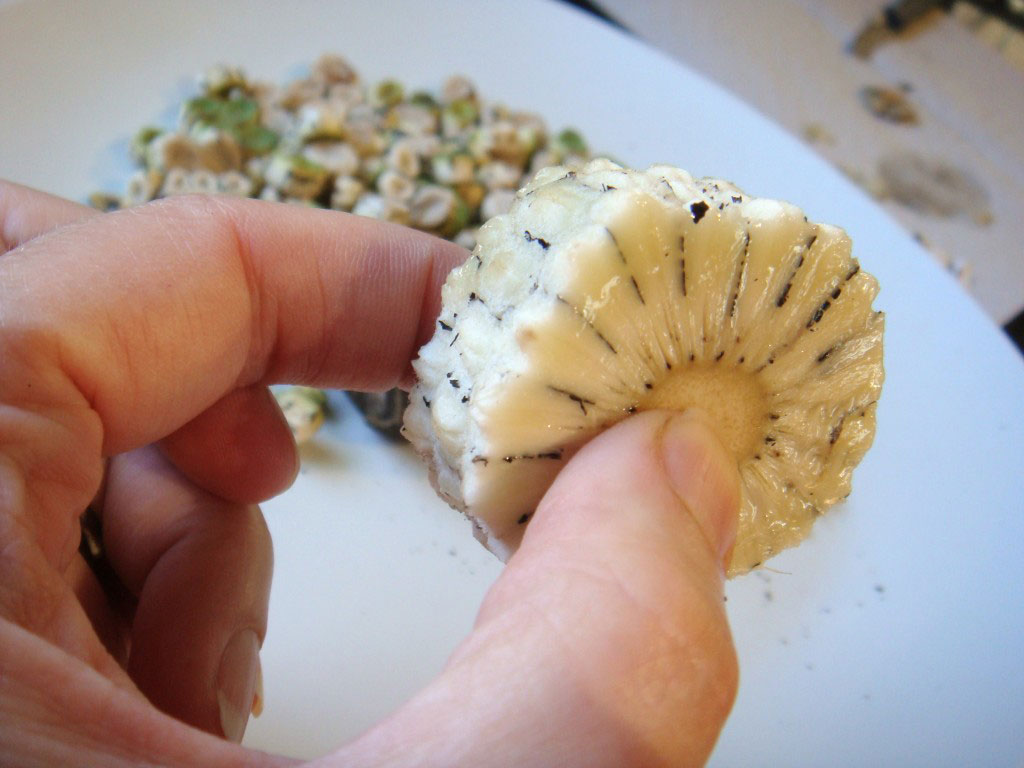
    The fruit of Monstera deliciosa is up to 25 cm (9.8 in) long and 3–4 cm (1.2–1.6 in) diameter, looking like a green ear of maize covered with hexagonal scales. As the fruit ripens, these scales or platelets fall off the fruit, releasing a strong and sweet scent. The smell has been compared to a combination of pineapples and bananas. The fruit is edible and safe for humans.

    It takes longer than a year for fruits to reach maturity. The fruit first shows signs of ripening by its bottommost scales becoming yellowed. As it ripens, the starch that was stored in the green fruit is converted to sugar, giving it its sweet flavor. This mechanism is similar to how banana fruits ripen. The strong odor the fruit produces becomes noticeable when it is half-ripe. As time passes and the fruit continues to ripen, the odor becomes stronger. After it becomes fully ripe, however, the scent deteriorates quickly.

    Ceriman Image Gallery
    Ceriman-Plant Ceriman-Plant
    Ceriman-plant-growing-wild Ceriman-plant-growing-wild
    Flowering-bud-of-Ceriman Flowering-bud-of-Ceriman
    Flower-of-Ceriman Flower-of-Ceriman
    Immature-fruits-of-Ceriman Immature-fruits-of-Ceriman
    Indoor-Ceriman-plant Indoor-Ceriman-plant
    Leaves-of-Ceriman Leaves-of-Ceriman
    Ripening-Ceriman-fruit Ripening-Ceriman-fruit
    Root-of-Ceriman Root-of-Ceriman
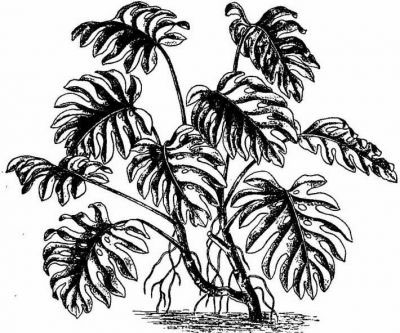
    Sketch-of-Ceriman Sketch-of-Ceriman
    Slice-of-Ceriman-fruit Slice-of-Ceriman-fruit
    Ventral-view-of-leaves-of-Ceriman Ventral-view-of-leaves-of-Ceriman
    History

    The Ceriman is indigenous to the wet tropical forests of southern Mexico, Guatemala and parts of Costa Rica and Panama. Now it is pan tropical and has naturalized in many areas for instance in Florida and coastal areas of North Coast and Central Coast, also scattered throughout the lower to mid Blue Mountains (Central Coast) of New South Wales in Australia.

    Traditional uses and benefits of Ceriman

    • Roots of monster fruit (or sometimes the leaves) are used in Mexico to make an infused beverage used to treat arthritis.
    • Inhabitants of the Caribbean island of Martinique prepare a cure for venomous snakebites from the roots of the monster fruit.
    • Wounds are sealed with a paste made from the mashed leaves of monster fruit in Brazil.
    • Chinese believe that various parts of the plant are an effective cure for a number of diseases, like bruises, cough, fever or some types of infection.
    • Due to high dose of potassium and vitamin C, a smoothie prepared from monster fruits is quite popular among sportsmen who want to have more stamina and raise their energy levels.
    • It also provides a useful mix of nutrients to cancer patients who recover after a period of radiotherapy.

    Culinary Uses

    • Fruit can be consumed raw.
    • Juicy, sub acid fruits have an excellent aroma and taste, combining the flavors of bananas and pineapples.
    • The fruit is eaten raw, made into jellies and jams, and is also used in ice creams, sherbets, soft drinks etc.
    • Some people find the fruit unpleasant to eat because it can contain irritating crystals in the pulp.
    • Fruiting spadices become whitish at maturity and very juicy. They are sweet and of good flavor and often are eaten, but care must be taken to eat only fruits that are thoroughly ripe, since immature ones will cause swelling and irritation of the mouth because of needle-like crystals of calcium oxalate found in the tissues or sap.
    • Elongated fruit is ready to harvest when the tile-like caps (scales) of the fruit-lets at the base start to separate and show creamy color between them.
    • When mature, the fruit can be detached, leaving the flower stem.
    • Ripe sectioned of the fruit can be recognized by the separation of the scales.
    • Unripe section is left in the paper bag until the next portion is ready to eat.
    • Alternatively, the whole fruit can be ripened for eating at one time by standing the base in water and keeping it in the dark for a few days.
    • Pulp of ripe fruit is eaten fresh, made into jellies and jams.
    • It may be served as dessert with a little light cream, or may be added to fruit cups, salads or ice cream.
    • To make a preserve, rinsed segments can be stewed for 10 min in water, too which is added sugar or honey and lime juice and the mixture is simmered again for 20 min and then preserved in sterilized jars.
    • Pieces of the raw fruit can serve as ingredients in any type of salad, ice cream or fruit mix.

    Other Facts

    • Aerial roots are used as ropes and in making baskets.
    • They are much used in Guatemala for making the so-called mimbre furniture, similar to the light rattan furniture made commonly in the United States.
    • Dried roots, of uniform diameter, or sometimes the fresh ones, are wound tightly and evenly about a wooden frame, forming handsome and durable articles of furniture.
    • Roots are also used to make strong baskets.
    • It is especially suited for use as an ornamental on fences and tree stumps.
    • The plant is widely cultivated as an ornamental for home and tropical gardens.
    • In Mexico, they are fashioned into coarse, strong baskets.
    • Locals in Peru and Mexico gather the roots in order to manufacture baskets or ropes.
    • It is also a popular ornamental garden plant in Colombia, because of its attractive large leaves and flowers.

    Precautions

    • All parts of the plant except the fully ripe fruit are toxic and irritate the mouth and skin.
    • People with a tendency to rheumatism, arthritis, gout, kidney stones and hyper acidity should take especial caution if including this plant in their diet.
    • All parts of plant are poisonous if ingested handling plant may cause skin irritation or allergic reaction.
    • Unripe fruit contains so much oxalic acid that it is poisonous, causing immediate and painful blistering and irritation, swelling, itching, of mucous membranes and loss of voice and may lead to death.

    • High doses may cause stomach cramps and diarrhea.

    References:

    https://www.itis.gov/servlet/SingleRpt/SingleRpt?search_topic=TSN&search_value=503872#null

    https://davesgarden.com/guides/pf/go/1204/

    https://npgsweb.ars-grin.gov/gringlobal/taxonomydetail.aspx?id=24556

    https://pfaf.org/user/Plant.aspx?LatinName=Monstera+deliciosa

    http://www.missouribotanicalgarden.org/PlantFinder/PlantFinderDetails.aspx?kempercode=b605

    https://plants.usda.gov/core/profile?symbol=MODE

    https://en.wikipedia.org/wiki/Monstera_deliciosa

    https://www.wikidata.org/wiki/Q161077

    http://luirig.altervista.org/schedenam/fnam.php?taxon=Monstera+deliciosa

    http://www.theplantlist.org/tpl/record/kew-129588

    https://gd.eppo.int/taxon/MOSDE

    http://tropical.theferns.info/viewtropical.php?id=Monstera+deliciosa

    https://hort.purdue.edu/newcrop/morton/ceriman.html

    75%
    75%
    Awesome

    Comments

    comments

    C Herbs and Spices
    Share. Facebook Twitter Pinterest LinkedIn Tumblr Email
    Previous ArticleNatural Approaches To Mesothelioma Care
    Next Article Pea pumpkin

    Related Posts

    Uses of Monkey Pitcher plant

    April 16, 2024

    Traditional uses and benefits of Wild Marigold

    March 21, 2024

    Traditional uses and benefits of Drooping fig

    March 12, 2024

    Comments are closed.


    Ceriman Facts

    Ceriman Quick Facts
    Name: Ceriman
    Scientific Name: Monstera deliciosa
    Origin Southern Mexico, south to Panama
    Colors Green turning to white or pale yellow as they matures
    Shapes Spadix develops into the compound fruit. The hexagonal scales dry out and separate as the fruit ripens from the base upwards, revealing the white or pale yellow
    Taste Sweet, sour, fruity taste similar to jack fruit and pineapple
    Health benefits Beneficial for arthritis, snakebite, wounds, bruises, cough, fever or some types of infection.s
    Name Ceriman
    Scientific Name Monstera deliciosa
    Native Southern Mexico, south to Panama. It has been introduced to many tropical areas, and has become a mildly invasive species in Hawaii, Seychelles, Ascension Island and the Society Islands
    Common Names Ceriman, Windowleaf, Split-leaf Philodendron, Mexican Breadfruit, Balaco, Balazos, Banana de macaco, Costila de Adan, Cut leafed Philodendron, Fensterblatt, Fruit Salad Plant, Gui bei zhu, Harpon, Mexican breadfruit, Monstera, Monsutera derishioosa, Pinanona monstera, Pinanona, Swiss-cheese plant, Breadfruit-Vine, Delicious Monster, hurricane-plant, Monster Fruit, Locust and Wild Honey, Pine Fruit Tree,  fruit salad tree, monsterio delicio, monstereo, balazo, Penglai banana, Cheese Plant, Monstereo, Wild Honey
    Name in Other Languages Afrikaans: Geraamteplant
    Arabic: Qashtat dandurum  (قشطة دندروم)
    Belarusian: Manstera pryvabnaja  (Манстэра прывабная)
    Bengali: ফল সালাদ গাছ
    Chinese:  Gui bei zhu, Guī bèi yù (龜背芋)
    Columbia: Hojadillo
    Danish: Fingerfilodendron
    Dutch: Gatenplant, Vensterblad, Vingerplant
    English: Ceriman, Cut-leaf philodendron, Fruit-salad plant, Mexican breadfruit, Swiss-cheese plant, Split-leaf philodendron, Window leaf, Monstera, Tarovine, breadfruit vine, hurricane plant
    Esperanto: Serimao
    Finnish: Peikonlehti, Jättipeikonlehti
    French: Ananas des pauvres, Cériman, Monstera, Philodendron monstéra, Philodendron à feuilles incises, Faux philodendron, liane percée, ceriman, Ananas De Mexico,  Cériman, Monstère Délicieux, Monstera,
    French Guiana: Arum Du Pays, Arum Troud
    German: Fensterblatt, Köstlicher Kolbenriese, Zimmer-Philodendron, Großes Fensterblatt, Köstliches Fensterblatt, Kletterfensterblatt
    Guadeloupe: Caroal, Liane Percee, Liane Franche
    Guatemala: Harpon, Arpon Comun
    Hungarian: Könnyezöpálma
    India: Amar-Phal
    Italian: Monstera
    Japanese:  Monsutera derishioosa, Houraishou (ホウライショウ), Monsutera (モンステラ)
    Martinique: Siguine Couleurr
    Mexico: Piñanona
    Nepali: Amaraphal (Amarphal), Lahare karkalo
    Norwegian: Vindusblad
    Persian: برگ انجیری
    Polish: Monstera dziurawa
    Portuguese: Balaço, Banana de macaco, Costela de Adão, banana-do-brejo, banana-do-mato, Deliciosa, Fruta De México, Costela De Adão, Balaço, Tornélia, inebe
    Russian:  Monstera delikatesnaia, Monstera lakomaia, Monstera prelestnaia, Monstera privlekatel’naia, Монстера деликатесная
    Serbian: Монстера
    Spanish: Chirrivaca, costilla de Adán, hoja de piedra, mano de tigre, piñanona, Piñanona monstera, Balazos, Harpón, Cerimán, monster, Cerimán De México, Hojadillo, Huracán, Ojal, Piña Anona, hoja picada
    Swedish: Monstera
    Thai: Phlū c̄hīk (พลูฉีก)
    Tonga: Monesitela
    Ukrainian: Monstera delikatesna (Монстера делікатесна)
    Venezuela: Ojul, Huracan
    Yiddish: Manster frukht (מאנסטער פרוכט)
    Plant Growth Habit Robust, fast growing, stout, herbaceous or woody, epiphytic, scrambling or climbing vine
    Growing Climates Growing in the branches of trees in moist or wet, mountain forests
    Soil Plant grows vigorously in almost any soil, including calcareous but flourishes best in well-drained, loamy soils rich in organic matter. It is intolerant of saline conditions
    Plant Size 20 m (66 ft.)
    Stem Cylindrical, heavy, 6.0–7.5 cm diameter, thick rough with leaf scars, and producing numerous, long, tough, fibrous aerial roots
    Leaf Large, leathery, glossy green, cordate, 25–90 cm long by 25–75 cm broad. Juvenile plants start out with smaller and entire leaves with no lobes or holes, but older leaves and plant soon produce leaves with deeply cut strips or lobes around the margins and perforated on each side of the midrib with elliptic or oblong holes of various sizes
    Flower Composed of a special bract called a spathe enclosing a spadix and the inflorescences are adorned with a cream-white spathe uniform, velvety appearance, covering, like a hood, a yellowish white spike 10 to 15 cm (3.9 to 5.9 in) high and about 3 cm (1.2 in) in diameter
    Fruit Shape & Size Spadix develops into the compound fruit. The hexagonal scales dry out and separate as the fruit ripens from the base upwards, revealing the white or pale yellow, sweet pulp and the thin, black particles between the scales, usually there are no seed
    Fruit Color Green turning to white or pale yellow as they matures
    Propagation By air layering or internal cutting
    Flavor/Aroma Pungent odor
    Taste Sweet, sour, fruity taste similar to jackfruit and pineapple
    Plant Parts Used Leaves, Root and fruit

    Ceriman Scientific Classification

    Scientific Name: Monstera deliciosa

    Rank Scientific Name & (Common Name)
    Kingdom Plantae (Plants)
    Subkingdom Tracheobionta (Vascular plants)
    Infrakingdom Streptophyta  (land plants)
    Superdivision Spermatophyta (Seed plants)
    Division Magnoliophyta (Flowering plants)
    Subdivision Spermatophytina  (spermatophytes, seed plants, phanérogames)
    Class Liliopsida (Monocotyledons)
    Subclass Arecidae
    Superorder Lilianae  (monocots, monocotyledons, monocotyledons)
    Order Arales
    Family Araceae (Arum family)
    Genus Monstera Adans. (monster)
    Species Monstera deliciosa Liebm. (tarovine)
    Synonyms
    • Monstera borsigiana Engl.
    • Monstera borsigiana K.Koch
    • Monstera deliciosa var. borsigiana Engl.
    • Monstera deliciosa var. sierrana G.S.Bunting
    • Monstera lennea K.Koch
    • Monstera lenneana K.Koch
    • Monstera tacanaensis Matuda
    • Philodendron anatomicum Kunth
    • Tornelia fragrans Gutierrez
    • Tornelia fragrans Gutierrez ex Schott
    Categories
    • Beverages (78)
    • Dairy (28)
    • Dental Health (15)
    • Equipment (5)
    • Essential OIls (196)
    • Facts (2,939)
    • Foods (255)
    • Fruits (516)
    • Giveaway (1)
    • Grains and Cereals (36)
    • Health & Beauty (763)
    • Herbs and Spices (1,249)
    • Medicines (9)
    • Mental Health (19)
    • Nutritional value (27)
    • Nuts and seeds (73)
    • Oils (81)
    • Pets (4)
    • Poultry & Seafoods (67)
    • Pulses and Beans (16)
    • Reviews (25)
    • supplement (2)
    • Vegetables (304)
    • Weight Loss (22)

    What is Lupin Bean Flour?

    Science Backed Health Benefits of Durian (Durio zibethinus)

    Science Backed Health Benefits of Feijoa (Pineapple Guava) (Acca sellowiana)

    Science Backed Health Benefits of Gac Fruit (Momordica cochinchinensis)

    Science Backed Health Benefits of Amaranth Leaves (Amaranthus spp)

    Science Backed Health Benefits of Arrowhead (Sagittaria sagittifolia)

    ABOUT
    Home
    About us
    Contact us
    Privacy Policy
    Terms & conditions
    Disclaimer
    Direct Communication
    e-mail: [email protected]
    Gmail: [email protected]
    Whatsapp: +977-9841146511
    Viber: +977-9841146511
    Useful
    Health Wiki
    Nutrition
    Facebook Twitter Pinterest
    © 2025 www.healthbenefitstimes.com All rights reserved.

    Type above and press Enter to search. Press Esc to cancel.

    ×

    Log In

    Forgot Password?

    Not registered yet? Create an Account