Health Benefits
    Facebook Twitter Instagram
    Friday, December 5
    Facebook Twitter Pinterest
    Health Benefits
    • Home
    • Dental Health
    • Mental Health
    • Weight Loss
    • Health Wiki
    • Nutrition
    • Healthy Recipe
    • BMI Calculator
    Health Benefits
    Home»Herbs and Spices»Health benefits of Common Saltwort
    Herbs and Spices

    Health benefits of Common Saltwort

    By SylviaJuly 8, 2019Updated:July 8, 2019No Comments8 Mins Read
    Facebook Twitter Pinterest LinkedIn Tumblr Email

     Salsola kali L, (synonyms: Salsola. tragus, Salsola. kali var tragus or Salsola. pestifer) is a xero-halophyte plant that belongs to the Chenopodiaceae family. The plant is native to Europe, North Africa, the Middle East, Central Asia, China and Australia. It is usually absent in huge areas that include tropical zones, Pacific islands and the Eastern coast of Africa. It is categorized as an important weed in Argentina and Afghanistan, a main weed in Canada and Hungary and a common weed in Iran, Italy, Morocco, South Africa and the USA. The plant has several common names including Common saltwort, Prickly Russian thistle, Prickly saltwort, Russian thistle, saltwort, Russian tumbleweed, prickly glasswort, roly-poly, spiny saltwort and Soft roly-poly. The generic name Salsola means salty, while kali refers to ashes, in allusion to a sodium rich plant. It is widely known simply as tumbleweed because in many regions of the United States, it is the most common and most conspicuous species of tumbleweed. Informally, it also is known as “salsola”, which was its generic name until fairly recently.

    Plant Description

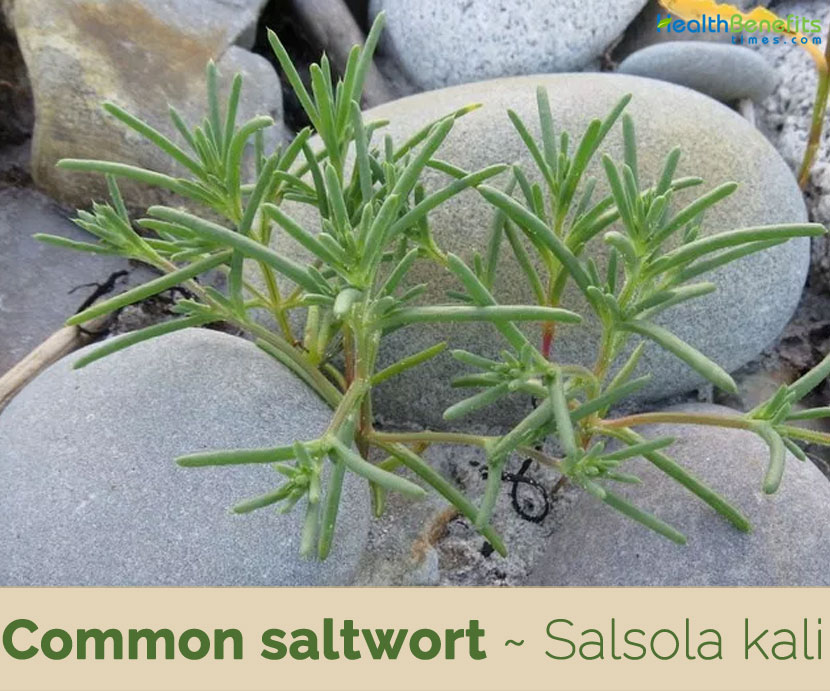
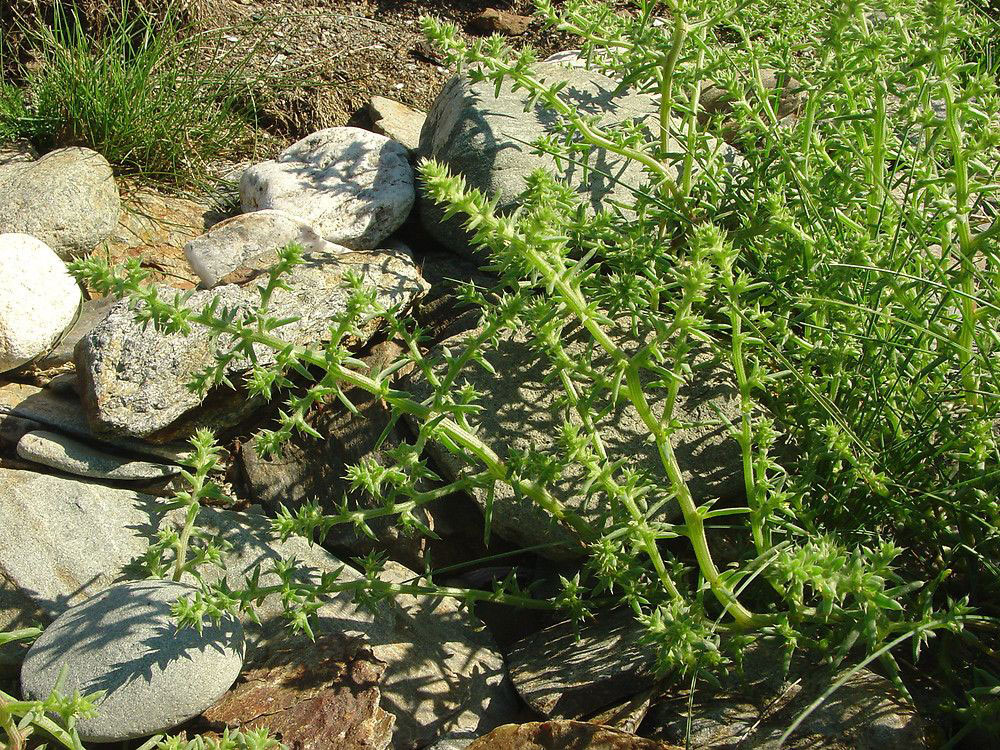
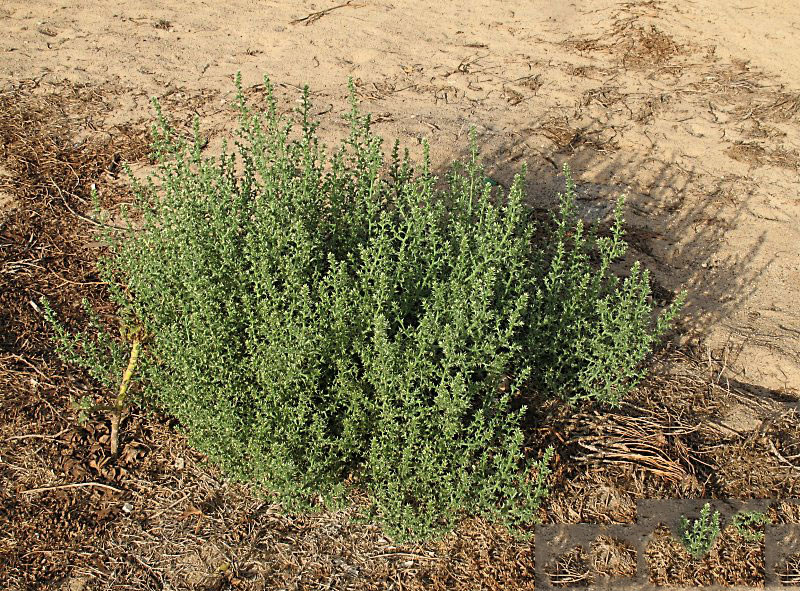
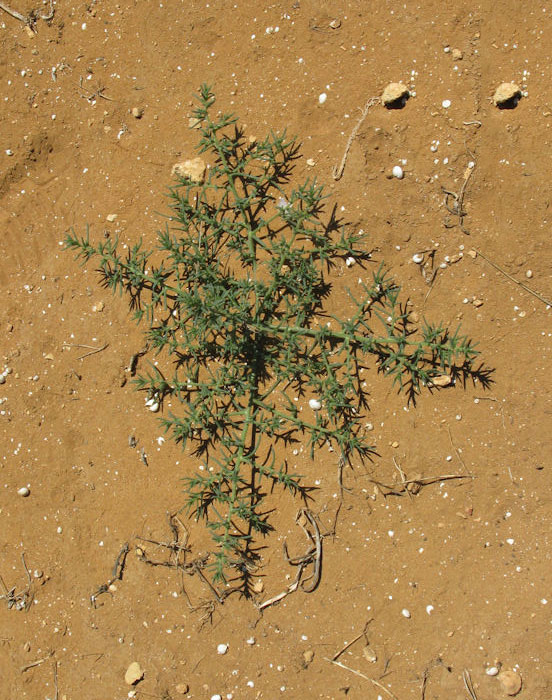
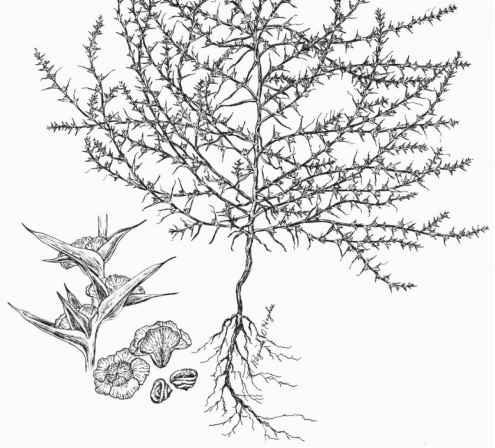
    Common saltwort is an exotic, annual, erect, xerohalophytic forb. It is highly branched and rounded in form, growing from 1 to 3 feet (0.3-1 m) in height and from 1 to 5 feet (0.3-1.5 m) in diameter. The plant is found growing in roadsides, disturbed areas, scrub vegetation, on former sugarcane fields, heath, shrub land and coastal areas, fallows, agricultural land, range land, abandoned fields, overgrazed pastures, shingle and sand behind beaches, dry gravelly sites, railways, and other dry, stony and sandy areas. It can be found growing in any type of well-drained, uncompacted soil with a sunny exposure. It is most frequent, however, in alkaline or saline soils due to reduced competition. Stem is erect, rarely ascending, profusely branched from or near base (rarely simple in underdeveloped specimens). Branches are arcuate, proximal ones occasionally prostrate.

    Leaves

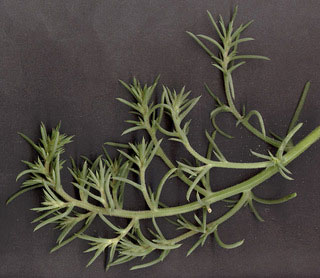
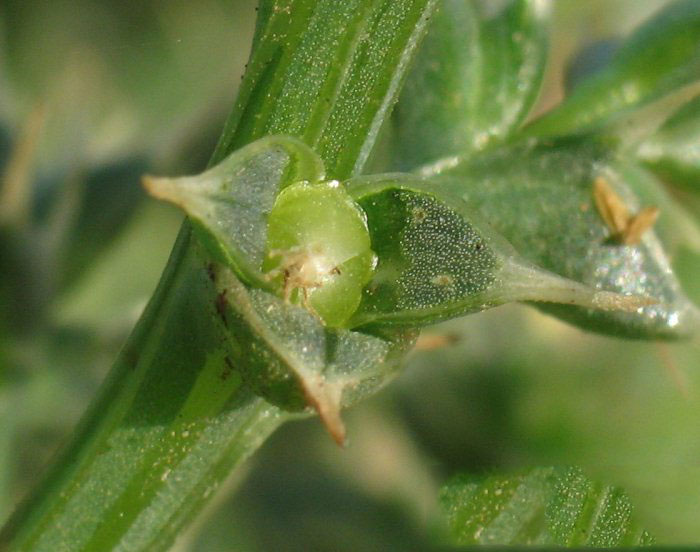
    Leaves are alternate and narrow. Blades are linear, 1-2 mm wide, fleshy, usually not swollen at base, apex acuminate, forming a rather firm spine, 1-1.5(-2.2) mm long. Upper leaves have a sharp point at the apex and are 1.3-2 in. (3.3-5.1 cm) long.

    Flowers and Fruits

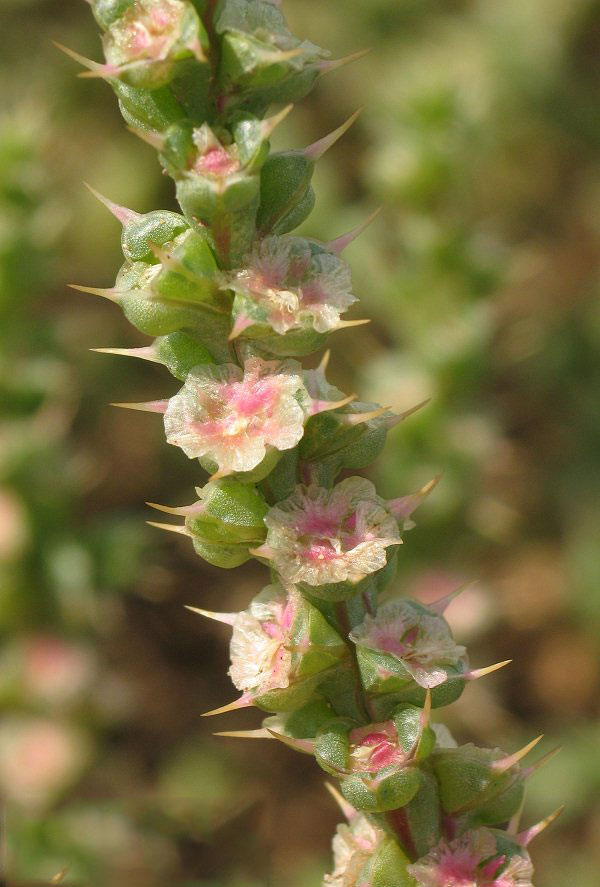
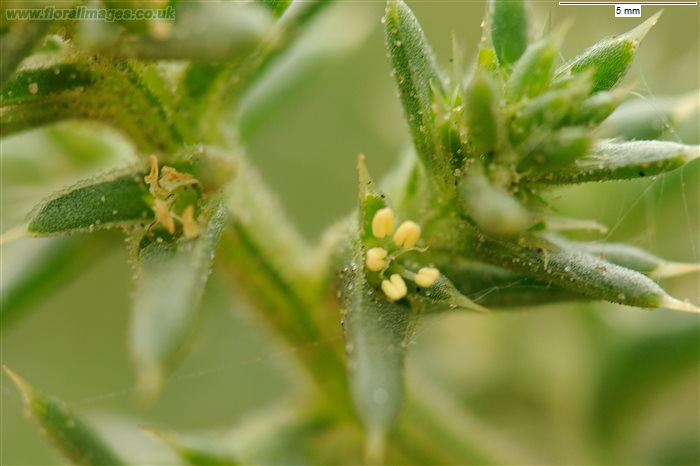
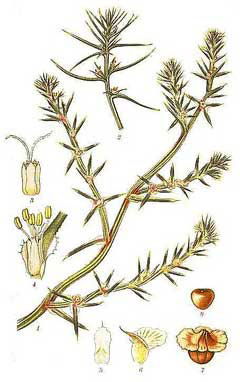
    Flowering occurs from midsummer to fall, when small, pink to greenish flowers develop from the leaf axils. Each flower is subtended by 3, spine-tipped leaves. Fertile flowers are followed by fruits that are 0.19-0.31 in. (4.8-7.9 mm) in diameter including the wings. Wings are opaque with smooth margins and veins. Seeds are cone shaped coiled utricle, 2 mm in diameter, dull brown to grey in color

    Common-saltwort-growing-wild Common-saltwort-plant Flowers-of-Common-saltwort Inflorescence-leaves-of-Common-saltwort Leaves-of-Common-saltwort Plant-illustration-of-Common-saltwort Single-Common-saltwort-plant Sketch-of-Common-saltwort Stem-of-Common-saltwort
    [Show thumbnails]

    Health benefits of Common Saltwort

    Listed below are some of the popular health benefits of using Common saltwort

    1. Treats Influenza

    If you suffer from influenza, then you might end up drinking a cup of hot tea. Indeed, tea is a drink which can relieve the certain health problems including fever and influenza. However, in this case, Common saltwort is supposed to have the ability in treating this disease. Thus, having this plant as your herbal treatment is something that should be taken into account.

    2. Helps Losing Weight

    Common saltwort consists of wonderful amount of fiber. As a result, it will be beneficial for those who want to have a healthy diet. Then, one of the health benefits of Common saltwort for weight loss is to make you feel full longer. Certainly, it will help you to control the appetite. Thus, by having this plant, then you will get the best health benefits you may have never anticipated before.

    3. Boost the energy

    Magnesium contained in Common saltwort is very beneficial to boost the energy. Magnesium present in this plant helps to calms the nerves and helps with the digestion. Indeed, magnesium does a good job of promoting the body functions and regulating the blood flow. For the tips, you have to consume Common saltwort together with spinach to get the best health results then.

    4. Boosts Immune System

    Presence of great minerals in Common saltwort can help to strengthen the immune system. What is even greater is the ability to reduce the body inflammation. Furthermore, it will help you to stimulate the production of antibodies and white blood cells as well. Then, with these great benefits of Russian thistle, it will reduce the risks of certain health problems such as a fever, headache, influenza, and weaknesses.

    5. Promote the bones density and structure

    Another health benefit provided by Common saltwort is the presence of the calcium source in it. It is known that mineral can help to promote the bones density and structure. This will be good as it can avoid the risks of osteoporosis and other bone problems for sure. Therefore, if you want to have the healthy bones, you should consume dairy products including milk and Common saltwort for getting the best health results.

    6. Treats Smallpox

    Common saltwort has the ability to treat smallpox. The use of this herbal treatment has been used since many years ago. Therefore, you can consult the doctor before using this plant to prevent any risks for sure.

    7. Treats Wasp Stings

    Common saltwort consists of several nutrients and essential minerals. The nutritional content will help you to treat wasp stings. To use this kind of herbal treatment, then you need to talk to the doctor first. Then, with the doctor’s prescriptions, you can safely use it.

    https://www.youtube.com/watch?v=28gB3r3GCrU

    Traditional uses and benefits of using Common Saltwort

    • Juice of the fresh plant is an excellent diuretic.
    • Seedpods can also be used.
    • Salsolin, one of the constituents of the plant, has been used to regulate the blood pressure.
    • It is said to look like papaverine in its effect on vasoconstriction and hydrastine in its effect on the smooth muscles of the uterus.
    • The plant is a folk remedy for dropsy and excrescences.
    • Twisted seed-vessels having the same virtue and being given in infusion.
    • Navaho used a decoction of the ashes, both internally and externally for influenza and smallpox.

    Culinary uses

    • It is, however, perfectly safe in small amounts and its acid taste adds a nice flavor to salads.
    • Young leaves and stems can be consumed raw or cooked.
    • It is an excellent food with a crunchy tender texture.
    • Leaves can be used as a spinach substitute or added in small quantities to salads.
    • Seed can be ground into a meal and used as gruel, thickener in soups etc. or added to cereal flours when making bread etc.
    • Seed is small and hard to collect any quantity.

    Other Facts

    • Ashes of the burnt plant are used for making glass and soap.
    • At one time large quantities of the ashes were imported into Britain for this purpose, but nowadays a chemical process using salt is employed.
    • Ashes can also be used as a cleaner for fabrics.
    • As a low-water-use plant, germinating quickly on minimally disturbed soils, and relatively free of diseases and parasites, this has been recommended as a fuel source for arid lands.
    • Yields of around 3 tons per hectare of plant material have been achieved.
    • Salsola kali and related species have been used as emergency forage during drought.
    • Whole plant was likewise burnt for its fixed salt used in making glass.
    • Russian-thistle is sometimes used for Christmas decoration.
    • One plant typically produces about 250,000 seeds, which remain viable for less than a year.

    Precautions

    • The plant consists of up to 5% oxalic acid, so it should only be used in moderation.
    • Oxalic acid can lock up certain of the nutrients in food and, if eaten in excess, can lead to nutritional deficiencies.
    • People with a tendency to rheumatism, arthritis, gout, kidney stones and hyper acidity should take especial caution if including this plant in their diet since it can aggravate their condition.

    Control

    Physical

    Establish desirable plants such as competitive perennial grasses in disturbed or open areas and after the control of Common saltwort.  Pull or uproot young plants or hoe just below ground level before seed set. Cutting flowers before maturity has worked for some stewards on preserves.  Mowing Salsola kali tends to cause the plant to grow low but repeated mowing may provide control.

    Chemical

    Some plants in the Pacific Northwest are resistant to sulfonylurea herbicides such as Glean, Finesse, Ally, Amber, Express and Harmony Extra. Resistance to the trazine herbicides has also been observed. A non-selective broadleaf herbicide such as glyphosate can provide control of Salsola kali. Apply the herbicide before seed set. An application of 2, 4-D may actually cause S. kali to become tough and leathery, producing a plant that is more difficult to manage.

    References:

    https://www.itis.gov/servlet/SingleRpt/SingleRpt?search_topic=TSN&search_value=20655#null

    https://davesgarden.com/guides/pf/go/31911/

    http://www.hear.org/pier/species/salsola_kali.htm

    https://pfaf.org/user/Plant.aspx?LatinName=Salsola+kali

    https://www.cabi.org/isc/datasheet/50297

    http://www.floracatalana.net/salsola-kali-l-s-l

    https://www.nps.gov/whsa/learn/nature/russian-thistle.htm

    https://botanical.com/botanical/mgmh/g/glassw18.html

    https://plants.usda.gov/core/profile?symbol=SAKA

    https://www.fs.fed.us/database/feis/plants/forb/salkal/all.html

    https://en.wikipedia.org/wiki/Kali_tragus

    http://www.theplantlist.org/tpl1.1/record/kew-2481347

    https://gd.eppo.int/taxon/SASKA

    https://hort.purdue.edu/newcrop/duke_energy/Salsola_kali.html

    78%
    78%
    Awesome

    Comments

    comments

    C Herbs and Spices
    Share. Facebook Twitter Pinterest LinkedIn Tumblr Email
    Previous ArticleFacts about Stereospermum chelonoides
    Next Article 5 Simple Tips That Help Me Stay Healthy and Energetic Throughout The Day

    Related Posts

    Uses of Monkey Pitcher plant

    April 16, 2024

    Traditional uses and benefits of Wild Marigold

    March 21, 2024

    Traditional uses and benefits of Drooping fig

    March 12, 2024

    Comments are closed.


    Common Saltwort Facts

    Common saltwort Quick Facts
    Name: Common saltwort
    Scientific Name: Salsola kali
    Origin Europe, North Africa, the Middle East, Central Asia, China and Australia
    Shapes Fruits that are 0.19-0.31 in. (4.8-7.9 mm) in diameter including the wings. Wings are opaque with smooth margins and veins
    Health benefits Treats Influenza, Helps Losing Weight, Treats Smallpox, Boost the energy, Boosts Immune System, Promote the bones density and structure, Treats Wasp Stings
    Name Common Saltwort
    Scientific Name Salsola kali
    Native Europe, North Africa, the Middle East, Central Asia, China and Australia
    Common Names Common saltwort, Prickly Russian thistle, Prickly saltwort, Russian thistle, saltwort, Russian tumbleweed, prickly glasswort, roly-poly, spiny saltwort, Soft roly-poly
    Name in Other Languages Afrikaans: Rolbos
    Albanian: Cimlë, Këmbëkuqja
    Arabic:  Hhurd, Shawk ahhmar, ashnan (‘ashnan),had (had)(اشنان (أَشْنان)،حاد (حَاد)، shanan (shinan) شنان (شِنان), kharit (khiryt, kharyt) (خريط (خِريْط، خَريط), shalatam (shiltam) (شلطام (شِلطام)، qalaa (qala) (قلى (قَلى)
    Bokmål: Sodaurt
    Breton: Bugelenn-mor
    Bulgarian: Rusko vŭlmo (руско вълмо)
    Catalan: Barrella, Barrella espinosa, Barrella punxosa, Capitana, Espinadella, Herba de nuguets, Salt, Sosa
    Croatian: Kalijska solnjača           
    Czech: Slanobýl draselný
    Danish: Almindelig Sodaurt, sodaurt      
    Dutch:  Kalikruid, loogkruid, stekend loogkruid en zacht loogkruid, Stekend loogkruid, Loogkruid
    English:  Common saltwort, Prickly Russian thistle, Prickly saltwort, Russian thistle, saltwort, Russian tumbleweed, prickly glasswort, roly-poly, spiny saltwort, Soft roly-poly
    Estonian: Rand-ogamalts             
    Finnish:  Otakilokki, Meriotakilokki
    French:  Soude couchÃe, Soude kali, Soude brûlée, salsola kali, salsovie, soude épineuse, Soude, Soude commune        
    Gaelic: Lus an tsalainn
    German:  Geflügeltes Salzkraut, Kali-Salzkraut, Kalikraut, Sodapflanze, Küsten-Salzkraut, Kalisalzkraut
    Greek:  Almyrídi (Αλμυρίδι),  Salsóla to káli  (Σαλσόλα το κάλι)
    Hebrew: Milchit ashleganit, מִלְחִית אַשְׁלְגָנִית        
    Hungarian: Homoki ballagófű, homoki ballangó
    Italian:  Bacicci, Erba cali, Cali, Capelli del diavolo, Roscano, Salsola Erba-cali, erba kali
    Japanese: Nohara hijiki (ノハラヒジキ)
    Latvian: Kālija sālszāle   
    Lithuanian: Smiltyninė druskė
    Navajo: Chʼil awoshí
    Netherlands: Kalikruid, Loogkruid
    Norwegian Nynorsk: Sodaurt
    Occitan: Mena de barrilha
    Polish: Solanka kolczysta
    Portuguese:  Barrilha-espinhosa, Barrilheira, Barrilleira, Barrilheira-espinhosa, Cardo-da-Rússia, Corredor-de-estepe, Gramata,  Soda,  Soda-espinhosa, Trago-espinhoso
    Romanian: Ciurlan          
    Serbian: Bodljikava solnjača (бодљикава солњача), obična solnjač (обична солњач)   
    Slovak: Slaná byľ draselná           
    Slovene: Navadna solinka
    Spanish:  Abrojos, Almajo de los jaboneros, Barella, Barella pinchosa, Barrella, Barrella borda, Barrella espinosa, Barrella punchosa, Barrila borde, Barrila pinchosa, Caramillo, Cardo ruso, Correcaminos, Espantabrujas, Espantamulas, Espinadella, Espinardo, Espinardos, Hierba de cristal, Hierba del jabon, Mata pinchosa, Pincho barrillero, Salicor borde, Salicor de la Mancha, Salsora
    Russian: Solianka kaliinaia (Солянка калийная),  Solianka russkaia (Солянка русская)
    Scottish Gaelic: Lus an tsalainn
    Spanish: Barrilla, Sodaört, barrila borde, barrila pinchosa, capitana; salicorn
    Swedish:  Sodaoert, sodaört
    Turkish:  Ã‡orak, Dikenli çuğen, Üşnan, cirimotu
    Ukrainian: Kuray potaşeviy (Курай поташевий), kuray íberíyskiy (курай іберійський)
    Welsh: Helys pigog
    Plant Growth Habit Exotic, annual, erect, xerohalophytic forb
    Growing Climates Roadsides, disturbed areas, scrub vegetation, on former sugarcane fields, heath, shrubland and coastal areas,  fallows, agricultural land, rangeland, abandoned fields, overgrazed pastures, shingle and sand behind beaches, dry gravelly sites, railways, and other dry, stony and sandy areas
    Soil Any type of well-drained, uncompacted soil with a sunny exposure. It is most frequent, however, in alkaline or saline soils due to reduced competition
    Plant Size 1 to 3 feet (0.3-1 m) in height and from 1 to 5 feet (0.3-1.5 m) in diameter
    Stem Erect, rarely ascending, profusely branched from or near base (rarely simple in underdeveloped specimens); branches arcuate, proximal ones occasionally prostrate
    Leaf Alternate; blades linear, 1-2 mm wide, fleshy, usually not swollen at base, apex acuminate, forming a rather firm spine, 1-1.5(-2.2) mm long
    Flowering season July, August, September, October
    Flower Flowers with bracteoles free or becoming connate and adnate to perianth base; perianth segments with comparatively narrow wing, or in lower flowers occasionally wingless, with weak or firm, acute apex, glabrous; fruiting perianth 4-6(-8) mm diameter
    Fruit Shape & Size Fruits are 0.19-0.31 in. (4.8-7.9 mm) in diameter including the wings. Wings are opaque with smooth margins and veins
    Fruit Color  
    Seed Cone shaped coiled utricle, 2 mm in diameter, dull brown to grey in color
    Propagation By Seed
    Plant Parts Used Whole Plant
    Health Benefits
    • Treats Influenza
    • Helps Losing Weight
    • Treats Smallpox
    • Boost the energy
    • Boosts Immune System
    • Promote the bones density and structure
    • Treats Wasp Stings

    Common saltwort Scientific Classification

    Scientific Name: Salsola kali

    Rank Scientific Name & (Common Name)
    Kingdom Plantae (Plants)
    Subkingdom Tracheobionta (Vascular plants)
    Infrakingdom Streptophyta  (land plants)
    Superdivision Spermatophyta (Seed plants)
    Division Magnoliophyta (Flowering plants)
    Subdivision Spermatophytina  (spermatophytes, seed plants, phanérogames)
    Class Magnoliopsida (Dicotyledons)
    Subclass Caryophyllidae
    Superorder Caryophyllanae
    Order Caryophyllales
    Family Chenopodiaceae (Goosefoot family)
    Genus Salsola L. (Russian thistle)
    Species Salsola kali L. (Russian thistle)
    Synonyms
    • Corispermum pilosum Raf
    • Kali australis (R.Br.) Akhani & Roalson
    • Kali soda Moench
    • Kali tragus Scop
    • Salsola acicularis Salisb
    • Salsola australis R.Br
    • Salsola australis var. strobilifera (Benth.) Domin
    • Salsola brachypteris Moq
    • Salsola decumbens Lam
    • Salsola kali var. angustifolia Fenzl             
    • Salsola kali subsp. austroafricana Aellen               
    • Salsola kali var. brachypteris (Moq.) Benth
    • Salsola kali var. glabra Forssk
    • Salsola kali f. hirsuta Hornem
    • Salsola kali var. hispida Forssk
    • Salsola kali var. hispida-polygama Forssk
    • Salsola kali subsp. iberica (L.) Rilke
    • Salsola kali subsp. kali    
    • Salsola kali var. kali
    • Salsola kali var. leptophylla Benth
    • Salsola kali subsp. pontica (Pall.) Mosyakin
    • Salsola kali var. pontica Pall
    • Salsola kali var. strobilifera Benth
    • Salsola macrophylla R. Br
    • Salsola pontica (Pall.) Iliin
    • Salsola tragus var. australis (R.Br.) Bég
    • Salsola tragus subsp. pontica (Pall.) Rilke
    • Salsola turgida Dumort.
    Categories
    • Beverages (78)
    • Dairy (28)
    • Dental Health (15)
    • Equipment (5)
    • Essential OIls (196)
    • Facts (2,939)
    • Foods (255)
    • Fruits (516)
    • Giveaway (1)
    • Grains and Cereals (36)
    • Health & Beauty (763)
    • Herbs and Spices (1,249)
    • Medicines (9)
    • Mental Health (19)
    • Nutritional value (27)
    • Nuts and seeds (73)
    • Oils (81)
    • Pets (4)
    • Poultry & Seafoods (67)
    • Pulses and Beans (16)
    • Reviews (25)
    • supplement (2)
    • Vegetables (304)
    • Weight Loss (22)

    What is Lupin Bean Flour?

    Science Backed Health Benefits of Durian (Durio zibethinus)

    Science Backed Health Benefits of Feijoa (Pineapple Guava) (Acca sellowiana)

    Science Backed Health Benefits of Gac Fruit (Momordica cochinchinensis)

    Science Backed Health Benefits of Amaranth Leaves (Amaranthus spp)

    Science Backed Health Benefits of Arrowhead (Sagittaria sagittifolia)

    ABOUT
    Home
    About us
    Contact us
    Privacy Policy
    Terms & conditions
    Disclaimer
    Direct Communication
    e-mail: [email protected]
    Gmail: [email protected]
    Whatsapp: +977-9841146511
    Viber: +977-9841146511
    Useful
    Health Wiki
    Nutrition
    Facebook Twitter Pinterest
    © 2025 www.healthbenefitstimes.com All rights reserved.

    Type above and press Enter to search. Press Esc to cancel.

    ×

    Log In

    Forgot Password?

    Not registered yet? Create an Account