

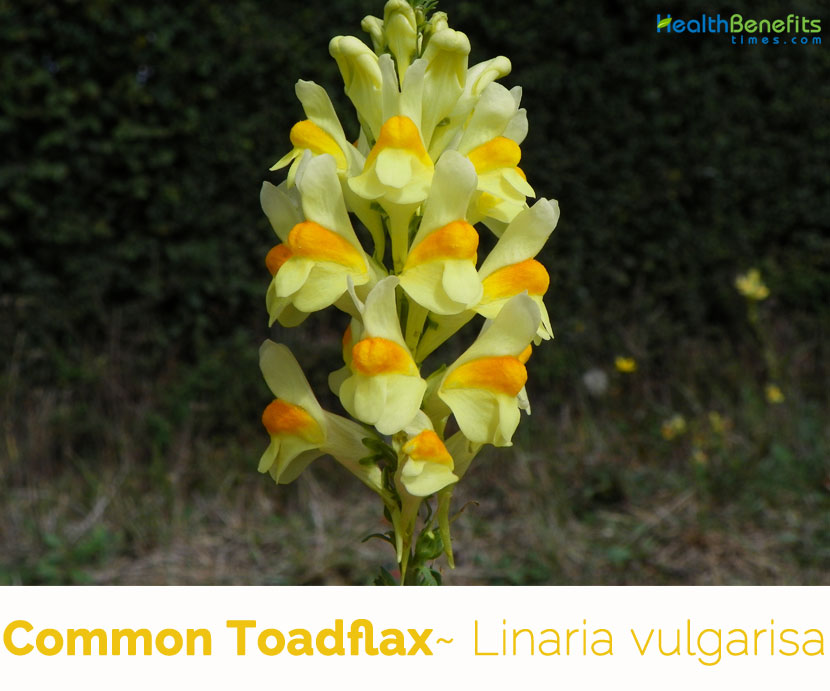
| Common Toadflax Quick Facts | |
|---|---|
| Name: | Common Toadflax |
| Scientific Name: | Linaria vulgaris |
| Origin | Europe and Asia, it has been widely introduced to North America, Australia, New Zealand and South Africa |
| Colors | Green when young turning to brown as they matures |
| Shapes | Two-celled globose capsule 5–11 mm (0.20–0.43 in) long and 5–7 mm (0.20–0.28 in) broad |
| Taste | Weakly saline, bitter and slightly acrid taste |
| Health benefits | Good for edema, jaundice, liver diseases, gall bladder complaints, skin problems, hemorrhoids, sores, malignant ulcers, piles, diarrhea, cystitis, dropsy, and enteritis with drowsiness |
| Name | Common Toadflax |
|---|---|
| Scientific Name | Linaria vulgaris |
| Native | Temperate areas of Europe and Asia, it has been widely introduced to North America, Australia, New Zealand and South Africa, and is regarded as noxious in many of these countries |
| Common Names | Brideweed, bridewort, butter and eggs, butter haycocks, bread and butter, bunny haycocks, bunny mouths, calf’s snout, Continental weed, dead men’s bones, devil’s flax, devil’s flower, doggies, dragon bushes, eggs and bacon, eggs and butter, false flax, flaxweed, fluellen, gallweed, gallwort, impudent lawyer, Jacob’s ladder, lion’s mouth, monkey flower, North American ramsted, rabbit flower, rancid, ransted, snapdragon, wild flax, wild snapdragon, wild tobacco, yellow rod, yellow toadflax |
| Name in Other Languages | Afrikaans: Toadflax Albanian: Toadflax, linarie, peçeruku Amharic: Todafalakisi (ቶዳፋላክስ) Arabic: Aldafadae (الضفدع) Armenian: Todflak’s (տոդֆլաքս) Azerbaijani: Toadflax, Adi mahmızca Basque: Igitai-belar arrunt Bengali: Ṭōḍā phlyāksa (টোড্ফ্ল্যাক্স) Bulgarian: Toadflax-ˈtōdˌflaks, obiknovena lulichka (обикновена луличка) Burmese: Kyaatswanmyaate (ကြက်သွန်မြိတ်) Catalan: Palometa, Cotó, Gallarets, Llinària Chinese : Chánchú (蟾蜍), liu chuan yu (柳穿鱼) Croatian: Lanilist, obični lanilist Czech: Ropucha, Lnice květel, lnice obecná, hosoba-unran, inice obecná, sporrebloma Danish: Torskemund, Almindelig torskemund Dutch: Toadflax, Vlasbekje, vlasleeuwebek English: Toadflax, Jacob’s ladder, Butter and eggs, Common toadflax, Flaxweed, Greater butter-and-eggs, Ramsted, Toadflax, Wild snapdragon, Yellow toadflax, common linaria, wild snapdragon Esperanto: Buŝflako Estonian: Toadflax, Harilik käokannus Filipino: Toadflax Finnish: Toadflax, Keltakannusruoho, Kannusruoho French: Crapaud, Linaire commune, Linaire vulgaire, linaire, gueule de lion, gueule de lion des champs, lin des crapauds, muflier sauvage, pain et beurre, pisse de chien, linaire vulgaire, muflier linaire Georgian: Todalaksi (ტოდალაქსი) German: Toadflax, Gemeines Leinkraut, Gewöhnliches Leinkraut, Echtes Leinkraut, Frauenflachs, Kleines Löwenmaul, Leinkraut, Flachskraut, großes Leinkraut Greek: Toadflax-ˈtōdˌflaks, linária (λινάρια) Gujarati: Toadflax-ˈtōdˌflaks Hausa: Toadflax Hebrew: קרפדת Hindi: Toadflax-ˈtōdˌflaks Hungarian: Toadflax, Közönséges gyújtoványfű Icelandic: Snjóflóð Indonesian: Toadflax Irish: Toadflax, buaflíon balla Italian: Toadflax, Linaria volgare, Linajola commune, linajola, cordiali, linaiola, linaiola commune, linaria commune, Jamaica: dead man bones Japanese: Hikigaeru (ヒキガエル), hosobaunran (ホソバウンラン), seiyou un-ran Javanese: Toadflax Kannada: Ṭōḍphlāks (ಟೋಡ್ಫ್ಲಾಕ್ಸ್) Kashubian: Zwùńc Kazakh: тоадфлак Korean: Dukkeobi (두꺼비) Kurdish: Toadflax, Newroz Lao: Toadflax-ˈtōdˌflaks Latin: Toadflax Latvian: Toadflax, Parastā vīrcele, Lithuanian: Toadflax, Paprastoji linažolė Macedonian: Zhaba (жаба), Običen lenolist (Обичен ленолист) Malagasy: Toadflax Malay: Toadflax Malayalam: Toadflax-ˈtōdˌflaks Maltese: Toadflax Marathi: Todaphleks (टॉडफ्लेक्स) Mongolian: Toadflax-ˈtōdˌflaks Nepali: Toadflax-ˈtōdˌflaks Netherlands: Vlasbekje, vlasleeuwebek Northern Sami: Čurrorássi Norwegian: Toadflax, Lintorskemunn, Torske-flab, Torskemunn Oriya: Toadflax Pashto: Oadflax Persian: Tadflax, گل کتانی Polish: Toadflax, Lnica pospolita, linnete Portuguese: Toadflax Punjabi: Toadflax-ˈtōdˌflaks Romanian: Toadflax Russian: lʹnyanka (льнянка), l’nânka obyknovennaâ (Льнянка обыкновенная) Serbian: Toadflak (тоадфлак), Lanilist (Ланилист), obični lanilist (обични ланилист) Sindhi: ٽوڊفلڪس Sinhala: Toadflax-ˈtōdˌflaks Slovak: Pyštek obyčajný, nevruzotu Slovenian: Toadflax, navadna madronščica Spanish: Sapo, Linaria común, navadna madronščica, pajarita, lino montesino Sudanese: Toadflax Swedish: Gulsporre, Keltakannusruoho, Gulsporreblomma, Sporreblomma Tajik: Toadflax-ˈtōdˌflaks Tamil: Toadflax-ˈtōdˌflaks Telugu: Toadflax-ˈtōdˌflaks Thai: Toadflax-ˈtōdˌflaks Turkish: Nevruzotu Ukrainian: Zhaba (жаба), Lʹonok zvychaynyy (Льонок звичайний), Yabluni (Яблуні), Yabluchne derevo (Яблучне дерево) Upper Sorbian: Dobry lenčk, Swjateje marijny len, Žonjace zelo Urdu: Toadflax USA: Jacob’s ladder, ranstead Uzbek: Toadflax Vietnamese: Cóc Welsh: Toadflax, Llin y llyffant Zulu: I-toadflax |
| Plant Growth Habit | Erect, invasive, herbaceous, short-lived perennial plant |
| Growing Climates | Hedgerows, by ditches, roadside verges, mountain slopes, trail-sides, meadows, gravelly steppes and forests, cropland, pastures, rangeland, river banks, railway lines and fallows, fields, undisturbed prairies, rangelands, farmlands, riparian corridors, old fields, clearings, and overgrazed rangeland and sterile waste ground |
| Soil | Prefer well-drained, relatively coarse-textured soils that range from coarse gravels to sandy loams, but they also can be found in heavy clay soils. It grows best in moist, more fertile soils |
| Plant Size | About 3.3 ft. (1 m) tall |
| Stem | Glabrous to glandular hairy near the top portion of the stem (CDFA, undated) and develops woody tissue near the base of the stem |
| Leaf | The leaves are 2-5 cm long, alternate, sessile not clasping (Ogden & Renz, 2005), linear to narrow, and pale green, soft, often drooping with small hairs |
| Flowering season | July to October |
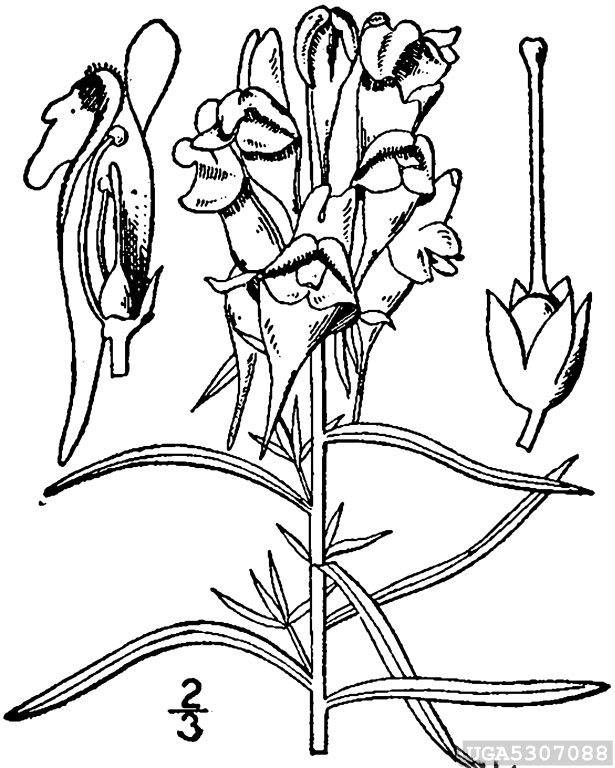
| Flower | Flowers are similar to those of the snapdragon, 25–33 mm (0.98–1.30 in) long, pale yellow except for the lower tip which is orange, borne in dense terminal racemes from mid-summer to mid-autumn. The flowers are mostly visited by bumblebees |
| Fruit Shape & Size | Two-celled globose capsule 5–11 mm (0.20–0.43 in) long and 5–7 mm (0.20–0.28 in) broad. Each capsule contains small, flat seeds with a papery wing |
| Fruit Color | Green when young turning to brown as they matures |
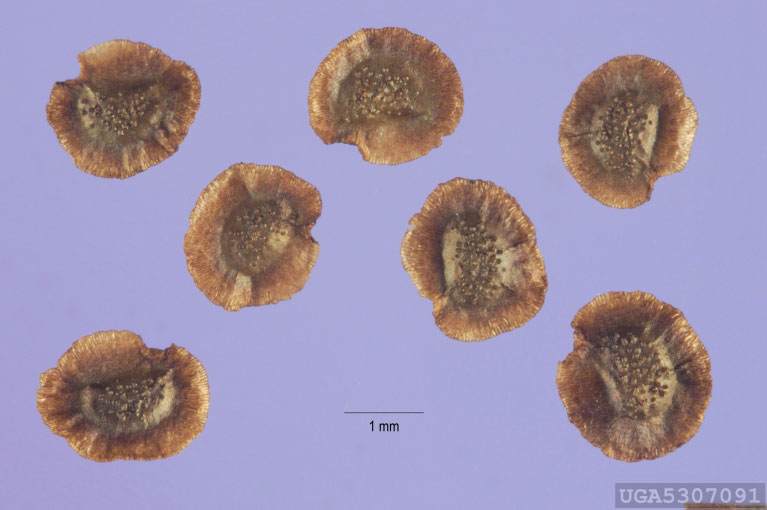
| Seed | Seeds are small, flat, dark brown in colour, with a circular papery wing |
| Propagation | By seed and vegetatively from adventitious buds |
| Flavor/Aroma | Peculiar, heavy, disagreeable smell |
| Taste | Weakly saline, bitter and slightly acrid taste |
| Plant Parts Used | Leaves, flowers, whole plant (fresh or dried) |
| Season | August to October |
| Culinary Uses |
|
| Precaution |
|
Yellow toadflax was first introduced to North America by a Welsh Quaker as an ornamental plant. In addition to its beauty, it was also used for creating yellow dye, and as a lotion to help heal insect bites. This is a short-lived perennial that some people consider invasive while others welcome the beauty of this medicinal plant. Interestingly, when boiled in milk, the plant is said to yield an excellent fly poison; and an old country custom in parts of Sweden is to leave this milk infusion where flies are troublesome.
Plant Description
Common Toadflax or Yellow toadflax is an erect, invasive, herbaceous, short-lived perennial plant that normally grows about 3.3 ft. (1 m) tall. The plant is found growing in hedgerows, by ditches, roadside verges, mountain slopes, trail-sides, meadows, gravelly steppes and forests, cropland, pastures, rangeland, river banks, railway lines and fallows, fields, undisturbed prairies, rangelands, farmlands, riparian corridors, old fields, clearings, and overgrazed rangeland and sterile waste ground. The plant prefers well-drained, relatively coarse-textured soils that range from coarse gravels to sandy loams, but they also can be found in heavy clay soils. It grows best in moist, more fertile soils. Yellow toadflax roots can grow over 3 feet deep and over 10 feet laterally. Root buds can be detected 2 to 3 weeks after germination
Stems
Yellow toadflax stems range from less than 1 ft. (31 cm) to nearly 3 ft. (0.9 m) tall, and are generally unbranched, or at most, sparsely branched. A single yellow toadflax plant can produce several woody stems. Mature plants may have 1 to 25 stems. The woody stems usually have a reddish color at the base, becoming more slender, succulent, and greener toward the growing tip. Stems are hairless
Leaves
The plant has long, soft, thin leaves about 1 to 2 in (2.5 to 5 cm) long and 1/8 to 1/6 inch wide that are pointed at both ends with a narrow, tapering base; pale green with a silvery tinge. They are arranged alternately, but may grow so closely along the stem that they appear to be whorled or opposite. The leaf margins are entire, and the leaves are not hairy. Older leaves have a single vein visible on the underside. Leaves closely resemble those of leafy spurge, but yellow toadflax shoots do not contain a milky sap.
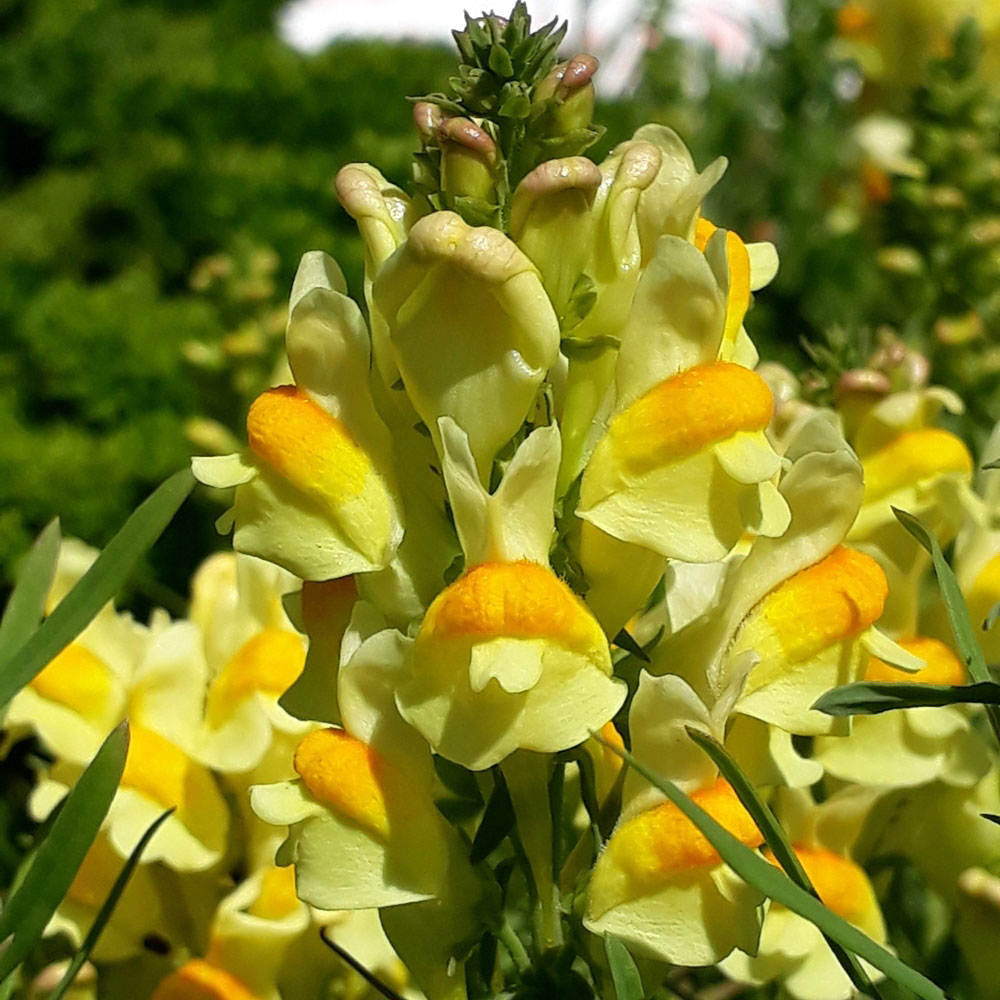 Closer-view-of-flowers-of-Common-Toadflax
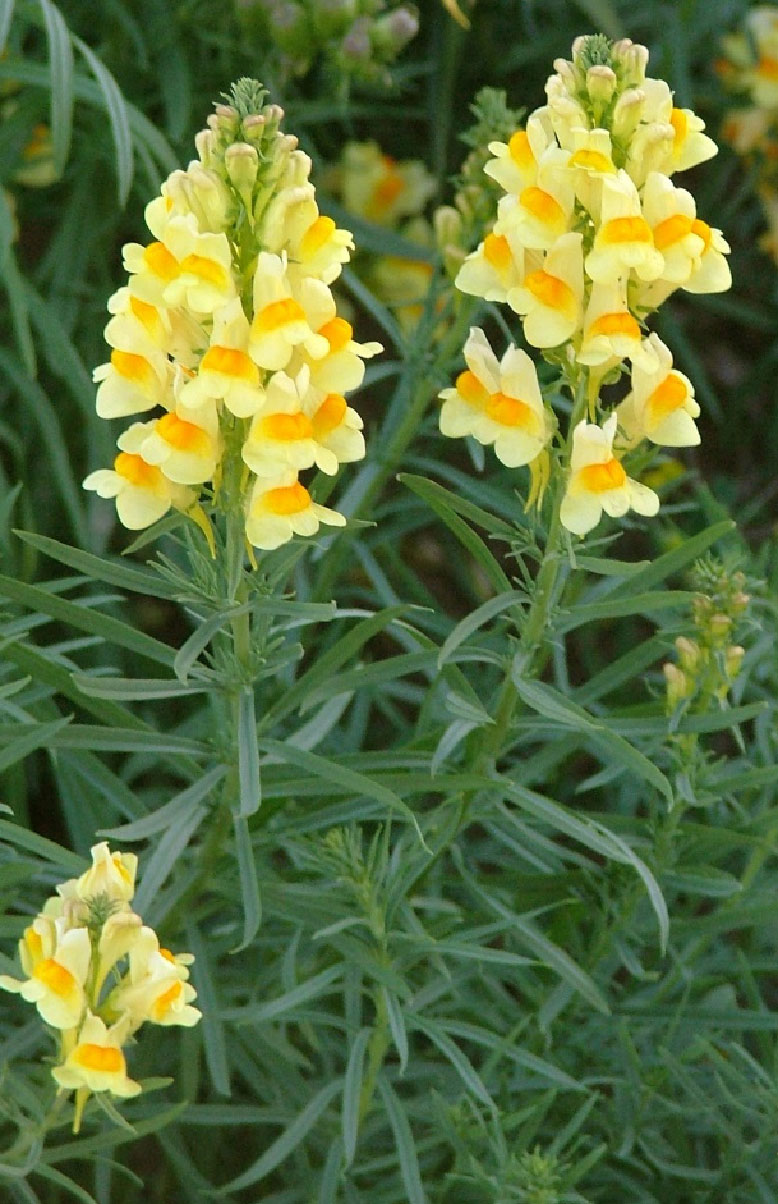 Common-Toadflax-plant
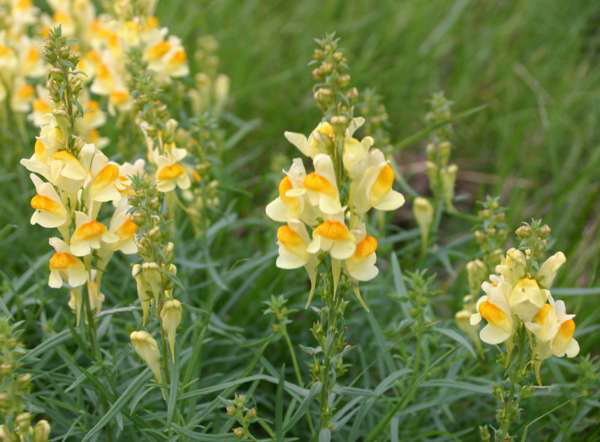 Common-Toadflax-plant-growing-wild
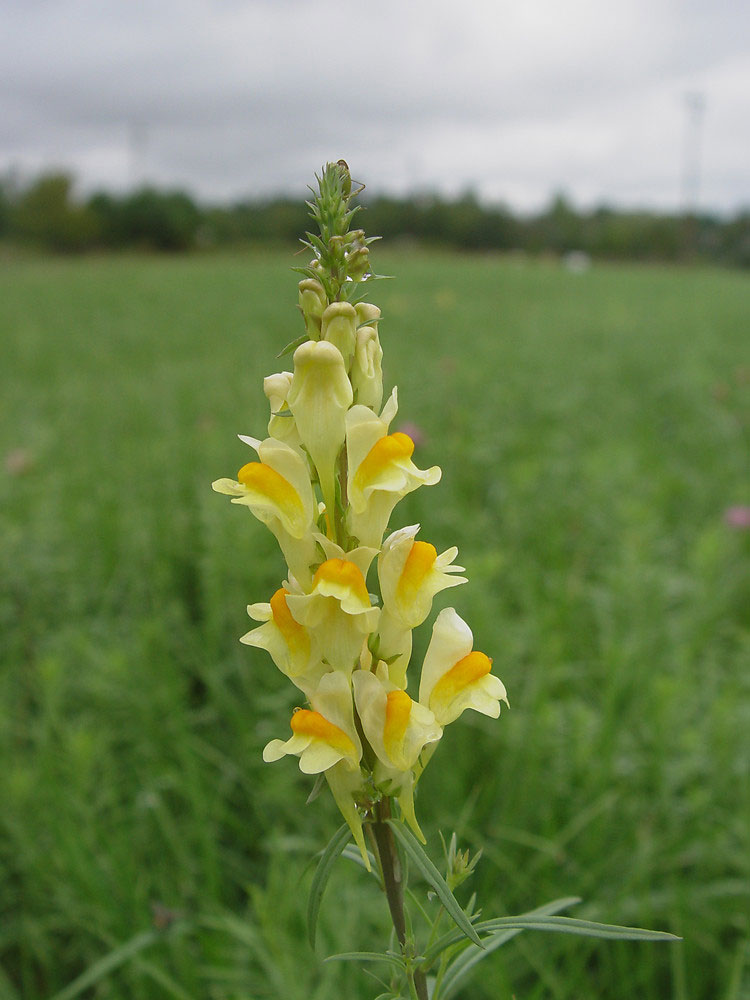 Flower-of-Common-Toadflax
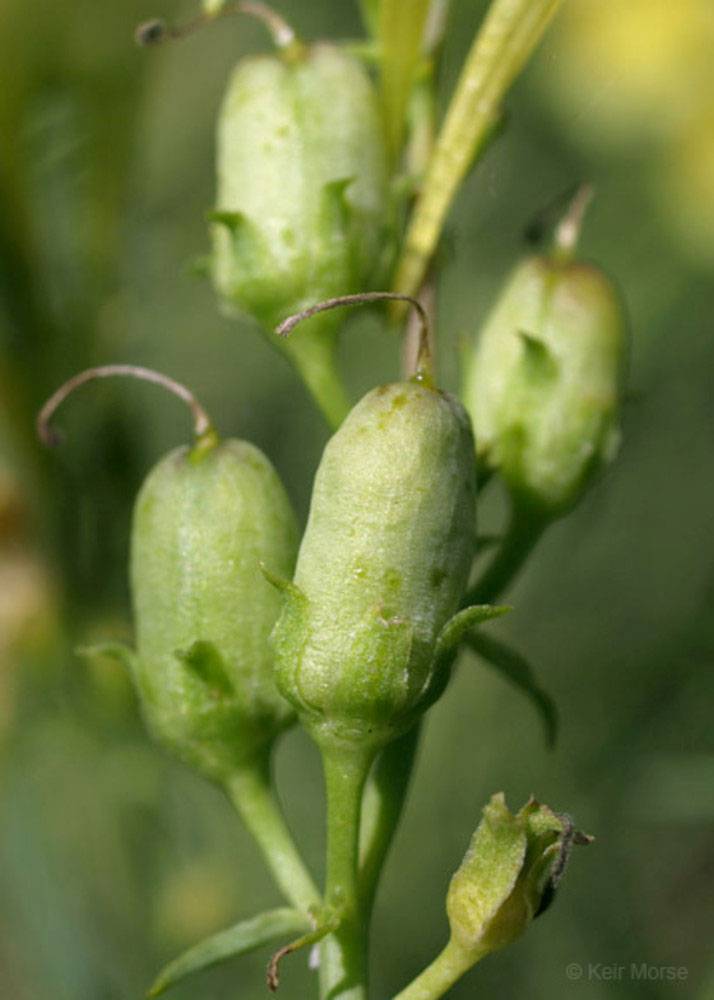 Fruits-of-Common-Toadflax
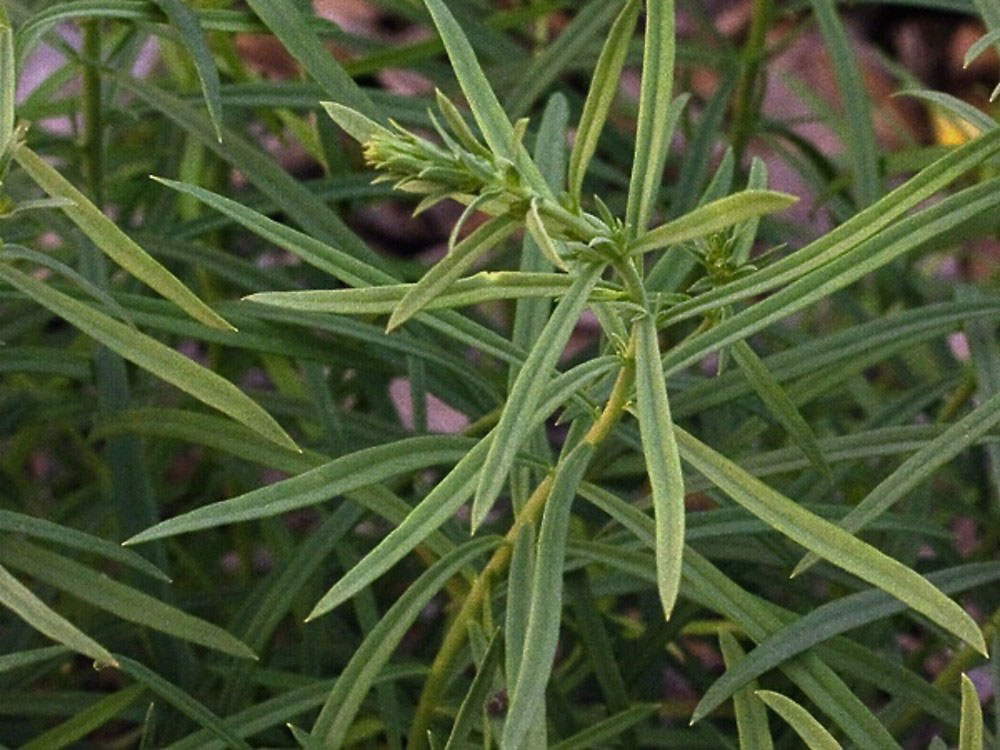 Leaves-of-Common-Toadflax
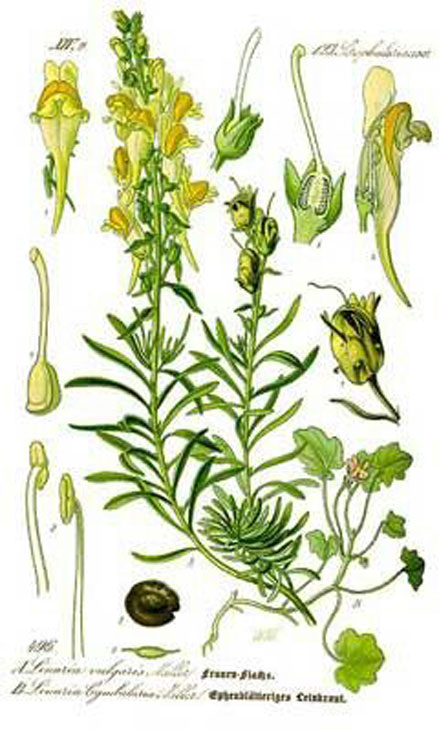 Plant-Illustration-of-Common-Toadflax
 Seeds-of-Common-Toadflax
 Sketch-of-Common-Toadflax
Flowers
Common toadflax flowers are pale yellow, two-lipped, spurred, snapdragon-like blossoms that are 0.8 to 1.6 in (2 to 4 cm) long. The upper lip is double-lobed and the lower lip has three lobes. The long spur contains nectar. The bearded throat of yellow toadflax flowers is bright orange (hence the common name “butter-and-eggs”). Flowers appear as dense terminal elongated clusters at the top of the stem in groups of six to 30. The mouth of the flower is totally closed and never opens until a bee forces it open. They flower at different times depending on site conditions. Common toadflax blooms later in August and September. In high elevations they could flower as late as July. Droughty conditions may delay yellow toadflax flowering.
Fruits and seeds
Yellow toadflax forms a brown two-celled globose capsule 5–11 mm (0.20–0.43 in) long and 5–7 mm (0.20–0.28 in) broad, containing numerous small seeds. Each stem can produce up to 30 capsules, with each capsule yielding up to 250 seeds. The seeds of yellow toadflax are very small, lightweight, rough, round, and flat with a papery notched circular wing that is about 0.06 in (0.02 mm) in diameter and dark brown in color. Each yellow toadflax seed capsule will have 10–110 seeds, and each plant may produce about 1,500 to 30,000 seeds. Normally, 80–90% of yellow toadflax seed falls within 18 inches of the parent plant. Seeds of yellow toadflax species can remain viable in the soil for over 10 years. Wind is the primary means of seed dispersal of toadflax species.
History
Toadflax is a native of Eurasia that was introduced into North America as a garden flower despite warnings of its weedy potential. Because it was regarded as a desirable wild flower, it was allowed to escape cultivation and spread. As a result, it is now naturalized throughout the U.S. and Canada. Toadflax is commonly found in eastern North America and along the Pacific Coast. It is distributed throughout Ohio. It can be found along roadsides, fence lines, waste places, pastures, rangeland, wood edges, and in cultivated fields. Reproduction is by seeds and creeping horizontal roots. The species is very adaptable and can be found growing in a wide range of conditions from sub-arctic to temperate, dry plateaus to damp rocks, mountain regions to grazed areas, and gravelly or sandy soils to fertile loams.
Traditional uses and benefits of Common Toadflax
- Yellow toadflax has a long history of herbal use.
- It acts mainly on the liver and was once widely used as a diuretic in the treatment of edema.
- Whole plant is antiphlogistic, astringent, cathartic, detergent, depurative, diuretic, hepatic, ophthalmic and purgative.
- It is collected when just coming into flower and can be used fresh or dried.
- The plant is especially valued for its strongly laxative and diuretic activities.
- It is used internally in the treatment of edema, jaundice, liver diseases, gall bladder complaints and skin problems.
- Externally it is applied to hemorrhoids, skin eruptions, sores and malignant ulcers.
- Fresh plant, or an ointment made from the flowers, is applied to piles, skin eruptions etc.
- Juice of the plant, or the distilled water, is a good remedy for inflamed eyes and cleaning ulcerous sores.
- A homeopathic remedy is made from the plant.
- It is used in the treatment of diarrhea and cystitis.
- Tea made from the leaves was taken as a laxative and strong diuretic as well as for jaundice, dropsy, and enteritis with drowsiness.
- For skin diseases and piles, either a leaf tea or an ointment made from the flowers was used.
- It is used in the treatment of Jaundice, Liver, Scrofula and Skin diseases.
- Fresh plant is occasionally applied as a poultice or fomentation to hemorrhoids and an ointment of the flowers has been used for the same purpose, and also locally in diseases of the skin.
Ayurvedic Health benefits of Common Toadflax
- Liver Disorders: Prepare decoction of the leaves and flowers of Toadflax and drink half cup twice daily.
- Wounds: Prepare an infusion of the whole plant and use as a cleanser for Wounds.
- Insecticidal: Toadflax steeped and boiled in milk can be used as a good Insecticidal, especially for flies. It can be placed where a lot of flies gather.
- Piles: Toadflax flowers can be used externally as an ointment for Piles.
Other Facts
- A yellow dye is obtained from the whole plant.
- It is obtained from the flowers according to other reports.
- A tea made from the plant has been used as an insecticide.
- The flower has been used to create yellow dye.
- A single plant can produce up to 500 000 seeds per year!
- The plant is poisonous to livestock if ingested.
Common Toadflax Management
Preventive measures
Prevention can be the easiest, cheapest, and most effective means of control. Stricter regulation of what agents, materials, or development can be brought or done into wilderness areas and public lands needs consideration. An example is the restriction of livestock in nature reserves should be considered. Monitoring is critical in knowing where invading populations occur and how abundant. It is easier to control small infestations before a population build-up. Education, awareness programs, advertising and community outreach are all excellent ways to stay informed at a local or regional level and allows earlier detection. Research is necessary in order to develop new methods and techniques of control and better understand the biology of the species.
Physical
Most physical methods of control for Linaria vulgaris alone are not satisfactory, and not recommended for medium to large stands. Mowing helps to prevent the plant from going to seed, but mowing also encourages vegetative reproduction from the lateral roots and rhizomes which can exasberate the problem further. Fire is also not effective because the underground rhizome system is not damaged and will just resprout shoots. Tilling on arable lands can be effective in eradicating L. vulgaris, but tilling needs to be done every 7-10 days over the course of the season and repeated yearly for several years in order to eradicate resprouting root fragments. Grazing by livestock is also not recommended as it stimulates vegetative growth with viable seeds passing through the digestive tract. Overgrazing can reduce competition and increase the disturbance to the site creating an ideal environment for toadflax establishment. The plant is not preferred by grazing livestock and contains poisonous glucosides that are moderately toxic to livestock.
Cultural
Some cultural options for control of L. vulgaris is proper timing of seeding agricultural crops, over-seeding, fertilizing, using high quality seed, planting at high densities, and using species that are adapted to your region. Revegetating with native species in particular perennial grasses which are more competitive to perennial forbs is another option.
Chemical
Chemicals that have shown to be effective in controlling L. vulgaris are glyphosates, a nonselective herbicide, and Telar and Tordon, two selective herbicides, among many others. Repeated applications may be required periodically every few years for up to twelve years. Applications should be timed around flowering when the plants are most vulnerable or after a hard frost. Integrated management by seeding competitive species shortly after a chemical application has shown to be effective in preventing reemergence (Beck, 2006). Always follow labeled instructions for any chemical and make sure that any chemical being applied is not going to kill or reduce the competitive ability of any native species.
References:
http://www.theplantlist.org/tpl1.1/record/kew-2498895
https://www.itis.gov/servlet/SingleRpt/SingleRpt?search_topic=TSN&search_value=33216#null
https://pfaf.org/user/Plant.aspx?LatinName=Linaria+vulgaris
https://www.cabi.org/isc/datasheet/30828
http://www.floracatalana.net/linaria-vulgaris-mill-
https://plants.usda.gov/core/profile?symbol=livu2#
https://en.wikipedia.org/wiki/Linaria_vulgaris
http://www.iucngisd.org/gisd/species.php?sc=1176
http://issg.org/database/species/ecology.asp?si=1176&fr=1&sts=&lang=EN
https://www.botanical.com/botanical/mgmh/t/toadfl19.html
https://gd.eppo.int/taxon/LINVU
https://openprairie.sdstate.edu/cgi/viewcontent.cgi?article=1136&context=extension_fact