| Prickly amaranth Quick Facts |
| Name: |
Prickly amaranth |
| Scientific Name: |
Amaranthus spinosus |
| Origin |
Lowlands of tropical America, but it is now a pantropical weed occurring in warmer areas worldwide |
| Shapes |
Ovoid shaped fruit, mostly dehiscent, compressed, ellipsoidal, acute or obtuse, with a short inflated neck below the style base |
| Taste |
Bitter |
| Health benefits |
Beneficial for bronchitis, appetizer, biliousness, galactagogue, hematinic, stomachic effects, nausea, flatulence, anorexia, blood diseases, burning sensation, leucorrhoea, leprosy, piles and as a treatment for hallucination, healing of wounds and rheumatism, and to arrest the coughing up of blood |
Amaranthus spinosus, commonly known as the spiny amaranth, spiny pigweed, prickly amaranth or thorny amaranth belongs to Amaranth family Amaranthaceae. The plant is widely distributed throughout the tropics and warm temperate regions of Asia from Japan to Indonesia to India, the Pacific islands, native to tropical America and Australia as a weed in cultivated as well as fallow lands. The plant is sometimes a noxious weed. It can be a serious weed of rice cultivation in Asia. You can cook the leaves and stems or eaten raw to get its very nutritious benefits. Prickly amaranth, Spiny amaranth, Thorny amaranth, Thorny pigweed, Prince-of-Wales-feather, Carelessweed, Edlebur, Needlebur, Pigweed, Prickly calalu, Spiny pigweed, prickly, pigweed, soldier-weed, spiny pigweed, thorny amaranthus, calaloo, needle burr, pigweed, prickly calaloo, prickly callau, prickly caterpillar, spiny amaranthus, spiny calaloo, sticker weed, thorny pigweed and wild callau are some of the well-known common names of the plant. This herbal plant is mainly found in warm area and known for traditional medicine throughout the world.
Plant Description
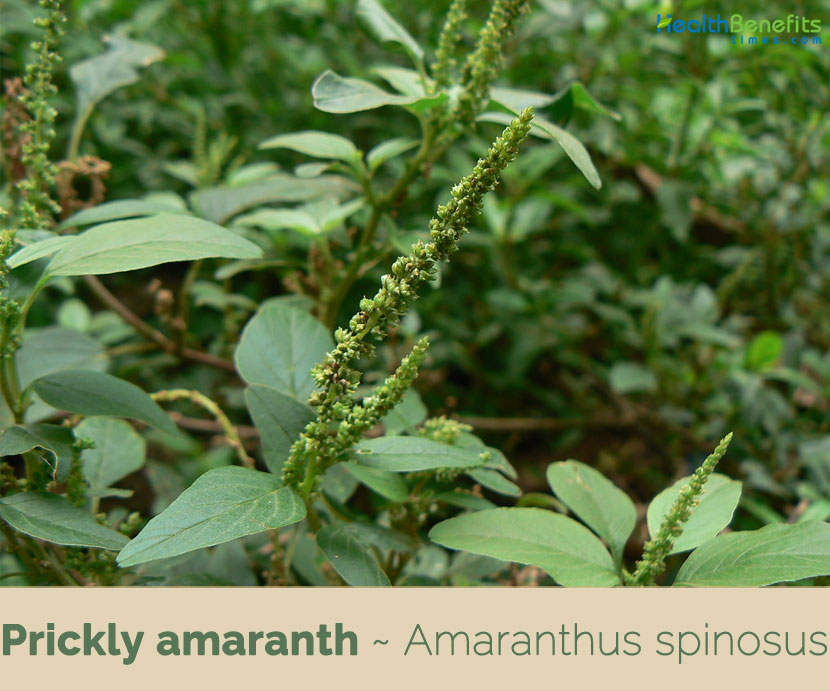
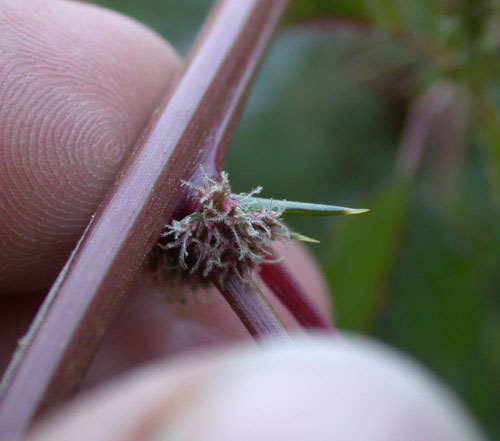
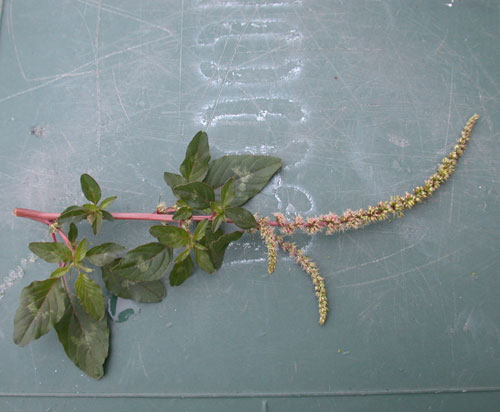
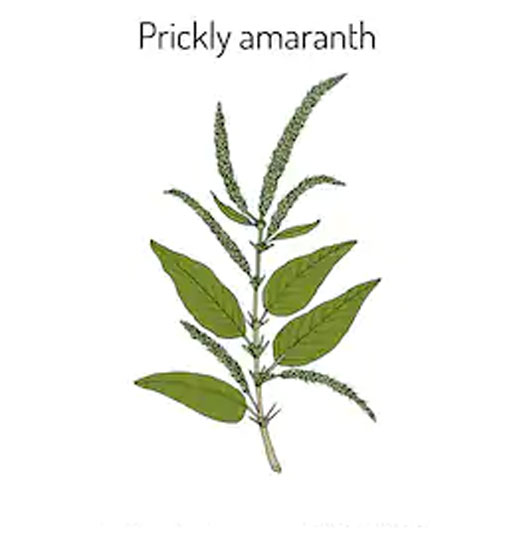
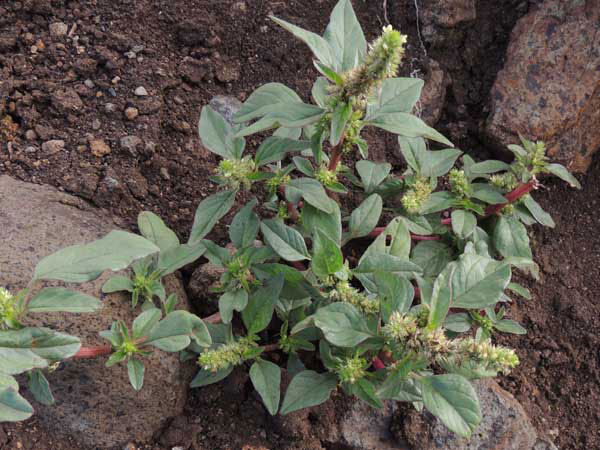
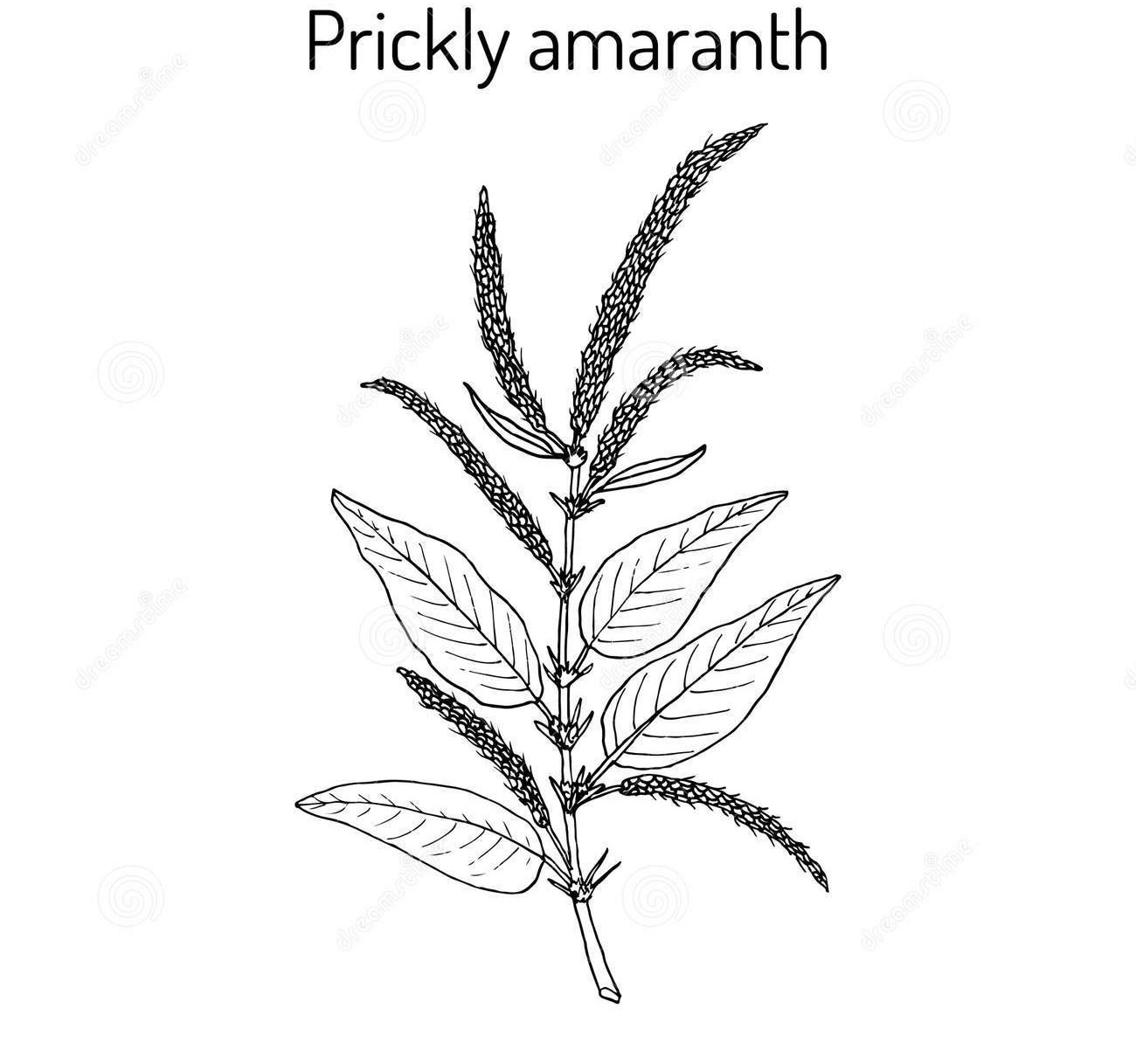
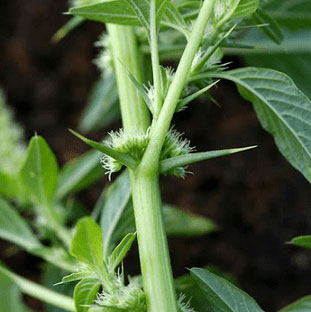
Prickly amaranth is an erect, spinous, multi branched, and smooth, herbaceous annual herb that grows up to 150 cm long. The plant is found growing in cultivated fields, waste places, roadsides; garbage heaps, and abandoned fields, disturbed areas, fields, along railroad tracks and stock pens. The plant thrives in rich, warm, loamy soils with high organic matter and sufficient nitrogen. The plant has strong taproot with a network of fibrous feeder roots. The taproot may or may not be distinctly reddish in color. Stem is erect or sometimes ascending proximally, much-branched and bushy, rarely nearly simple, 0.3-1(-2) m; each node with paired, divergent spines (modified bracts) to 1.5(-2.5) cm.
Leaves
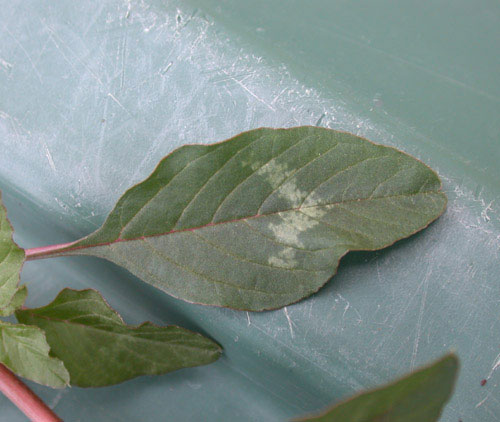
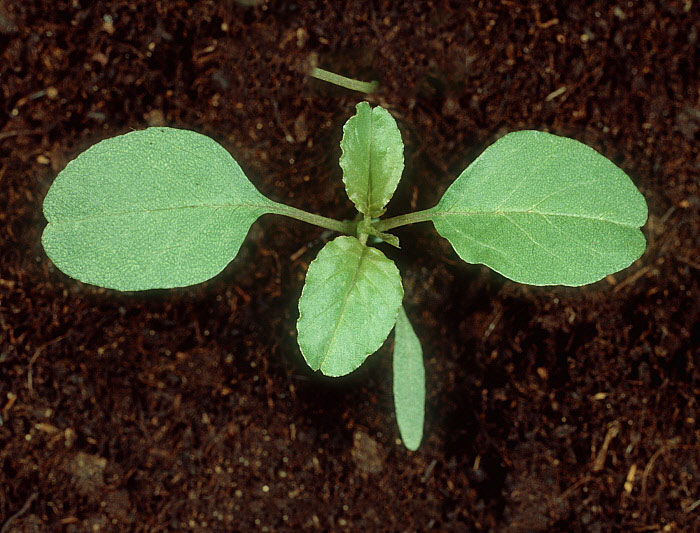
Leaves are simple and alternate without stipules. Leaf blades are egg-shaped to diamond-shaped, with the broader end closest to the stem, and 1–4 inches long and 0.5–2.5 inches wide. Petiole is approximately as long as the blade. Leaves may be variegated with a v-shaped watermark or area of lighter color, although this is not a definitive characteristic of this species, since some other amaranths can show a similar watermark. Both sides of the leaves are smooth, with many small translucent dots. The upper side is green, the lower side often purple.
Flower
Flowers are unisexual, solitary in the axil of a bract, subtended by 2 bracteoles. Bracts and bracteoles are scarious, mucronate from a broad base, shorter than or as long as the perianth. Male flowers are usually arranged in a terminal spike above the base of the inflorescence. Male flowers are often 3, free, sub equal, ovate-oblong to oblong-spatulate, up to 2.5 mm long, very convex, membranous, with transparent margins and green or purple median band. Male flowers have 5 stamens about as long as tepals. Female flowers are with superior, oblong ovary, 1-celled, styles 2–3, ultimately recurved. The female flowers are located at the base of the spikes, the male flowers at the tip.
Fruit and Seed
Fertile flowers are followed by ovoid shaped fruit, mostly dehiscent, compressed, ellipsoidal, acute or obtuse, with a short inflated neck below the style base, circum sessile a little below the middle or indehiscent. The fruit split along a transverse circular line (circumscissile) at maturity and are one-seeded. The seed is about 1 mm in diameter, lenticular, smooth, shiny, compressed, black or brownish-black in color with thin margin.
Health Benefits of Prickly Amaranth
Listed below are some of the well-known health benefits of Prickly amaranth
1. Help to lose weight
The most natural thing to do to lose weight is to maintain healthy eating; therefore we can gain the benefits of healthy eating. But amaranthus consists of a lot of vitamins and specific hormone that suppressed food appetite and helps to lose weight effectively.
2. Enhance eyes health
One of many health benefits of Prickly amaranth is to improve eye vision. It consists of lutein that is connected to eye tissue to make better vision.
3. Treatment for gastrointestinal problems
Leaves of Prickly amaranth consist of high fiber content that allows better circumstances to facilitate digestion process.
4. Hair health treatment
Prickly amaranth has rare amino acid that helps to prevent baldness.
5. Develop bones
It can be used as a super food to increase bone growth because it contain calcium that is necessary to develop bones. It has been said that this particular herbal plant is one of the most higher holdings of calcium compared to any other vegetables.
Traditional uses and benefits of Prickly amaranth
- Leaves, roots, and whole plant used as a laxative, blood purifier, diuretic, and soporific.
- Taking the crushed and squeezed juice from the plant will neutralize the venom in snake bites.
- Boiling the plant and taking it will keep help prevent miscarriages.
- Eating the leaves cooked in a curry will cure pain in urination and kidney stones.
- Juice squeezed from leaves can be licked with honey to cure vomiting and passing of blood, excessive menstruation, white vaginal discharge, gonorrhea, and sores and bumps.
- Paste of the root made with water will neutralize the poison if applied to the site of a scorpion sting.
- It can also be applied onto boils to cure them.
- Applying either the paste of the root or using the crushed root as a poultice will cure stiffness of the muscles.
- Paste made with water can be strained and taken once in the morning and once at night to cure excessive menstruation.
- Seed is used as a poultice for broken bones.
- Plant is astringent, diaphoretic, diuretic, emollient, febrifuge and galactogogue.
- It is used internally in the treatment of internal bleeding, diarrhea and excessive menstruation.
- Externally, it is used to treat ulcerated mouths, vaginal discharges, nosebleeds and wounds.
- Root is emmenogogue and galactogogue.
- Paste of the root is used in the treatment of menorrhagia, gonorrhea, eczema and colic.
- It helps to remove pus from boils.
- Juice of the root is used in Nepal to treat fevers, urinary troubles, diarrhea and dysentery.
- It is also used, often combined with the root juice of Dichrophela integra and Rubus ellipticus, to treat stomach disorders and, on its own, to treat indigestion and vomiting that occur after eating unusual foods.
- Decoction of the root is used to treat gonorrhea and as an antipyretic in South East Asia.
- Bruised leaves are considered a good emollient and applied externally in cases of eczema, burns, wounds, boils, earache and hemorrhoids.
- Some tribes in India used A. spinosus to induce abortion.
- Ash of fruits of Amaranthus spinosus is used for jaundice in folk medicine of India.
- The plant ash in solution is used to wash sores.
- Plant sap is used as an eye wash to treat ophthalmia and convulsions in children.
- It is used as an expectorant and to relieve breathing in acute bronchitis in Malaysia.
- Decoction of roots has been used for treatment of gonorrhea in Philippines.
- Roots – sun dried, calcined, powdered and made into pill are used for gonorrhea.
- Roots are used for menorrhagia, gonorrhea, eczema, colic and as lactagogue in Pakistan.
- Leaves and roots used as laxative, on boils and as poultice for abscesses.
- It is used for diabetes in traditional medicine of Taiwan and China.
- Enema prepared from the plant is used for piles in Gold Coast.
- Poultice of seeds are used for broken bones; used internally for bleeding, diarrhea and menorrhagia in China.
- Infusion of roots used in treatment of eczema in India.
- Bruised leaves used as emollient; applied externally to ulcerations in the mouth, eczema, burns, wounds, boils, earaches and hemorrhoids.
- It is used as expectorant and for acute bronchitis in Malaysia.
- In Ayurveda, leaf infusion used as diuretic and for treatment of anemia.
- Root paste used in treatment of gonorrhea.
- Ashes from burnt plant used for sores; juice from plant used as eye wash in Nigeria.
- In Hindi medicine, roots used as a specific colic remedy.
- Warmed leaves are applied locally three times daily for five to cure boils and burns in the Bhadrak district of Odisha, India.
- The Anyi-Ndenye women of eastern Cote d’Ivoire use leaf enema during pregnancy.
- In the Guianas, root used for toothache; leaf compresses used as compresses in herbal curative baths by the Surinam Saramaccan Bush Negroes.
- Juice of A. spinosus is used by tribal of Kerala, India to prevent swelling around stomach.
- Leaves are boiled without salt and consumed for 2–3 days to cure jaundice.
- it is a popular medicinal plant used to reputed for treat digestible, bronchitis, appetizer, biliousness, galactagogue, hematinic, stomachic effects, nausea, flatulence, anorexia, blood diseases, burning sensation, leucorrhoea, leprosy, piles and as a treatment for hallucination, healing of wounds and rheumatism, and to arrest the coughing up of blood.
- Village people of Sikkim who use leaf infusion of in stomach disorder especially in case of indigestion and peptic ulcer.
- Leaves and roots are applied as poultice to relief bruises, abscesses, burns, wound, inflammation, menorrhagia, gonorrhea, eczema, gastroenteritis, gall bladder inflammation, arthritis and for the treatment of snakebites.
- Plant is used in the treatment of abdominal pain, chicken pox, dysentery, dysuria, fever, hysteria, malaria, mania, tonsillitis & vomiting.
- Leaf juice of the plant, two tea spoonful thrice a day, is given to patients suffering from peptic ulcer.
- The Chinese use A. spinosus as a traditional medicine to treat diabetes.
- Seed is used as a poultice for broken bones.
- The Nepalese and some tribes in India apply A. spinosus to induce abortion.
- Root is also used for toothaches.
- In many countries, including those in Africa, the bruised leaves are considered a good emollient and applied externally in cases of ulcerated mouths, eczema, burns, wounds, boils, earache and hemorrhoids.
- Bark decoction is taken in a volume of about one liter three times a day to ward off malaria.
Culinary Uses
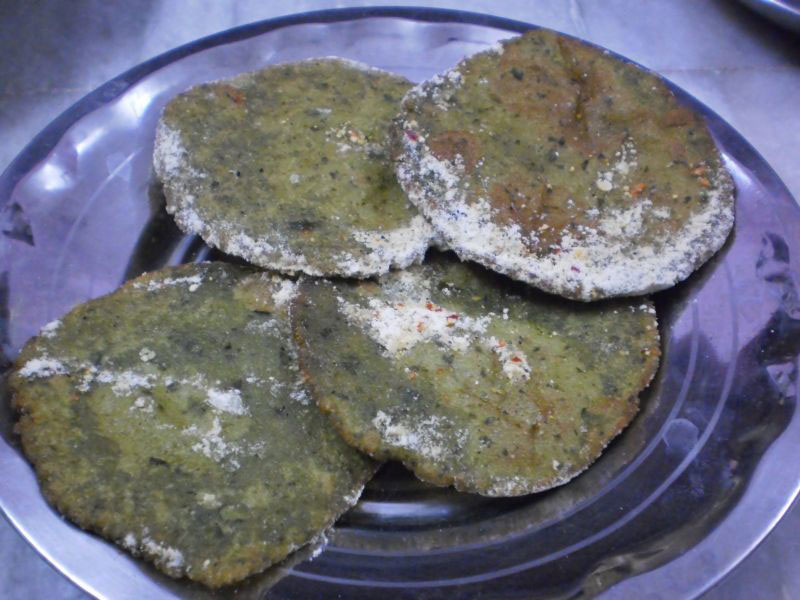
- Leaves and stems of Amaranthus spinosus are eaten raw or cooked as spinach.
- Ash is also used as a vegetable salt and in southern Africa it is used as a snuff, alone or with tobacco.
- Mature stems are piled, cut into small pieces and cooked as vegetable especially with small fishes.
- It is also added to the water as a tenderizer when cooking tough vegetables such as cowpea leaves and pigeon peas.
- Red pigment obtained from the plant (the report does not specify which part of the plant) is used as a coloring in foods.
Other Facts
- Yellow and green dyes can be obtained from the whole plant.
- Red pigment obtained from the plant (the report does not specify which part of the plant) is used as a coloring in foods and medicines.
- In tropical Africa and elsewhere, A. spinosus leaves and young plants are collected for home consumption as a cooked, steamed or fried vegetable, especially during periods of drought.
- It is also used as forage and said to increase the yield of milk in cattle.
- It can produce up to 235 thousand seeds per plant.
References:
https://www.itis.gov/servlet/SingleRpt/SingleRpt?search_topic=TSN&search_value=20748#null
http://www.hear.org/pier/species/amaranthus_spinosus.htm
https://npgsweb.ars-grin.gov/gringlobal/taxonomydetail.aspx?id=2804
https://pfaf.org/user/Plant.aspx?LatinName=Amaranthus+spinosus
https://www.cabi.org/isc/datasheet/4653
http://www.floracatalana.net/amaranthus-spinosus-l
https://www.plants.usda.gov/core/profile?symbol=Amsp
https://en.wikipedia.org/wiki/Amaranthus_spinosus
http://floraofalabama.org/Plant.aspx?id=285&display=photos
http://www.theplantlist.org/tpl/record/kew-2633107
https://gd.eppo.int/taxon/AMASP
http://www.medicinalplantsindia.com/prickly-amaranth.html
http://www.flowersofindia.net/catalog/slides/Prickly%20Amaranth.html
https://uses.plantnet-project.org/en/Amaranthus_spinosus_(PROTA)
http://www.stuartxchange.org/Uray.html
http://www.ijrpc.com/files/20-4130.pdf
https://indiabiodiversity.org/species/show/32937
https://eorganic.org/node/5125
https://www.prota4u.org/database/protav8.asp?g=pe&p=Amaranthus+spinosus+L.
Comments
comments