Health Benefits
    Facebook Twitter Instagram
    Friday, December 5
    Facebook Twitter Pinterest
    Health Benefits
    • Home
    • Dental Health
    • Mental Health
    • Weight Loss
    • Health Wiki
    • Nutrition
    • Healthy Recipe
    • BMI Calculator
    Health Benefits
    Home»Herbs and Spices»Facts about Prickly sow thistle
    Herbs and Spices

    Facts about Prickly sow thistle

    By SylviaMarch 8, 2019Updated:March 8, 2019No Comments8 Mins Read
    Facebook Twitter Pinterest LinkedIn Tumblr Email

    Facts-about-Prickly-sow-thistle

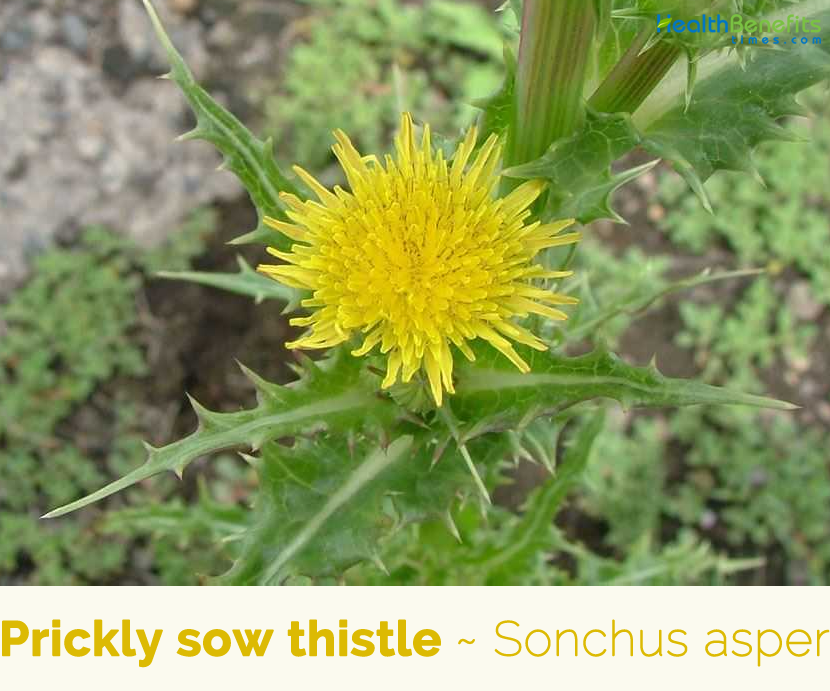
    Prickly sow thistle scientifically known as Sonchus asper is a dicotyledonous perennial or annual herb in the Asteraceae ⁄ Compositae (Aster family). The plant is native to Africa (i.e. Algeria, Egypt, Libya, Morocco, Tunisia, Ethiopia, Sudan, Kenya, Tanzania, Uganda, Cameroon, Rwanda, Zaire, Senegal, Angola, Malawi, Mozambique, Zambia, Zimbabwe and Botswana), Madagascar, Europe, western and central Asia (i.e. Afghanistan, Iran, Iraq, Jordan, Lebanon, Syria, Armenia, Azerbaijan, Georgia, Kazakhstan, Kyrgyzstan, Tajikistan, Turkmenistan, Uzbekistan and Russia), China and the Indian Sub-continent (i.e. India, Nepal and Pakistan). It is considered a weed in agricultural systems mostly due to its role in harboring diseases and pests. It produces large numbers of seeds that are dispersed by wind. Few of the popular common names of the plant are blue sow-thistle, prickly sow thistle, prickly sow-thistle, prickly sow thistle, rough sow thistle, rough sow-thistle, rough sow thistle, sow thistle, spiny sow thistle, spiny sow thistle, spiny-leaf sow thistle, spiny leaf sow thistle, spiny-leaved sow thistle, Native Sow-Thistle, sharp-fringed sow thistle and spiny milk thistle.

    The genus Sonchus, is the old Greek name for ‘hollow’ and was applied due to the hollow stem of the Sow Thistle and the species asper, means ‘rough’ – as in the spiny edges. The author name for the plant classification is as follows: The first to classify was ‘(L.)’ which refers to Carl Linnaeus (1707-1778), Swedish botanist and the developer of the binomial nomenclature of modern taxonomy. His work was modified by ‘Hill’ which is for John Hill (c1716-1775), English botanist, author of 76 works including the 26 volume The Vegetable System. The origin of the name ‘Sow Thistle’ is ancient but obscure. Sonchus asper is a major problem in winter crops and in tillage systems throughout southern Australia, South-East Queensland and Northern New South Wales. Its edible leaves make a palatable and nutritious leaf vegetable.

    Plant description

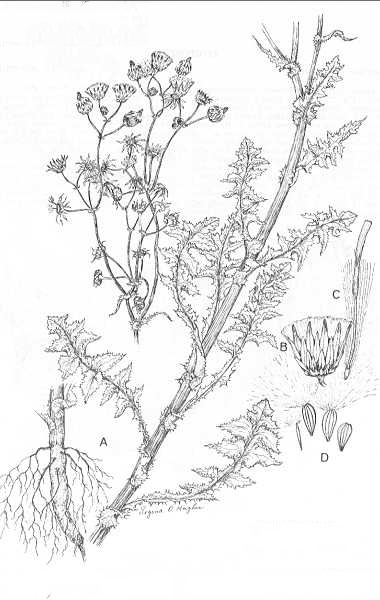
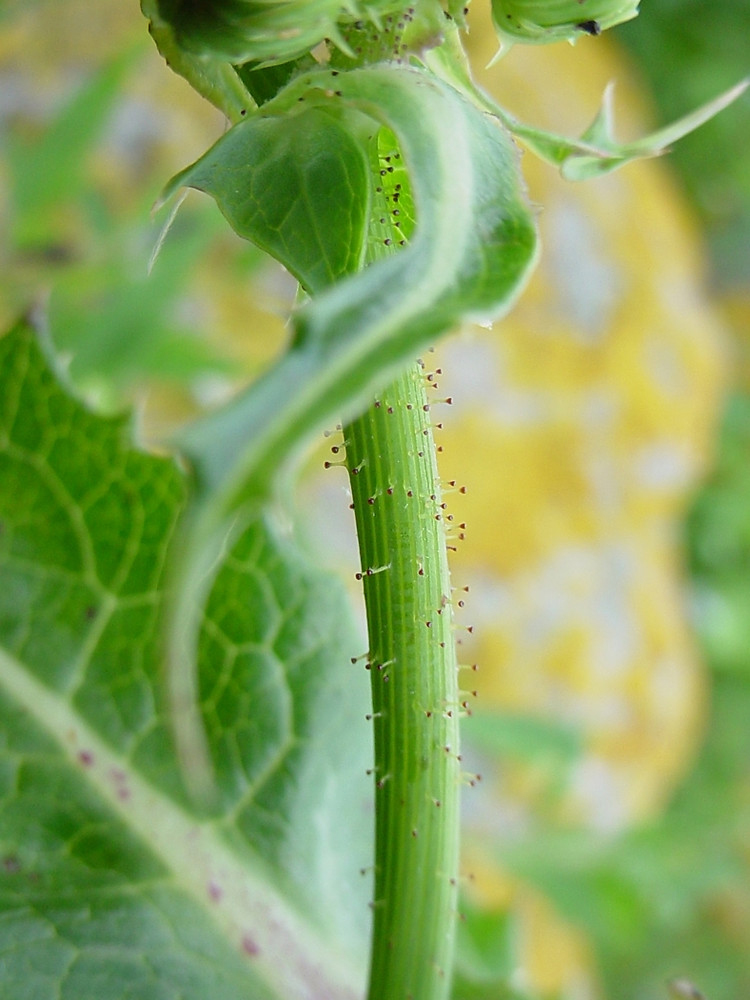
    Prickly sow thistle is an erect, creeping rooted annual plant, occasionally becoming biennial that grows about 1 to 5 feet tall. The plant is fond growing in roadsides, cultivated fields, wastelands, gardens, gravel pits, mines and logged areas, mountain slopes, forest, field margins, ruderal areas, grasslands, along lakeshores and streams, and on muddy sites, pastures, hay fields, dunes, riparian areas, orchards, and wetlands, irregularly mowed lawns, edges of yards, driveways, areas along roads and railroads, vacant lots, barnyards, yards, soil heaps, arable land, around inhabited areas and harbors.  The plant grows on a variety of soil types including white to grey sand, brown clayey loam, black sandy loam and black clayey peat. It also prefers well drained, slightly acid to alkaline soils, but are tolerant of saline soils. The plant has tap root and stem is erect, smooth, thick, herbaceous, fistulose, purplish, glabrous and glaucous. It appears single or multiple from base, branching, hollow between stem joints (nodes), and secretes a milky sap when cut.

    Leaves

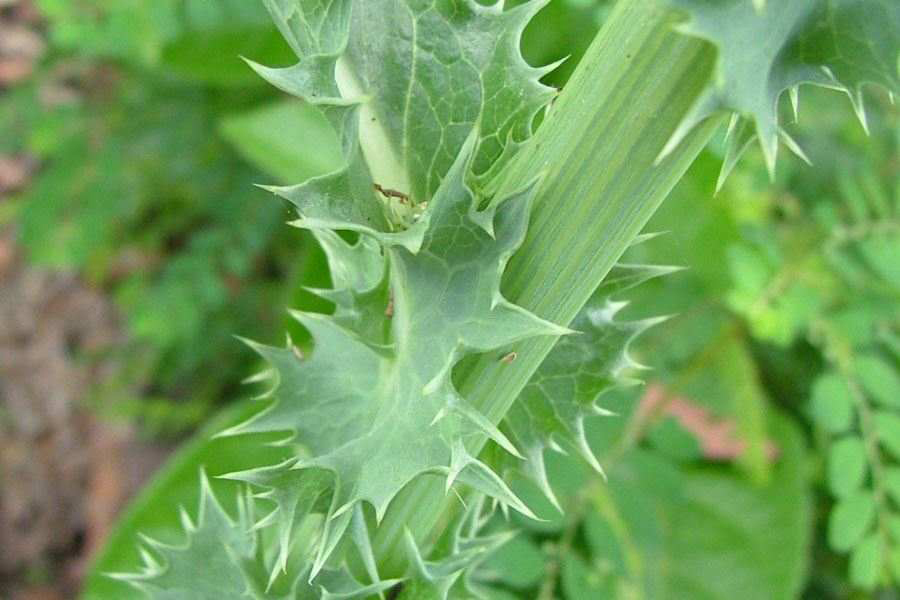
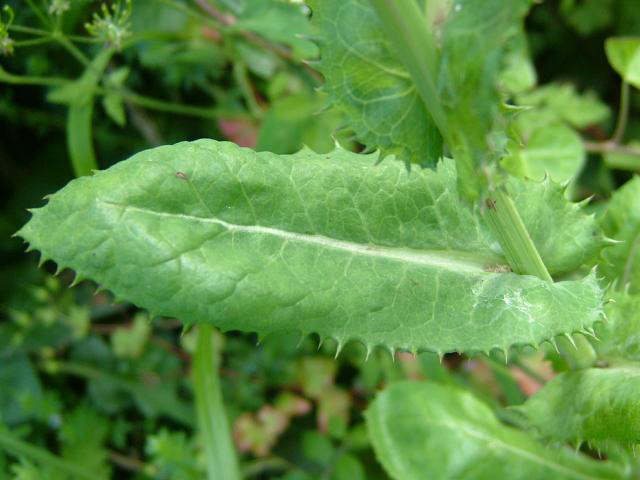
    Leaves are hairless somewhat bluish green. Upper leaves are smaller than the lower leaves, stalk less, and clasp the stems with claw like basal lobes. Upper leaves are up to 6 inches long with a rounded, widely lobed (auriculate) base semi-clasping the stem. Lower leaves are up to 10 inches long and 3½ inches wide, more spatula shaped with deeper lobes. All leaves are coarsely toothed with soft spines and are shiny waxy green on the upper surface.

    Flowers

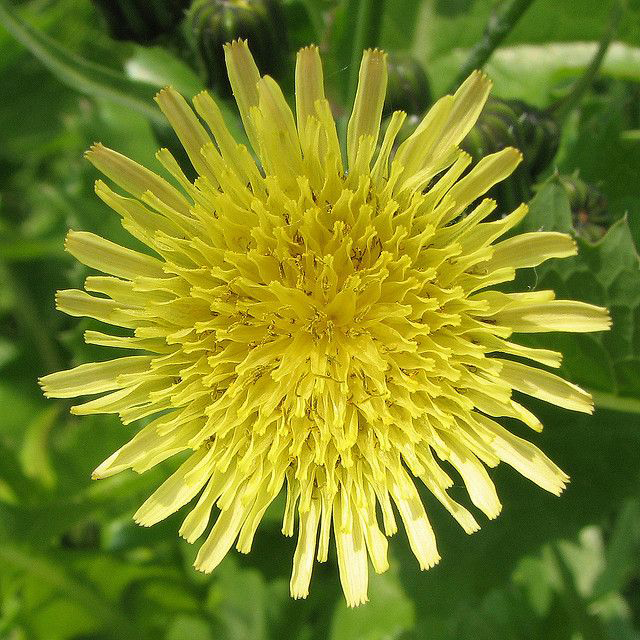
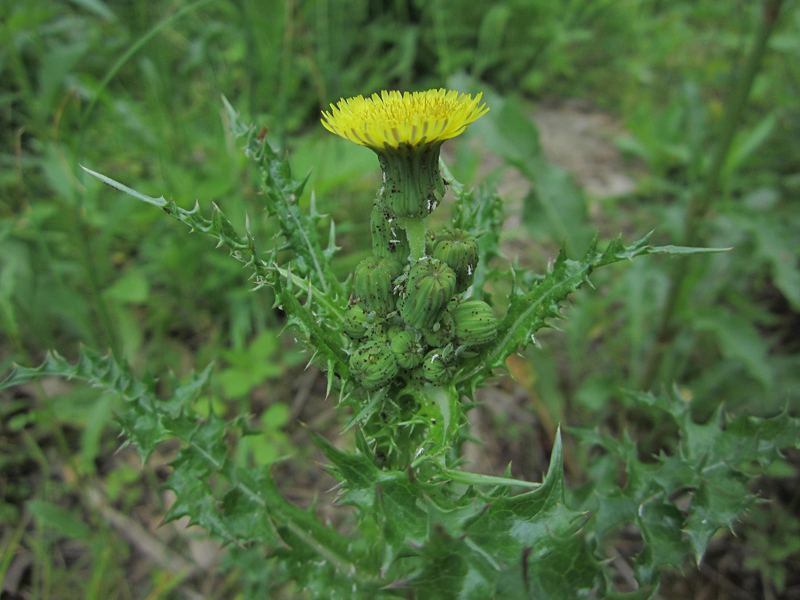
    Many small, loose open clusters (corymbiform) of yellow dandelion type flower heads, each up to 1 inch across when fully open appears at the top of the stem and arising from leaf axils. The flower head, consisting of bracts, receptacle and ray flowers (petals), is thick, barrel to vase shaped, usually with tiny glandular hairs on the stalk just below the cluster. Bracts are in 3 or 4 layers, those in the outer layer shorter and broader at the base, sometimes with sparse glandular hairs, those in the inner-most layer long and narrow. Several small attending leaves are typically at the base of cluster. Flowering normally takes place from June to August.

    Fruits

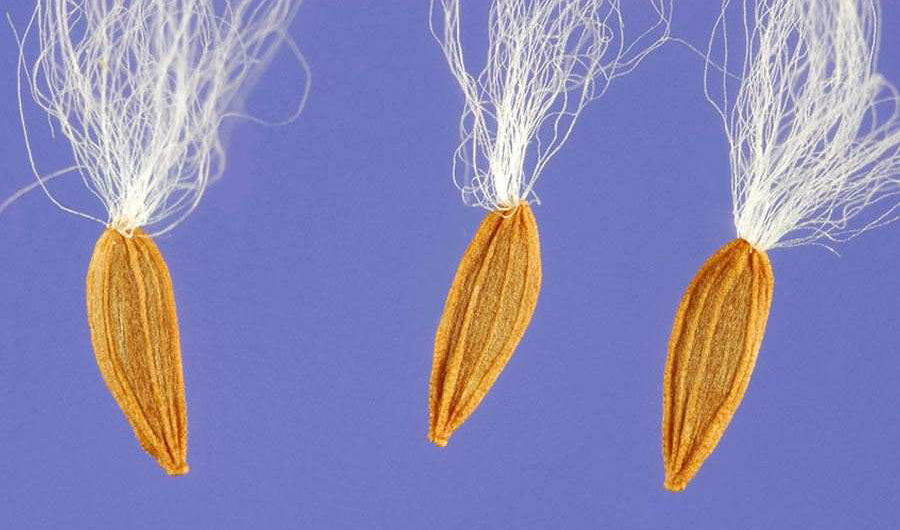
    Fertile flowers are followed by brown, wrinkled achenes 2.5-4 mm long and 1.5 mm wide. Achenes have 3 (or rarely 4-5) longitudinal ribs on each face. Mature seeds are brown colored and have a white feathery pappus (8 mm long) that jointly form a white puff ball, similar to dandelion.

    History

    The edibility of Sonchus species is probably known since antiquity, being already declared by Dioscorides in the first century, who recognized two kinds of sónkhos, one more rough and prickly, the other more tender and edible, probably Sonchus asper and S. oleraceus, respectively.

    Prickly sow thistle Image Gallery
    Closer-view-of-flower-of-Prickly-sow-thistle Closer-view-of-flower-of-Prickly-sow-thistle
    Close-up-view-of-stem-and-stem-clasping-leaf-base-of-Prickly-sow-thistle Close-up-view-of-stem-and-stem-clasping-leaf-base-of-Prickly-sow-thistle
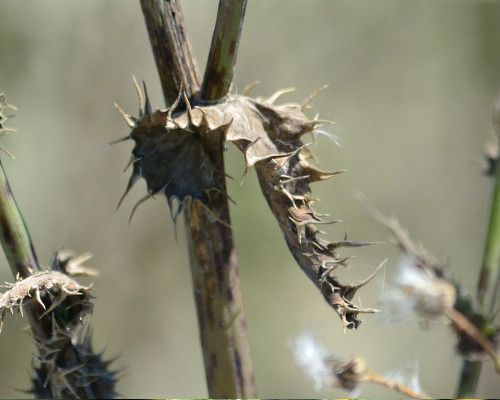
    Dried-leaves-of-Prickly-sow-thistle Dried-leaves-of-Prickly-sow-thistle
    Flower-and-flowerbuds-of-Prickly-sow-thistle Flower-and-flowerbuds-of-Prickly-sow-thistle
    Leaves-of-Prickly-sow-thistle Leaves-of-Prickly-sow-thistle
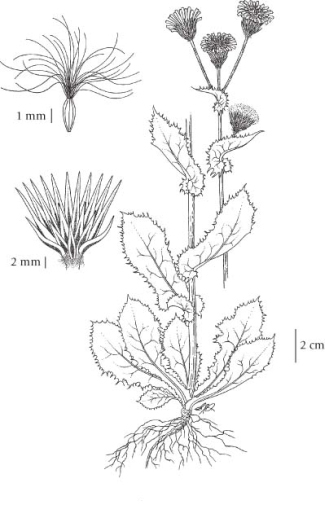
    Plant-Illustration-of-Prickly-sow-thistle Plant-Illustration-of-Prickly-sow-thistle
    Prickly-sow-thistle-plant Prickly-sow-thistle-plant
    Seed-head-showing-the-reddish-brown-ribbed-seeds-with-fine-white-pappus Seed-head-showing-the-reddish-brown-ribbed-seeds-with-fine-white-pappus
    Seeds-of-Prickly-sow-thistle Seeds-of-Prickly-sow-thistle
    Sketch-of-Prickly-sow-thistle Sketch-of-Prickly-sow-thistle
    Stem-of-Prickly-sow-thistle Stem-of-Prickly-sow-thistle
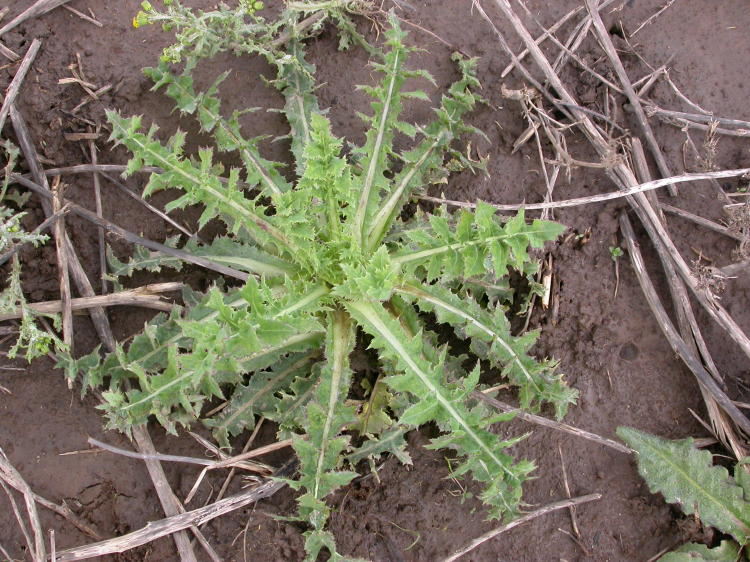
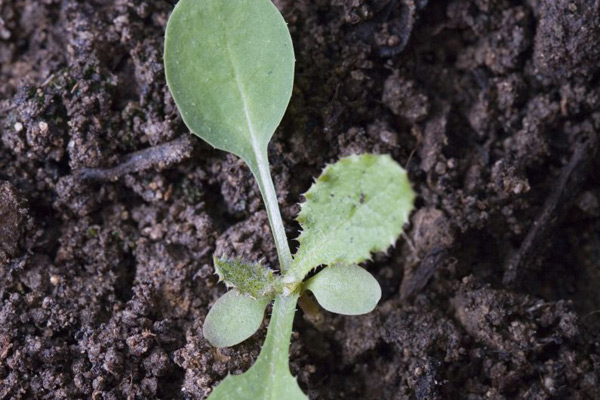
    Young-Prickly-sow-thistle-Plant Young-Prickly-sow-thistle-Plant
    Traditional uses and benefits of Prickly sow thistle

    • Its roots, stem, leaves, juice, latex or whole plant has also been used to treat a vast variety of conditions, ailments and diseases.
    • Plant is pounded and applied as a poultice to wounds and boils.
    • Latex in the plant has been used as a treatment on warts.
    • It is used in various human disorder including wounds, burns, cough, bronchitis, asthma, gastrointestinal infection, inflammation, diabetes and cardiac dysfunction, kidney and liver disorders, reproductive disorder like impotence (erectile dysfunction) in humans, jaundice and cancer.
    • Leaves and roots of the plant are used in indigestion and as a febrifuge.
    • Roots of the plants act as a vermifuge and the stems are recommended as a sedative and tonic.
    • Leaf infusion was used to cause urination and open obstructions.
    • Plant extract is applied to fresh injuries.
    • Latex has also been used to treat warts.
    • Its consumption raw in salads is considered to have depurative and diuretic effects, and it has been recommended in western Turkey attributing anti-tumor activity.
    • Other medicinal uses recorded in the Italian folk medicine include its use to treat high blood pressure, sore throat, wounds, sores and boils (or furuncles), and scorpion or insect bites.

    Culinary Uses

    • Tender young leaves and stem tops are consumed raw or cooked.
    • They can be added to salads or used like spinach.
    • Young leaves have a mild agreeable flavor.
    • Stems should be bruised and the bitter-tasting milky juice washed out before eating or cooking them.
    • Stems have been peeled and eaten raw like celery.
    • It was occasionally used in soups; the smoothest variety is said to be excellent boiled like spinach.
    • Asian counterparts use its tops and leaves after steaming which make a palatable and nutritious leaf vegetable.
    • They are consumed raw in salads and also cooked for preparing soups, omelets, fried with onion and eggs, or used as pastry stuffing.
    • It is sometimes boiled mixed with other herbs, as in some traditional recipes such as the Moroccan beqoul, the Italian pistic, and the pastissets de brosses, traditional vegetable pies from eastern Spain made with several Sonchus species.

    Other Facts

    • The entire plant contains sticky white latex.
    • The average number of seeds per flower head is 200, and a plant often has over 100 flower heads. Seed numbers per plant range from 21,500 to 25,000 but a large plant may produce 60,000.
    • This species has also been used as fodder for pigs, cows, sheep, goats, and rabbits.

    Management Info

    Physical Control

    Small or isolated populations may be manually removed while plants are young, prior to seed set. The taproot must be removed, as re-sprouting can occur if left in the soil. Slashing is often ineffective as flowers continue to be produced. Regular cultivation of plants, every three months or so, will stimulate germination and can lead to a reduced seed bank. This will also drain food reserves stored in the roots and cause death. Mulching and soil sterilization methods can complement other management efforts.

    Grazing

    Grazing by cattle and sheep effectively destroys infestations in pastures, and weakens plants allowing other control methods to be more effectively used. They also make excellent feed for livestock.

    Chemical Control

    For control of Sonchus asper, a pre-emergent herbicide containing isoxaben can be used, herbicidal soaps when the plants are young, or glyphosate when plants are mature. Zollinger and Parker recommend 2,4-D, clopyralid, dicamba, glyphosate, and picloram for control of Sonchus asper., while Rice 2,4-D, DCPA, diethatyl-ethyl, MCPA, amitrole, atrazine, bromoxynil, chlorsulfuron, dicamba, dichlorprop & 2,4-D, diuron, glyphosate, isoxaben (Snapshot), norflurazon, oryzalin, oxyfluorfen, paraquat, Ornamental Herbicide II, napropamide, simazine and tebuthiuron.

    Biological Control

    Biological agents are currently being researched as a possibility for managing S. asper and other Sonchus species in Australia. Sonchus species have previously been the target of biological control in Canada. Preliminary reviews for biological control agents have been made in southern France and northern Europe. Currently the rust fungus Miyagia pseudosphaeria and an unidentified eriophyid mite species are two widespread organisms in Australia with potential for control. The CSIRO project will focus on determining the impact of these potential control agents on related native Australian species.


    References:

    https://www.itis.gov/servlet/SingleRpt/SingleRpt?search_topic=TSN&search_value=38424#null

    https://davesgarden.com/guides/pf/go/55202/

    http://www.hear.org/pier/species/sonchus_asper.htm

    https://npgsweb.ars-grin.gov/gringlobal/taxonomydetail.aspx?id=34933

    https://pfaf.org/user/Plant.aspx?LatinName=Sonchus+asper

    https://www.cabi.org/ISC/datasheet/110319

    http://www.floracatalana.net/sonchus-asper-l-hill

    https://botanical.com/botanical/mgmh/s/sowthi71.html

    https://plants.usda.gov/core/profile?symbol=SOAS

    http://www.theplantlist.org/tpl/record/gcc-130230

    https://keyserver.lucidcentral.org/weeds/data/media/Html/sonchus_asper.htm

    https://en.wikipedia.org/wiki/Sonchus_asper

    https://uses.plantnet-project.org/en/Sonchus_asper_(PROTA)

    78%
    78%
    Awesome

    Comments

    comments

    Herbs and Spices P
    Share. Facebook Twitter Pinterest LinkedIn Tumblr Email
    Previous ArticleFacts about Indian Shot
    Next Article 5 Unexpected Household Objects to Boost Beauty

    Related Posts

    Uses of Monkey Pitcher plant

    April 16, 2024

    Traditional uses and benefits of Wild Marigold

    March 21, 2024

    Traditional uses and benefits of Drooping fig

    March 12, 2024

    Comments are closed.


    Prickly Sow Thistle Facts

    Prickly sow thistle Quick Facts
    Name: Prickly sow thistle
    Scientific Name: Sonchus asper
    Origin Africa, Madagascar, Europe, western and central Asia, China and the Indian Sub-continent
    Colors Brown
    Shapes Flat, winged, glossy-ridged, brown, 2–3 mm (0.08–0.12 in.) long achene, crowned by unbranched hairs
    Calories 37 Kcal./cup
    Major nutrients Vitamin C (69.78%)
    Manganese (38.26%)
    Iron (37.25%)
    Copper (34.44%)
    Calcium (13.70%)
    Health benefits Beneficial for wounds, burns, cough, bronchitis, asthma, gastrointestinal infection, inflammation, diabetes, cardiac dysfunction, kidney and liver disorders, reproductive disorder, jaundice and cancer
    Name Prickly sow thistle
    Scientific Name Sonchus asper
    Native Africa, Madagascar, Europe, western and central Asia, China and the Indian Sub-continent (i.e. India, Nepal and Pakistan)
    Common Names Blue sow-thistle, prickly sow thistle, prickly sow-thistle, prickly sowthistle, rough sow thistle, rough sow-thistle, rough sowthistle, sowthistle, spiny sow thistle, spiny sowthistle, spiny-leaf sowthistle, spinyleaf sowthistle, spiny-leaved sow thistle, Native Sow-Thistle, sharp-fringed sow thistle, spiny milk thistle
    Name in Other Languages Albanian: Rrëshyell i ashpër
    Arabic: Khuwwaysh, tafaf jasi  (تفاف جاسئ), tafaf jasa (تفاف جاسىء)
    Bokmål: Stivdylle
    Bulgarian: Влакнест кострец
    Catalan: lletsó punxós, Herba lletera, Lletsó aspre, Lletsó bord, Lletsó
    Chinese: Hua ye dian ku cai  (花叶滇苦菜), Guǐ kǔ jù cài (鬼苦苣菜)
    Corsican: Lattarone
    Cymraeg: Llaethysgallen arw
    Czech: Mléč drsný, mle
    Danish: Ru Svinemælk
    Deutsch: Rauhe Gänsedistel, Raue Gänsedistel
    Diné bizaad: Azeeʼ hókánii łibáhígíí
    Dominican Republic: Lechuguilla; yerba espinosa
    Dutch: Gekroesde melkdistel, Ruwe melkdistel
    English: Native Sow-Thistle, Native Sowthistle, Prickly Sow-thistle, Prickly Sowthistle, Rough Milk Thistle, Rough Sow-thistle, Sow Thistle, Spiny Sow-thistle, Rough sow thistle,  sharp-fringed sow thistle, spiny milk thistle, spiny-leaved sow thistle
    Estonian: Kare piimohakas
    Finnish: Otavalvatti, aitoukonhattu; metsätähti
    French: Laiteron piquant, Laiteron rude, Laiteron épineux, Lastron, Lastron piquant, laiteron apre, chaudronnet
    Gaelic: Searbhan Muice
    Gaelg: Bee muc friogganagh
    Gàidhlig: Searbhan Muice
    German: Raue Gänsedistel, Rauhe Gänsedistel
    Hebrew: מרור מכחיל
    Hindi: Didhi, Dodak
    Italian: Grespino spinoso
    Japanese:  Oni-nogeshi (オニノゲシ)
    Kinyarwanda: Kikembekembe, Rurira
    Korean: Keung-bang-ga-ji-tong
    Latina: Sonchus asper
    Latvian: Dzeloņainā mīkstpiene
    Manx: Bee muc friogganagh
    Maori: Raurōroa
    Marathi: Mahatra
    Navaho: Azeeʼ hókánii łibáhígíí
    Nederlands: Gekroesde melkdistel, Ruwe melkdistel
    Norwegian: Stivdylle, skogstjerne, venusvogn
    Polish: Mlecz kolczasty
    Portuguese: Serralha-espinhosa, Serralha-áspera, serralha-comum, serralha preta
    Quechua: Khishka khishka, Kichka-kichka lichi-lichi, Yuyu k’ana, Yuyu khana
    Romanian: Сусай аспру
    Runa Simi: Kichka-kichka lichi-lichi, Yuyu khana, Khishka khishka, Yuyu k’ana
    Russian: Osot sherokhovatyy (Осот шероховатый)
    Slovak: Mlieč drsný
    Spanish: Azapuercos, cardeña, cardimuelle, cardincha, cardinche, cardinchi, cardo lechar, cardo lechera, cardo lechero, cardo lecherín, cardo lincherín, cardo meleño, cardo, cardoncha, cerraja, cerrajas, cerrajón, cerrayas, diente de león, latazín, lechacino, lechariega, lechazines, lechazino, lecherina, lecherines, lecherín, lechiterna, lechugos, lechuguilla, lencherina, lincharina, lincherina, lincherines, llataim, llatazín, muelle
    Suomi: Otavalvatti
    Swedish: Svinmjölktistel, Svinmolke, Svintistel, balkansippa, skogsalpsklocka, skogsstjärna, trädgårdsstormhatt
    Tsonga: Hlavi
    Turkish: Sütleğen
    Welsh: Llaethysgallen arw
    Western Frysian: Molktiksel
    Plant Growth Habit Erect, creeping rooted annual plant, occasionally becoming biennial
    Growing Climates Roadsides, cultivated fields, wastelands, gardens, gravel pits, mines and logged areas, mountain slopes, forest, field margins, ruderal areas, grasslands, along lakeshores and streams, and on muddy sites, pastures, hay fields, dunes, riparian areas
    Soil Grow on a variety of soil types including white to grey sand, brown clayey loam, black sandy loam and black clayey peat. prefers well drained, slightly acid to alkaline soils, but are tolerant of saline soils
    Plant Size 1 to 5 feet tall
    Root Tap root
    Stem Erect, smooth, thick, herbaceous, fistulose, purplish, glabrous, glaucous, with milky sap, single or multiple from base, branching, hollow between stem joints (nodes), and secretes a milky sap when cut
    Leaf Alternate, sessile, clasping, auriculate, with undulate spiny margins, deep shiny green above, glaucous below. Lowest leaves obovate to spatulate or somewhat lyrate-pinnatifid, to +15cm long. Upper leaves reduced, becoming ovate-lanceolate
    Pollination By solitary bees and fly species
    Flowering season June to August
    Flower Bisexual, ligulate, yellow; corolla tube 6 mm long, ligule 4–5 mm long; stamens 5, anthers united into a tube around the style; ovary inferior, 1-celled, style 2-branched
    Fruit Shape & Size Flat, winged, glossy-ridged, brown, 2–3 mm (0.08–0.12 in.) long achene, crowned by unbranched hairs
    Fruit Color Brown
    Propagation By seed
    Plant Parts Used Roots, stem, leaves, juice, latex or whole plant
    Season July to September
    Major Nutrition Vitamin C (Ascorbic acid) 62.8 mg (69.78%)
    Manganese, Mn 0.88 mg (38.26%)
    Iron, Fe 2.98 mg (37.25%)
    Copper, Cu 0.31 mg (34.44%)
    Calcium, Ca 137 mg (13.70%)
    Potassium, K 511 mg (10.87%)
    Sodium, Na 137 mg (9.13%)
    Zinc, Zn 0.9 mg (8.18%)
    Protein 3.56 g (7.12%)
    Phosphorus, P 49.3 mg (7.04%)

    Prickly sow thistle Scientific Classification

    Scientific Name: Sonchus asper

    Rank Scientific Name & (Common Name)
    Kingdom Plantae (Plants)
    Subkingdom Tracheobionta (Vascular plants)
    Infrakingdom Streptophyta  (land plants)
    Superdivision Spermatophyta (Seed plants)
    Division Magnoliophyta (Flowering plants)
    Subdivision Spermatophytina  (spermatophytes, seed plants, phanérogames)
    Class Magnoliopsida (Dicotyledons)
    Subclass Asteridae
    Superorder Asteranae
    Order Asterales
    Family Asteraceae ⁄ Compositae (Aster family)
    Genus Sonchus L. (sowthistle)
    Species Sonchus asper (L.) Hill (spiny sowthistle)
    Synonyms
    • Hieracium asperum (L.) Bernh.
    • Hieracium sonchus E.H.L.Krause
    • Sonchus asper (L.) Vill.
    • Sonchus asper Garsault
    • Sonchus asper P.Gaertn. & al.
    • Sonchus asper f. adenotrichus Soó
    • Sonchus asper f. asper
    • Sonchus asper f. laevis (Wallr.) V.Kuusk
    • Sonchus asper f. lignosus A.T.Szabo
    • Sonchus asper subsp. euasper Hayek
    • Sonchus asper var. asper
    • Sonchus asper var. decipiens De Notaris
    • Sonchus asper var. horridus Schur
    • Sonchus asper var. integer Schur
    • Sonchus asper var. laevis (Wallr.) Neilr.
    • Sonchus asper var. orientalis Degen
    • Sonchus asper var. pinnatisectus Lojac.
    • Sonchus asper var. pinnatus Schur
    • Sonchus asper var. rigidus Baumg.
    • Sonchus asper var. sabulosus P.D.Sell
    • Sonchus asper var. setosoglandulosus Hausm.
    • Sonchus asper var. simplicifolius Schur
    • Sonchus asper var. spinosus Neilr.
    • Sonchus asper var. sulphureus Boiss.
    • Sonchus australis hort. ex Colla
    • Sonchus borderi Gand.
    • Sonchus carolinianus Walt.
    • Sonchus crocifolius hort.
    • Sonchus crocifolius hort. ex Sch.Bip.
    • Sonchus cuspidatus Blume
    • Sonchus decipiens Zenari
    • Sonchus eryngiifolius Sosn.
    • Sonchus eryngioides DC.
    • Sonchus fallax Wallr.
    • Sonchus fallax var. asper Wallr.
    • Sonchus fallax var. decipiens De Not.
    • Sonchus fallax var. fallax
    • Sonchus fallax var. laevis Wallr.
    • Sonchus ferox Wall.
    • Sonchus glaber Thunb.
    • Sonchus infestus Poepp.
    • Sonchus infestus Poepp. ex DC.
    • Sonchus oleraceus Wall.
    • Sonchus oleraceus f. asper (L.)
    • Sonchus oleraceus subsp. asper (L.) Ehrh.
    • Sonchus oleraceus var. asper L.
    • Sonchus oleraceus var. oleraceus
    • Sonchus spinosus Lam.
    • Sonchus spinulosus Bigel.
    • Sonchus sulphureus Boiss.
    • Sonchus tibesticus Quézel
    • Sonchus umbellatus E.Mey.
    • Sonchus umbellatus E.Mey. ex DC.
    • Sonchus viridis Zenari
    Nutritional value of Prickly sow thistle
    Serving Size: 100 g

    Calories 37 K cal. Calories from Fat 6.12 K cal.

    Proximity Amount % DV
    Water 86.4 g N/D
    Energy 37 Kcal N/D
    Protein 3.56 g 7.12%
    Total Fat (lipid) 0.68 g 1.94%
    Ash 3.04 g N/D
    Carbohydrate 3.25 g 2.50%
    Total dietary Fiber 1.98 g 5.21%

     
    Minerals Amount % DV
    Calcium, Ca 137 mg 13.70%
    Iron, Fe 2.98 mg 37.25%
    Magnesium, Mg 26.4 mg 6.29%
    Phosphorus, P 49.3 mg 7.04%
    Potassium, K 511 mg 10.87%
    Sodium, Na 137 mg 9.13%
    Zinc, Zn 0.9 mg 8.18%
    Copper, Cu 0.31 mg 34.44%
    Manganese, Mn 0.88 mg 38.26%


    Vitamins Amount % DV
    Water soluble Vitamins
    Vitamin B1 (Thiamin) 0.018 mg 1.50%
    Vitamin B2 (Riboflavin) 0.086 mg 6.62%
    Vitamin B3 (Niacin) 0.006 mg 0.04%
    Vitamin C (Ascorbic acid) 62.8 mg 69.78%


    Organic acids Amount % DV
    Oxalic acid 61 mg N/D
    Phenolics (total) 516 mg N/D
    Flavonoids 9.92 mg N/D
    Flavonols 9.21 mg N/D
    Proanthocyanidins 22.7 mg N/D
    Nitrate 72.6 mg N/D

     
    Lipids Amount % DV
    Fatty acids, total saturated 34.3 g N/D
    Myristic acid  14:00(Tetradecanoic acid) 3.44 g N/D
    Palmitic acid 16:00 (Hexadecanoic acid) 15.3 g N/D
    Stearic acid 18:00 (Octadecanoic acid) 2.01 g N/D
    Arachidic acid 20:00 (Eicosanoic acid) 3.39 g N/D
    Behenic acid (docosanoic acid) 22:00 2.96 g N/D
    Lignoceric acid (tetracosanoic acid) 24:00 1.42 g N/D
    Fatty acids, total monounsaturated 5.2 g N/D
    Palmitoleic acid 16:1 (hexadecenoic acid) 0.99 g N/D
    Oleic acid 18:1 (octadecenoic acid) 3.34 g N/D
    Fatty acids, total polyunsaturated 60.5 g N/D
    Linoleic acid 18:2 (octadecadienoic acid) 9.9 g N/D
    Linolenic acid 18:3 (Octadecatrienoic acid) 39.9 g N/D
    18:3n − 6 0.47 g N/D
    18:4n − 3 0.09 g N/D
    Omega-3 fatty acids (n-3) 48.2 g N/D
    Omega-6 fatty acids (n-6) 12.5 g N/D
    Omega-9 fatty acids (n-9) 4 g N/D

    *Above mentioned Percent Daily Values (%DVs) are based on 2,000 calorie diet intake. Daily values (DVs) may be different depending upon your daily calorie needs. Mentioned values are recommended by a U.S. Department of Agriculture. They are not healthbenefitstimes.com recommendations. Calculations are based on average age of 19 to 50 years and weighs 194 lbs.

    Source:
    https://www.springer.com/

    Categories
    • Beverages (78)
    • Dairy (28)
    • Dental Health (15)
    • Equipment (5)
    • Essential OIls (196)
    • Facts (2,939)
    • Foods (255)
    • Fruits (516)
    • Giveaway (1)
    • Grains and Cereals (36)
    • Health & Beauty (763)
    • Herbs and Spices (1,249)
    • Medicines (9)
    • Mental Health (19)
    • Nutritional value (27)
    • Nuts and seeds (73)
    • Oils (81)
    • Pets (4)
    • Poultry & Seafoods (67)
    • Pulses and Beans (16)
    • Reviews (25)
    • supplement (2)
    • Vegetables (304)
    • Weight Loss (22)

    What is Lupin Bean Flour?

    Science Backed Health Benefits of Durian (Durio zibethinus)

    Science Backed Health Benefits of Feijoa (Pineapple Guava) (Acca sellowiana)

    Science Backed Health Benefits of Gac Fruit (Momordica cochinchinensis)

    Science Backed Health Benefits of Amaranth Leaves (Amaranthus spp)

    Science Backed Health Benefits of Arrowhead (Sagittaria sagittifolia)

    ABOUT
    Home
    About us
    Contact us
    Privacy Policy
    Terms & conditions
    Disclaimer
    Direct Communication
    e-mail: [email protected]
    Gmail: [email protected]
    Whatsapp: +977-9841146511
    Viber: +977-9841146511
    Useful
    Health Wiki
    Nutrition
    Facebook Twitter Pinterest
    © 2025 www.healthbenefitstimes.com All rights reserved.

    Type above and press Enter to search. Press Esc to cancel.

    ×

    Log In

    Forgot Password?

    Not registered yet? Create an Account