

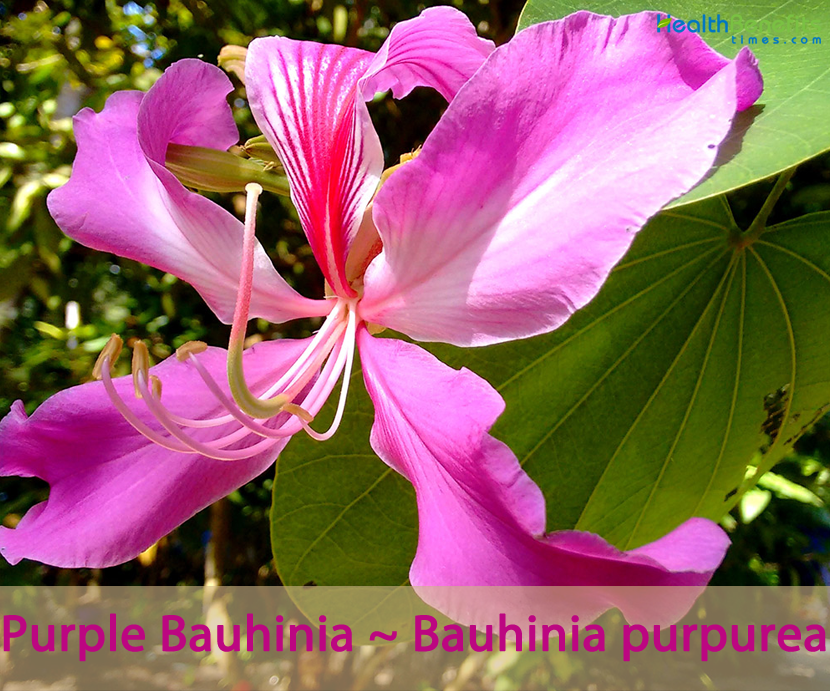
| Purple Bauhinia Quick Facts | |
|---|---|
| Name: | Purple Bauhinia |
| Scientific Name: | Bauhinia purpurea |
| Origin | South China (which includes Hong Kong) and found throughout India. It is Indigenous to Southern Asia, South-Eastern Asia and widely distributed throughout the world and common in Himalayan, Sub-Himalayan and western track of India |
| Colors | Green turning to brown as they mature |
| Shapes | Brown, strap-shaped, not separate, elongated dehiscent pods, 15- 30 cm long, up to 1.5-2.5 cm wide, containing 10-15- shiny-brown seeds. |
| Taste | Pungent |
| Health benefits | Support ulcer, wound, glandular swelling, stomach tumor, diarrhea, dysentery, amoebic dysentery, ano-rectal, piles, lymph nodes swelling, lymph node enlargement, inflammatory swelling and hemorrhage-bleeding, cold and cough |
| Name | Purple Bauhinia |
|---|---|
| Scientific Name | Bauhinia purpurea |
| Native | South China (which includes Hong Kong) and found throughout India. It is Indigenous to Southern Asia, South-Eastern Asia and widely distributed throughout the world and common in Himalayan, Sub-Himalayan and western track of India. In the United States of America, the tree grows in Hawaii, coastal California, southern Texas, and southwest Florida |
| Common Names | Hawaiian Orchid Tree, Hong Kong Orchid Tree, Pink Butterfly Tree, Purple Butterfly Tree, Purple Camel’s Foot, Purple Bauhinia, Purple Orchid Tree, Semki-Gona Gum, butterfly tree, camel’s foot tree, geranium tree, orchid tree, Mountain Ebony, Geranium Tree, Alibangbang, Barada, Bol-megong, Bunga kupu-kupu, Ching-kho, Chuvannamandaram, Dev-Kanchan, Deva kanchan, Guiral, Jia telong, Kachnar, Kachner, Kairwal, Kanchanam, Kandan, Kaniar, Karalli, Karar, Keelra, Koiralo, Koliar, Kurul, Levosii, Mandari, Mong bo hoa tim, Msekese, Phak-siew, Rakia kanchan, Rakia-kanchan, Rato kanchan, Sarul, Shivapa, Sona, Tanki, Tapak kuda, Tapak unta, Vaubeh, Vau-fa-vang, Zi Yangtija |
| Name in Other Languages | Afrikaans : Skoenlapperorgideëboom Andhra Pradesh: Kanchanam Assamese: Kurial, Kanchan, Og-yok, Ronga-kanchan, Tenga-kotora, Raṅā kāñcana (ৰঙা কাঞ্চন) Bengali: Devakanchan (দেবকাঞ্চন), Kanchan, Rakta Kanchan, Raktakanchan, Singyara, Koiral Burmese: Mahahlegani, swèý-tau ni Chinese: Zi Yang Ti Jia (紫羊 蹄甲), Yang Ti Jia (羊蹄甲) Cuba: Bauhinia, orquídea Silvestre, puente de mono English: Butterfly Tree, Orchid Tree, Pink Butterfly Tree, Purple Bauhinia, Purple Butterfly Tree, Butterfly-orchid-tree, Butterfly-tree, Camel’s-foot, Orchidtree, Hawaiian Orchid Tree, Hong Kong Orchid Tree, Purple Camel’s Foot, Australian orchid tree, fall orchid tree, Estonian: Purpur-sämplehik Finnish: Punabauhinia French : Arbre À Orchidées, Bauhinia À Fleurs Pourpres, Bauhinie, Bauhinier, fleurs pourpres German: Purpurfarbener Orchideenbaum, Purpurrote Bauhinie, Schmetterlings-Bauhinie Garo: Megong Hebrew: בוהניה ארגמנית Hindi: Ashta, Gairal, Guiral, Gurial, Jhinjhora, Kachnar, Kaliar, Kandan, Kaniar, Karal, Karial, Khairwal, Koilari, Koinar, Koliar, Kwiryal, Lal Karal, Makkuna, Mawai, Lal Kachnar, Sona , kovidaar (कोविदार), Kaniyar (कनियार), Baswanpada, chambali, devakanchan, kachan, kanchan, kanchivala, karar, keolav, kolia, kota, kurial, manmadarai, raktakanchan, sono, survannamansaran Indonesia : Bunga kupu-kupu, suwoto, Aroy kupu-kupu Japanese : Murasaki mokuwan-ju, Murasakisoshinka (ムラサキソシンカ) Kannada: Arelu, Akilu, Banne, Basavanapadu, Deva Kaanchana (ದೇವಕಾಂಚನ), Kanchivaala, Kanchivala, Kanchuvaala (ಕಂಚುವಾಳ), Kancivala, Kanjivala, Kempu Kanchuvaala, Kempu Mandaara, Kempukanchavala, Kempukancivala, Kempukanjivala, Kempumandara, Kempu Kanchivaala, Kempumandaara, Mandara, Sarul, Uleppe, Ulipe, Kanchivaala (ಕಂಚಿವಾಳ), Kanchavaala (ಕಂಚವಾಳ), ಕಂಚಾಳ (Kanchaala), Kengaanchaala (ಕೆಂಗಂಚಾಳ) Khasi: Dieng Long Malaysia : Tapak Kuda, lupit, daun tangkop bedaup, akah punan, dakun punan, urok punan, dahup dahup, ikop, babayak Malayalam: Chovanna-Mandaru, Chovannamandaru, Cuvannamandaram (ചുവന്നമന്ദാരം), Mandaram, Suvannamandaram, Manipuri: Chingthao Angangba, Chingthrao nganglei-naba Marathi: Atmatti, Kanchan, Dev Kanchan, Deva, Devana Kanchana, Kanchana, Ragtachandan, Ragthachandan,Rakta Kanchan, Raktha Kaanchan, Tambdo-Apto , Rakta kanchan (रक्त कंचन) Mizoram: Vaube, Vaufavang Nepali: Khwairalo, Koeralo, tanki (टाँकी) Oriya: Borodo, Vaube Pakistan: Kachan, karar, khairwal Philippines : Alibang-bang Portuguese: Pie De Cabra Sanskrit: Camarikah, Kancanarah, Kanchan, Kovidara, Kovidarah, Mahayamalapatrakah, Raktakovidara, Raktapushpakovidara, Swetakancanara, Tamrapuspah, Vanaraja, Devakanchan (देवकाञ्चनः) Singapore : Tapak Kuda Spanish: Bauhinia roja, gorro de Napoleón, mariposa, palo de orquídeas, pie de cabra, pata de vaca Sri Lanka : Kolar Swedish : Purpurbauhinia Tamil: Acanomantarai, Acanomantaraimaram, Acuvacam-purappu, Arputaveni, Atthi, Cikappu Mantarai, Compucikam, Kalavilaccai, Compucikamaram, Kalavilaichi, Kalarviluti, Kalaviluti, Mancaltarai, Karuppumantarai, Kattu Mantarai, Mancaltaraimaram, Mandarai, Mandari, Mandareh, Mandharai, Mantarai, Mantharai, Nilataru, Mutiraikkali, Nilattiruvatti, Periyavatti, Punkaram, Purapicam, Segappumandarai, Ulittikam, Nilattiruvatti (நீலத்திருவத்தி) Tangkhul: Haochokwon Telugu: Aroe,Bodanta, Bodanta Chettu, Deva-Kasla, Kanchanam, Devakaanchanamu, Devakanjanamu, Kaanchanamu, Kanjanamu, Peddaare, Peddare, Peddari, Dēvakān̄canaṁ (దేవకాంచనం) Thai : Chong Kho (ชงโค), Seaw Dok Dang, Sio Dak Dang sieowaan, sieo dok daeng Tibetan: Go Bi Da Ra, Ko Bi Da Ra, Ko Bid Dri Vietnamese : Mòng bò tím, Móng bò hoa đỏ, Mòng bò lan, Cây móng bò |
| Plant Growth Habit | Small to medium-sized deciduous evergreen, fast-growing shrub or tree |
| Growing Climates | Evergreen lowland rainforests, mountain forests, savanna, scrublands, dry deciduous forests and swamp forests. It can also grow in disturbed areas, secondary forest, along roadsides and in gardens, parks, and disturbed sites near urban areas |
| Soil | Grows on a variety of sandy, loamy and gravelly soils in full sun in fertile, moisture-retentive but well-drained soils. It demands plenty of light and requires good drainage. However, it’s adaptable to any free-draining garden soils |
| Plant Size | 7.6 m in height and 17.8 cm in diameter. It can reach a height of 4.6 m in less than 2 years |
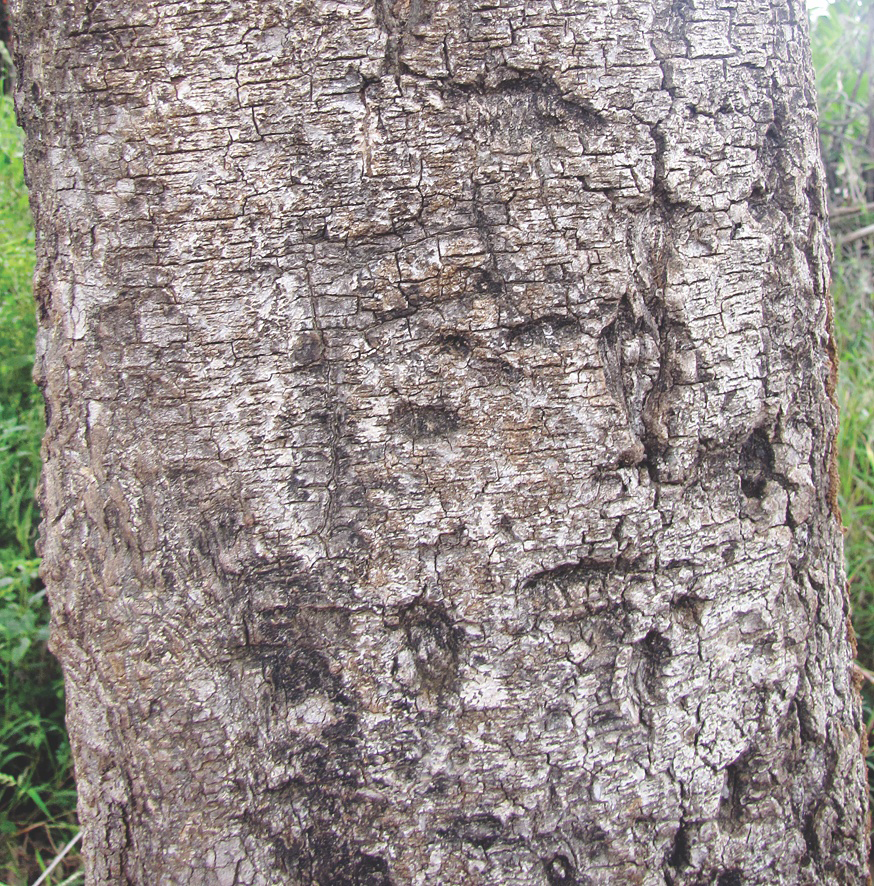
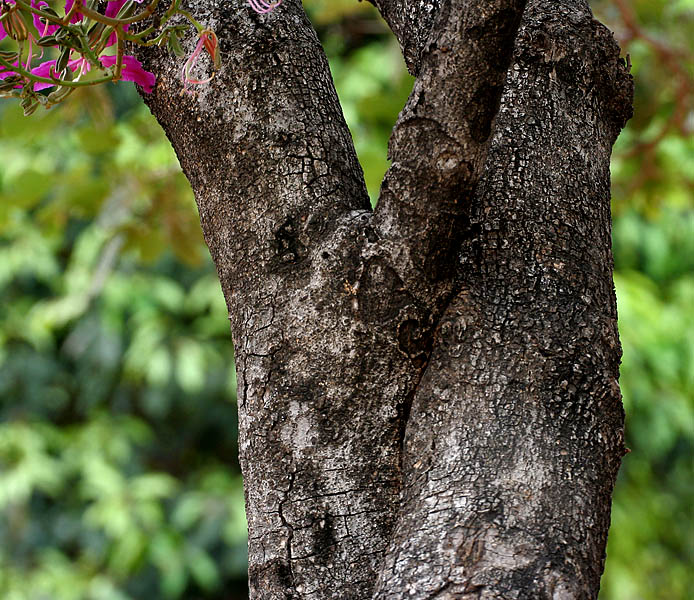
| Trunk | Woody with pale grey to brown coloured bark that is smooth to slightly fissured and scaly |
| Twigs | Twigs are slender, light green, slightly hairy and angled |
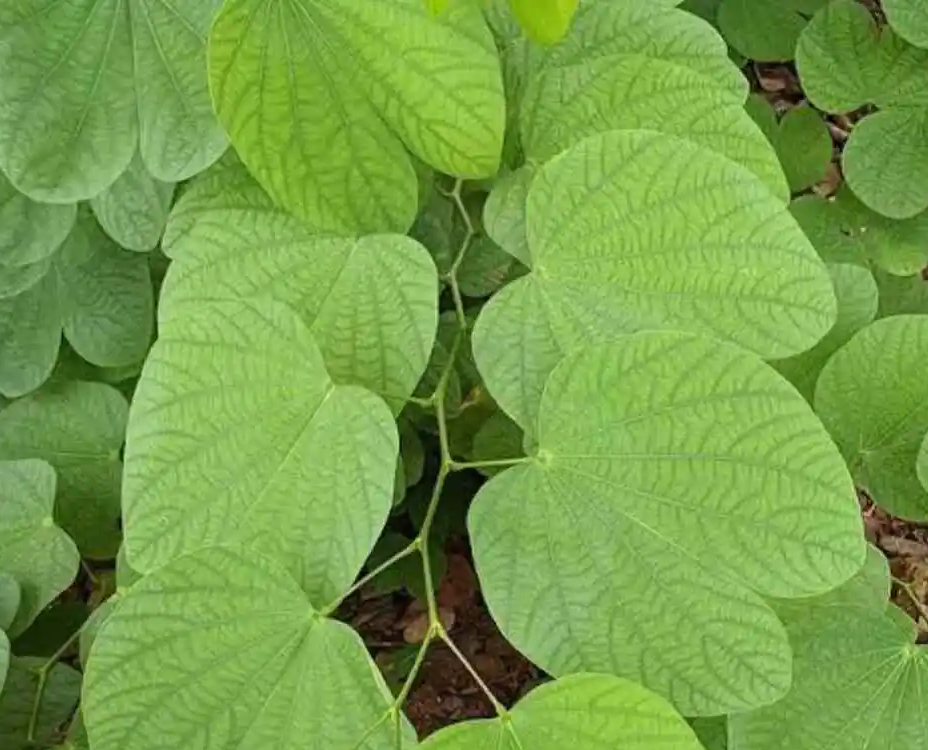
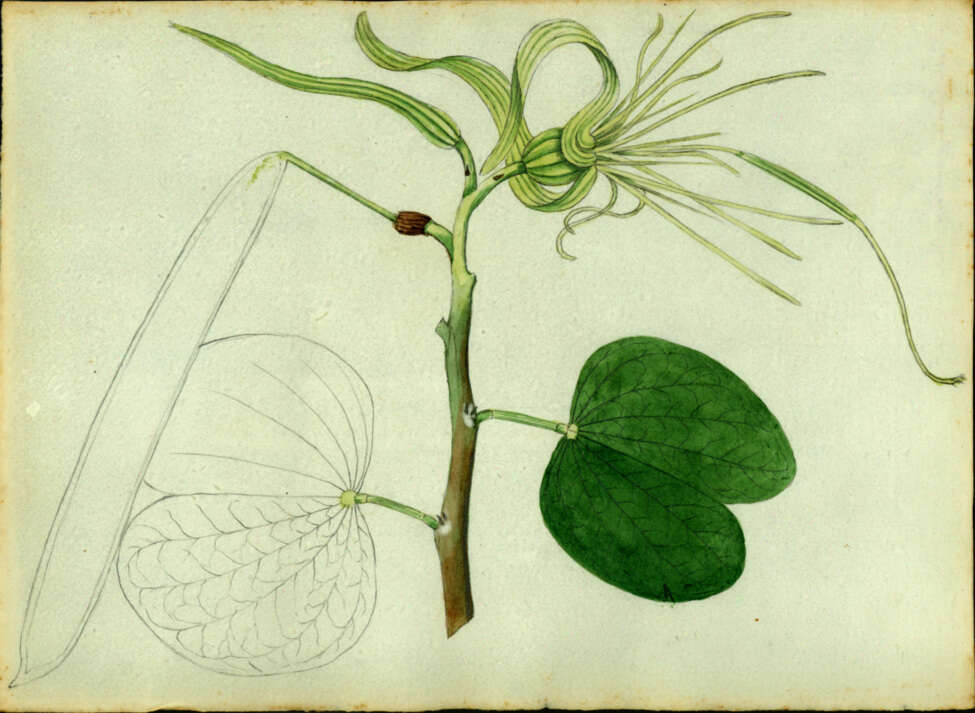
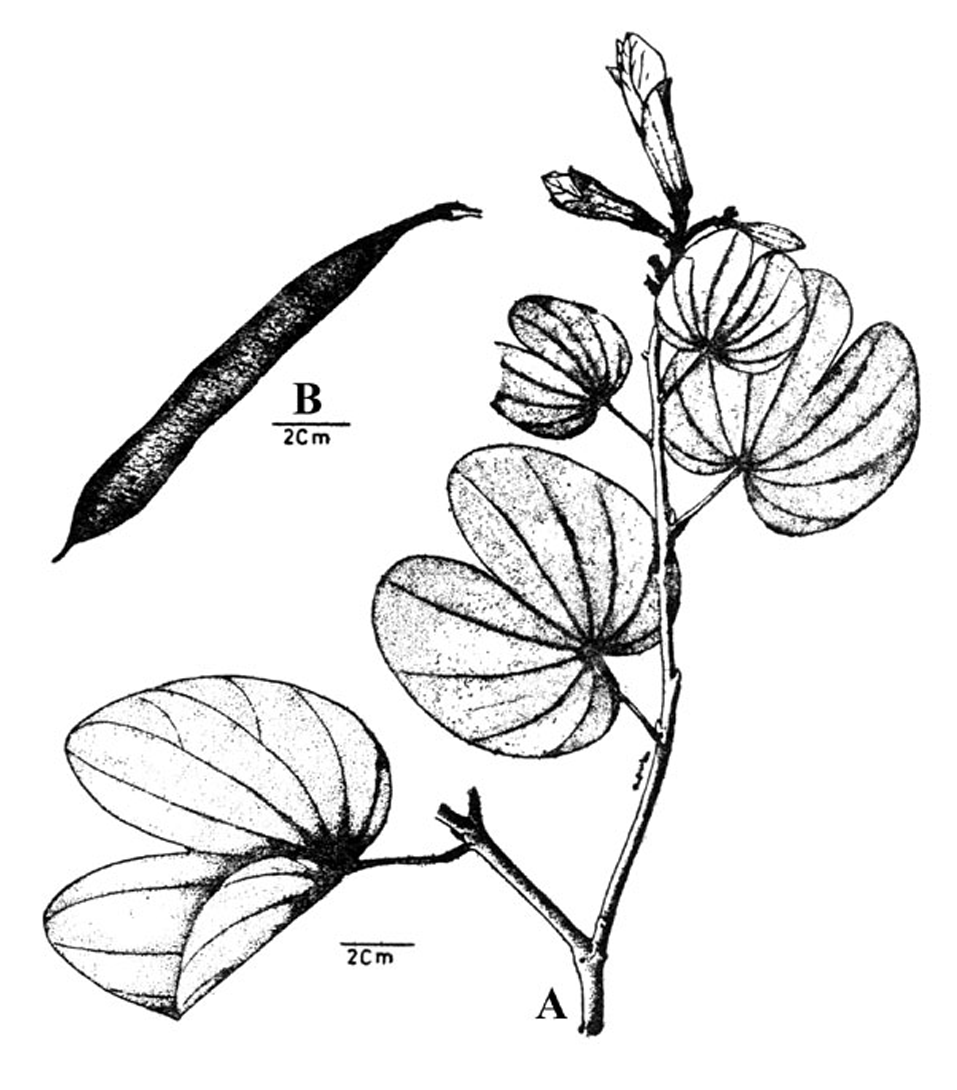
| Leaf | Leaves are simple, alternate, base rounded to shallow-cordate, up to 4.5–11 cm long and 4.5–10 cm wide, deeply 2-lobed at apex, margin entire and the surfaces smooth and glabrous, and 9- 11 nerved at base |
| Leaf fall | January–March |
| Flowering season | September to November |
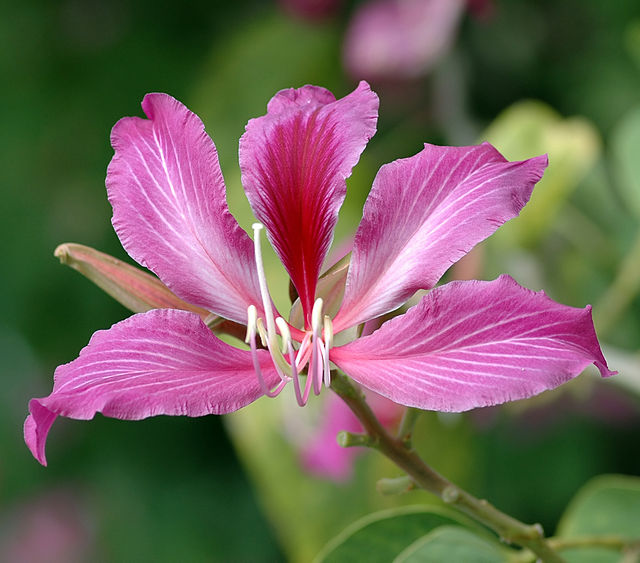
| Flower | flowers are conspicuous, pink and fragrant with five petals. Pedicels 5-13 mm long, stout, tementose, bract and bracteoles small tementose, deltoid. Calyx tementose, tube 7.5-10 mm long, limb long as the tube. Petals 3.8 to 5 cm long, oblanceolate, long clawed, spreadind veined. Stamens usually 3 fertile, others reduced to antherless filaments. Ovary downy, long-stalked; style long; stigma large, oblique |
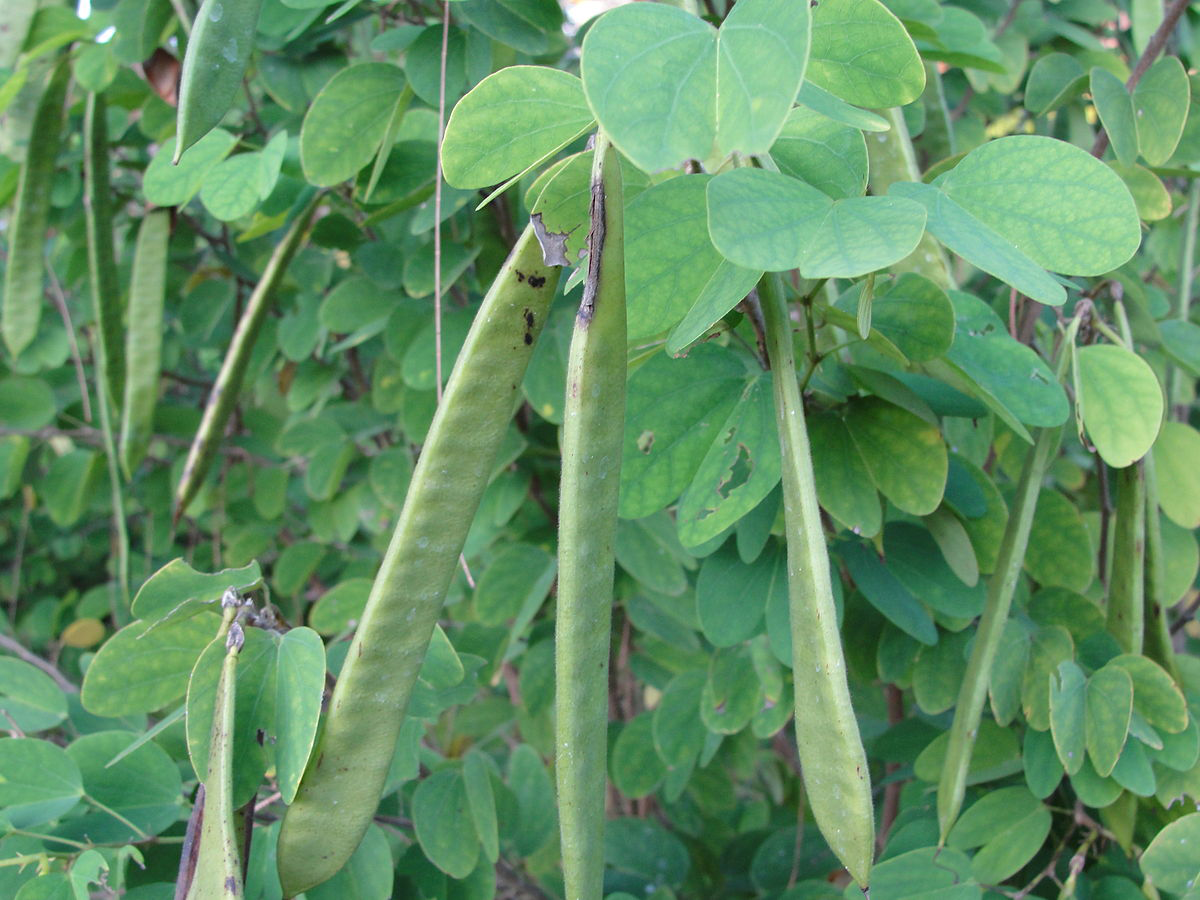
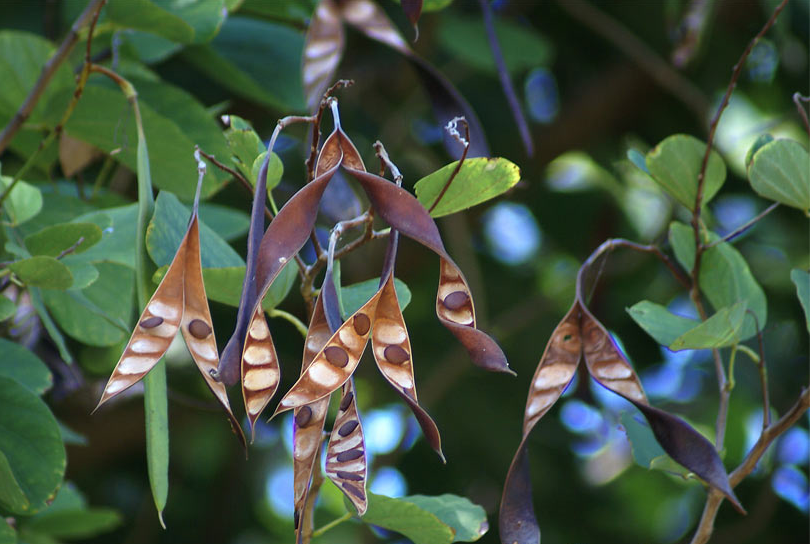
| Fruit Shape & Size | Brown, strap-shaped, not separate, elongated dehiscent pods, 15- 30 cm long, up to 1.5-2.5 cm wide, containing 10-15- shiny-brown seeds |
| Fruit Color | Green turning to brown as they mature |
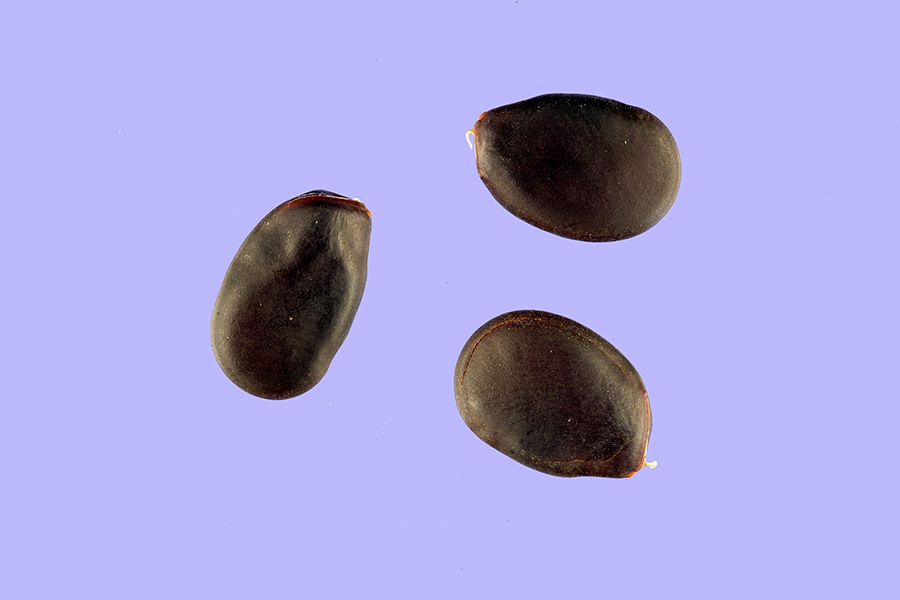
| Seed | Shiny-brown, glabrous, dehiscent, rounded, flat seeds that are 13-16 mm in diameter and 1-2mm thick; twists as opens |
| Propagation | By seeds, grafting, cuttings and air-layering |
| Taste | Pungent |
| Plant Parts Used | Bark, leaves, root, flowers stems |
| Season | February to March |
Plant Description
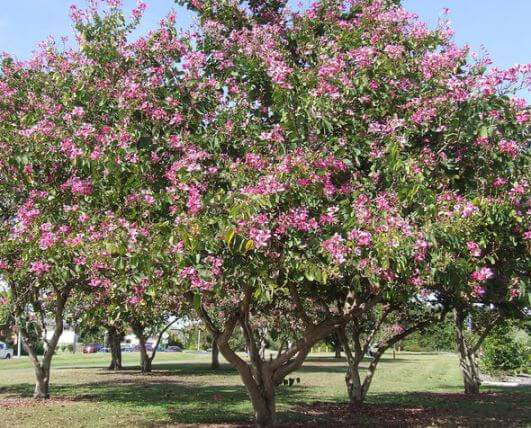
Purple Bauhinia is a small to medium-sized deciduous evergreen, fast-growing shrub or tree with a round, symmetrical, moderate dense crown, young branches becoming glabrous or nearly so (glabrescent). The plant normally grows about 7.6 m in height and 17.8 cm in diameter. It can reach a height of 4.6 m in less than 2 years. It is found growing in evergreen lowland rainforests, mountain forests, savanna, scrublands, dry deciduous forests and swamp forests. It can also grow in disturbed areas, secondary forest, along roadsides and in gardens, parks, and disturbed sites near urban areas. It grows on a variety of sandy, loamy and gravelly soils in full sun in fertile, moisture-retentive but well-drained soils. It demands plenty of light and requires good drainage. However, it’s adaptable to any free-draining garden soils. Trunk is woody with pale grey to brown colored bark that is fairly smooth to slightly fissured and scaly. The twigs are slender, light green, slightly hairy, and angled, becoming brownish grey. The heart-wood is brown, hard and durable.
Leaves
Leaves are simple, alternate, base rounded to shallow-cordate, up to 4.5–11 cm long and 4.5–10 cm wide, deeply 2-lobed at apex, margin entire and the surfaces smooth and glabrous, and 9- 11 nerved at base. The apex lobes are rounded or obtuse to sub-acute, minute stipules 1-2 mm long, petioles puberulous to glabrous, 2.5-3.5 cm long. Leaf blades are 4.5-11 cm long.
| Leaf arrangement | Alternate |
| Leaf type | Simple |
| Leaf margin | Cleft, lobed |
| Leaf shape | Orbiculate |
| Leaf venation | Palmate |
| Leaf type and persistence | Deciduous |
| Leaf blade length | 2 to 4 inches |
| Leaf color | Green |
| Fall color | No color change |
| Fall characteristic | Not showy |
Flower
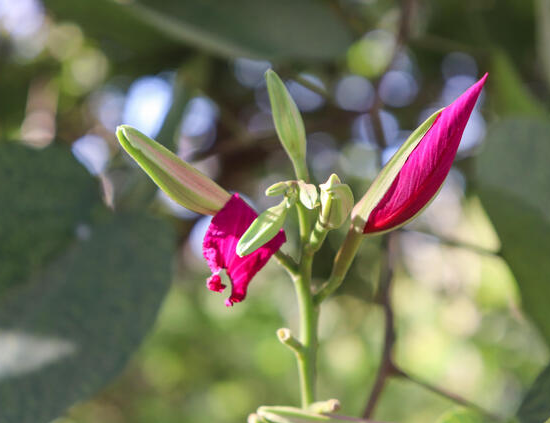
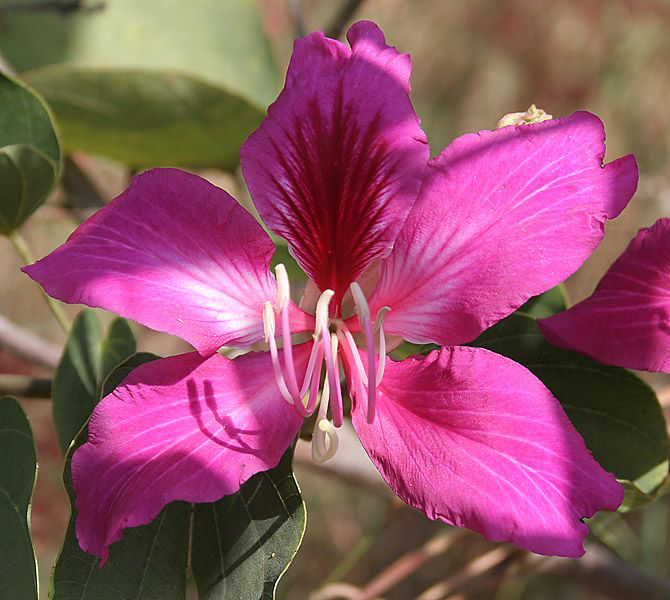
Inflorescence a 6-10-flowered raceme in terminal panicles; flowers numerous, hypanthium, turbinate, purple to nearly white or at least purple marked, the flower buds clavate (club-shaped), velvety, ca 3-4 cm long prior to anthesis; fertile stamens 3 or 4, the anthers ca 6 mm long, versatile; ovary superior; corolla of 5 narrow petals and constricted at base, oblanceolate, 3-5 cm long, claws 5-10 mm long, the banner purple striate, 7 mm wide. Calyx is tubular, erupted by corolla along one side when flower fully expanding; calyx split into 2 valves with 5 teeth. In fall, before the leaves drop, Orchid-Tree is festooned with many showy and delightfully fragrant, five-inch-wide blossoms, the narrow purple, pink, and lavender petals arranged to closely resemble an orchid. These flowers appear on the trees from September through November and are a beautiful sight to see, creating a vivid splash of color in the autumn landscape.
| Flower color | Red, purple, blue |
| Flower characteristics | Very showy |
Fruit
Fertile flowers are followed by 12-inch-long, slender, brown, flat seed pods which usually persist on the tree throughout the winter. Fruit is brown, strap-shaped, not separate, elongated dehiscent pods, 15- 30 cm long, up to 1.5-2.5 cm wide, containing 10-15- shiny-brown, glabrous, dehiscent, rounded, flat seeds that are 13-16 mm in diameter and 1-2mm thick; twists as opens. Seed forms very rapidly and trees in flower may already show numerous green pods. While most pods will open in the drier winter weather some may persist through to the next flowering season. Fruit mature in spring and summer. Fruit does not attract wildlife.
| Fruit shape | Elongated, pod or pod-like |
| Fruit length | 6 to 12 inches |
| Fruit covering | Dry or hard |
| Fruit color | Brown |
| Fruit characteristics | Does not attract wildlife; showy; fruit/leaves a litter problem |
Traditional uses and benefits of Purple Bauhinia
- Bark, root, leaves and flowers of Purple Bauhinia are supposed to have medicinal properties and used in traditional folk medicine in India, Pakistan, Sri Lanka and Malaysia.
- Leaves are applied externally to the forehead to treat fever.
- Leaves consist of tannin and are used for poulticing sores and boils in Malaysia and India.
- Dried buds are used in the treatment of piles, dysentery, diarrhea and worms.
- Bark is used for poulticing treatment of skin diseases, scrofula and ulcers stomach tumor and wounds in India.
- Root is used as an antidote to snake poison and decoction of the root used for dyspepsia.
- The Ibans consume a tea made from the roots for high blood pressure, stomachache and diarrhea in Sarawak, Malaysia.
- Pounded leaves are rubbed on the back to alleviate backache.
- The Kayan take the root decoction for cough, stomachache and diarrhea and the solution used as gargle for toothache.
- The Kedayan boiled the root with fennel and shallot and drink the decoction for stomach-ache and diarrhea.
- The Penan drinks the root decoction for toothache.
- The Selako boil the leaves with sea weed and sea shells and drink the decoction to relieve kidney problems and pain when urinating.
- Purple Bauhinia has been traditionally used by the Indian, Sri Lankan and Pakistani people to treat ailment like ulcer, wound, glandular swelling and stomach tumor.
- Decoction of the root is used for expelling gases, flatulence and griping pain from the stomach and bowel.
- Bark of the plant is used as an astringent in the treatment of diarrhea.
- Its decoctions are recommended as a useful wash solution for ulcers.
- Decoction of stem is administered twice a day as folk remedy was found to be effective against asthma and other respiratory disorders.
- Bark or root and flower mixture with boiled rice water is used as maturant for boils and abscesses.
- Fresh bark of Kaanchanaara mixed with Shunthi, pounded with sour gruel, was prescribed in enlarge cervical glands as well as in goiter.
- Over the counter Kaanchanaara, Guggulu is used to treat enlarge cervical glands, goiter and scrofulous tumors.
- Roots are used as carminative and flower buds as laxative and anthelmintic in folkloric medicine in Mangalore, India.
- Bark sap with honey is taken against leucorrhoea and is also used to treat menstrual problems in Assam.
- In India the bark is used as an ingredient in medicine for dropsy, scorpion sting and insect bites, rheumatism, convulsions, stomach tumors, and as an antidote to certain toxins and poisons.
- The flower is used for indigestion.
- Its extract is a good cure for healing wounds and injuries.
- Leaves are crushed into a paste and used for treating boils and sores.
- Its plant is a good herb for curbing rheumatic pain and swellings.
- It helps in curing the illness, dropsy.
- It is used to get rid of respiratory ailments like asthma, cold and cough.
- Its decoction helps in preventing the growth of tumor cells.
- Its bark is used for the treatment of diarrhea.
- Its flower bud is used to treat dysentery and piles.
- It is an antidote to animal bites.
- Its bark extract increases the production of both T4 and T3 levels.
- The Malays use the leaves to treat sores and boils.
- The bark is used in the treatment of skin disease.
- In Peninsular Malaysia and Thailand the leaves are used for poulticing sores and boils.
- In India, the bark is extensively applied in glandular diseases and as a poison antidote.
- It is well known for its astringent, anthelmintic, carminative and diuretic effects and is used in diarrhea.
- Leaves are used as a cough medicine.
- Various parts of the plant are used in decoctions to treat fever and stomach ailments, as well as being used as an astringent.
- In Indian traditional medicine, the leaves are used to treat coughs while the bark is used for glandular diseases and as an antidote for poisons.
- Flowers are laxative, mixture of flower buds and flowers, fried in purified butter are beneficial to treat dysentery.
- Stem bark are useful in respiratory disorder and menstruation trouble.
- It is useful in treatment of various diseases like diarrhea, dysentery, amoebic dysentery, ano-rectal, piles, lymph nodes swelling, lymph node enlargement, inflammatory swelling and hemorrhage-bleeding, cold and cough, disorders related to urinary system and skin disease.
- Flower buds are used for bloody dysentery and piles.
- It is used for dropsy, anasarca, rheumatic pains and swelling, convulsions, febrile delirium, animal bites, datura intoxication.
- In Pakistan, leaves, stems, and root are used to treat infections, pain, diabetes, jaundice, leprosy and cough.
Ayurvedic Health benefits of Purple Bauhinia
- Flatulence: Drink 10 ml root decoction of Butterfly Tree twice a day.
- Diarrhea: Make a decoction using bark of Purple Bauhinia. Have 5 ml twice a day.
- Ulcers: Wash your Ulcers using bark decoction of Purple Bauhinia.
- Laxative: Prepare a flower decoction of Purple Bauhinia. Drink 5 ml thrice a day.
Culinary Uses
- Leaves, flower buds, flowers and young pods are eaten as vegetable and pot herb.
- Flower and buds are often used in curries and pickles and as condiments.
- Flower buds are cooked and eaten as vegetables in Andhra Pradesh and Uttarakhand Himalaya.
- In Thailand, young shoots and leaves are added in curry dishes; the taste is somewhat sour.
- Young pods and mature seeds of kachnar are known to be cooked and eaten by tribes such as the Kathkors and Gondas of India.
- Leaves have a citrusy and sour taste and are used as a souring agent for sinigang and similar dishes in Philippine cuisine.
- Flowers are said to be laxative and used in curries and pickles.
- Flower buds can also be pickled and used in curries.
Other Facts
- It is mostly cultivated as an ornamental shrub and for erosion control.
- The leaves and flowers are used as fodder.
- Plant is often cultivated as an ornamental, roadside, garden plant and shade tree.
- It is also used for soil improvement.
- Leaves, pods and shoots are used as fodder.
- Stem yields semki-gona gum and the bark is good as tanning material, dyeing and for fiber.
- Wood is used for making furniture, agricultural implement and for house building and fuel.
- Trees start flowering at a very early age of 2-3 years and yield viable seeds.
- The bark is a source of tannins and fiber, and is used for dyeing.
- The fine wood is hard and durable and is used in carpentry and fuel.
- It is known to eject its dehiscent seeds as far as 15 m away.
Other Different Products
Fodder: In an experiment in Nepal, it was found increase milk production in lactating buffaloes. Leaves make good fodder and are greedily eaten by sheep, goats and cattle with protein content estimated at 12.6%.
Tannin or dyestuff: Bark of various bauhinia species consist of considerable amounts of tannin widely used in leather industry in India. Medicinal uses of bark can be largely attributed to the presence of these tannins. Flavonoids are a common feature of Bauhinia.
Medicine: Throughout South-East Asia various parts of numerous Bauhinia species are used in poulticing to reduce swelling and bruises, and to ripen ulcerations and boils. Decoctions of various plant parts are taken internally as a febrifugal, anti-diarrheal and anti-dysenteric remedy and also it is used as an astringent. In India, the bark is extensively applied in glandular diseases and as a poison antidote while the leaves are administered as cough medicine. The flowers are said to be laxative and used in curries and pickles.
Lipid: Seeds consists of high amounts of linolenic and oleic fatty acids (15% of non-drying oil) and low amounts of myristic and linolenic fatty acids.
Gum or resin: The tree yield edible gum.
Fuel: It is also used as fuel wood; its calorific value is 4 800 kcal/kg.
Timber: The wood is used for agricultural implements.
Other products: Apart from being an ornamental it is well known as the source of Bauhinia purpurea agglutin (BPA), a lectin with an affinity to galactose and lactose, widely applied in biochemical, immunochemical and histo-chemical studies.
Services
Erosion control: Bauhinia purpurea with a deep root system and high root: shoot ratio may be a suitable species for slope stabilization.
Ornamental: B. purpurea is extensively planted as an ornamental tree in parks, gardens and homesteads, and along avenues for its showy fragrant, purple flowers. The weak wood is susceptible to breakage in storms; the abundant seedlings, which may germinate in the landscape; and the litter problem, created by the falling leaves, flowers, and seedpods
Precautions
- It can cause side effects such as stomach upset, headaches, nausea, vomiting, loose stools, diarrhea, belching, and hiccups.
- It can also cause allergic reactions such as rash and itching.
- It is best to avoid taking Kachnar Guggul in high doses such as 6000 mg per day.
- Although less common, some other side-effects include restlessness, apprehension, and breakdown of muscle tissue.
- Pregnant and lactating mothers should avoid consuming it orally or otherwise.
- People with a sensitive stomach may experience mild gastric irritation.
- People with bleeding disorders should avoid consuming it as it can slow blood clotting and might cause bleeding or bruising.
- People with high cholesterol levels should avoid it as it might increase levels of low-density lipoprotein (LDL) cholesterol.
- People suffering from hormone-sensitive conditions such as breast cancer, uterine cancer, ovarian cancer, endometriosis, or uterine fibroids should also avoid taking Kachnar Guggul as it might act like estrogen in the body.
- People who have undergone surgery recently should not take it as it might increase the risk of bleeding during and after surgery.
- People taking medicine for diabetes should consume it under a doctor’s consultation.
- Do not take it continuously for more than one month.
References:
https://www.itis.gov/servlet/SingleRpt/SingleRpt?search_topic=TSN&search_value=26493#null
http://www.hear.org/pier/species/bauhinia_purpurea.htm
https://npgsweb.ars-grin.gov/gringlobal/taxon/taxonomydetail?id=6590
https://www.cabi.org/isc/datasheet/8638
https://gd.eppo.int/taxon/BAUPU
http://www.theplantlist.org/tpl1.1/record/ild-823
https://en.wikipedia.org/wiki/Bauhinia_purpurea
https://pfaf.org/user/Plant.aspx?LatinName=Bauhinia+purpurea
http://www.flowersofindia.net/catalog/slides/Purple%20Orchid%20Tree.html
https://plants.usda.gov/home/plantProfile?symbol=BAPU