

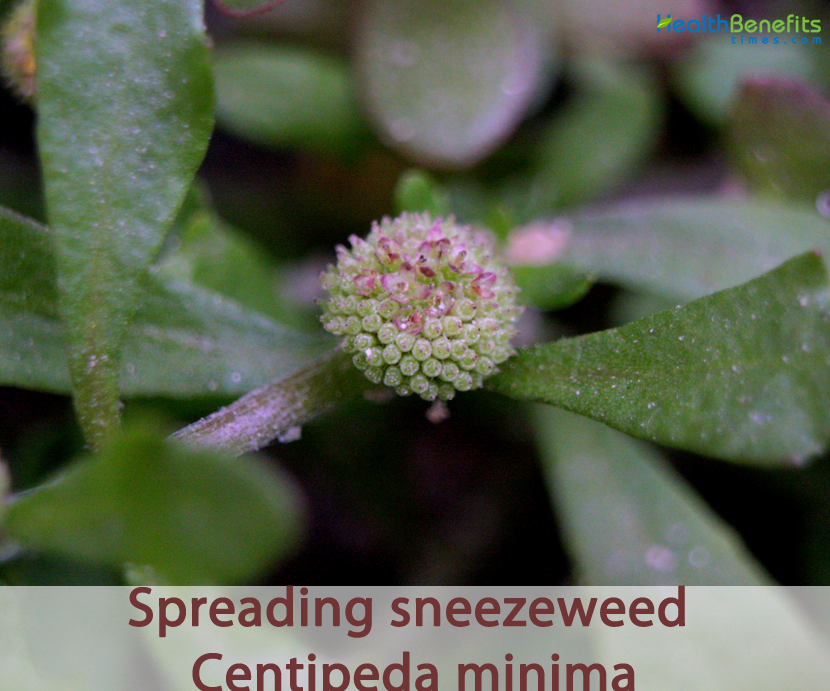
| Spreading sneezeweed Quick Facts | |
|---|---|
| Name: | Spreading sneezeweed |
| Scientific Name: | Centipeda minima |
| Origin | Africa through Afghanistan and India to China and Japan, and southwards through South-East Asia to Australia and the Pacific Islands |
| Colors | Initially green turning to brown as they mature |
| Shapes | Oblong and curved achene 1 mm long tipped with the persistent style |
| Taste | Sweet, Acrid, Pungent |
| Health benefits | Malaria, hepatitis, diabetes mellitus, eczema, insect or snake bites, opium poisoning, whooping cough, gallstones, hypertrophic rhinitis, chronic bronchitis, conjunctivitis, vaginitis, pelvic inflammatory disease, chronic pelvic inflammatory disease, fungal vaginitis, eczema, soft tissue injury, rheumatic arthralgia, peripheral facial nerve palsy, and hookworm cercariae infection |
| Name | Spreading sneezeweed |
|---|---|
| Scientific Name | Centipeda minima |
| Native | From Africa through Afghanistan and India to China and Japan, and southwards through South-East Asia to Australia and the Pacific Islands |
| Common Names | Sneeize-wort, Small Centipeda, Centipeda Herb, Sneezeweed, Sneezewort, Spreading Sneezeweed, Kundush, Herba Centipedae |
| Name in Other Languages | Arabic: Kundush Assamese: Hachuti, Hansia bon, Hansia-bon Bodo: Hansio bighang Chinese: E Bu Shi Cao (鹅不食草), shí hú suī shǔ (石胡荽属), Shi hu sui (石胡荽), Qui zi cao, Tǔ jīn cǎo (吐金草), De hújiāo (地胡椒) English: Spreading sneezeweed, Sneezeweed, Sneezewort French: D’s aigrettes German: Kleine Centipede Gujarati: Chhikani, Nakshikani Hindi: Kundush, Nakchikni, Newari, Nakchhikni (नाकछिकनी), Pochitti, Nagdowana Indonesian: Mbakoan Japanese: Tokinsou (トキンソウ), hanahirigusa (ハナヒリグサ), tanehirigusa (タネヒリグサ), tokinsô Kannada: Chikani (ಛಿಕನೀ) Korean: Jung dae ga ri pul (중대가리풀) Marathi: Naakashikani (नाकशिकनी), Shikani Nepali: Chhinke Jhaar (छिन्के झार), Chhiuke Jhaar (छिऊँके झार) , Hachhiu Jhaar (हाच्छिउँ झार), Naak Chhikaani (नाक छिकानी ) Oriya: Nakchika Persian: Bekhe Gazran Philippines: Harangan, pisik Russian: Stonozhka malaya (стоножка малая), stonozhka okruglaya (стоножка округлая) Sanskrit: Chhikka (छिक्का), Chhikkani (छिक्कनि), Kshavakrita (क्षवक्रिता), Chikkana, Kshavaka, Chhikka, tikshna, ghrandukhahda, chhikkani, kashvakrit, mecheta Sinhalese: Vishadhuli (විශධූලි ), Heen kimbu (හීන් කිඹු), Visha Chunniya (විශ චූන්ණිය ) Tamil: Tittarokani, Tummarpuntu, Marukolunthu, Tittarokani Thai: Krataai chan, yaa krachaam, mueat lot Tibetan: Kas ba ka (ཀས་བ་ཀ) Urdu: Nakchhikni ناک چھکنی Vietnam: C[us]c m[awr]n, c[os]c m[awr]n, c[or] the |
| Plant Growth Habit | Small, erect, prostrate or ascending, slender, low growing leafy herb, somewhat woolly or nearly smooth |
| Growing Climates | Waste ground, roadsides, fallow rice fields, in wet places, marshy banks, humid open locations, on thinly grassed patches, on banks of permanent waterholes, muddy banks of rivers and sometimes found submerged in shallow water |
| Plant Size | 8-20(-30) cm tall |
| Stem | Filiform, ribbed, internodes 2-10 mm long, 1 mm large, sparsely to densely covered with fine white, cobwebby hairs |
| Leaf | Alternate, simple, narrowly spatulate, about 5-20 mm long and 1-7 mm wide, base attenuate, apex obtuse and mucronulate, sometimes 3-lobed at the apex and entire at the lower part, margins pinnatilobed or dentate (lobes or teeth mucronulate), sparsely pilose on both sides; petiole absent; stipules absent |
| Flowering season | September to February |
| Flower | Flowers all tubular, marginal flowers numerous. Florets are of 2-types. Female florets in outer few rows; flower minute, tubular, shortly 4-toothed, yellow. Bisexual florets are inner, few; floret bell-shaped, 0.6 mm long, 4-lobed, yellow; stamens 4, anthers entire at base |
| Fruit Shape & Size | Oblong and curved achene 1 mm long tipped with the persistent style, and bristly on the angles |
| Fruit Color | Initially green turning to brown as they mature |
| Taste | Sweet, Acrid, Pungent |
| Plant Parts Used | Whole Plant |
Plant Description
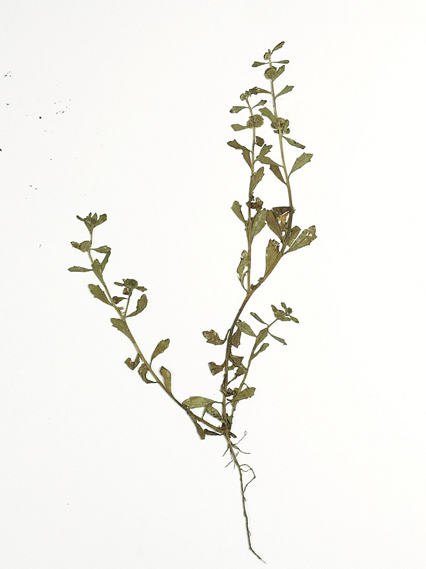
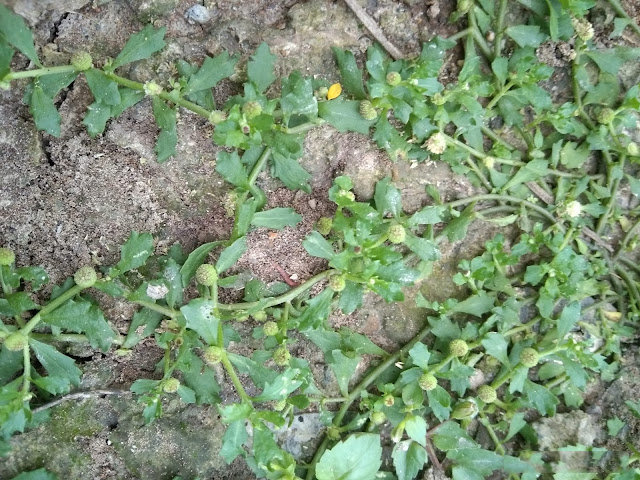
Spreading sneezeweed is a small, erect, prostrate or ascending, slender, low growing leafy herb, somewhat woolly or nearly smooth with numerous branches spreading from the root, and 8 to 20 centimeters long, sometimes to 30 cm. Its duration is annual which means it grows for one season only. Centipeda Minima or Spreading Sneezeweed’s floral region is North America US Lower 48, specifically in the states of Massachusetts and Pennsylvania. The plant is found growing in waste ground, roadsides, fallow rice fields, in wet places, marshy banks, humid open locations, on thinly grassed patches, on banks of permanent waterholes, muddy banks of rivers and sometimes found submerged in shallow water. Stems are filiform, ribbed, internodes 2-10 mm long, 1 mm large, sparsely to densely covered with fine white, cobwebby hairs.
Leaves
Leaves are alternate, simple, oblong-obovate to oblanceolate, narrowly spatulate, about 5-20 mm long and 1-7 mm wide, base attenuate, apex obtuse and mucronulate, sometimes 3-lobed at the apex and entire at the lower part, margins pinnatilobed or dentate (lobes or teeth mucronulate), sparsely pilose on both sides; petiole absent; stipules absent.
Flowers
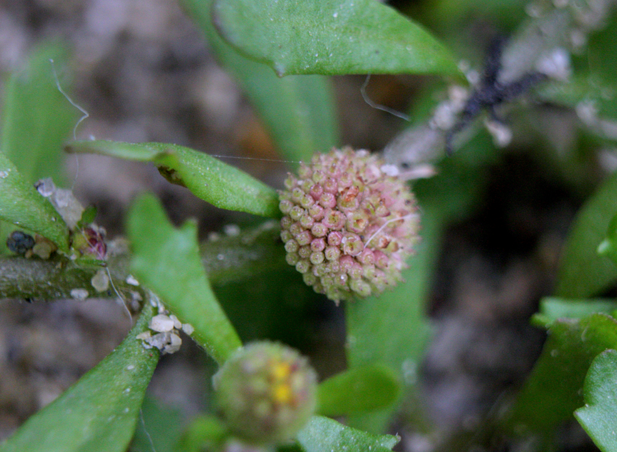
Inflorescence an axillary head, 2-4 mm in diameter, opposed to a leaf; peduncle absent, involucral bracts 2-seriate, oblong, about 1 mm long, margins membranous, sub-dentate, with long, cotton-like hairs, apex rounded. Flowers all tubular, marginal flowers numerous. Florets are of 2-types. Female florets in outer few rows; flower minute, tubular, shortly 4-toothed, yellow. Bisexual florets are inner, few; floret bell-shaped, 0.6 mm long, 4-lobed, yellow; stamens 4, anthers entire at base. Flowers borne singly in the axils of the leaves. Flowering normally takes place in between September to February.
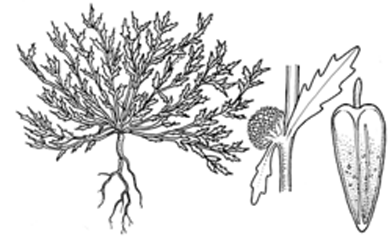 Sketch-of-Spreading-sneezeweed
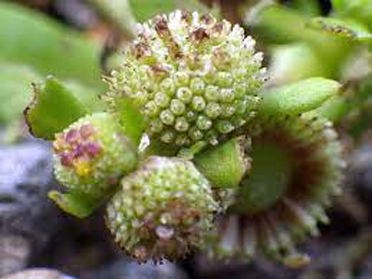 Closer-view-of-flower-of-Spreading-sneezeweed
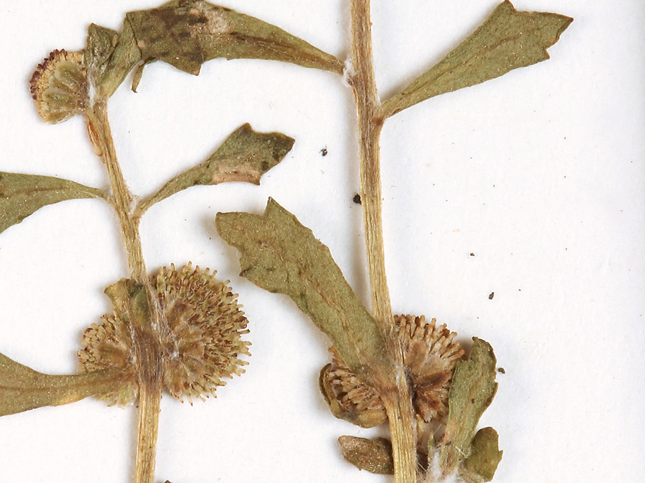 Dried-Spreading-sneezeweed-plant
 Plant-Illustration-of-Spreading-sneezeweed
 Spreading-sneezeweed-extract-powder
 Flower-of-Spreading-sneezeweed
 Spreading-sneezeweed-plant-growing-wild
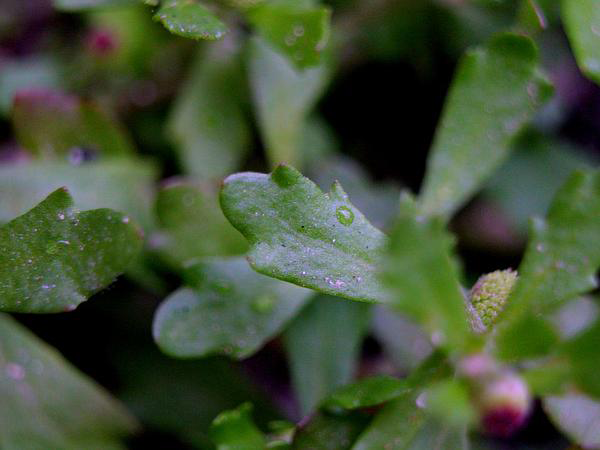 Leaves-of-Spreading-sneezeweed
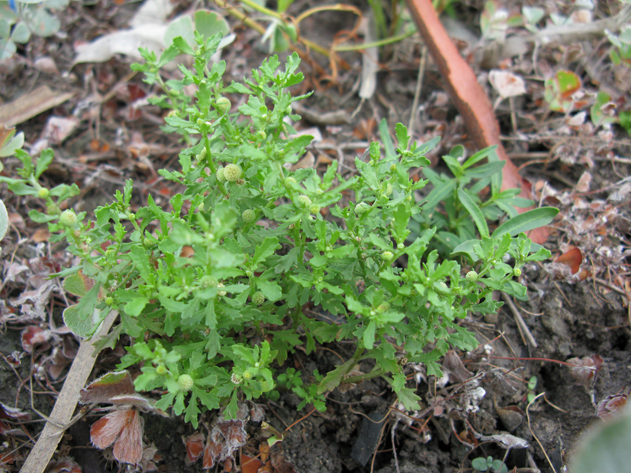 Whole-Spreading-sneezeweed-plant
Fruits
Fertile flowers are followed by oblong and curved achene 1 mm long tipped with the persistent style, and bristly on the angles. They are obovate, 4-angled, fringed with hairs, brown; pappus absent.
Traditional uses and benefits of spreading sneezeweed
- The plant is anodyne, antitussive, depurative, diuretic, stimulates blood circulation.
- When the aroma of the squeezed flower heads is inhaled it induces sneezing and so is used to relieve nasal congestion, especially during coughs and colds.
- Paste made from the flower heads is applied externally in the treatment of swellings and skin inflammations.
- Spreading Sneezeweed is used traditionally to treat skin disorders including relief of itching, dry skin from psoriasis.
- It is used medicinally to treat sinus infections in Nepal.
- In the Philippines, leaves are squeezed between the fingers and inhaled, making the eyes water, clearing the head and provoke sneezing.
- It is used for rheumatic lumbar and leg pains.
- Powdered herb and minute seeds are used as sternutatory.
- It is used as hot and dry medicine for paralysis, joint pains and worms.
- Ointment made dried pulverized material with camphor or yerba buena (Mentha arvensis) to make a 10% valenine ointment, applied to the nose for rhinitis.
- It is used for sprains, bone fractures, poisonous snake bites, and furuncle.
- Poultice is used for sprains, contusions and snake bites.
- In India, it is used as snuff for treatment of head colds.
- The Mundas of Chota Nagpur sniff the crushed plant for fevers and colds.
- In China, it is used for nasopharyngeal cancers.
- Infusion of plant is used as a kind of snuff for ophthalmia, causing the eyes to water.
- Plant decoction is used for treatment of paralysis, malaria, joint pains.
- It is used in general against eye and sinus infections and nose polyps.
- In Indo-China and Thailand, the plant is also used against cough, common cold and bronchitis.
- In China, it is considered a hot and dry medicine which is useful as a decoction in paralysis and pain in the joints, and also against malaria, hepatitis, diabetes mellitus, eczema, insect or snake bites, and opium poisoning.
- When taken with wine, it is a remedy for internal injuries.
- Seed or dried aerial parts are used as a vermifuge and amoebicide.
- In India, the herb is boiled to a paste and applied to the cheeks for toothache, and also used for other swellings and inflammations.
- Decoction is suggested as a remedy for rickets and children’s sores, and for diseases of the digestive system in Taiwan.
- To reduce the pain, the paste of this herb is used by the local application on the affected part.
- In liver or spleen hardening, this herb is used as a detoxifier in the form of decoction or powder.
- It is helpful in strengthening the neuromuscular tissues.
- Paste prepared from the seeds of the plant is applied externally to treat skin diseases like ringworm, scabies.
- The powder of the seed is given in a dose of 2-3 gm. with milk to improve the strength of the nerves and treat general debility.
- The decoction of the plant is given in a dose of 30-40 ml to expel the phlegm and control cough.
- The powder of the seed is given in a dose of 2-4 gm. to treat erectile dysfunctions.
- Cold infusion prepared from the seeds is given in a dose of 20-30 ml to treat indigestion and lack of appetite.
- The decoction of the seed is given in a dose of 25-30 ml to treat intestinal worms.
- The paste prepared from the leaves of the plant is applied over the area affected with pain.
- In traditional Chinese medicine, it is often used to disperse wind and cold, relieve stuffy nose, relieve cough and remove toxins, treat whooping cough, gallstones, acute rhinitis, chronic simple rhinitis, hypertrophic rhinitis, allergic rhinitis, chronic bronchitis, conjunctivitis, vaginitis, pelvic inflammatory disease, chronic pelvic inflammatory disease, fungal vaginitis, eczema, malaria, soft tissue injury, rheumatic arthralgia, peripheral facial nerve palsy, and hookworm cercariae infection.
Ayurvedic Health benefits of spreading sneezeweed
- Headache: Freshly collected leaves are made into fine paste and juice is extracted. 1-2 drop of this leaf juice is used as nose drops, on empty stomach. This is effective in headache and severe cold.
- Throat Pain: Spreading sneezeweed and black pepper are taken in equal amount and fine powder/paste is made. This is applied to the throat/neck from outside: to the cheeks in mumps. 3-5 days of medication gives significant benefits.
- Worm Infestation: Fine powder of the seeds or hot infusion is used in the treatment of intestinal worms.
- Toothache: For toothache and dental carries, fine powder or leaves/flower paste is applied along with a piece of salt.
- Nasal Congestion: Fine powder of roots or seeds is used to snuff or to take 2-3 puff by adding/dusting over the fire. This helps to relieve nasal congestion and rhinitis and sneezing.
Other Facts
- It is only locally used as a medicinal plant and is not traded on the international market.
- It is harvested either when the flower heads are just opening or are in full bloom.
- The plant is said to have caused poisoning of livestock in northern Australia.
- Plant has been reported to cause poisoning in livestock.
- Overdose may cause nausea, vomiting, acute abdominal pain, or gastric discomfort, and other adverse reactions.
- People who are allergic to geese non-grass should not take it.
- Avoid taking its decoction on an empty stomach.
- People with internal heat due to yin-deficiency should not take it.
- People with weakness of the spleen and the stomach should not take it.
- People with stomach ulcers and gastritis should not take it.
- Pregnant women and breastfeeding women should take it under the guidance of a doctor.
References:
https://www.itis.gov/servlet/SingleRpt/SingleRpt?search_topic=TSN&search_value=36980#null
https://pfaf.org/user/Plant.aspx?LatinName=Centipeda+minima
https://gd.eppo.int/taxon/CEPMI
http://www.theplantlist.org/tpl1.1/record/gcc-75376
http://www.flowersofindia.net/catalog/slides/Spreading%20Sneeze%20Weed.html
https://gobotany.nativeplanttrust.org/species/centipeda/minima/
https://indiabiodiversity.org/species/show/226807
http://www.stuartxchange.com/Harangan.html
https://tropical.theferns.info/viewtropical.php?id=Centipeda+minima
https://plants.usda.gov/home/plantProfile?symbol=CEMI5