

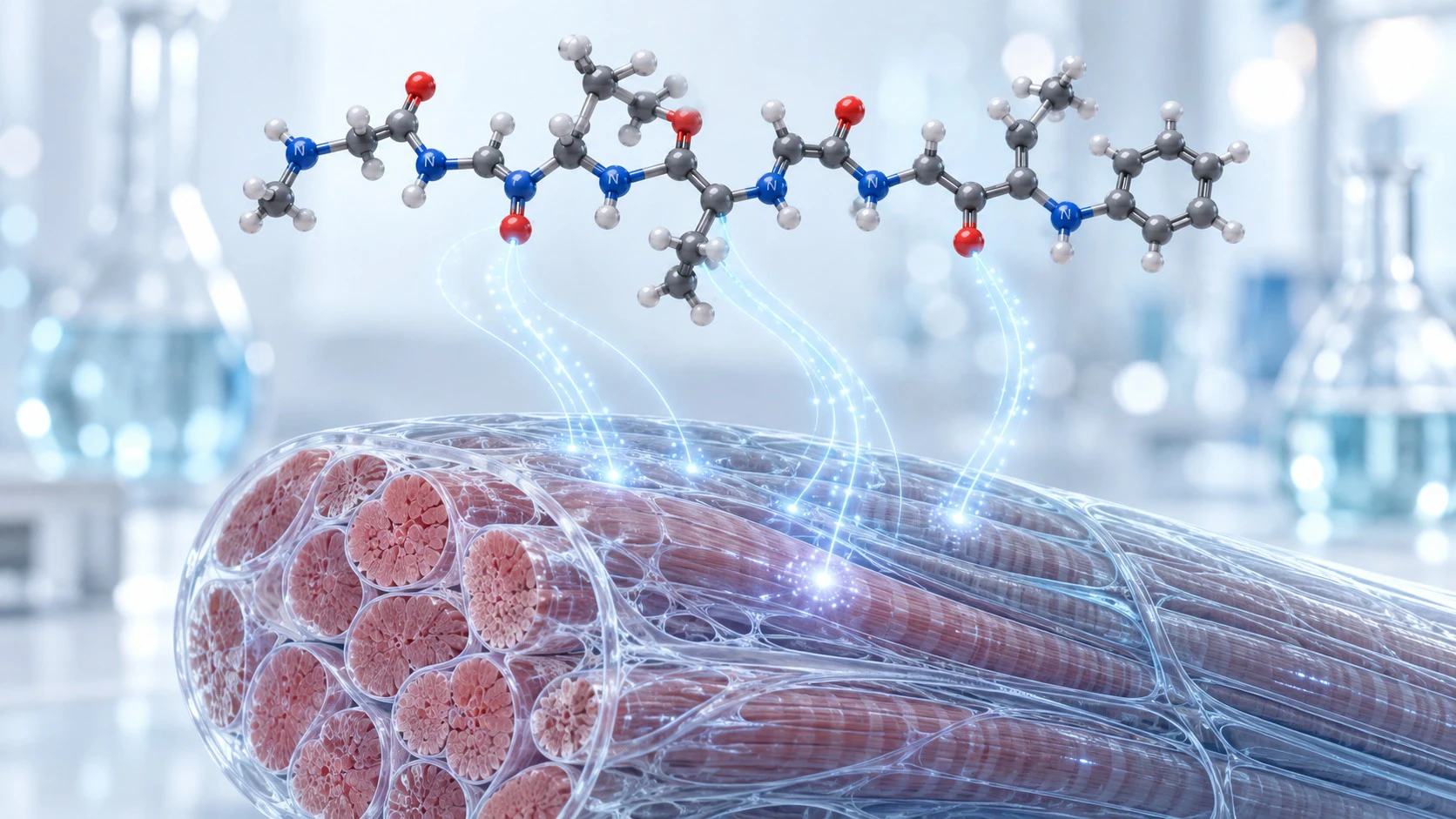
 Peptides and muscle research: collagen, protein and growth hormone secretagogues
“Peptides for muscle” is one of the most-searched health topics of the past two years, and one of the most confusing. The phrase covers everything from the collagen powder in your morning coffee to synthetic research compounds that are not approved for any use. These are very different molecules with very different evidence, and lumping them together is how people end up with unrealistic expectations.
This article sorts the research by type of peptide and by type of study — human trials, animal experiments, or cell culture — so you can see what is established, what is promising, and what is still speculation.
First, What a Peptide Is
A peptide is a short chain of amino acids, typically 2 to 50 residues long. Proteins are longer versions of the same thing. When you digest a steak or a scoop of whey, your gut breaks the protein into peptides and free amino acids before absorbing them. Some peptides also act as signaling molecules in the body: insulin, growth hormone–releasing hormone (GHRH), and ghrelin are all peptides.
That dual role — nutrient and signal — is why the word covers such different products. Dietary peptides supply building blocks. Signaling peptides tell cells what to do with them.
Dietary Peptides: The Strongest Human Evidence
Protein and whey
The best-supported way to use peptides for muscle is the least exotic. A 2018 meta-analysis of 49 randomized trials with 1,863 adults found that protein supplementation during resistance training added about 0.3 kg of fat-free mass and a modest strength gain beyond training alone [1]. The effect plateaued around 1.6 g of protein per kilogram of body weight per day and was smaller in older adults.
Whey is a convenient source because it is rich in leucine, the amino acid that most strongly triggers muscle protein synthesis. But the research does not show that whey peptides are “special” — they are an efficient delivery of amino acids.
Collagen peptides
Collagen hydrolysate has a more specific story. In a 2015 randomized trial of 53 older men with sarcopenia, those who took collagen peptides alongside 12 weeks of resistance training gained more fat-free mass and strength than the placebo group [2]. A 2019 trial in 77 premenopausal women found a similar pattern [3]. The mechanism is unclear — collagen is low in leucine — and the studies came from a single research group, so independent replication would strengthen the case. Still, these are controlled human trials with muscle outcomes, which is more than most peptides can claim.
Signaling Peptides: Growth Hormone Secretagogues
The second class of “muscle peptides” does not supply amino acids at all. These are synthetic analogs of the body’s own hormones that stimulate the pituitary gland to release growth hormone (GH). GH in turn raises insulin-like growth factor 1 (IGF-1), which drives anabolic signaling in muscle.
Two families exist:
- GHRH analogs such as sermorelin, tesamorelin, and MOD GRF 1-29 (also called CJC-1295 without DAC), which mimic the hypothalamic hormone that tells the pituitary to release GH.
- Ghrelin-receptor agonists such as ipamorelin and GHRP-2, which act on a separate receptor and release GH by a different route. The two pathways are synergistic in human studies [4].
What human studies show — and don’t
Human pharmacology studies consistently confirm that these compounds raise GH and IGF-1. The CJC-1295 trials in healthy adults, for example, showed GH elevated for days after a single administration [5]. What is missing is the next step: controlled trials with muscle mass or strength as the endpoint.
The closest evidence comes from two sources. A one-year randomized trial of MK-677, an oral ghrelin mimetic, in 65 healthy older adults found about 1.1 kg more fat-free mass than placebo — but no improvement in strength or function, plus rises in fasting glucose [6]. And a systematic review of recombinant GH itself in healthy older adults found about 2 kg more lean mass and 2 kg less fat, with no demonstrated strength benefit and more side effects such as joint pain, swelling, and glucose changes [7].
The pattern is consistent: more lean tissue on the scan, no more strength in the gym, and a real side-effect profile. For anyone evaluating a product in this class, that is the honest summary of the human data.
Where these compounds actually sit
None of the GHRH analogs or GHRPs is approved for muscle growth. Tesamorelin is approved for a specific HIV-related indication; sermorelin was once approved as a diagnostic (Geref) and was discontinued by its manufacturer in 2008. MOD GRF 1-29 has never been through clinical trials under its own name. These compounds are sold as research materials — for example, listings such as mod grf 1-29 for sale are intended for laboratory study, not for consumers — and they are prohibited in sport by the World Anti-Doping Agency.
Direct Growth Factors and “Repair” Peptides
A third group is even further from human evidence. IGF-1 LR3, an engineered analog of IGF-1, is about three times as potent as the native hormone in rat studies and is widely used as a cell-culture supplement, but it has never been tested in a controlled human trial [8]. PEG-MGF, a modified fragment of a muscle-specific IGF-1 variant, increased fiber size when injected into mouse muscle, again with no human data [9].
BPC-157 and TB-500 are often included in lists of muscle building peptides, but the research on them concerns repair after injury, not growth — and it is almost entirely in animals. A 2026 rat tendon study that tested the two together found each improved healing scores on its own, and that combining them added nothing beyond either alone.
A Simple Way to Read Any “Muscle Peptide” Claim
- What was the model? Cell culture, animal, or human. Most peptide claims rest on the first two.
- What was measured? A rise in GH or IGF-1 is a biomarker. Lean mass on a DXA scan is better. Strength and function are what matter — and are the endpoints most often missing.
- Who was studied? Older adults with low GH, patients with a specific disease, or rats are not interchangeable with healthy trained adults.
- Is it the same molecule? CJC-1295 trial data are for the DAC version; MK-677 is not a peptide; thymosin β4 trial data are for the full protein, not the TB-500 fragment.
Research Peptides Are Not Supplements
It is worth being explicit about the difference. Collagen and whey are foods. The synthetic compounds above are research chemicals: they are not regulated as supplements, they have no approved use, and the suppliers who sell them — such as generic peptides vendors serving laboratories — label them for research use only. A certificate of analysis showing HPLC purity and mass-spectrometry identity is the minimum a laboratory should expect for any such material.
The Bottom Line
If the question is what the research supports for building muscle, the answer in 2026 is unglamorous: resistance training with adequate protein, where collagen peptides have some supporting trials and whey is an efficient protein source. Growth hormone secretagogues raise hormone levels in humans without proven strength benefit. Everything else is preclinical. Understanding that hierarchy is the best protection against the marketing that surrounds the word “peptide.”
FAQ
Do collagen peptides build muscle? In two randomized trials, collagen peptides combined with resistance training produced greater gains in fat-free mass and strength than placebo. The effect depends on training; collagen alone has not been shown to build muscle.
Are growth hormone peptides proven to increase muscle? They are proven to raise GH and IGF-1 in humans. Trials measuring body composition found more lean mass but no strength improvement, along with side effects. None is approved for this purpose.
What is MOD GRF 1-29? A modified 29-amino-acid fragment of GHRH, engineered to resist enzymatic breakdown. It stimulates GH release in the pituitary and is sold only as a research compound.
Is BPC-157 a muscle-growth peptide? No. It is studied for injury repair in animal models, and no controlled human trial exists.
References
- Morton RW, et al. A systematic review, meta-analysis and meta-regression of the effect of protein supplementation on resistance training-induced gains in muscle mass and strength in healthy adults. Br J Sports Med. 2018;52(6):376–384. PMID 28698222.
- Zdzieblik D, et al. Collagen peptide supplementation in combination with resistance training improves body composition and increases muscle strength in elderly sarcopenic men. Br J Nutr. 2015;114(8):1237–1245. PMID 26353786.
- Jendricke P, et al. Specific collagen peptides in combination with resistance training improve body composition and regional muscle strength in premenopausal women. 2019;11(4):892. PMID 31010031.
- Bowers CY, et al. Growth hormone (GH)-releasing peptide stimulates GH release in normal men and acts synergistically with GH-releasing hormone. J Clin Endocrinol Metab. 1990;70(4):975–982. PMID 2108187.
- Teichman SL, et al. Prolonged stimulation of growth hormone (GH) and insulin-like growth factor I secretion by CJC-1295 in healthy adults. J Clin Endocrinol Metab. 2006;91(3):799–805. PMID 16352683.
- Nass R, et al. Effects of an oral ghrelin mimetic on body composition and clinical outcomes in healthy older adults: a randomized trial. Ann Intern Med. 2008;149(9):601–611. PMID 18981485.
- Liu H, et al. Systematic review: the safety and efficacy of growth hormone in the healthy elderly. Ann Intern Med. 2007;146(2):104–115. PMID 17227934.
- Tomas FM, et al. Superior potency of infused IGF-I analogues which bind poorly to IGF-binding proteins is maintained when administered by injection. J Endocrinol. 1996;150(1):77–84. PMID 8708565.
- Goldspink G. Mechanical signals, IGF-I gene splicing, and muscle adaptation. Physiology (Bethesda). 2005;20:232–238. PMID 16024511.
For research use only. Not for human consumption. This content is for informational purposes and is not medical advice.