

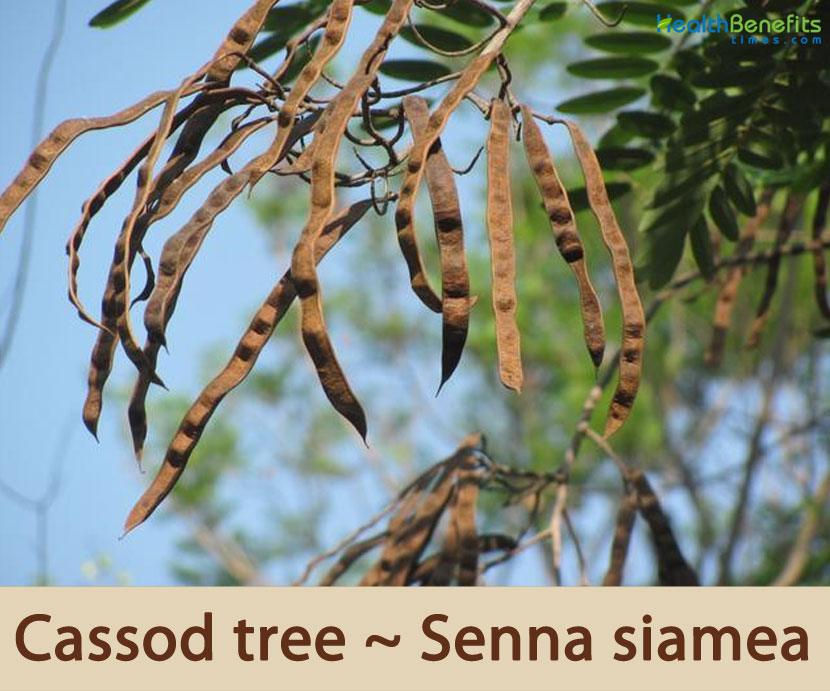
| Cassod tree Quick Facts | |
|---|---|
| Name: | Cassod tree |
| Scientific Name: | Senna siamea |
| Origin | Indian Sub-continent (i.e. India and Sri Lanka) and south-eastern Asia (i.e. Cambodia, Laos, Myanmar, Thailand, Vietnam and possibly also Malaysia) |
| Colors | Green when young turning to brown when mature |
| Shapes | Pendants, linear, and often slightly curved pods that are long, narrow about 5-25 cm long and 12-20 mm broad |
| Health benefits | Hypertension, malaria, diabetes, insomnia, constipation, scabies, cough, stomach pains, syphilis, herpes, swine fever, jaundice, abdominal pain, menstrual pain |
| Name | Cassod tree |
|---|---|
| Scientific Name | Senna siamea |
| Native | Indian Sub-continent (i.e. India and Sri Lanka) and south-eastern Asia (i.e. Cambodia, Laos, Myanmar, Thailand, Vietnam and possibly also Malaysia). It has been introduced to other humid tropical countries |
| Common Names | Blackwood Cassia, Bombay Blackwood, Cassod, Cassod Tree, Iron Wood, Kassod Tree, Pheasant Wood, Siamese Cassia, Siamese Senna, Siamese Shower, Thai Cassia, Thai Copper Pod, Thailand Shower, Yellow Cassia, Cassia Tree, Khilek, Mezali, kassod, minjri, muong, siamese tree senna |
| Name in Other Languages | Amharic : Yeferenji Digita Arabic: kasya samia (كاسيا ساميا), kasia siamiatun (كاسيا سيامية) Bambara: Baga-sinedian, Sinia Bengali: Minjiri (মিনজিরি) Brazil : Cássia-Do-Sião, Cássia-Siâmica, Cássia- Siamesa Burmese : Mezali, maal j le (မယ်ဇလီ), maal j le pain (မယ်ဇလီပင်) Cambodia: Angkanh Chinese : Guo Mai Xi Li, Tie Do Mu, Tie dao mu (铁 刀木 ) Creole : Kasya English: Iron Wood Tree, Kassod Tree, Siamese Senna, Siamese cassia, Thai cassia, Thailand shower, Pheasantwood, Cassod tree, Thai copper pod, Yellow Cassia, Thai Cassia, cassia tree Finnish: Siaminsenna French : Bois Perdrix, Casse Du Siam, Flamboyan, sindian, Cassia German : Kassodbaum Hindi: Seemia, Kassod (कसोद), beati, kassod, kilek, manjakonnai, manje-konna, minjori, minjri, ponavari, simaiavari, sima-tangedu, simethangadi, vakai, vakoi Indonesia : Bujak, Dulang, Johar, Juhar, Juwar, Jnar, Johor, Juwah Ivory Coast : Ando, Akassia Japanese : Tagayasan (タガヤサン) Kannada: Hiretangedi, Motovolanyaro, Sima Tangedu (ಸೀಮೆತಂಗಡಿ) Khmer : Ângkanh Laotian : Khi ‘Lek, ‘Khi:Z Hlek, Phak khi lek Lesser Antilles: Casse, kas Malay: Johar Malaysia : Busok-Busok, Guah Hitam, Jaha, Jahor, Jeragor, Johor, Jual, Petai Belalang, Sebusok Malayalam: Manjakonna, Manjakonnei, maññakkeānna (മഞ്ഞക്കൊന്ന) Marathi: Kassod Nepali : Casia Nigeria: Bikini raskata, Odan Pakistan : Minjri Philippines : Robles, Thailand shower Portuguese: Cássia-de-sião, cassia-siamesa, cássia-siamica, cássia-da-tailândia Sierra Leone: Mende Sheku Turay Sinhalese: Aramana, Wa Spanish : Flamboyán Amarillo, casia amarilla; casia de Siam, casia siamea Sri Lanka : Aramana, Wa, Manga Konnei, Vakai Sudanese: Juwar Swahili : Mjohoro Taiwan : Tie Dao Mu Tamil: Mancal Konrai, Manjal Konrai, Manje-Konne, Cimaiyaviri, Celumalarkkonrai, Cuvarnakam, Karunkonnai, Karunkonrai, Kotakkini, Macantakatukkai, Makaraciya, Mancalkonrai, Mampalakkonrai, Mancatkonrai, Manga Konnei, Mulateciyam, Perumalarkkonrai, Pirampukkonnai, Ponnavirai, Vakai, Visakkini Telugu: Kurumbi, Sima Tangedu, Tangedu Thai : Khi Lek, Khi Lek Ban, Khi Lek Kaen, Khi Lek Luang, Khi Lek Yai, Phak Chili, K̄hī̂h̄el̆k (ขี้เหล็ก) Tongan : Kasia Vietnamese : Muồng Ðen, Muồng Xiêm Wolof: Àkkasaa |
| Plant Growth Habit | Medium-sized, evergreen, much-branched perennial tree |
| Growing Climates | Invaded forests near towns and is spreading along river banks on the lower Cape York Peninsula |
| Soil | Grows best on deep, well-drained soil rich in organic matter, but will succeed on degraded, lateritic soils provided drainage is not impeded. It grows poorly on infertile, poorly drained podzolic soils. It is not tolerant of salinity, but is reasonably tolerant of acid soil conditions |
| Plant Size | 10- to 12 meters high, occasionally reaching 20 meters and under exception circumstances 30 m with a straight trunk of 30 cm diameter |
| Root | Root system consists of a few thick roots, growing to considerable depth, and a dense mat of rootlets in the top 10-20 cm of soil, which may reach a distance of 7 m |
| Bark | Light grey or brown, smooth in young trees, becoming slightly cracked and rough with age |
| Stem | Erect and slender stem |
| Leaf | Alternate and pinnate, 23–33 cm long, and made up of 5–14 pairs of lanceolate, oblong or ovate elliptic leaflets, 3–7 cm long and 12–20 mm wide, abaxially finely pubescent, adaxially smooth and glabrous |
| Flower | Occur in many-flowered, axillary or terminal, 40 cm long, racemose panicles. Flower is 3 cm across, pedicellate, bisexual, zygomorphic, pentamerous, hypogynous |
| Fruit Shape & Size | Pendants, linear, and often slightly curved pods that are long, narrow about 5-25 cm long and 12-20 mm broad, flat, dehiscent and compressed between seeds |
| Fruit Color | Green when young turning to brown when mature |
| Seed | Bean-shaped, greenish-brown, 8-15 mm long. There are 35,000-45,000 seeds/kg |
| Propagation | By seeds, although stumps can be used |
| Plant Parts Used | Leaves, Tender Pods, Seeds, Flowers, Roots, Stems |
| Precaution |
|
Plant Description
Cassod tree is a medium-sized, evergreen, much-branched perennial tree that normally grows about 10- to 12 meters high, occasionally reaching 20 meters and in exceptional circumstances up to 30 m. The trunk is straight, up to 30 cm in diameter, with a rounded and dense crown. The bark is light grey or brown, smooth in young trees, becoming slightly cracked and rough with age. The root system consists of a few thick roots, growing to considerable depth, and a dense mat of rootlets in the top 10-20 cm of soil, which may reach a distance of 7 m from the stem in 1 year and eventually a distance up to 15 m. The plant is found growing in invaded forests near towns and is spreading along river banks on the lower Cape York Peninsula. It grows best on deep, well-drained soil rich in organic matter, but will succeed on degraded, lateritic soils provided drainage is not impeded. It grows poorly on infertile, poorly drained podzolic soils. It is not tolerant of salinity, but is reasonably tolerant of acid soil conditions.
Leaves
Leaves are alternate and pinnate, 23–33 cm long, and made up of 5–14 pairs of lanceolate, oblong or ovate elliptic leaflets, 3–7 cm long and 12–20 mm wide, abaxially finely pubescent, adaxially smooth and glabrous; base rounded and apex obtuse, borne on 25–40 mm long, terete petioles with caducous, minute subulate stipules. Upper side is dark green and shining while underside is dull-green and shortly haired.
| Leaf Arrangement | Alternate |
| Leaf Venation | Pinnate |
| Leaf Persistance | Evergreen |
| Leaf Type | Bipinnately compound |
| Leaf Blade | 20 – 30 |
| Leaf Shape | Oval |
| Leaf Margins | Entire |
| Leaf Textures | Smooth |
| Leaf Scent | No Fragrance |
| Color(growing season) | Green, Yellow |
| Color(changing season) | Green, Yellow |
Flowers
Flowers occur in many-flowered, axillary or terminal, 40 cm long, racemose panicles. Flower is 3 cm across, pedicellate, bisexual, zygomorphic, pentamerous, hypogynous. Sepals are imbricate, sub orbicular, obtuse at the apex, pubescent outside. Petals are sub equal, broadly obovate, bright yellow and shortly clawed. Stamens are 10, accrescent toward the abaxial side of the flower. Filaments are straight and not more than twice as long as the anthers. Ovary is superior, sessile, pubescent, linear and slightly curved.
| Flower Showiness | True |
| Flower Size Range | 7 – 10 |
| Flower Type | Raceme |
| Flower Sexuality | Monoecious (Bisexual) |
| Flower Scent | No Fragrance |
| Flower Color | Yellow |
| Seasons | Summer |
Fruits
Fertile flowers are followed by numerous pendants, linear, and often slightly curved pods that are long, narrow about 5-25 cm long and 12-20 mm broad, flat, dehiscent and compressed between seeds. They are green ribbon like when young turning to brown when mature. The seeds are subglobose to ovate, numerous (20-30), bean-shaped, shiny, dark brown and 8 mm long, with distinct areole. There are 35,000 to 41,000 seeds per kilogram.
| Fruit Type | Legume |
| Fruit Showiness | True |
| Fruit Size Range | 7 – 10 |
| Fruit Colors | Brown |
| Seasons | Summer |
Traditional uses and benefits of Cassod tree
- It is also used to prevent blood from pooling in organs or in the genito-urinary tract.
- Plant has excellent tranquilizer and calming properties that help counter the effects of stress and anxiety.
- Decoction using Cassia Siamea is used to treat scabies and rhinitis in Cambodia.
- It is considered a first class psycho-pharmaceutical.
- The leaves are used to treat malaria.
- Fruit is used to treat intestinal worms and prevent convulsions in children in Ayurvedic medicines.
- Fresh and dried leaves can be decocted and enjoyed with lemon juice to treat malaria and liver disorders.
- Leaves are picked, cleaned, and chewed with the liquid being swallowed to treat abdominal pains in Uganda.
- Prepared leaves are taken in capsule form as a laxative and sleep aid in Thailand.
- Macerated roots are used with other herbs to treat snake bites and diabetes in Kenya.
- Small repetitive doses of decocted roots are used to treat angina and malaria in Ivory Coast.
- Seeds are used to treat intestinal worms and scorpion bites.
- Decoction of the leaves and stems is enjoyed as an aperitif and to counter arthritic swelling in China.
- Plant is commonly used in traditional medicine to treat hypertension, malaria and diabetes Mellitus.
- Decoction of the leaves with lemon juice is used for the treatment of fevers in Burkina Faso.
- Tree is very popular for its local usage in the treatment of typhoid fever in Northern Nigeria.
- Hardwood decoction is used against scabies in Kampuchea.
- Fruit and seeds have been used to treat intestinal worms.
- In Thailand, the leaves and flowers are used as a remedy for insomnia, as laxative for constipation and as appetite stimulant and digestive stimulant.
- Flower and root decoctions are used to treat anxiety, nervousness and stress, and wood decoction for fever.
- Flowers are used to treat insomnia and asthma traditional medicine.
- It is used against intestinal worms and scabies.
- Fruit is used to charm away intestinal worms and to prevent convulsions in children in traditional medicine.
- This medicinal plant has been used successfully over thousands of years to treat anxiety disorders, mild panic attacks, and stress- and sleep disorders in traditional Thai medicine.
- Leaves, stems, roots, seeds, and flowers used for treatment of malaria.
- In Burkina Faso, decoction of fresh and dried leaves, stem bark, and flowers used to treat malaria and liver disorders.
- Decoction of stem bark drunk for diabetes.
- In Cote d’Ivoire, decoction of leaves drunk for cough, stomach pains, and malaria.
- In India daily dose of 150 ml leaf decoction with honey is taken 3 times a day for anemia and fever.
- Decoction of leaves and stems mixture are used as aperitif, anti-rheumatic, and for swelling in China and Pakistan.
- Decoction of leaves and stems used for periodic fever and malaria in Congo.
- It is used for the treatment of syphilis, herpes, swine fever, typhoid fever, jaundice, abdominal pain, menstrual pain in Nigeria.
- Fresh leaves are used to repel or kill insects i.e., termites, bed bugs, and mosquitoes.
- Leaves are used as antimalarial; fruits used to treat intestinal worms and to prevent convulsions in children in Cameroon.
- Leaves are used in the treatment of leucorrhoea.
- Decoction of leaves is administered orally for treating cough, stomach pains and malaria in Côte d’Ivoire.
- Leaves decoction is drunk against constipation and hypertension and are inhaled in toothache.
- Root decoction is used against fever, constipation, hypertension, and insomnia in Benin.
- Infusion, decoction or maceration of mixture of the roots is used as antidote for snake bites in Kenya.
- Decoction is used against scabies, urogenital diseases, herpes, and rhinitis in Cambodia.
Culinary Uses
- Young fruits and leaves are eaten as a vegetable and the flowers and young fruits are used in curries.
- Leaves are occasionally called caper leaves because the young flower buds look like caper berries, and are a common ingredient in Thai curries dishes.
- Young leaves have a bitter taste; young tender pods and inflorescences are edible.
- Young leafy shoots and young inflorescences are bundled and sold in markets as vegetables.
- Leaves and flowers are commonly used in soups and in the Thai curry dish known as ‘kaeng khi-lek’ which is prepared with and without coconut milk.
- Fresh young leaves are boiled with water 2–3 times to get rid of the bitterness and to reduce the toxic barakol content before the boiled mush is used for curry.
- They are also pickled in brine.
- In the Burmese full moon day of Tazaungmon, buds are picked and used in a soup or to prepare a salad called mezali phu thokke.
Other Uses
- In Thailand it is the provincial tree of Chaiyaphum Province and some places in the country are named after it.
- It is often used as shade tree in cocoa, coffee and tea plantations.
- It is cultivated as windbreaks, shelterbelts, live fence, boundary markers, ornamental in parks and gardens, wayside tree and shade tree for tea, cocoa and coffee plantings.
- Tree is also used for erosion control, for land reclamation in former tin/aluminum mining sites and in alley cropping systems in agroforestry, largely because of its coppicing ability and high biomass production shade besides also for its nitrogen fixing capability.
- In India, it is used as a host for the semi-parasitic sandalwood.
- In China, it has been cultivated as fuel wood by the Dai people since 400 years ago and as a host plant for lac insects.
- Its foliage is rich in nitrogen and organic matter and is used as green manure.
- Foliage can be used as browse or fodder for cattle, sheep and goats but are toxic to poultry and swine.
- Flower is an important nectar source for bees.
- Tree afford a hard, heavy, dense, durable, dark blackish brown and termite-resistant wood that is used in joinery, cabinet making, furniture, inlaying, tool handles, walking sticks, posts, bridges, mine poles and beams and other decorative carvings.
- All parts of the tree including the bark can be used for tanning.
- It can be made into charcoal of excellent quality.
- It starts flowering and fruiting at the age of 2-3 years.
Different Uses
Food
In Thailand, young fruits and leaves are eaten as a vegetable. During preparation the cooking liquid is replaced 3 times to remove toxins. In Sri Lanka, the flowers and young fruits are used in curries.
Fodder
The tree is widely grown for fodder, but the trees can be browsed. Alkaloids and other secondary plant compounds in the leaves, flowers and pods are extremely toxic to non-ruminants, such as pigs and poultry, and these animals should be kept away from S. siamea plantations.
Fuel
Dense, dark-coloured wood of makes good fuel, although it produces some smoke when burning. The energy value of the wood is 22 400 kJ/kg, and the density is 600-800 kg/m³. The wood was formerly preferred for locomotive engines. Its charcoal is also of excellent quality.
Timber
The tree yields a medium-weight to heavy hardwood with a density of 600-1010 kg/m³ at 15% mc. Heartwood is black-brown with paler streaks, sharply demarcated from the 6-cm wide, pale sapwood; grain is interlocked and occasionally straight; texture is slightly coarse but even. Shrinkage of the wood during seasoning is moderate to high but it seasons with little degradation. Wood is hard to very hard, resistant to termites, strong, durable, and difficult to work, with a tendency to pick up in planing and it takes a high polish. Sapwood is permeable to pressure impregnation.
Tannin or dyestuff
All parts of the plant can be used for tanning. The concentrations of tannin vary slightly from 17% in the leaves to 9% in the bark and 7% in the fruits.
Medicine
In traditional medicine, the fruit is used to charm away intestinal worms and to prevent convulsions in children. The heartwood is said to be a laxative, and in Cambodia a decoction is used against scabies.
Poison
Sawdust may cause some irritation to the nose, throat and eyes.
Other products
The plant is used in China as a host plant for the lac insect.
Erosion control
When used as a hedgerow, it effectively increases topsoil infiltration, reducing runoff and combating soil erosion.
Shade or shelter
The plant is grown as a shade tree along roads and in cocoa, coffee and tea plantations. It is also planted as a dense windbreak and shelterbelt.
Reclamation
It is used extensively for rehabilitation of degraded land, for example, to re-vegetate aluminum mine tailings.
Soil improver
Leaves are used as green manure, and a well-grown tree can yield 500 kg/year of fresh leaves. It forms ecto-mycorrhizae and provides very useful mulch, especially in alley-cropping systems.
Ornamental
It is often planted as an ornamental for its abundant yellow flowers.
Boundary or barrier or support
It is pruned into hedgerows and used as a live fence around food crops.
Intercropping
Although not a nitrogen-fixing tree, it has been increasingly used in alley cropping systems, largely because of its coppicing ability and high biomass production.
Other services
In India, it is used as a host for sandalwood, a parasitic tree producing the well-known aromatic.
References:
https://en.wikipedia.org/wiki/Senna_siamea
https://www.itis.gov/servlet/SingleRpt/SingleRpt?search_topic=TSN&search_value=505177#null
http://www.hear.org/pier/species/senna_siamea.htm
https://pfaf.org/user/Plant.aspx?LatinName=Senna+siamea
https://www.cabi.org/isc/datasheet/11462
https://npgsweb.ars-grin.gov/gringlobal/taxon/taxonomydetail?id=100033
http://tropical.theferns.info/viewtropical.php?id=Senna+siamea
http://apps.worldagroforestry.org/treedb/AFTPDFS/Senna_siamea.PDF
http://www.plantsoftheworldonline.org/taxon/urn:lsid:ipni.org:names:911410-1
https://gd.eppo.int/taxon/CASSM
http://www.flowersofindia.net/catalog/slides/Siamese%20Cassia.html
https://indiabiodiversity.org/species/show/231116
https://plants.usda.gov/home/plantProfile?symbol=SESI3