

| Duck Lettuce Quick Facts | |
|---|---|
| Name: | Duck Lettuce |
| Scientific Name: | Ottelia alismoides |
| Origin | Africa, Asia, northern Australia, and the Pacific |
| Shapes | Ribbed, ellipsoid to ovoid, rarely cylindrical fruits, 2.5 to 4 centimeters long and 1-2 cm wide with a beaked tip |
| Health benefits | Support hemorrhoids, fever, abscesses of the breasts, cancer, ulcers, burns, bilateral tuberculosis of the cervical lymph glands. |
| Name | Duck Lettuce |
|---|---|
| Scientific Name | Ottelia alismoides |
| Native | Africa, Asia, northern Australia, and the Pacific. In China, it is distributed in Yunnan, Sichuan, Guangxi, Guangdong, Hunan, Hubei, Jiangxi, Fujian Zhejiang, Anhui, Jiangsu, Henan |
| Common Names | Duck lettuce, Water-plantain ottelia, ottelia |
| Name in Other Languages | Arabic: Uwtilia mizmaria (أوتليا مزمارية) Assamese: Hentepa/ Kechoir/ Panikola, Panikola Bengali: Parmikalla, Pānikalā (পানিকলা), Ram korola, Kaobali, Torukola, Shyamkola, Kuchkolai, Jol-kolosh, Pani-kolosh, Jol-kola Chinese: Shui bai cai, Lung she ts’ao, Shui che qian, Long she cao, Shuǐ chēqiáncǎo (水車前草), Lóng shé cǎo (龙舌草) Dutch: Duikerbloem English: Duck lettuce, Water-plantain ottelia, ottelia French: Ottélie German: Froschlöffelähnliche Ottelie India: Pokok kelur, Dainithalir Italian: Erba coltella delle risaie, mestolaccia falsa, ottelia Japanese: Mizu-ôba-Ko (ミズオオバコ), mizuô-bako (ミズオウバコ), ômizu-ôbako (オウミズオウバコ) Kannada: Hasiru neeru paathre, Kottigenau balli, ga neun ip mul jil gyeong I (가는잎물질경이) Korean: Mul jil gyeong (물질경이) Malay: Keladi ayer, Kreboboth Malayalam: Ottel-ambel, oṭṭeliya alismēāyiḍes (ഒട്ടെലിയ അലിസ്മോയിഡെസ്) Manipuri: Lairenchak Marathi: Olek alsem, Bhat(Rice)-kamal Min Dong: Liék-siĕk-chāu Myanmar: Ye-hnyi Netherlands: Duikerbloem Russian: otteliya chastukhovidnaya (оттелия частуховидная) Spanish: Espada, Tangila Swedish: Ottelia Tamil: Nirkkuliri Telugu: Edukula thaamara, Neeru veniki Thai: Santawa, S̄ạntawā bı phāy (สันตะวาใบพาย) |
| Plant Growth Habit | Short-stemmed, robust, completely submersed, rooted, aquatic herbaceous plant |
| Growing Climates | Shallow fresh water of lakes and bayous, slow-moving streams, stagnant pools, on a muddy bottom, along lake shorelines, marsh ponds, irrigation ditches and stream margins in water and in rice field |
| Root | Roots are fibrous |
| Stem | Small and corm-like, occasionally forked, with fibrous roots |
| Leaf | Leaf blades of the submerged leaves are often narrow; the floating ones are ovate or somewhat rounded, with a rounded or often heart-shaped base, 7 to 22 centimeters long and 4.5 to 21 cm wide |
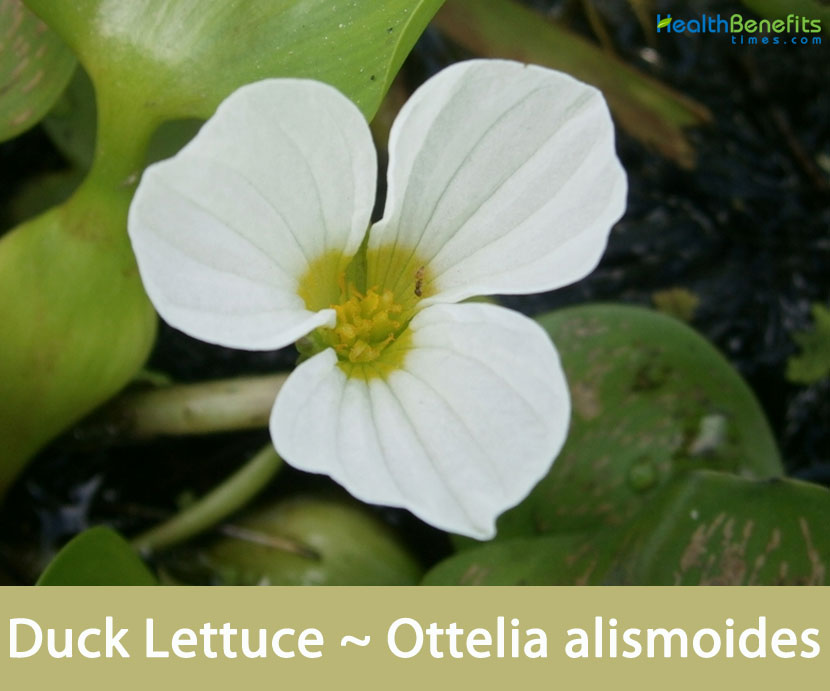
| Flower | Small terminal flower is held on a long peduncle which projects it above the surface of the water. The flower may open fully even when still submersed. Sepals are 1-1.5 cm long. Flowers have obovate petals 2-3 cm long, that range from white to pinkish in color with bright yellow anthers |
| Fruit Shape & Size | Ribbed, ellipsoid to ovoid, rarely cylindrical fruits, 2.5 to 4 centimeters long and 1-2 cm wide with a beaked tip |
| Plant Parts Used | Leaves, flowers |
| Propagation | By seed or sucker separation |
Plant Description
Duck Lettuce is a short-stemmed, robust, completely submersed, rooted, aquatic herbaceous plant native to the rice fields of southeastern Asia, but has naturalized to Louisiana, California, and more recently Missouri and Florida. The plant is found growing in shallow fresh water of lakes and bayous, slow-moving streams, stagnant pools, on a muddy bottom, along lake shorelines, marsh ponds, irrigation ditches and stream margins in water and in rice field. Stem is small and corm-like, occasionally forked, with fibrous roots.
Leaves
Leaves are extremely variable, with short or long petioles, according to the depth of the water. Leaf blades of the submerged leaves are often narrow; the floating ones are ovate or somewhat rounded, with a rounded or often heart-shaped base, 7 to 22 centimeters long and 4.5 to 21 cm wide. The veins in the leaves run parallel. Leaf-margins are entire or denticulate.
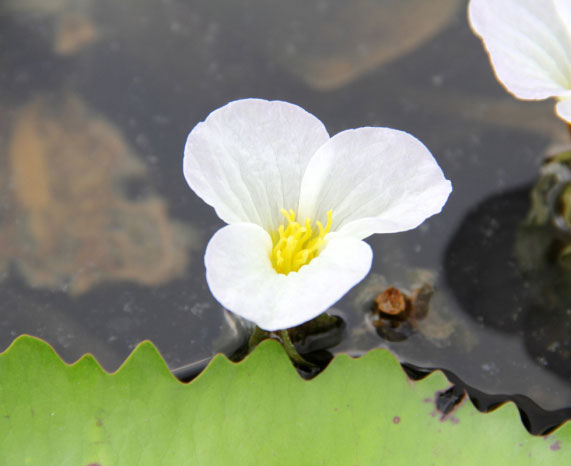 Flower-of-Duck-Lettuce
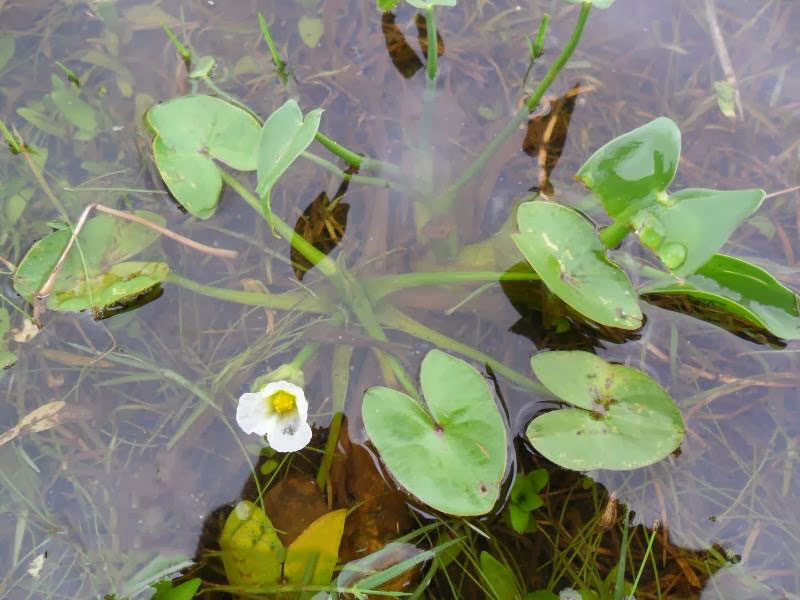 Duck-Lettuce-submerged-in-water
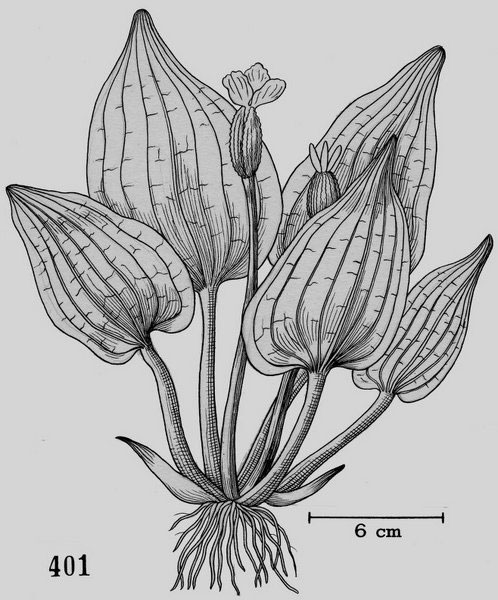 Sketch-of-Duck-Lettuce
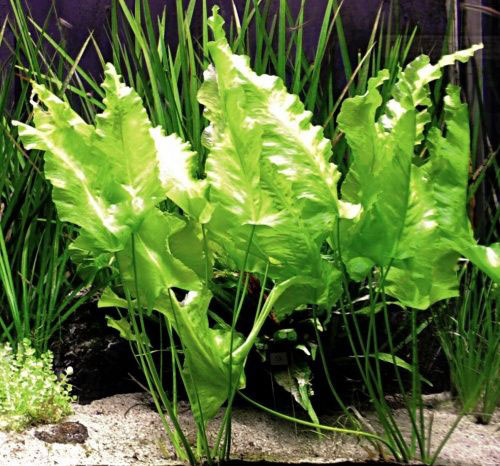 Leaves-of-Duck-Lettuce
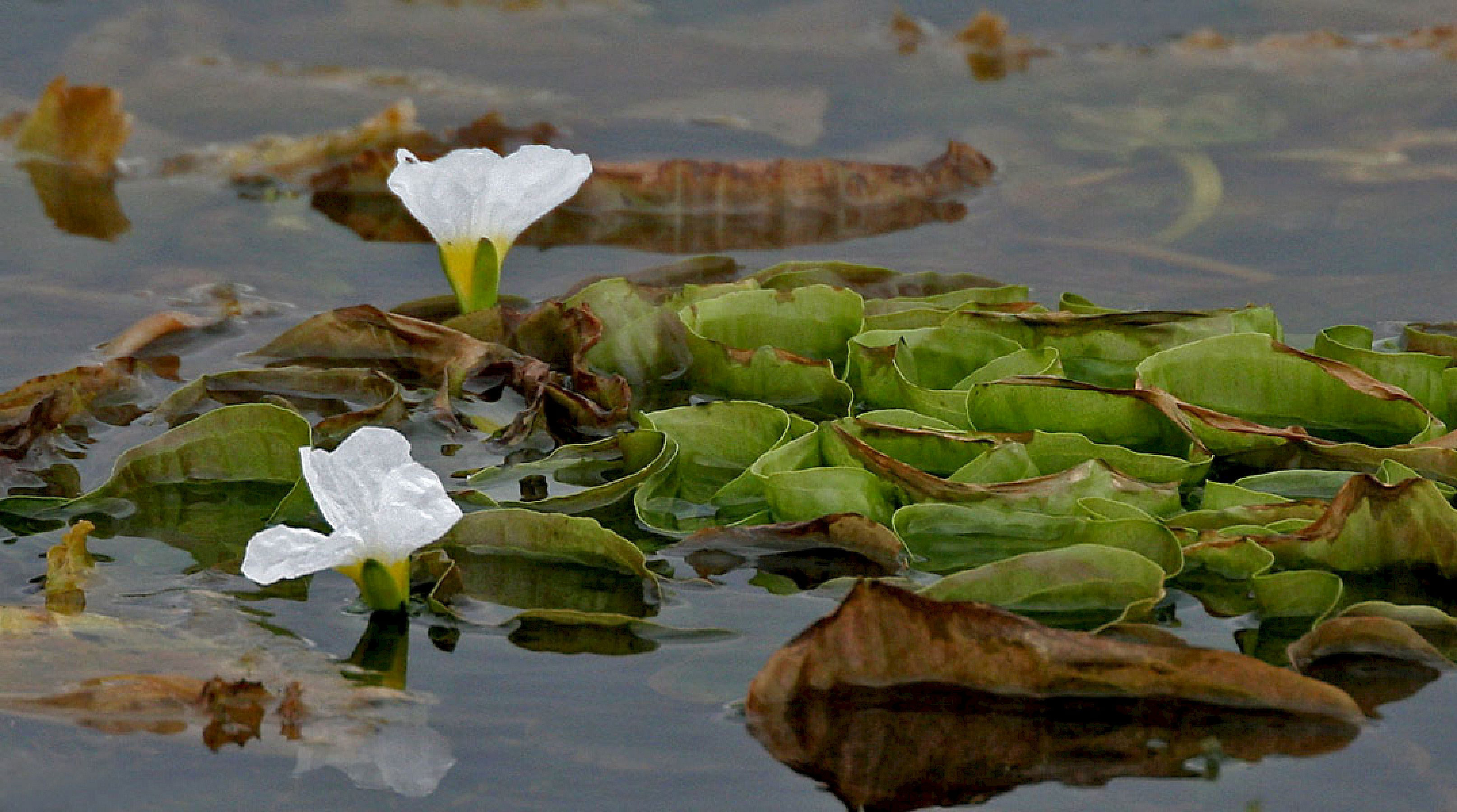 Duck-Lettuce-plant
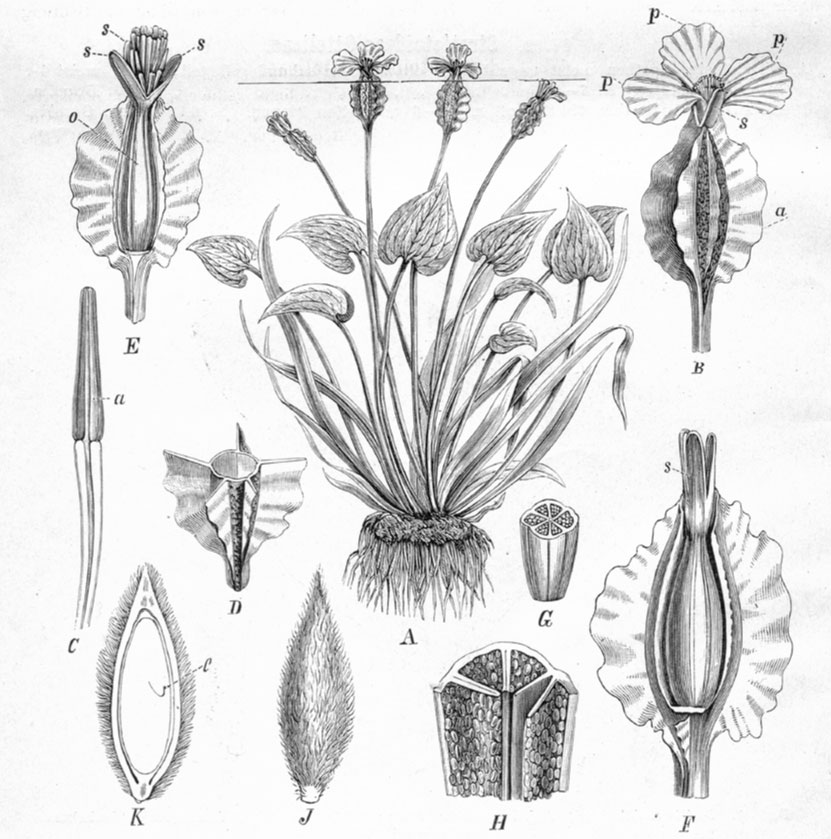 Plant-illustration-of-Duck-Lettuce
Flowers
The small terminal flower is held on a long peduncle which projects it above the surface of the water. The flower may open fully even when still submersed. Sepals are 1-1.5 cm long. Flowers have obovate petals 2-3 cm long, that range from white to pinkish in color with bright yellow anthers. They bloom from spring through summer.
Fruits
Fertile flowers are followed by ribbed, ellipsoid to ovoid, rarely cylindrical fruits, 2.5 to 4 centimeters long and 1-2 cm wide with a beaked tip. It can produce up to 2000 seeds. Duck Lettuce reproduces only by seed. Seeds are narrowly cylindric, 0.9–1.3 mm. long and 0.3–0.5 mm. wide, dark purple to black, with longitudinal striations.
Traditional uses and benefits of Duck Lettuce
- Leaves used as arm and leg poultices in fever.
- Leaves are used as topical for hemorrhoids.
- Leaves used for snake bites.
- The leaves are antibacterial, febrifuge and rubefacient.
- In Assam, India, flower paste taken orally early morning for curing hemorrhoids.
- In Tamil Nadu, India, leaves used to treat hemorrhoids.
- The Bodo community in Assam, India, use a decoction of ground leaves mixed with shoots of Ipomoea aquatica, Allium sativum, Lasia spinosa, Ocimum sanctum, Centella asiatica, and Typha angustata for the treatment of pneumonia.
- In China, plant prepared as paste and applied to abscesses of the breasts, cancer, ulcers and burns.
- Leaves used to check bleeding.
- In West Bengal, India, paste of dry seeds used externally on boils for relief of burning sensation.
- Dry leaf powder applied externally for various skin ailments.
- Plant is used in the treatment of hemorrhoids and applied as the poultice against fever.
- An extract of the plant cured two cases of bilateral tuberculosis of the cervical lymph glands within 3 months.
- The stem and leaf mash can be applied to cure ulcer, soup fire burn, etc.
Culinary Uses
- The petioles and leaves are eaten as a vegetable with excellent flavor.
- The leaves are used in Thailand for seasoning rice.
- The fruit is also edible.
Other Facts
- Seeds may remain viable for up to four years.
- Plants are used to improve the water quality in fish ponds by capturing floating mud particles.
- It is also grown as an aquarium plant.
- The plant is often regarded locally as a troublesome aquatic weed and removed manually.
References:
http://www.stuartxchange.com/Kalabua.html
https://www.itis.gov/servlet/SingleRpt/SingleRpt?search_topic=TSN&search_value=38976#null
http://www.hear.org/pier/species/ottelia_alismoides.htm
https://gd.eppo.int/taxon/OTEAL
https://en.wikipedia.org/wiki/Ottelia_alismoides
https://www.invasiveplantatlas.org/subject.html?sub=4619
https://nas.er.usgs.gov/queries/FactSheet.aspx?SpeciesID=1113
http://www.flowersofindia.net/catalog/slides/Duck%20Lettuce.html
https://indiabiodiversity.org/species/show/230552
https://www.texasinvasives.org/plant_database/detail.php?symbol=OTAL
http://tropical.theferns.info/viewtropical.php?id=Ottelia+alismoides
https://www.cabi.org/isc/datasheet/38087
https://plants.usda.gov/home/plantProfile?symbol=OTAL