

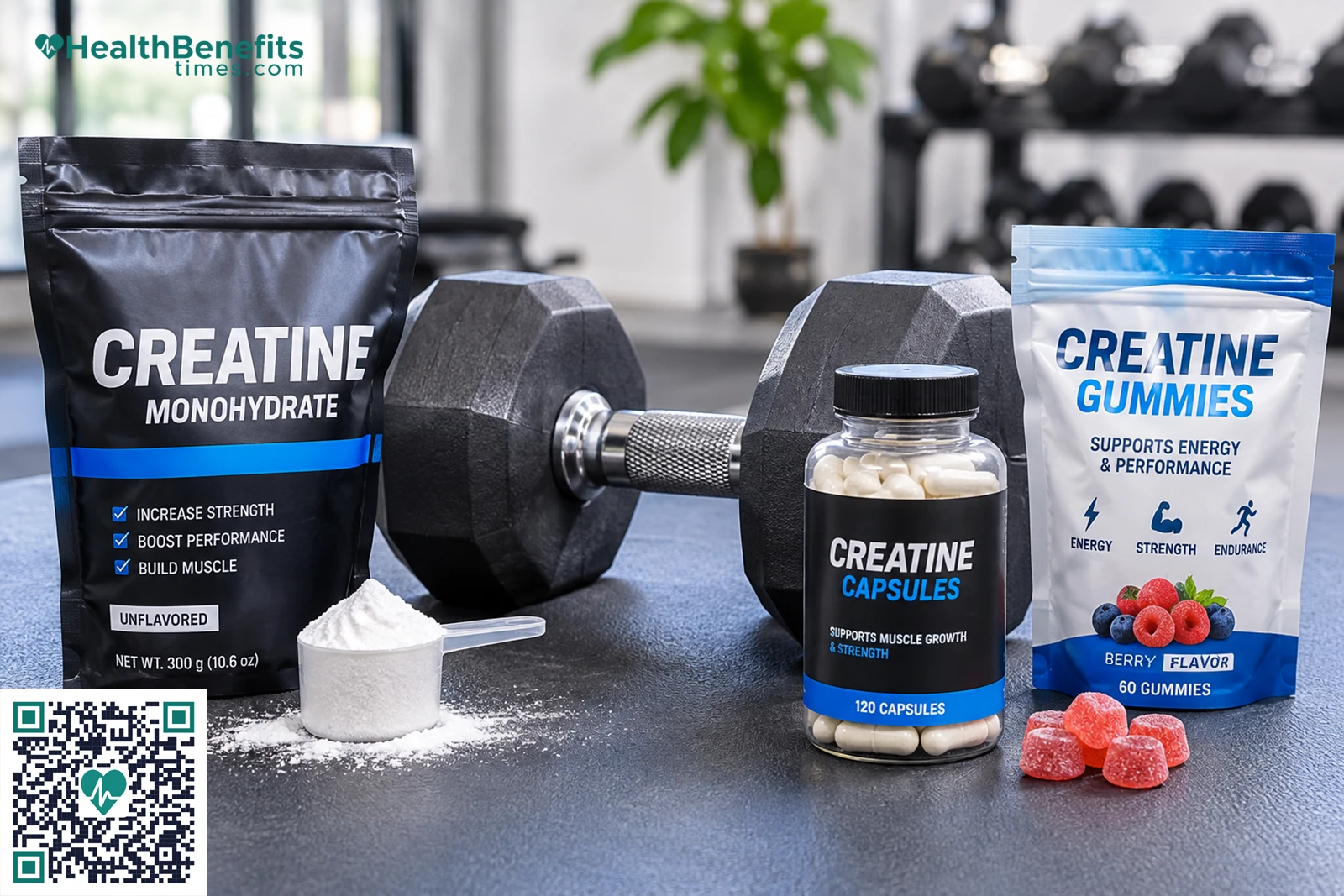
Creatine is one of the better-studied supplements used alongside resistance training. Yet shopping for it can be surprisingly confusing. The same ingredient appears in tubs of powder, bottles of capsules and chewable gummies, often with very different serving instructions and prices. The packaging can make one option look more effective than another, but the format alone does not tell you how well a product will work.
Start with the ingredient, not the packaging
Creatine helps the body regenerate energy used during short, intense efforts such as heavy sets of lifting or repeated sprints. Creatine monohydrate is the form most extensively studied for exercise performance. Research supports benefits for certain high-intensity activities and, when combined with resistance training, improvements in strength and lean mass over time. That does not mean it works equally well for everyone, or that it replaces training, adequate food or recovery.
Powder: straightforward and easy to measure
For someone who already makes a daily shake, powder may be the simplest choice. Unflavoured creatine monohydrate can be stirred into water or another drink, and a scoop or scale makes it relatively easy to adjust the amount. Powder is often economical when comparing cost per gram of creatine. The drawbacks are practical rather than scientific: you need something to mix it with, and carrying a tub to work or the gym is not always convenient. Check the label because scoop sizes vary.
Capsules: convenient when you are away from home
Capsules avoid mixing and usually travel well. They may appeal to people who dislike the texture of powder or prefer a pre-measured product. But convenience can come with a trade-off. A full labelled serving might mean swallowing several capsules, depending on how much creatine each contains. Before buying, compare the number of capsules per serving with the total amount of creatine delivered.
Gummies: an alternative worth reading carefully
Gummies offer a chewable option for people who do not want to mix drinks or swallow capsules. That can make them easier to work into a routine. Still, it is worth looking beyond the flavour and packaging. How much creatine does the stated serving provide? How many gummies make up that serving? Are there added sugars, sweeteners or other ingredients you want to avoid? Product formulation and quality matter, and research on creatine monohydrate in general should not be taken as proof that every gummy product performs identically. For readers comparing formats, creatine gummies are one available option, but the ingredient list and labelled amount deserve the same scrutiny as any powder or capsule.
Does the format change the results?
There is no good reason to assume that a supplement is superior simply because it is chewable, portable or marketed as fast-acting. Much of the evidence relates to creatine monohydrate itself. When comparing products, consider whether the stated form and amount match what has been studied, and whether the product provides clear quality information. Consistent use according to product directions matters more than a fashionable delivery format.
What to compare before paying
Instead of comparing only the price on the front of the pack, work out the cost for the amount of creatine you would actually receive. Read the serving instructions closely: a bottle that looks inexpensive may contain fewer full servings than expected. Also look for transparent ingredient labelling, credible independent quality testing where available, and clear storage instructions. If a product makes dramatic claims about instant muscle growth or guaranteed results, treat those claims cautiously.
A note on safety
Creatine is not appropriate for everyone without individual advice. People with kidney disease or other medical conditions, those taking medications, and people who are pregnant or breastfeeding should speak with a qualified healthcare professional before using it. Younger athletes should seek appropriate professional guidance as well. Follow the product label rather than assuming that taking more will produce better results.
The practical takeaway
Powder can be a sensible choice if you value flexibility and cost. Capsules may suit a busy schedule. Gummies may appeal if you prefer something chewable. None of these preferences automatically makes a product more effective. The useful question is whether the creatine form, labelled amount, other ingredients and price fit your needs and whether the product comes from a trustworthy supplier.
References and further reading
- National Institutes of Health, Office of Dietary Supplements. Dietary Supplements for Exercise and Athletic Performance (Health Professional Fact Sheet). https://ods.od.nih.gov/factsheets/ExerciseAndAthleticPerformance-HealthProfessional/
- Kreider RB et al. International Society of Sports Nutrition position stand: safety and efficacy of creatine supplementation in exercise, sport, and medicine. Journal of the International Society of Sports Nutrition (2017). https://doi.org/10.1186/s12970-017-0173-z