

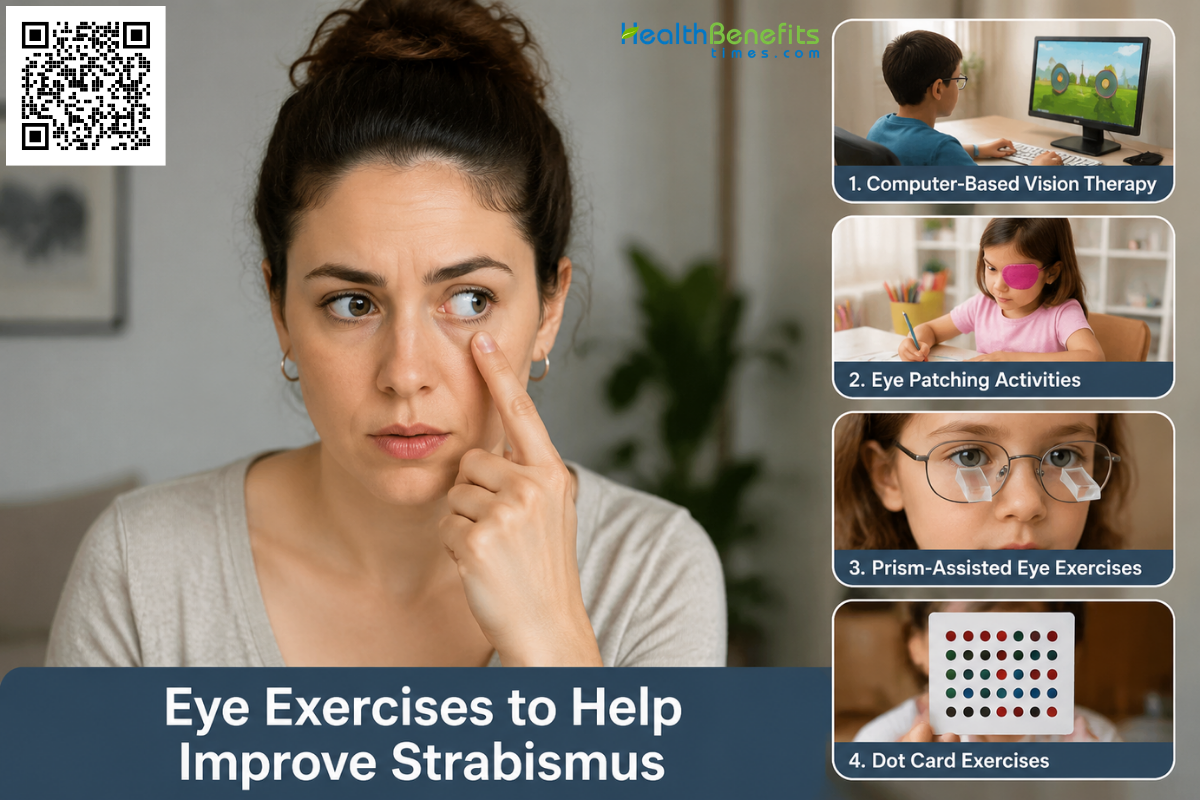
Strabismus, commonly recognized as crossed eyes, is a visual disorder in which the eyes fail to properly align when focusing on an object. This misalignment occurs due to inadequate control of the extraocular muscles or underlying nerve dysfunctions, causing one eye to look directly at a target while the other turns inward, outward, upward, or downward 1. Because the eyes point in different directions, the brain receives two conflicting images and typically resolves this confusion by suppressing the visual input from the deviated eye to prevent double vision 2. If medical professionals do not correct the alignment early in childhood, this continuous neurological suppression frequently leads to amblyopia, a secondary condition that causes permanent vision loss in the affected eye 1.
Causes of Strabismus
- Uncorrected Farsightedness: Extreme farsightedness forces the visual system to overwork to see clearly, which frequently causes the eyes to cross inward as the focusing system overcompensates 1.
- Neurological and Genetic Disorders: Medical conditions that affect the brain’s ability to coordinate muscle movement, such as cerebral palsy, Down syndrome, and hydrocephalus, often disrupt the nerve signals required for proper eye alignment 2.
- Cranial Nerve Damage: Injuries to the specific nerves controlling eye movement, which can result from traumatic head injuries, strokes, or brain tumors, prevent the eyes from moving together synchronously 3.
- Muscle and Systemic Diseases: Systemic conditions that directly inflame or weaken the eye muscles, particularly thyroid eye disease or myasthenia gravis, physically restrict normal eye movement and cause visible misalignment 4.
- Poor Vision in One Eye: Medical issues that obstruct clear sight in a single eye, such as childhood cataracts or retinal tumors, disrupt the brain’s ability to fuse images, causing the poorly seeing eye to drift 2.
- Family History: A strong genetic predisposition exists for eye misalignment, meaning individuals with parents or siblings who have strabismus face a significantly higher risk of developing the condition themselves 1.
Symptoms of Strabismus
- Visible Eye Misalignment: The most obvious clinical sign is an eye that visibly drifts inward, outward, upward, or downward while the other eye focuses steadily on a target 1.
- Double Vision: Adults and older children frequently see two overlapping or separate images of a single object because the brain receives conflicting visual signals from the misaligned eyes 2.
- Poor Depth Perception: Because the brain requires synchronized input from both eyes to accurately judge distance, individuals often lose their three-dimensional vision and may frequently bump into objects 1.
- Squinting or Closing One Eye: People with misaligned eyes often unconsciously shut or squint one eye, particularly in bright sunlight, to block out the confusing secondary image and restore single vision 2.
- Abnormal Head Posturing: Individuals may frequently tilt, turn, or elevate their heads in specific directions, attempting to find a visual angle where the eye muscles can temporarily align and eliminate double vision 3.
- Eye Strain and Headaches: The visual system’s constant effort to force the eyes into alignment and process conflicting images often leads to severe physical fatigue around the eyes and chronic headaches 3.
Eye Exercises to Help Improve Strabismus
1. Pencil Push-Up Exercises
How it may help
Pencil push-up exercises target the extraocular muscles to improve convergence, which is the ability of both eyes to focus simultaneously on a near object. By repeatedly tracking a close target as it moves toward the face, this therapy trains the brain and eye muscles to work together, reducing the outward drift common in convergence insufficiency 5.
What research says
Clinical trials indicate that while pencil push-ups are a standard home-based treatment, they are significantly less effective at resolving symptoms when used alone compared to supervised, office-based vision therapy 6. Researchers conclude that this exercise provides only limited therapeutic benefit for restoring normal binocular vision without additional professional intervention 5.
How to use it safely
Hold a pencil at arm’s length, focusing steadily on the tip. Slowly bring the pencil toward your nose until the single image splits into two, then push it back out 5. You should consult an eye care professional to establish a safe and effective daily schedule.
Potential precautions or side effects
Overusing this exercise can trigger severe eye strain, visual fatigue, and chronic headaches. You should stop the activity immediately if eye pain occurs and consult a vision specialist.
2. Brock String Training
How it may help
Brock string training utilizes a simple cord with colored beads to provide immediate visual feedback regarding eye alignment. It trains the brain to process images from both eyes simultaneously, which improves binocular vision and strengthens the extraocular muscles responsible for convergence, helping to reduce outward eye drift 5.
What research says
Clinical studies demonstrate that Brock string exercises significantly improve eye coordination when utilized as a component of supervised, office-based vision therapy 6. Researchers conclude this method effectively restores normal binocular function for individuals with convergence insufficiency, although standalone home-based treatments yield lower success rates than professionally monitored protocols 5.
How to use it safely
Secure one end of the string to a stationary object and hold the other end against your nose. Slowly shift your focus between the colored beads, ensuring the string appears to intersect exactly at the bead you are viewing 5. You should practice this under professional guidance.
Potential precautions or side effects
Extended practice may cause temporary double vision, eye fatigue, and headaches. You should stop the exercise and consult a vision specialist if experiencing persistent discomfort or sharp eye pain.
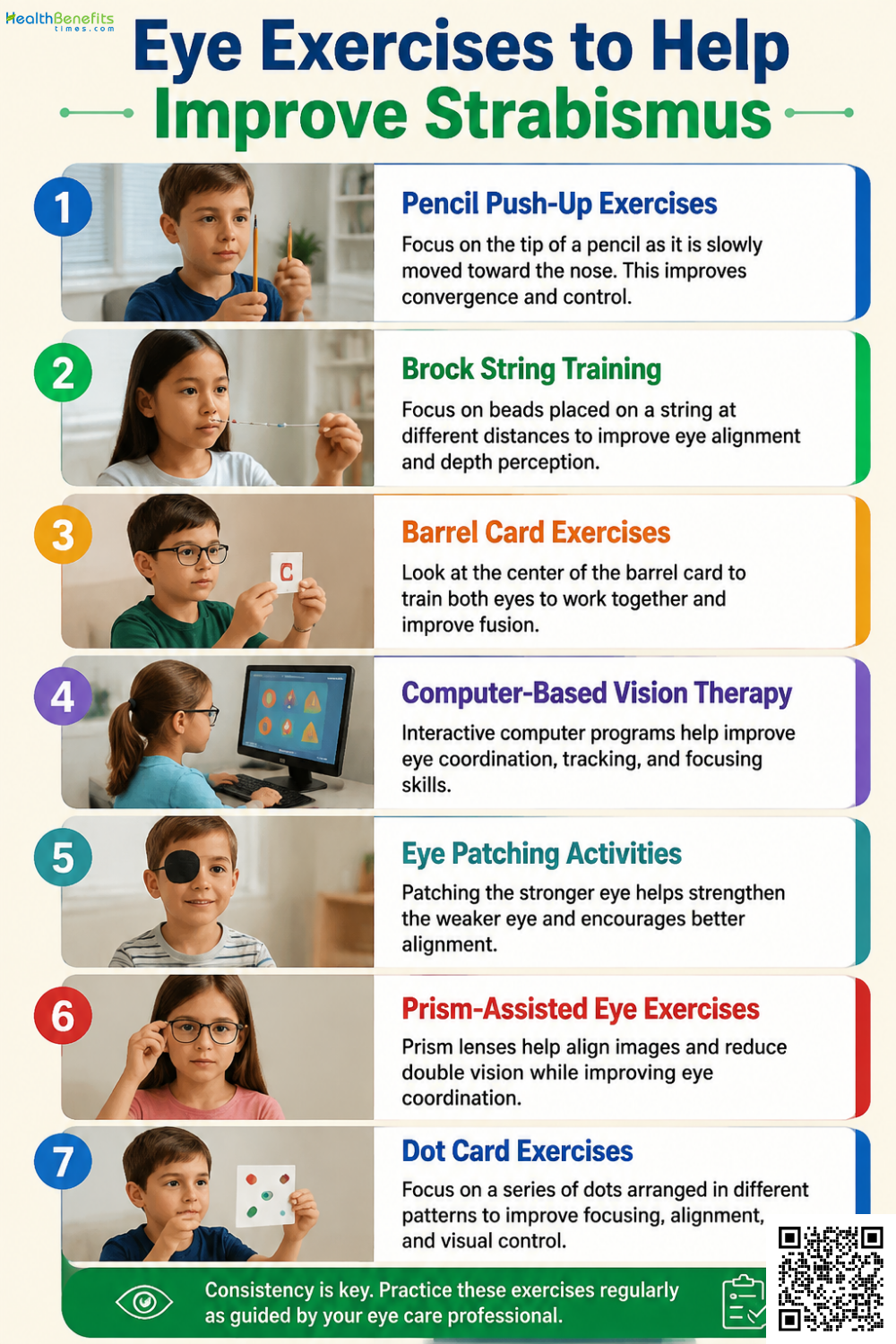
3. Barrel Card Exercises
How it may help
Barrel card exercises use specialized visual targets printed on a card to train both eyes to work together smoothly. This activity targets the extraocular muscles and improves your ability to fuse separate images into a single, unified view, reducing inward or outward eye turning 5.
What research says
Clinical studies conclude that barrel card drills effectively improve binocular coordination and eye alignment when integrated into formal vision therapy programs 6. Researchers note that while these exercises help correct convergence insufficiency, they yield the best clinical outcomes when supervised by a qualified eye care professional 5.
How to use it safely
Hold the barrel card lengthwise against the bridge of your nose with the red and green barrels facing outward. Focus on the most distant pair of barrels until they merge into one central image, then shift your focus sequentially to the closer pairs 5.
Potential precautions or side effects
Extended practice can cause severe eye strain, temporary double vision, and tension headaches. You should stop the activity immediately if you experience sharp eye pain.
4. Computer-Based Vision Therapy
How it may help
Computer-based vision therapy uses specialized interactive software and digital games to train the brain and eye muscles to coordinate effectively. These programs challenge both eyes to work together simultaneously, helping to correct misalignment and improve binocular depth perception 1.
What research says
Clinical trials demonstrate that office-based, computer-guided vision therapy significantly improves eye alignment and focusing ability in individuals with strabismus and convergence insufficiency 6. Researchers conclude that digital programs supervised by professionals offer superior clinical outcomes compared to unsupervised home exercises 5.
How to use it safely
Complete the digital eye exercises on a calibrated display screen while wearing specialized anaglyph or polarized glasses as prescribed 6. You must follow a structured schedule established by a certified eye care specialist to ensure safe progression.
Potential precautions or side effects
Extended screen use can trigger digital eye strain, visual fatigue, and tension headaches. You should take frequent rest breaks to prevent discomfort.
5. Eye Patching Activities
How it may help
Eye patching involves covering the stronger, dominant eye for prescribed periods. This forces the brain to rely on and process visual signals from the weaker, misaligned eye, which stimulates visual development and helps prevent permanent vision loss from suppression 7.
What research says
Clinical studies conclude that eye patching is a highly effective primary treatment for children with strabismic amblyopia 7. Research shows that consistent adherence to a physician-prescribed patching schedule significantly improves visual acuity in the weaker eye 8.
How to use it safely
Apply an adhesive medical patch directly over the stronger eye for the exact duration recommended by your eye doctor 7. You must strictly follow the prescribed wear schedule without altering the duration independently.
Potential precautions or side effects
Overuse can cause vision loss in the patched eye or skin irritation. You should consult a specialist regularly to monitor progress.
6. Prism-Assisted Eye Exercises
How it may help
Prism lenses bend light before it enters the eyes, shifting the image to match the eye’s misaligned position. When combined with targeted eye exercises, prisms help reduce double vision and encourage the brain to fuse separate images into a single view by easing the muscle strain required to align the eyes 9.
What research says
Clinical studies conclude that incorporating prisms into vision therapy effectively improves binocular coordination and alleviates double vision in patients with strabismus 9. Research indicates that professionally prescribed prisms provide substantial relief when standard alignment exercises alone are insufficient 6.
How to use it safely
Wear the specialized prism lenses during targeted eye tracking and focusing exercises as directed 9. You must obtain a precise prescription from an eye care specialist to ensure the prism strength matches your specific degree of eye misalignment.
Potential precautions or side effects
Incorrect prism strength can cause severe dizziness, spatial confusion, and intense headaches. You should consult your specialist immediately if discomfort occurs.
7. Dot Card Exercises
How it may help
Dot card exercises utilize a card marked with sequential dots to train convergence and binocular coordination. By focusing sequentially on each dot along the line, this activity encourages both eyes to lock onto the target simultaneously, strengthening extraocular muscle control and reducing eye drifting 10.
What research says
Clinical studies conclude that dot card training effectively improves near-point convergence and visual fusion when used in structured vision therapy programs 6. Researchers note that consistent home practice yields positive outcomes for individuals managing convergence insufficiency 10.
How to use it safely
Hold the dot card touching the tip of your nose and angle it downward. Slowly shift your focus from the furthest dot to the closest one, ensuring each dot appears single and clear 10. You should practice under professional guidance.
Potential precautions or side effects
Extended practice may trigger temporary eye strain, double vision, and tension headaches. You should stop immediately if pain occurs.
Foods to Avoid When You suffer from Strabismus
Strabismus is primarily a muscular and neurological condition governing eye alignment rather than a metabolic disease caused by specific dietary components. While no particular foods directly trigger or worsen eye muscle misalignment, maintaining overall vascular and neurological health is vital. If you are recovering from corrective eye muscle surgery or managing general ocular health, clinical guidelines recommend avoiding specific dietary elements that promote systemic inflammation or complications 11.
1. Heavy, greasy fried foods
Fried items contain high levels of trans fats that impair blood circulation, reducing optimal nutrient delivery to delicate ocular tissues and nerves 12.
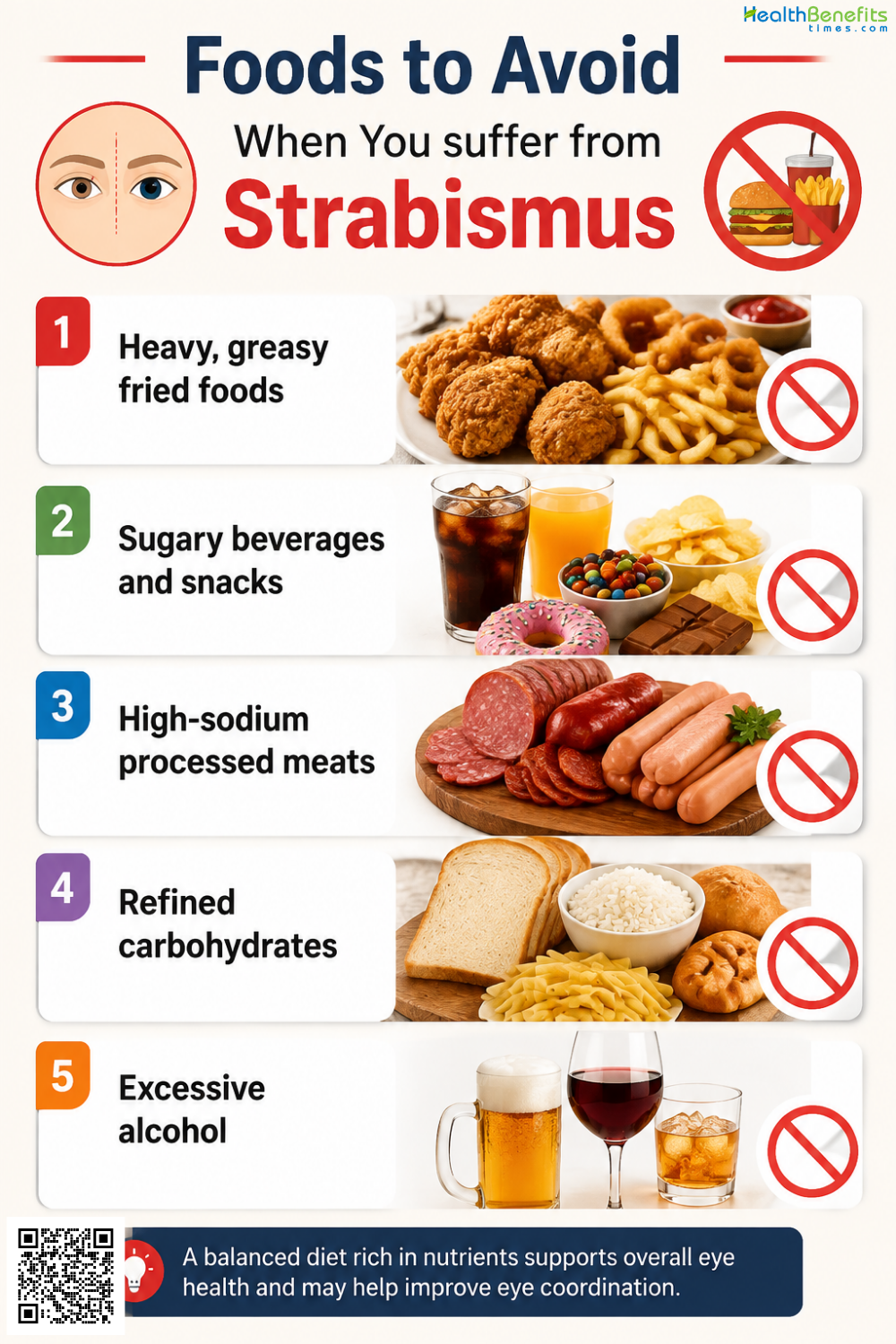
2. Sugary beverages and snacks
Excessive sugar consumption elevates blood glucose levels over time, increasing the risk of vascular complications that can compromise overall eye health 12.
3. High-sodium processed meats
Salty, preserved meats elevate blood pressure, placing unnecessary strain on the sensitive blood vessels supporting proper eye and nerve function 12.
4. Refined carbohydrates
White bread and pastries cause rapid blood sugar spikes and systemic inflammation, which can negatively affect long-term ocular health and neural function 11.
5. Excessive alcohol
Heavy alcohol intake interferes with the body’s absorption of essential vitamins and can induce fatigue, worsening visual focus and coordination during recovery 11.
When to see Doctor when you struggle from Strabismus
Early detection and timely clinical evaluation are critical for managing strabismus, particularly during childhood when the visual system is still developing. You must schedule an immediate professional eye examination if you notice persistent eye misalignment or sudden vision changes to prevent permanent vision loss or chronic binocular impairment 1.
- Persistent eye turning: You should consult a doctor right away if you notice an eye constantly drifting inward, outward, upward, or downward 1.
- Sudden double vision: Experiencing sudden or persistent double vision requires an urgent neurological and ophthalmological evaluation to check for underlying nerve injury 2.
- Frequent squinting or head tilting: If a child constantly squints in sunlight or tilts their head to see clearly, you must seek a professional eye exam 3.
- Sudden vision loss or blurriness: Any abrupt decrease in visual sharpness in one or both eyes demands immediate medical attention to rule out progressive complications 1.
- Infants past four months old: You should contact a pediatrician if an infant’s eyes continue to cross or wander frequently past the age of four months 2.