

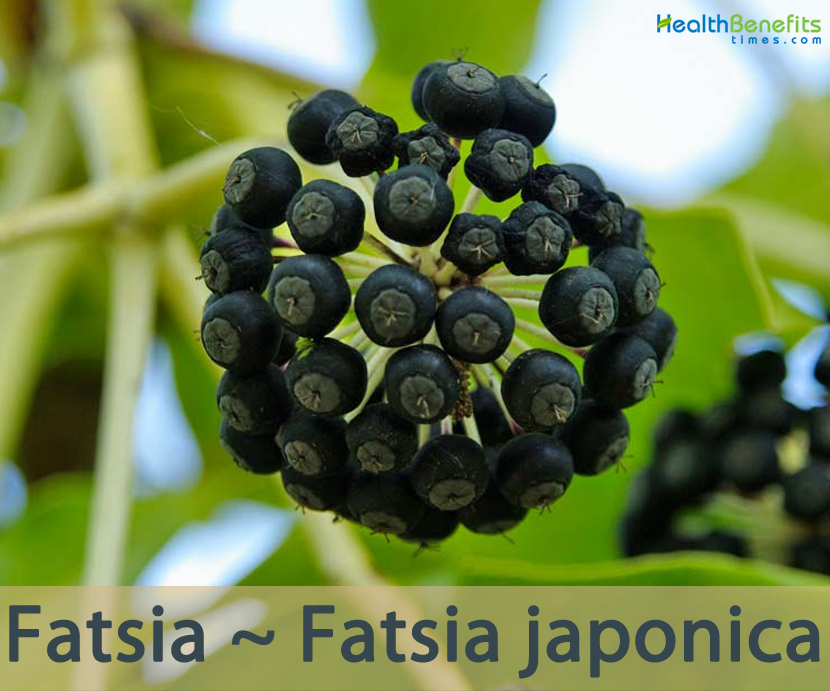
| Fatsia Quick Facts | |
|---|---|
| Name: | Fatsia |
| Scientific Name: | Fatsia japonica |
| Origin | Southern Japan, southern Korea and Taiwan |
| Colors | Initially green maturing to shiny black berries |
| Shapes | Sub globose pea-shaped berries that are nearly 5 mm in diameter |
| Health benefits | Support for diabetes, gastro enteric disorders (stomach disease), arteriosclerosis, high blood pressure, cough, osteoarthritis and rheumatism |
| Name | Fatsia |
|---|---|
| Scientific Name | Fatsia japonica |
| Native | Southern Japan and southern Korea |
| Common Names | Fatsia, Japanese Fatsia, Japanese Aralia, Fatsi, Fig-Leaf Palm, Glossy-Leaved Paper Plant, Paperplant, Castor oil plant, Aralia, Glossy-leafed paper plant, false castor oil plant and Formosa rice tree |
| Name in Other Languages | Afrikaans: Fatsia, Vingerplant Albanian: Fatsia Amharic: Fatīsīya (ፋቲሲያ) Arabic: Fatsia (фатсия) Armenian: Fat’ia (ֆաթիա) Azerbaijani: Fatsia Bengali: Fatsia (фатсия) Bulgarian: Fatsia (Фатсия), yaponska fat·siya (японска фатсия) Burmese: Fatsia (фатсия) Catalan: Aràlia del Japó Cebuano: Aralia Chinese: Féipàng zhèng (肥胖症), bā jiǎo jīn pán (八角金盘) Croatian: Fatsia Czech: Unava Danish: Fatsia Dutch: Fatsia, fingerplant, Japanse aralia, Vingerplant English: Fatsia, Japanese Fatsia, Fatsi, Glossy-leaf paperplant, Paperplant, Formosa rice tree, Japanese aralia, fatsi , Glossy-leaved paperplant Esperanto: Fatsia Estonian: Fatsia Filipino: Fatsia Finnish: Fatsia, Huonearalia French: Fatsia, Aralia du Japon, aralia commun, fatsia japonais, faux ricin, ricin japonais, Aralie du Japon Georgian: Fatsia (фатсия) German: Fatsia, Zimmeraralie, japanische Fatsia, japanische Zimmeraralie Greek: Lipothymía (λιποθυμία) Gujarati: Phēṭasiyā (ફેટસિયા) Hausa: Fatsia Hebrew: פטציה Hindi: Fatsia (фатсия) Hungarian: Fatsia, Japán arália Icelandic: Fatsíu Indonesian: Fatsia Irish: Fatsia Italian: Fatsia Japanese: Fatsia (Фатсия), yatsude (ヤツデ) Javanese: Lemak Kannada: Phyāṭsiyā (ಫ್ಯಾಟ್ಸಿಯಾ) Kazakh: Fatsija (фатсия) Korean: Ttungttunghan (뚱뚱한), palsoninamu, songak, Palson I (팔손이), palson-inamu (팔손이나무) Kurdish: Fatsia Lao: Khaiman (ໄຂມັນ) Latin: Fatsia Latvian: Fatsia Lithuanian: Fatsia Macedonian: Faca (фаца) Malagasy: Fatsia Malay: Fatsia Malayalam: Phāṟṟsiya (ഫാറ്റ്സിയ) Maltese: Fatsia Marathi: Phĕṭasiyā (फॅटसिया) Mongolian: Fatia (фатиа) Nepali: Phyātsiyā (फ्यात्सिया) Norwegian: Fatsia, aralia, Japanse, fingerplant Oriya: ଫ୍ୟାଟିସିଆ Pashto: فټسیا Persian: چربی, آرالیای برگپهن Polish: Fatsia Portuguese: Fatsia, arália-do-japão, fátsia-do-japão Punjabi: Fatsia (фатсия) Romanian: Fatsia Russian: Fatsia (Фатсия), Araliia iaponskaia (Аралия японская), Fatsiya yaponskaya (Фатсия японская) Serbian: Fatsia (фатсиа) Sindhi: فٽسيا Sinhala: Fatsia-fatsija Slovenian: Fatsia Spanish: Fatsia Sundanese: Lemakna Swedish: Fatsia, Aralia Tajik: Fatsija Tamil: fatsia-fatsija (fatsia-фатсия) Telugu: Fatsia (фатсия) Thai: Fatsia-Fatsija (Fatsia-Фатсия) Turkish: Fatsia, Fatsiya Ukrainian: Fat·siya (фатсія) Urdu: Fatsia Uzbek: Fatsia Vietnamese: Mỡ Welsh: Fatsia, Ffatsia Zulu: Fatsia |
| Plant Growth Habit | Medium sized, semi-dense broadleaf evergreen shrub or small tree |
| Growing Climates | Forests, mountains, waste areas, abandoned gardens and coastal woodlands |
| Soil | Grows best in moist, well-drained, acidic soil rich in organic matter. Shade or dappled shade is necessary for best foliage appearance. Fatsia will grow well even in deep shade. Despite its preferences fatsia will tolerate sandy or heavy clay soils, moderate drought and air pollution and is moderately tolerant of salt spray |
| Plant Size | Grows 6 to 10 feet tall by 6 to 10 feet wide. Old plants in ideal growing conditions may reach 15 feet tall |
| Stem | Stems very smooth, thick, not much branched, unarmed, marked with large scars left by fallen leaves |
| Leaf | Large, leathery, sub-orbicular varying in size according to the size and vigor of the plant, normally 12-30 cm in diameter, palmately 7-9 deeply lobed, with a broad heart-shaped base. The lobes reach more than half-way to the base, ovate, coarsely and bluntly toothed except towards the base |
| Flowering season | October to November |
| Flower | Terminal panicle is 20-40 cm long. Inflorescences are 3-5cm in diameter, rachis brownish tomentose; Calyx is sub entire, glabrous. Japanese aralia has 5 petals that are ovate-triangular, 2.5 – 3 mm long, yellow-white and glabrous. It has 5 stamens, filaments equal to petals length. |
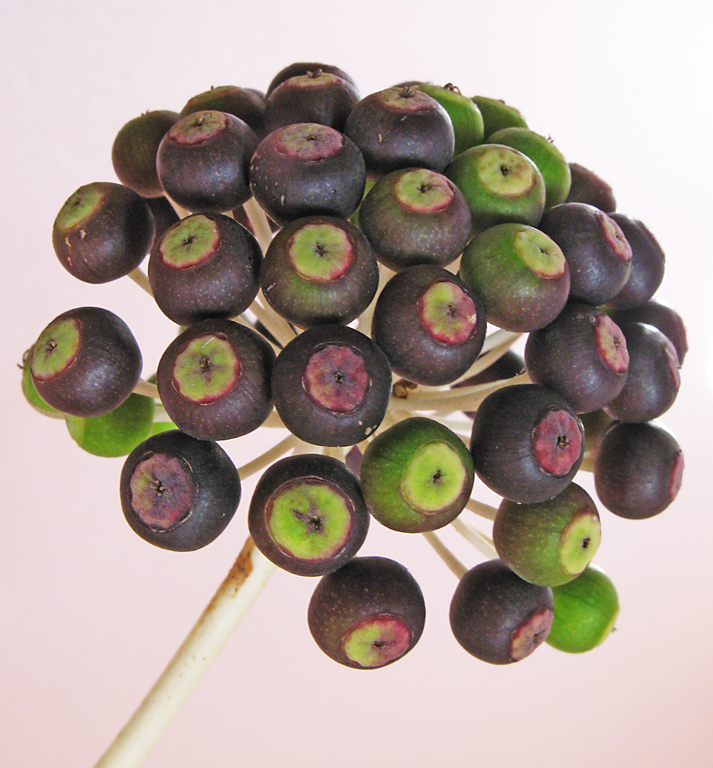
| Fruit Shape & Size | Sub globose pea-shaped berries that are nearly 5 mm in diameter. |
| Fruit Color | Initially green maturing to shiny black berries |
| Propagation | By suckers, prolific self-seeding and by semi-hardwood cuttings |
| Varieties |
|
| Season | Feb-May |
| Precautions |
|
Plant Description
Fatsia is a medium sized semi-dense broadleaf evergreen shrub or small tree that normally grows about 6 to 10 feet tall and 6 to 10 feet wide. Old plants in ideal growing conditions may reach 15 feet tall. Fatsia grows at a moderate to fast rate (8 to 12 inches per year) depending on growing conditions. Growth will be slower in full sun and dry soil, and faster in shade with rich, moist soil. The plant is found growing in forests, mountains, waste areas, abandoned gardens and coastal woodlands. The plant grows best in moist, well-drained, acidic soil rich in organic matter. Shade or dappled shade is necessary for best foliage appearance. Fatsia will grow well even in deep shade. Despite its preferences fatsia will tolerate sandy or heavy clay soils, moderate drought and air pollution and is moderately tolerant of salt spray.
Stem
Stems are very smooth, thick, not much branched, unarmed, and marked with large scars left by fallen leaves.
Leaves
Leaves are large, leathery, sub-orbicular varying in size according to the size and vigor of the plant, normally 12-30 cm in diameter, palmately 7-9 deeply lobed, with a broad heart-shaped base. The lobes reach more than half-way to the base, ovate, coarsely and bluntly toothed except towards the base, where the opening between the lobes is wide and rounded. Upper surface is dark shining green while the lower one is lighter, granular pro-tuberance, both quite glabrous, margin occasionally golden yellow. Lateral pulse bulges on both sides, reticulate veins slightly prominent below. Petiole is round, stout, smooth, often 1 ft. or more long.
| Leaf arrangement | Alternate |
| Leaf type | Simple |
| Leaf margin | Serrate |
| Leaf shape | Star-shaped |
| Leaf venation | Palmate |
| Leaf type and persistence | Evergreen |
| Leaf blade length | 8 to 12 inches |
| Leaf color | Green |
| Fall color | No fall color change |
| Fall characteristic | Not showy |
Flower
Terminal panicle is 20-40 cm long. Inflorescences are 3-5cm in diameter, rachis brownish tomentose; Calyx is sub entire, glabrous. Japanese aralia has 5 petals that are ovate-triangular, 2.5 – 3 mm long, yellow-white and glabrous. It has 5 stamens, filaments equal to petals length. Ovary is inferior, 5-locule, with 1 blastomere in each locule. It has 5 styles, detached; Disk is convex semicircle. They appear in October to November and last for several weeks.
| Flower color | White |
| Flower characteristic | Fall flowering |
Fruits
Fertile flowers are followed by sub globose pea-shaped berries that are nearly 5 mm in diameter. These berries are initially green maturing to shiny black berries during early to mid-winter in the Upstate and mid to late winter along the coast. Berries last well on the plants, unless eaten by birds. Hard freezes will eventually cause the berry clusters to collapse.
| Fruit shape | Round |
| Fruit length | Less than .5 inch |
| Fruit cover | Fleshy |
| Fruit color | Black |
| Fruit characteristic | Attracts birds |
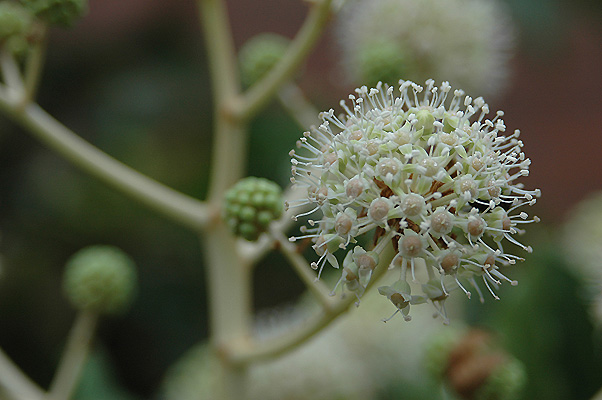 Flower-of-Fatsia
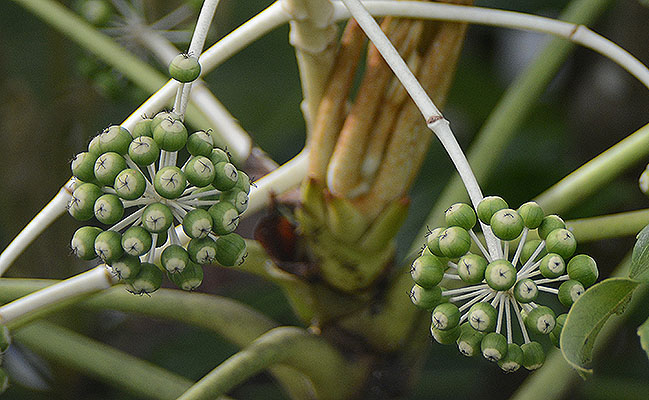 Immature-fruits-of-Fatsia
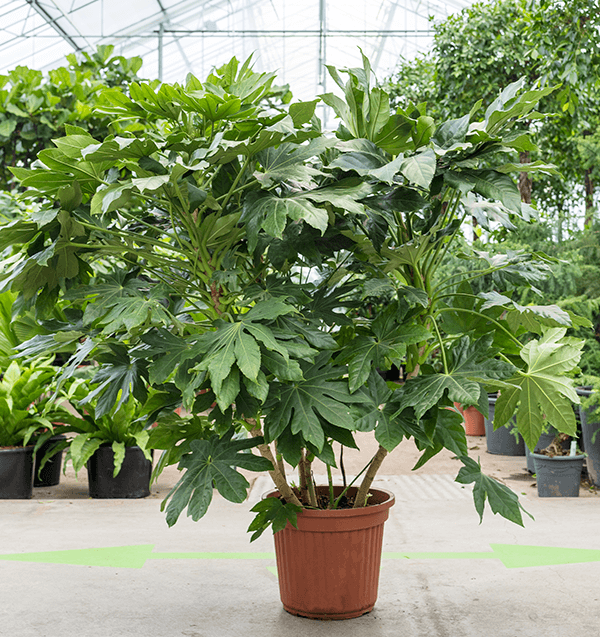 Fatsia-grown-on-pot
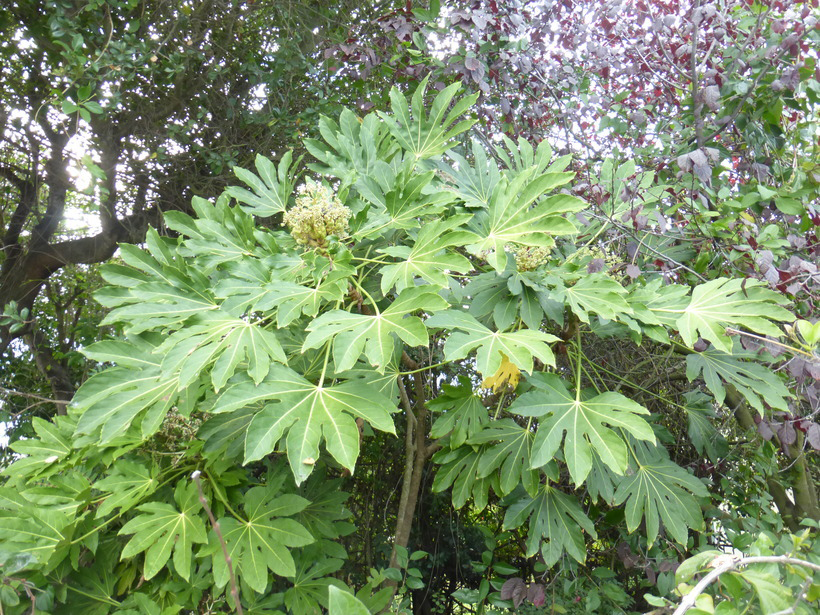 Fatsia-plant-growing-wild
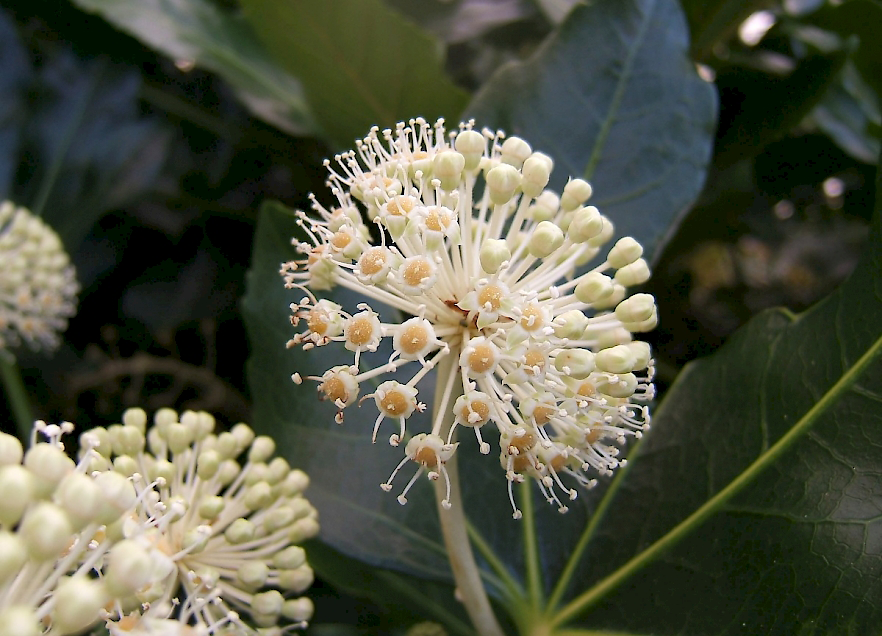 Closer-view-of-flower-of-Fatsia
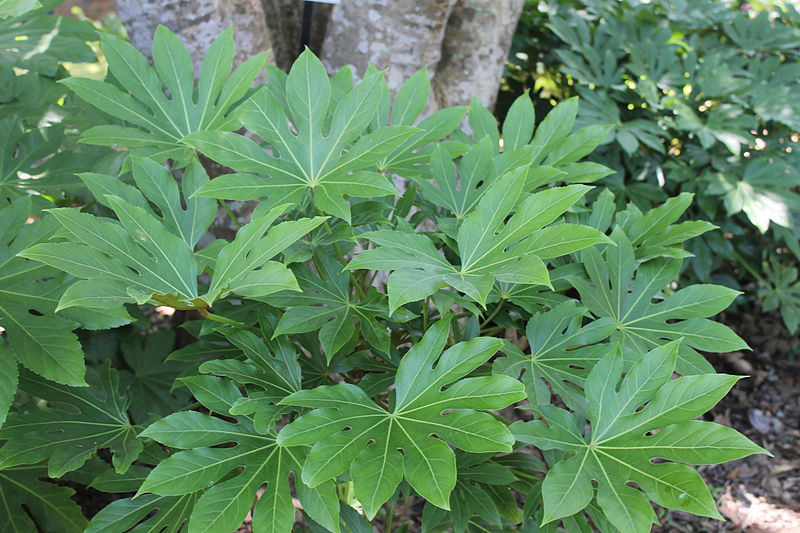 Leaves-of-Fatsia
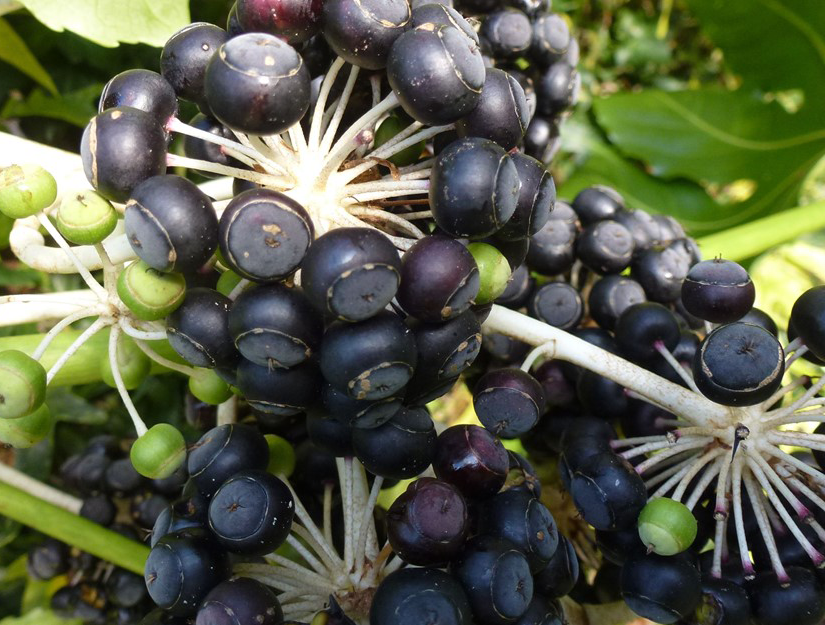 Mature-fruits-of-Fatsia
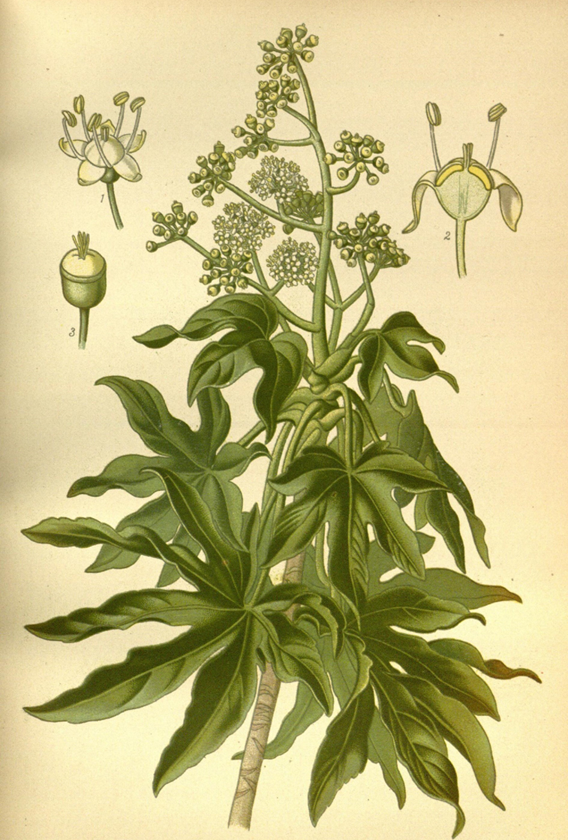 Plant-illustration-of-Fatsia
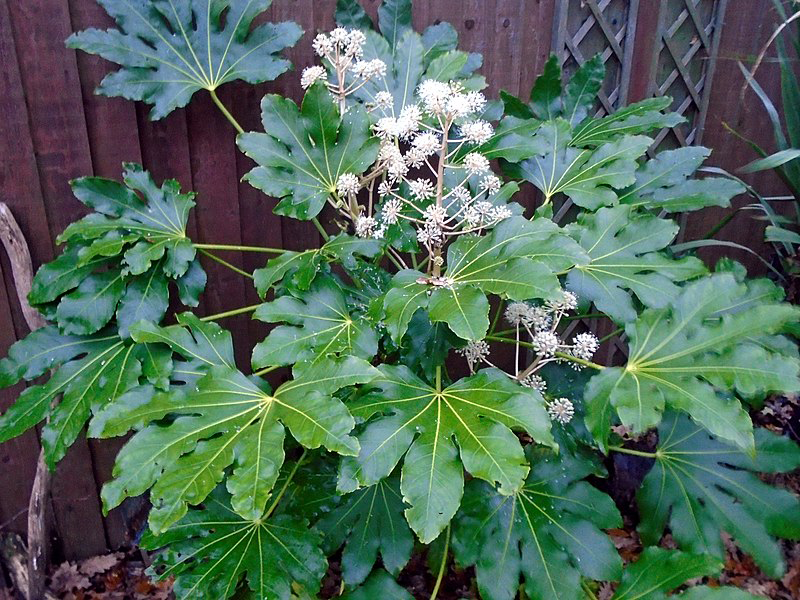 Fatsia-Plant
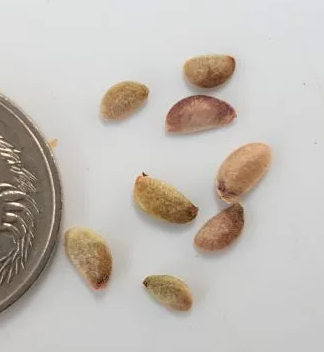 Seeds-of-Fatsia
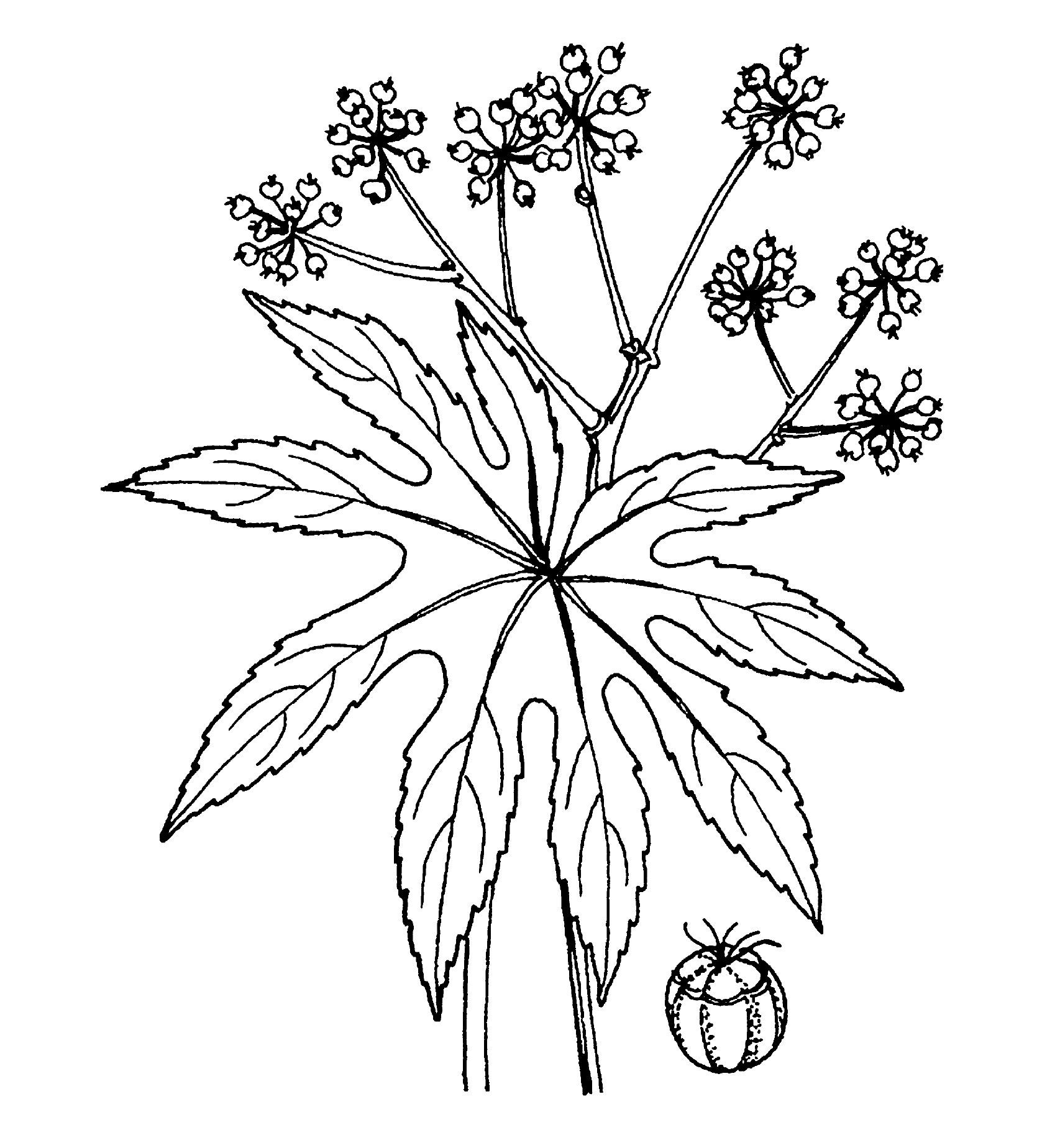 Sketch-of-Fatsia
 Maturing-Fruits-of-Fatsia
Fatsia Varieties in the UK
There are a number of different Fatsia forms available to buy in the UK. The most, the standard Fatsia japonica is widely grown and often used in council landscaping due to its tough, reliable nature and visual architectural impact. Listed below are some of the popular varieties grown or available in UK
1. Fatsia japonica ‘Moseri’
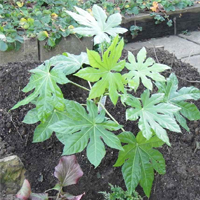
It is a more compact form of Fatsia found with ‘Moseri’. It doesn’t grow as tall and is supposedly said to have larger foliage. It is a good alternative for those with less space.
2. Fatsia Japonica ‘Spiders Web’
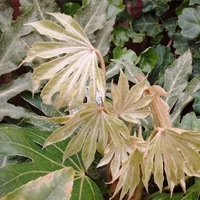
Fatsia ‘Spiders Web’ is an unusual variegated form where the large lobed leaves are covered in white spidery variegation giving it a mottled appearance. If you have limited space or want something stunning for a pot then Spiders Web is a good option.
3. Fatsia japonica ‘Variegata’
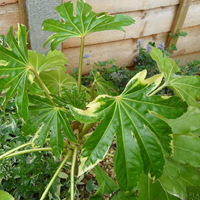
There is a cream variegated version of the standard green Fatsia. Variegata perform very similarly to the green leaved Fatsia except for the variegation which appears randomly but mostly around the edges of the leaf.
Sometimes the cream patterning does not appear, sometimes there is a small amount of cream coloring on the green foliage but it looks most spectacular when large patches of creamy white variegation appear on the leaves.
4. Fatsia japonica ‘Annelise’
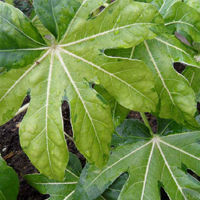
The most spectacular looking variegation appears on the form ‘Annelise’ which has cream veined leaves with dark, mid and light green variegated patterning. Again like ‘Spiders Web’ it looks great in a pot and this will also restrict the growth if space is a limiting factor.
5. Fatsia polycarpa ‘Green Fingers’
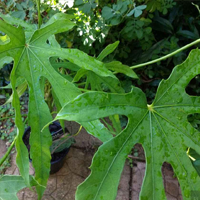
Not strictly japonica (Japan) but polycarpa (Taiwan) a close relation and very similar in looks. This has more slender lobed foliage and overall more airy and delicate looking giving it a more exotic and tropical appearance.
It is not as hardy as taking lows down to around -5°c to -10°c, possibly hardier than the standard Fatsia polycarpa although not long term proven in the UK.
Traditional uses and benefits of Aralia
- Fatsia shoots are the jewels of the mountain, and only a little bit is needed to revitalize the body.
- Fatsia is considered effective to help treat glucosuria (diabetes), gastro enteric disorders (stomach disease), arteriosclerosis, and high blood pressure.
- It is also considered effective in enhancing kidney function.
- Fatsia is most commonly used for stress relief, to help clear the mind, and to allow one to sleep deeply.
- It is known to lower cholesterol, blood sugar, and lipid levels. Fatsia shoots are also rich in calcium.
- Japanese Aralia can promote blood circulation and remove blood stasis.
- It reduces phlegm and relieving cough.
- It removes stasis and relieving pain.
- They are also are used as a medicinal treatment in Japan and Taiwan to ward off conditions like osteoarthritis and rheumatism.
Fatsia uses
Garden use of Japanese Aralia
Fatsia is evergreen with large leaves, a beautiful leaf shape, dark green light, is a popular indoor foliage plant. Adapt to indoor weak light environment, for hotels, restaurants, office buildings and family beautification commonly used plant materials. It is used to decorate the hall, window sill, corridor, poolside, or as the substrate of the indoor Flower bed. The leaf is also a good match for flower arrangement. In the south of the Yangtze River basin, it can be used in the open field and should be planted in the garden, corner and shady part of the building. Japanese Aralia also can adorn in the stream, pool or group under the forest, the grass side. It is an excellent foliage plant. It also can be potted for indoor ornamental.
Absorption of harmful gases
Fatsia can absorb harmful gases such as carbon dioxide in the air and purify the air. In the house that modern lives, a lot of people often door window is closed, let the air in the home and the air outside be ventilated rarely, the harmful gas that the human body inside the home exhales is discharged to wait a moment outside the house. And when these harmful gases are accumulated to a certain amount in the room, the indoor air will become more and more turbid. Additionally, the air quality in cities is getting worse and worse. Fatsia is planted at home; it can absorb some harmful gases such as carbon dioxide, purify the air and make the owner’s life more comfortable.
Green indoor environment
Fatsia is an ornamental plant that is evergreen all year round and produces elegant flowers. Growing a Japanese Aralia indoors is a good way to make your environment green. There is no need to spend a lot of effort inbreeding, it will be kept in the courtyard, door, window, wall corner and the shade of the building can be, the owner can also appreciate its green appearance at any time.
Other Facts
- It was favored in the UK by the Victorians and Edwardians due to its fine architectural qualities!
- Fatsia grows at a moderate to fast rate (8 to 12 inches per year) depending on growing conditions.
- The Royal Horticultural Society has given it the Award of Garden Merit (AGM).
- Many cultivars are used as ornamentals.
- In folklore, the Fatsia japonica’s large eight-pointed finger-shaped leaves are believed to deflect devils that would enter on the north side of a home.
Precautions
- The sap, which is sticky and resinous, can cause contact dermatitis in sensitive people.
- Fatsia is poisonous, and can cause immune system poisoning and mental sex poisoning, organ damage sex poisoning.
References:
https://www.itis.gov/servlet/SingleRpt/SingleRpt?search_topic=TSN&search_value=505935#null
http://www.theplantlist.org/tpl1.1/record/kew-84268
https://en.wikipedia.org/wiki/Fatsia_japonica
https://treesandshrubsonline.org/articles/fatsia/fatsia-japonica/
https://gd.eppo.int/taxon/FATJA
https://apg.pir.sa.gov.au/gringlobal/taxonomydetail.aspx?id=102545
https://www.cabi.org/isc/datasheet/23918
https://plants.usda.gov/home/plantProfile?symbol=FAJA