

| Golden Trumpet Quick Facts | |
|---|---|
| Name: | Golden Trumpet |
| Scientific Name: | Allamanda cathartica |
| Origin | South America including Brazil, French Guyana, Guyana, Suriname, and Venezuela |
| Colors | Initially green turning to brown as they mature |
| Shapes | Rounded capsules about 30-75 mm across that are densely covered with soft spines (about 1 cm long) |
| Health benefits | Support malaria, jaundice, wounds and ulcers, coughs, headaches, gastritis, bile problems, indigestion, anorexia, heartburn, toothache, gonorrhea, dysentery and hepatitis |
| Name | Golden Trumpet |
|---|---|
| Scientific Name | Allamanda cathartica |
| Native | South America including Brazil, French Guyana, Guyana, Suriname, and Venezuela. Outside its native range, it is widely naturalized and cultivated as an ornamental in warm, tropical and subtropical climates around the world, including Australia, Africa, China, Central America, West Indies, and numerous islands in the Pacific Ocean |
| Common Names | Allamanda, brownbud allamanda, buttercup flower, common trumpet vine, cup of gold, golden allamanda, golden cup, golden trumpet, golden trumpet flower, golden trumpet vine, golden-trumpet, Guinea herb, yellow allamanda, yellow bell, yellow trumpet vine, angel’s trumpet, buttercup vine, Common Allamanda, Akar Cempaka Hutan, Bunga Akar Kuning, Akar Chempaka Kuning, Allamada Trumpet Vine |
| Name in Other Languages | Assamese: লতা কৰৱী Australia: Golden trumpet vine Bengali: Alakānandā (অলকানন্দা) Brazil: Alamanda, alamanda-amarela, Carolina, collazo, dedal-da-princesa, dedal-da-rainha, dedal-de-dama, margarida, orelia, santamaria Chinese: Ruan zhi huang chan (軟枝黃蟬), Huang ying Cook Islands: Aramena, puapua, tiare regarenga Cuba: Barber, barbera, cinco llagas, collazo, flor de barbero, jazmín de tierra, malasuegra Dominican Republic: Mantequilla Dutch: Wilkens bitter English: Buttercup vine, Golden trumpet, Allamanda, Common trumpetvine, Golden-trumpet, Yellow allamanda, Buttercup, Yellow Bell, Common allamanda Esperanto: Ortrumpeto Finnish: Köynnöskustaankukka French: Allamanda, canari, liane à lait, liane jaune, liane s’aime, monette jaune, allamanda jaune, trompette dorée German: Allamande, Goldtrompete Hawaiian: Lani ali‘i, nani ali‘i Hindi: Pilaghanti, Saithani phool, Malatilata, Ghanta phul, Harkakra Hungarian: Sárga dzsungelharang Indonesia: Lame areuy Italian: Allamanda Japanese: Ariakekazura (アリアケカズラ), aramanda (アラマンダ) Malay: Bunga akar kuning Malaysia: Akar chempaka hutan, akar chempaka kuning, bunga akar kuning, Bungaa loceng Malayalam: Kēāḷāmpi (കോളാമ്പി) Maori (Cook Islands): Aramena, pūpua, pua, puapua, pupua, tiare rengarenga Mexico: Jazmín de Cuba, trompeta amrialla, trompetilla Persian: گل شیپور طلایی Philippines: Kampanero, campanilla Pohnpeian: Pah-toh, pahtou Portuguese: Dedal-de-princesa, Dedal-de-rainha, Margarida, alamanda-amarela, Carolina, dedal-de-dama, orélia, alamanda-dourada, flor-de-manteiga, alamanda, santamaria Russian: Allamanda slabitelʹnaya (Алламанда слабительная) Samoan: Pua taunofo, puatauno Spanish: Allamanda, campana de oro, canario, cautiva, copa de mantequilla, copa de oro, jazmin Amarillo, Amanda, campana, flor de mantequilla, jazmín de Cuba, San José, trompeta amarilla, trompeta de oro, trompeta dorada Swedish: Allamanda Tahitian: Piti Tamil: Allamanda Telugu: Allenanda tīga (అల్లెనంద తీగ) Thai: Ban buri lueang, Bānburī (บานบุรี) Tongan: Pua, pula, Pua engeenga Tongarevan: Tiale lenga USA/Hawaii: Lani ali’I, nani ali’i Vietnamese: Huỳnh anh, dây huỳnh |
| Plant Growth Habit | Evergreen, vigorous, perennial, clambering or sometimes twining, woody compact shrub or creeping shrub |
| Growing Climates | Wet forests, secondary forests, swampy areas near rivers and lagoons, disturbed areas, roadsides, forest edges, abandoned gardens, farms, riverbanks, along creeks, waste areas |
| Soil | As a tropical shrub, golden trumpet is best grown in soils rich in organic matter. Soils should also be moist but well-drained. These plants are tolerant of most soil types, but prefer either clay soils or sandy-clay. In alkaline soils, golden trumpet can become chlorotic – if possible, aim for a pH of between 5.0 and 6.0 for the healthiest plants |
| Plant Size | About 2 to 4 meters tall and spread up to 5 m or more |
| Stem | Older stems are mostly woody and brownish in color, while the younger branches are generally green and hairless |
| Bark | Brown and furrowed |
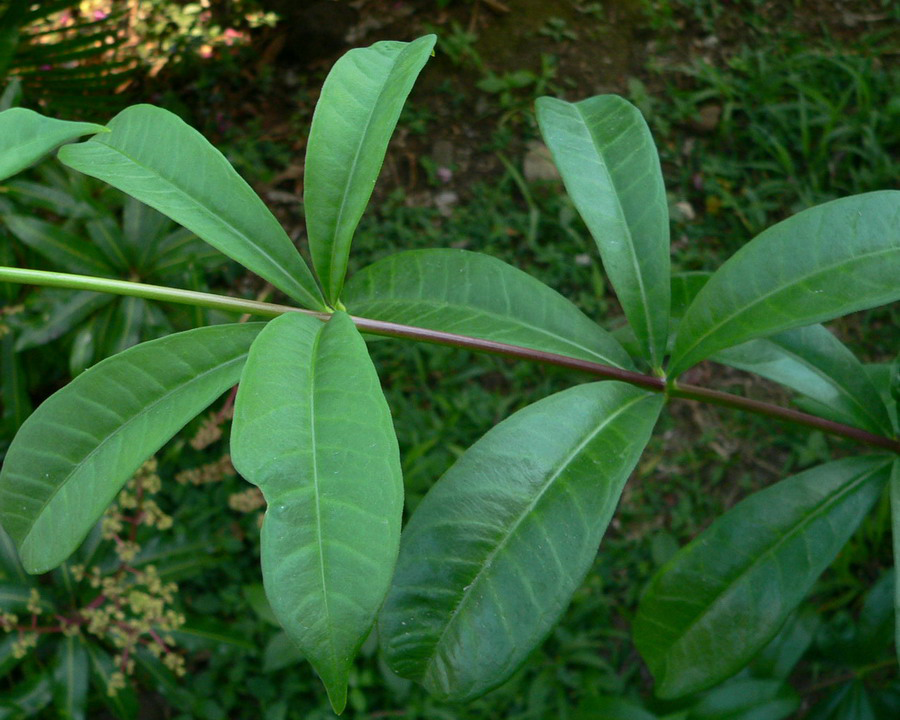
| Leaf | Simple leaves are arranged in groups of three or four along the branches (i.e. the leaves are whorled or verticillate). They are borne on very short stalks (i.e. petioles) only 2-5 mm long and have blades that are egg-shaped in outline to somewhat elongated in shape |
| Flowering season | May – August |
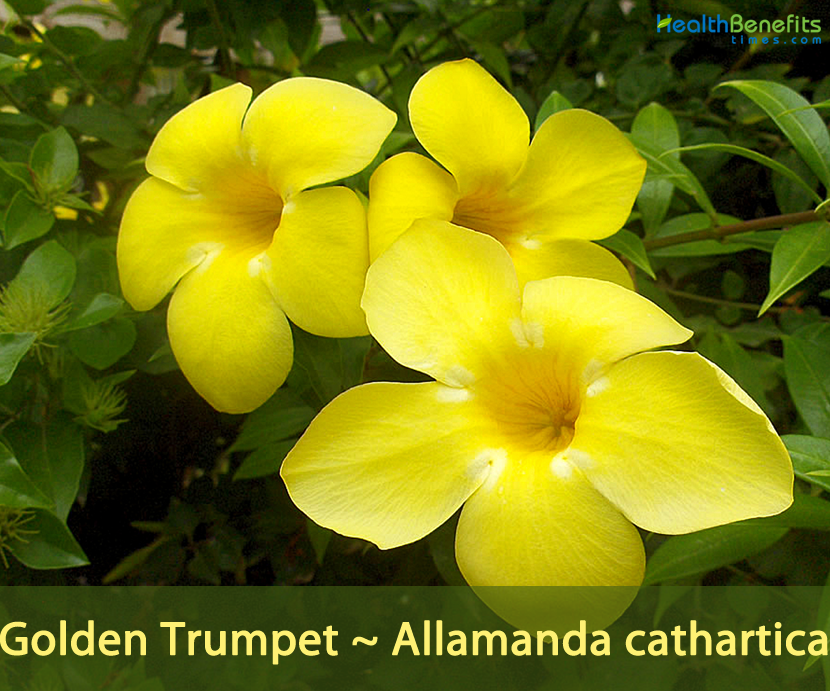
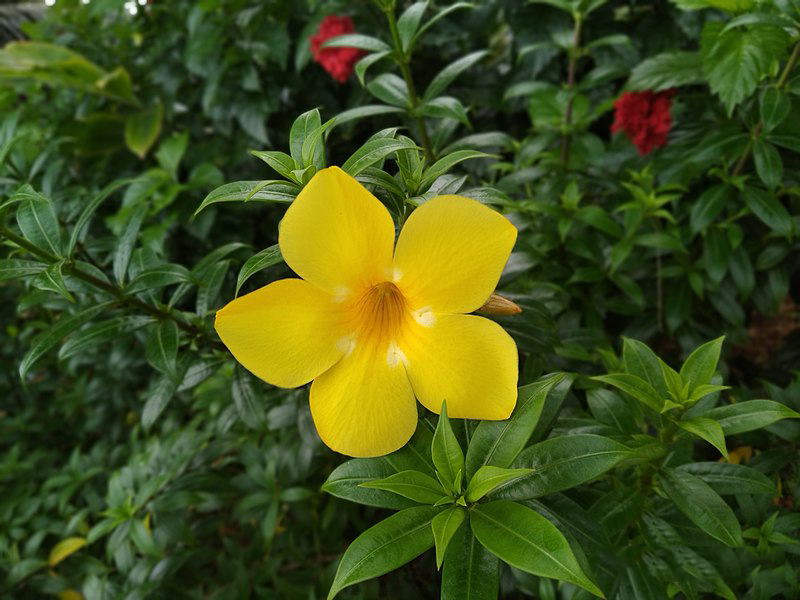
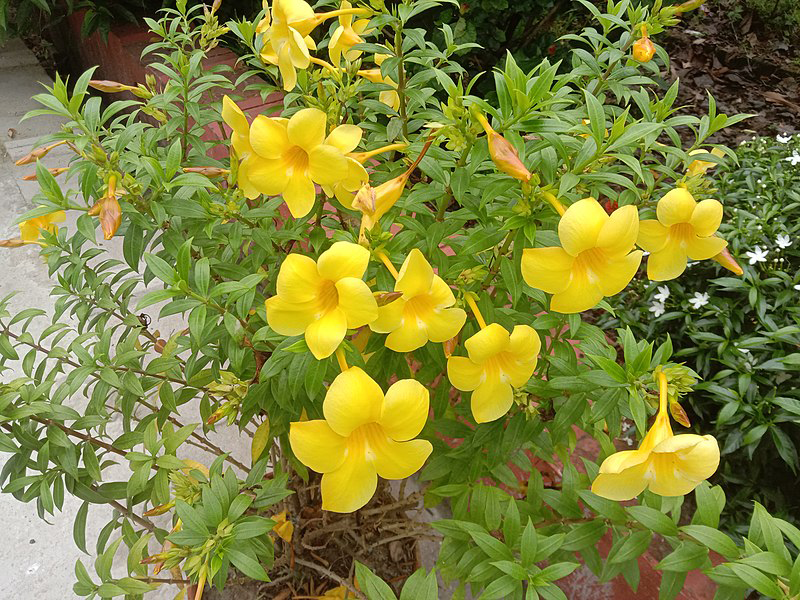
| Flower | Large flowers are 7-11 cm long and 5-7.5 cm wide and have five bright yellow petals that are fused together at the base to form a tube (i.e. corolla tube) about 4-8 cm long. This tube has reddish markings on the inside and is topped with five spreading petal lobes. The flowers also have five sepals (8-22 mm long) that are fused into a much smaller, greenish-coloured, tube at their bases (i.e. a calyx tube). |
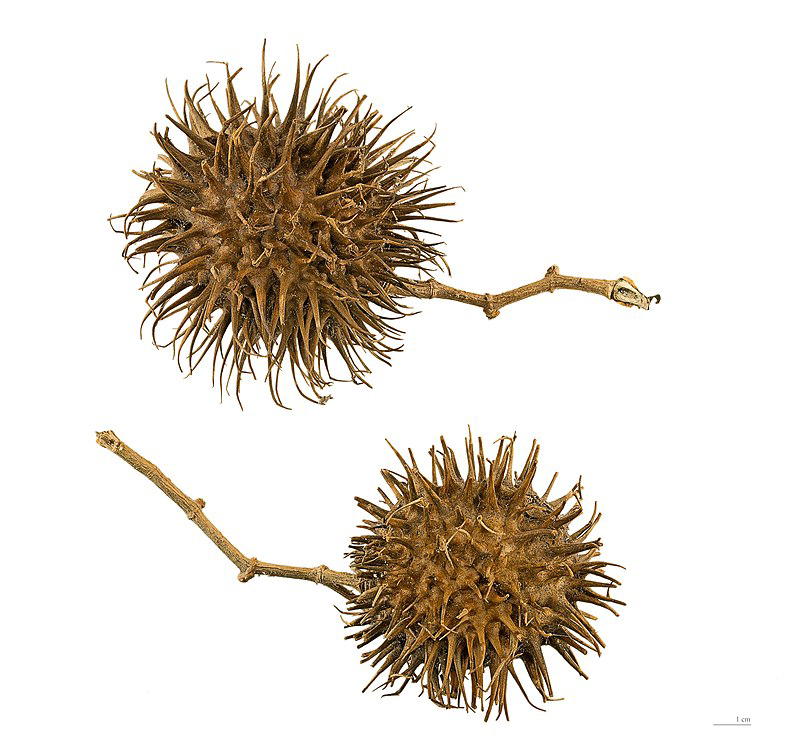
| Fruit Shape & Size | Rounded (i.e. globose) capsules about 30-75 mm across that are densely covered with soft spines (about 1 cm long) |
| Fruit Color | Initially green turning to brown as they mature |
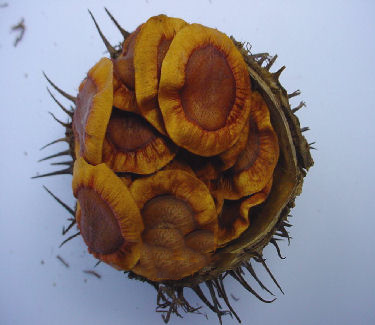
| Seed | Seeds are somewhat flattened (i.e. compressed), tan in color and are slightly winged or have a thin (i.e. membranous) margin. |
| Propagation | By seeds and stem segments (cuttings) |
| Plant Parts Used | Leaves, Bark, latex |
| Other Facts |
|
Plant Description
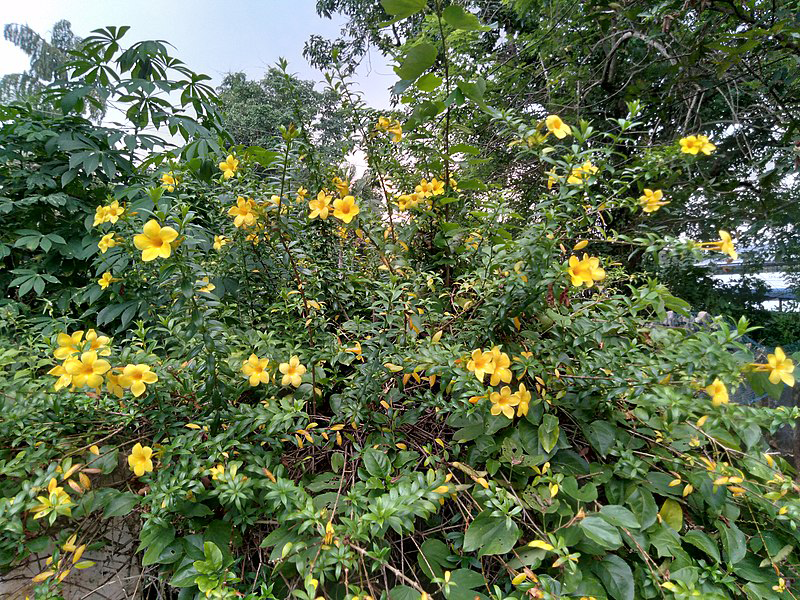
Golden Trumpet is an evergreen, vigorous, perennial, clambering or sometimes twining, woody compact shrub or creeping shrub that normally grows about 2 to 4 meters tall and spread up to 5 m or more, but can grow much higher when climbing up over other vegetation (i.e. up to 6 m in height).It does not twine, nor does it have tendrils or aerial roots. It can be pruned into a shrub form. The plant is found growing in wet forests, secondary forests, swampy areas near rivers and lagoons, disturbed areas, roadsides, forest edges, abandoned gardens, farms, riverbanks, along creeks and waste areas. As a tropical shrub, golden trumpet is best grown in soils rich in organic matter. Soils should also be moist but well-drained. These plants are tolerant of most soil types, but prefer either clay soils or sandy-clay. In alkaline soils, golden trumpet can become chlorotic – if possible, aim for a pH of between 5.0 and 6.0 for the healthiest plants.
Stems
The older stems are mostly woody and brownish in color, while the younger branches are generally green and hairless (i.e. glabrous). Bark of lower stems is brown and furrowed. Twigs are green or yellow green. The stems and leaves both contain a milky sap (i.e. latex).
Leaves
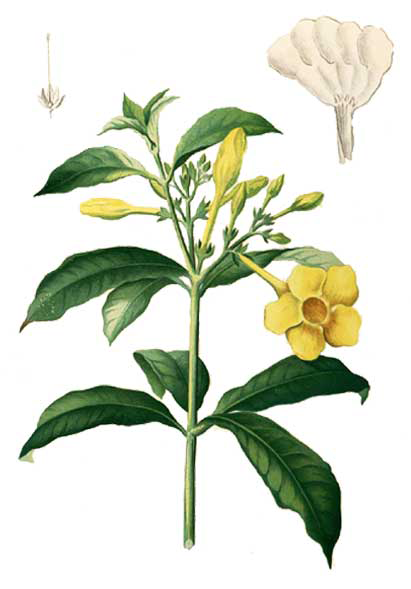
The simple leaves are arranged in groups of three or four along the branches (i.e. the leaves are whorled or verticillate). They are borne on very short stalks (i.e. petioles) only 2-5 mm long and have blades that are egg-shaped in outline (i.e. obovate) to somewhat elongated in shape (i.e. oblong-lanceolate). These leaves are 5-17 cm long and 2.5-6 cm wide and have a narrowed (i.e. attenuate) base, entire margins, and a pointed tip (i.e. acuminate apex). They are somewhat shiny in appearance, relatively thick and leathery in nature, and hairless (i.e. glabrous).
Flowers
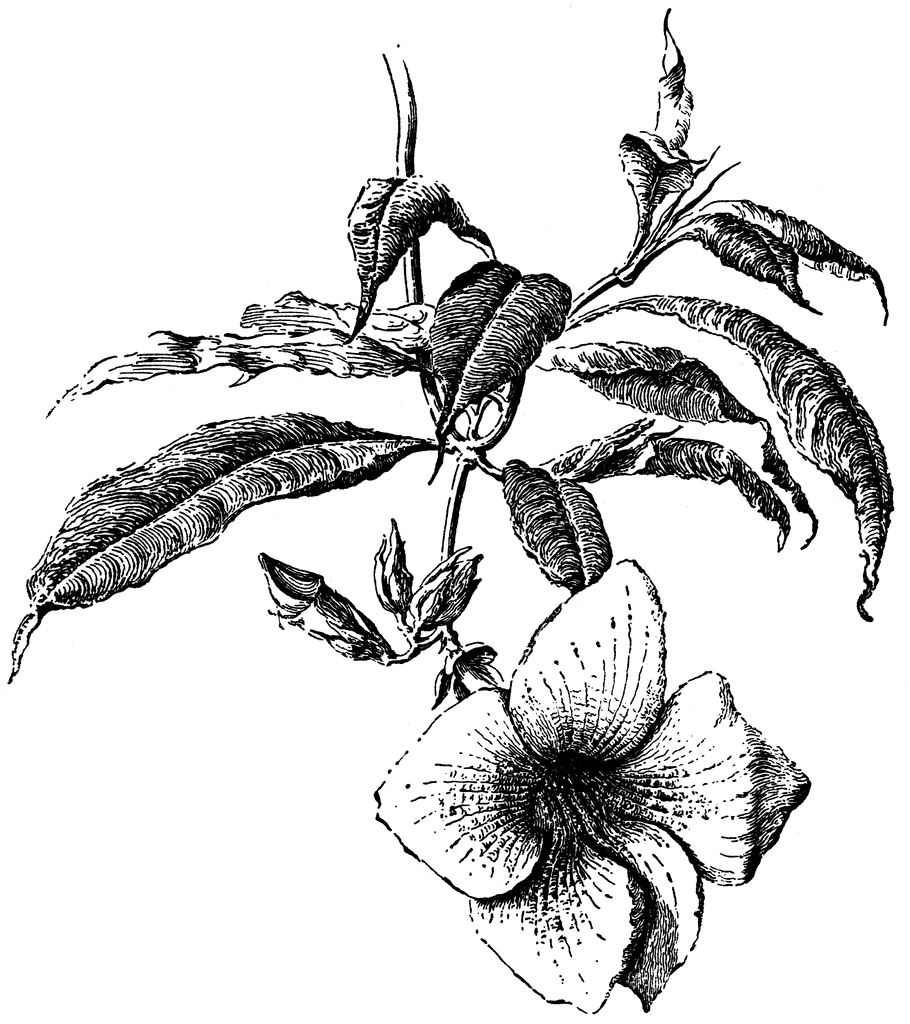
The large flowers are 7-11 cm long and 5-7.5 cm wide and have five bright yellow petals that are fused together at the base to form a tube (i.e. corolla tube) about 4-8 cm long. This tube has reddish markings on the inside and is topped with five spreading petal lobes. The flowers also have five sepals (8-22 mm long) that are fused into a much smaller, greenish-colored, tube at their bases (i.e. a calyx tube). Each flower also has five stamens that are joined directly onto the inside of the petals (i.e. adnate to the corolla tube) and a long style with two small branches at its tip. The flowers are borne in loose clusters (i.e. cymes) near the tips of the stems, each containing about ten flowers. Individual flowers are borne on short stalks (i.e. pedicels) about 5-7 mm long and the petals (i.e. corolla lobes) are folded and twisted when in bud. Flowering probably occurs mostly during spring and summer.
Fruit
Fertile flowers are followed by rounded (i.e. globose) capsules about 30-75 mm across that are densely covered with soft spines (about 1 cm long). These fruit are rarely seen in cultivated plants. The seeds are somewhat flattened (i.e. compressed), tan in color and are slightly winged or have a thin (i.e. membranous) margin.
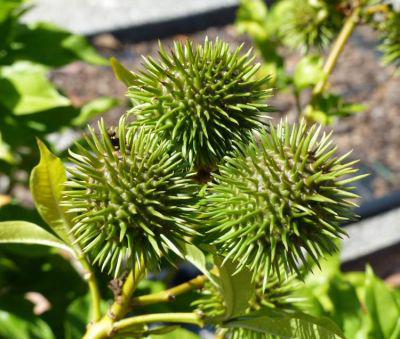 Immature-fruits-of-Golden-Trumpet
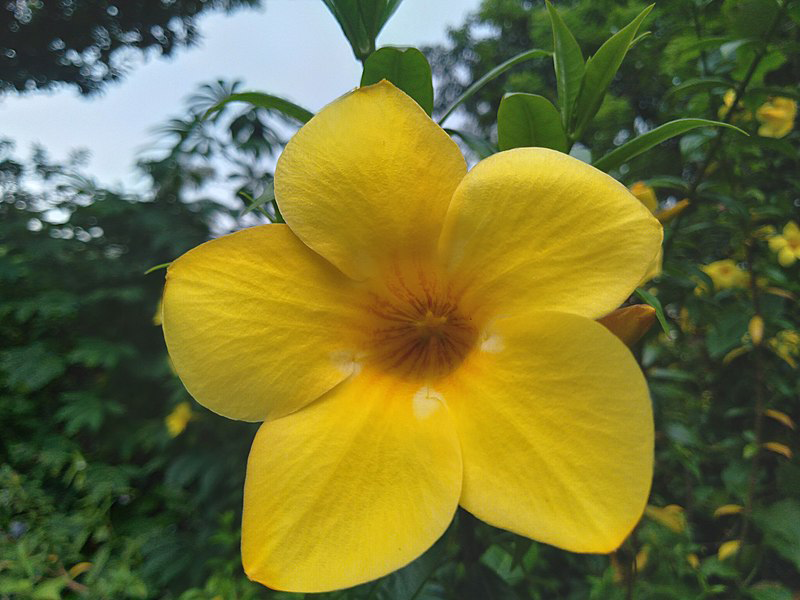 Closer-view-of-flower-of-Golden-Trumpet
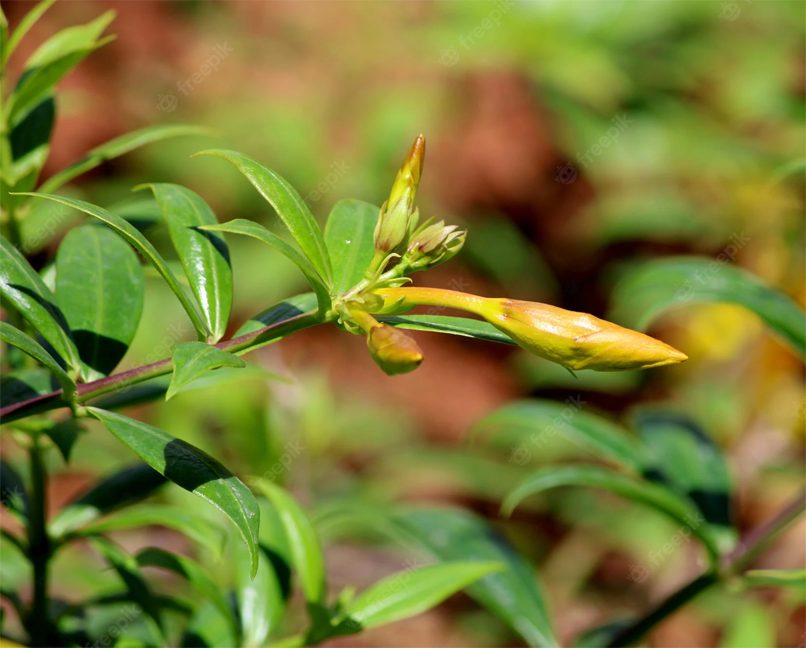 Flowering-bud-of-Golden-Trumpet
 Flower-of-Golden-Trumpet
 Golden-Trumpet-Plant-growing-wild
 Mature-fruits-of-Golden-Trumpet
 Plant-Illustration-of-Golden-Trumpet
 Leaves-of-Golden-Trumpet
 Golden-Trumpet-plant
 Sketch-of-Golden-Trumpet
 Seeds-of-Golden-Trumpet
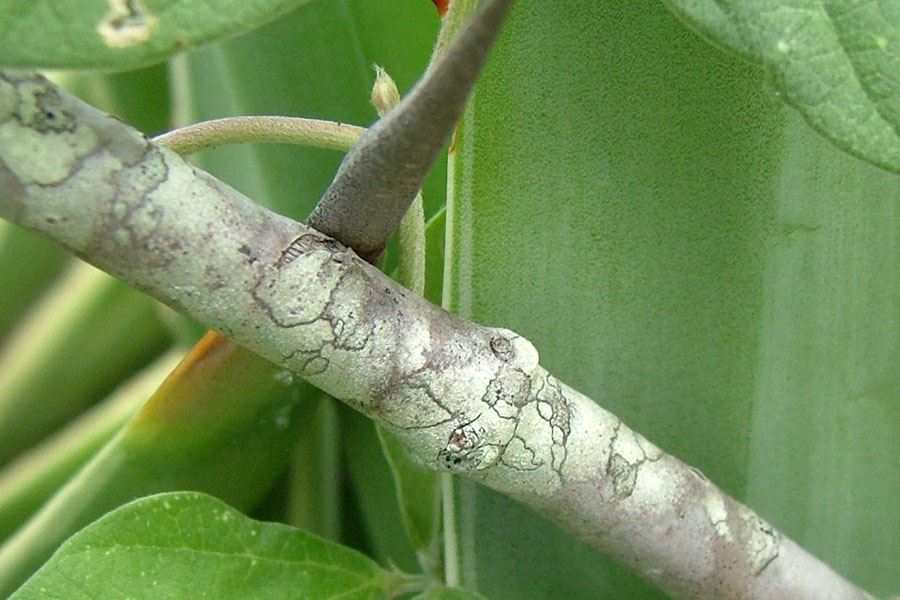 Stem-of-Golden-Trumpet
Traditional uses and benefits of Golden Trumpet
- As the name implies, the leaves, roots and flowers may be used in preparing a powerful cathartic.
- The plant draws its name from Allamand, who made the plant known a century and a half ago, who used a cathartic infusion of the leaves for colic.
- Infusion of leaves in moderate doses is an excellent cathartic; in considerable doses, it is purgative and a violent emetic.
- Decoction of leaves in small doses is used as antidote for poisoning.
- Extract of leaves are used for colic and as laxative; in large doses causes diarrhea and vomiting.
- In Trinidad, it is used for treating malaria and jaundice.
- In Guiana, the latex is used as a purgative and used for colic.
- In Ayurvedic and Unani medicine, it is used for healing of wounds and ulcers.
- Bark is used as hydragogue in ascites, leaves are used as cathartic, roots are used for snake bites and whole plant is used for jaundice and malaria.
- Throughout South-East Asia, a decoction of the leaves is used as a purgative or emetic.
- In the Philippines, a decoction of the plant is used as an antidote.
- In Java a steaming infusion is used to relieve coughs and headaches; the patient breathes in the vapor.
- In South America, the leaves or latex are used as a purgative.
- In Peru, the bark is used as a febrifuge.
- In Suriname, a decoction of the root is taken as a remedy for jaundice and enlarged spleen resulting from malaria.
- Flowers act as a laxative and antibiotic against Staphyloccus spp, malaria and root used for jaundice.
- Externally, the leaves and flowers are made into a poultice or wash to treat skin infections.
- In Veracruz the flowers are used to treat stomach pain.
- The plant can all help with gastritis, bile problems, indigestion, anorexia, heartburn and liver problems.
- It is an appetite stimulant and it works against toothache.
- It is also used externally, for example for wounds, skin diseases, smallpox and as an antidote for scorpion bites or contact with a poisonous plant.
- The plant purifies the blood and calms the nerves.
- It has a long history as a medicinal plant for the treatment of varied conditions such as feverish infections like gonorrhea, dysentery and hepatitis.
- The bark and latex, in small doses, are considered cathartic; in large doses, poisonous.
Precautions
- Plant parts are also toxic if ingested.
- All parts contain the toxic iridoid lactone, allamandin, which is toxic to livestock and humans, and the sticky milky sap can cause skin irritation.
- In the Philippines, whole plant is considered poisonous.
- In small doses, allamanda leaves, stems and the flowers produce diarrhea.
- Larger amounts cause violent vomiting and diarrhea.
- Regularly drinking allamanda tea causes chronic diarrhea.
- All parts of the plant have white milky sap that may cause rashes, itch, and blister once expose to it.
- Do not use in any form during pregnancy or lactation
- Avoid use in small children
- Teas made from the plant may interact with prescription anti-diabetic medications.
- Do not take concurrently with any oral anti-diabetic medications, as hypoglycemia (very low blood sugar levels) may occur.
Prevention and Control
Golden Trumpet has a very strong and extensive root system and therefore a combination of manual and chemical methods are recommended for its management. In the case of smaller infestations, plants should be removed manually and uprooted. All plant segments should be removed from infested areas to avoid re-sprouting. Larger infestations can be controlled by first digging out all plants. Later, all plant segments and re-sprouts should be sprayed with the herbicide triclopyr. Follow-up treatment and repeated applications of herbicide might be necessary to kill remaining plants and all re-sprouts.
Control
Manual control
Yellow allamanda has a very strong and extensive root system and requires persistent effort to remove by hand. Dig out large areas using a garden fork and mattock. If stems are cut, the stump must be treated with a suitable herbicide to prevent reshooting. Hand weeded yellow allamanda must be hung up off the ground or preferably taken out of bush land areas as stem fragments can take root.
Herbicide control
Larger plants and thickets may be treated with herbicide. There is no herbicide products specifically registered for the control of yellow allamanda in Queensland. However, a permit held by the Department of Agriculture and Fisheries allows people generally to use some herbicide products to control yellow allamanda as an environmental weed in various situations.
References:
https://www.itis.gov/servlet/SingleRpt/SingleRpt?search_topic=TSN&search_value=30127#null
http://www.hear.org/pier/species/allamanda_cathartica.htm
https://npgsweb.ars-grin.gov/gringlobal/taxon/taxonomydetail?id=312549
https://cabi.org/isc/datasheet/4098
https://www.missouribotanicalgarden.org/PlantFinder/PlantFinderDetails.aspx?kempercode=a479
http://www.theplantlist.org/tpl1.1/record/kew-6157
https://keyserver.lucidcentral.org/weeds/data/media/Html/allamanda_cathartica.htm
http://www.stuartxchange.com/Kampanilya.html
https://en.wikipedia.org/wiki/Allamanda_cathartica
https://gd.eppo.int/taxon/ALWCA
http://uses.plantnet-project.org/en/Allamanda_cathartica_(PROSEA)
https://www.amdi.usm.my/allamandacathartical-plantdatabase
https://www.nparks.gov.sg/florafaunaweb/flora/1/3/1303
https://indiabiodiversity.org/species/show/228638#morphology
http://tropical.theferns.info/viewtropical.php?id=Allamanda+cathartica
http://www.flowersofindia.net/catalog/slides/Golden%20Trumpet%20Vine.html
https://plants.usda.gov/home/plantProfile?symbol=ALCA7