

| Gumplant Quick Facts | |
|---|---|
| Name: | Gumplant |
| Scientific Name: | Grindelia camporum |
| Origin | Central California |
| Shapes | Small, wind-borne, dandelion-like achenes with featherlike tufts |
| Taste | Bitter |
| Health benefits | Cold and Cough, Bronchitis and Congestion, Calming effects, Relieves Tension, Skin Health, Cures Inflammation, Antioxidant Potential, Antimicrobial benefits, Urinary Tract Infection, Treats Allergic Reaction to Poison oak, |
| Name | Gumplant |
|---|---|
| Scientific Name | Grindelia camporum |
| Native | Central California. It is found primarily in the Sacramento and San Joaquin Valleys |
| Common Names | Gumweed, field gumweed, bracted gumweed, common gumplant, Great Valley gumplant, rosin weed, scaly gumweed and, simply, big California gumplant, Giant gum plant, Grindelia, Hardy grindelia, Rosin weed, Scaly grindelia, Wild sunflower, boton de oro |
| Name in Other Languages | Afrikaans: Gumweed Albanian: Gumweed Amharic: Much’a (ሙጫ) Arabic: Ealaka (علكة) Armenian: Mastak (մաստակ) Azerbaijani: Saqqız Bengali: Gumweed Bulgarian: Gumweed Burmese: S raat (သရက်) Chinese: Zá cǎo (杂草) Croatian: Gumweed Czech: Zvýkačka Danish: Gumweed Dutch: Kauwgom English: Great Valley gumweed, Grindelia, Gumweed, Wild sunflower, Bract gumweed, Hardy Grindelia. Gum Plant. California Gum Plant. Scaly Grindelia. Rosin Weed, common gumplant, Great Valley gumplant, resinweed, boton de oro Esperanto: Gumweed Estonian: Kummikomm Filipino: Gumweed Finnish: Gumweed French: Gumweed Georgian: Rezina (რეზინა) German: Gummibärchen Greek: Gumweed Gujarati: Gumweed Hausa: Gumweed Hebrew: אצות גומי Hindi: Gumweed Hungarian: Gumweed Icelandic: Gumweed Indonesian: Gumweed Irish: Gumweed Italian: Gumweed Japanese: Hakobe (ハコベ) Javanese: Gumuk Kannada: Gamvīḍ (ಗಮ್ವೀಡ್) Kazakh: Sağız (сағыз) Korean: Kkeom (껌) Kurdish: Gumweed Lao: Khi hengoa (ຂີ້ເຫງົາ) Latin: Gumweed Latvian: Gumija Lithuanian: Dantenų Macedonian: Džvakanje (џвакање) Malagasy: Gumweed Malay: Gumweed Malayalam: Ganvīḍ (ഗംവീഡ്) Maltese: Gumweed Marathi: Gamavēḍa (गमवेड) Mongolian: Bokhi iddeg (бохь иддэг) Nepali: Gumweed Norwegian: Gumweed Oriya: Gumweed Pashto: ګومویډ Persian: آدامس Polish: Doględka wielka, gumowata Portuguese: Goma Punjabi: Gamavēḍa (ਗਮਵੇਡ) Romanian: Gumweed Russian: Gumweed Serbian: Gumeded (гумедед) Sindhi: مسخرو Sinhala: Gumweed Slovenian: Gumied Spanish: Gumweed Sudanese: Gumweed Swedish: Klibbgrindelia, gumweed Tajik: Gumweed Tamil: Kamvīṭ (கம்வீட்) Telugu: Gumweed Thai: Gumweed Turkish: Gumweed Ukrainian: Humka (гумка) Urdu: گومویڈ Uzbek: Gumweed Vietnamese: Kẹo cao su Welsh: Gumweed Zulu: Gumweed |
| Plant Growth Habit | Drought-deciduous, herbaceous perennial or semi-woody sub-shrub |
| Growing Climates | Dry banks, rocky fields and plains, low alkaline ground, sandy or saline bottomlands, roadsides, ditches, chaparral, woodlands, arroyos and washes, along seasonal streams/wetlands |
| Soil | Prefers sunny areas with sandy or loamy, well-drained soil |
| Plant Size | 1.2 to 2.0 meters by 80 cm wide |
| Stem | Mature plant has half a dozen or more erect, stiff, stems that can grow up to 3 feet tall depending on the species. Each stem typically has 6 or more branches in the top 2/3 of the plant |
| Leaf | Lance-shaped (lanceolate) to ovate, alternate, and stalkless, often with clasping bases. They have entire or serrate margins, grow up to 2½ inches long and ½ inch wide |
| Flowering season | May to November |
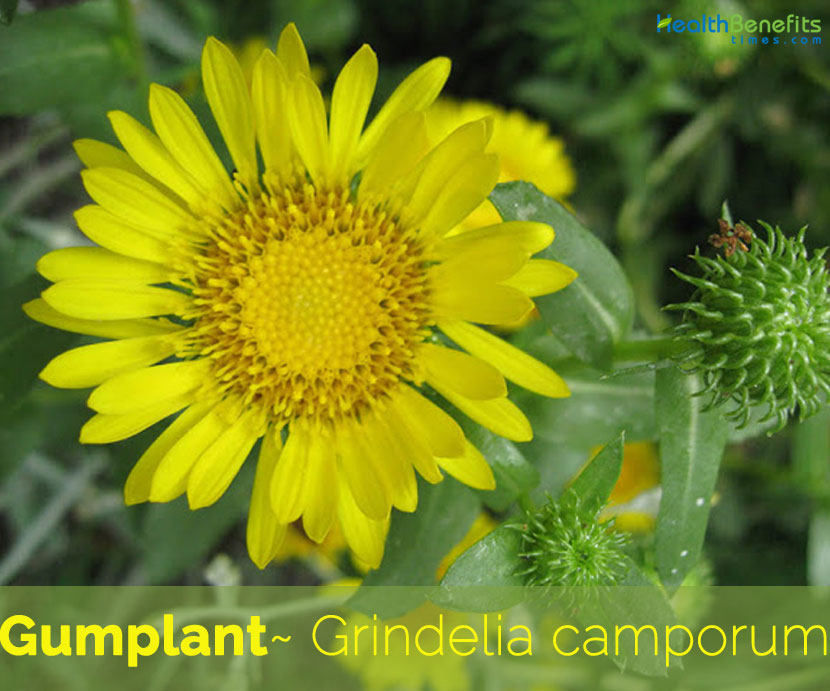
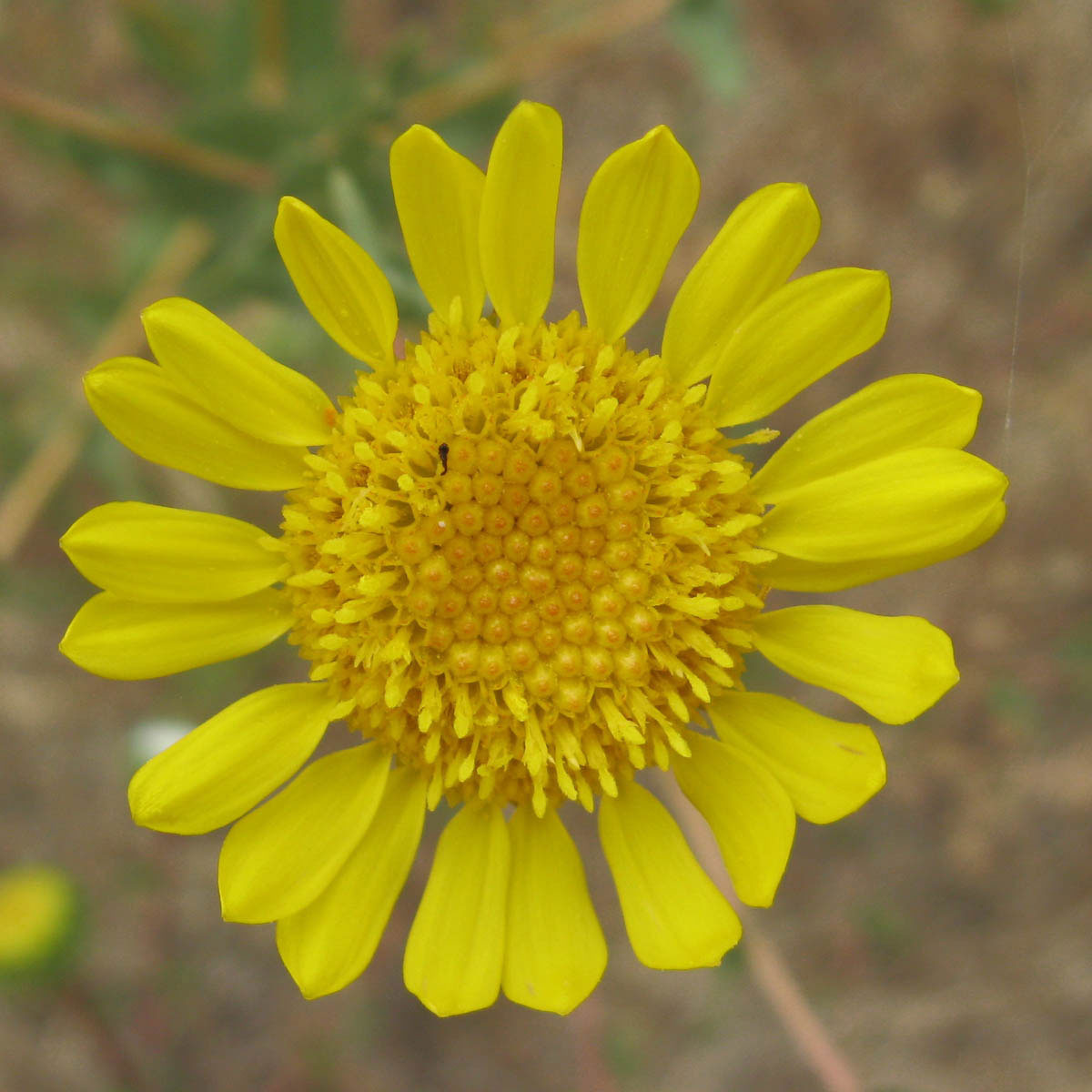
| Flower | Daisy-like flower heads are 1 to 2 inches across and are composed of 25–39 yellow petal like ray flowers |
| Fruit Shape & Size | Small, wind-borne, dandelion-like achenes with featherlike tufts of two to several firm, but deciduous, awns |
| Seed | Somewhat flattened, 3/8 inch long, and 1/16 inch wide |
| Lifespan | About 4-5 years |
| Propagation | Both by seed and stem cuttings |
| Taste | Bitter |
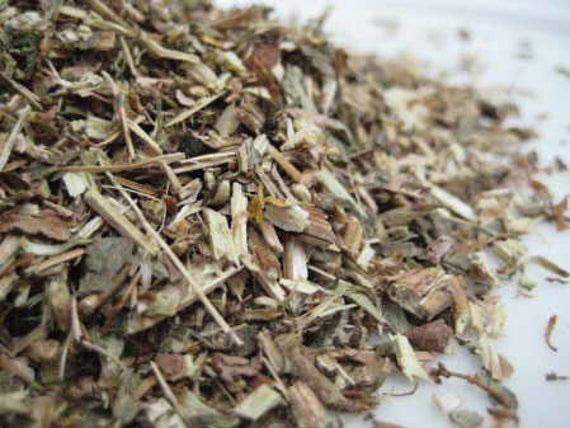
| Plant Parts Used | Dried leaves, flowering tops, aerial parts |
| Available Forms | Tinctures, syrups, liquid extract and teas |
| Health Benefits |
|
Plant Description
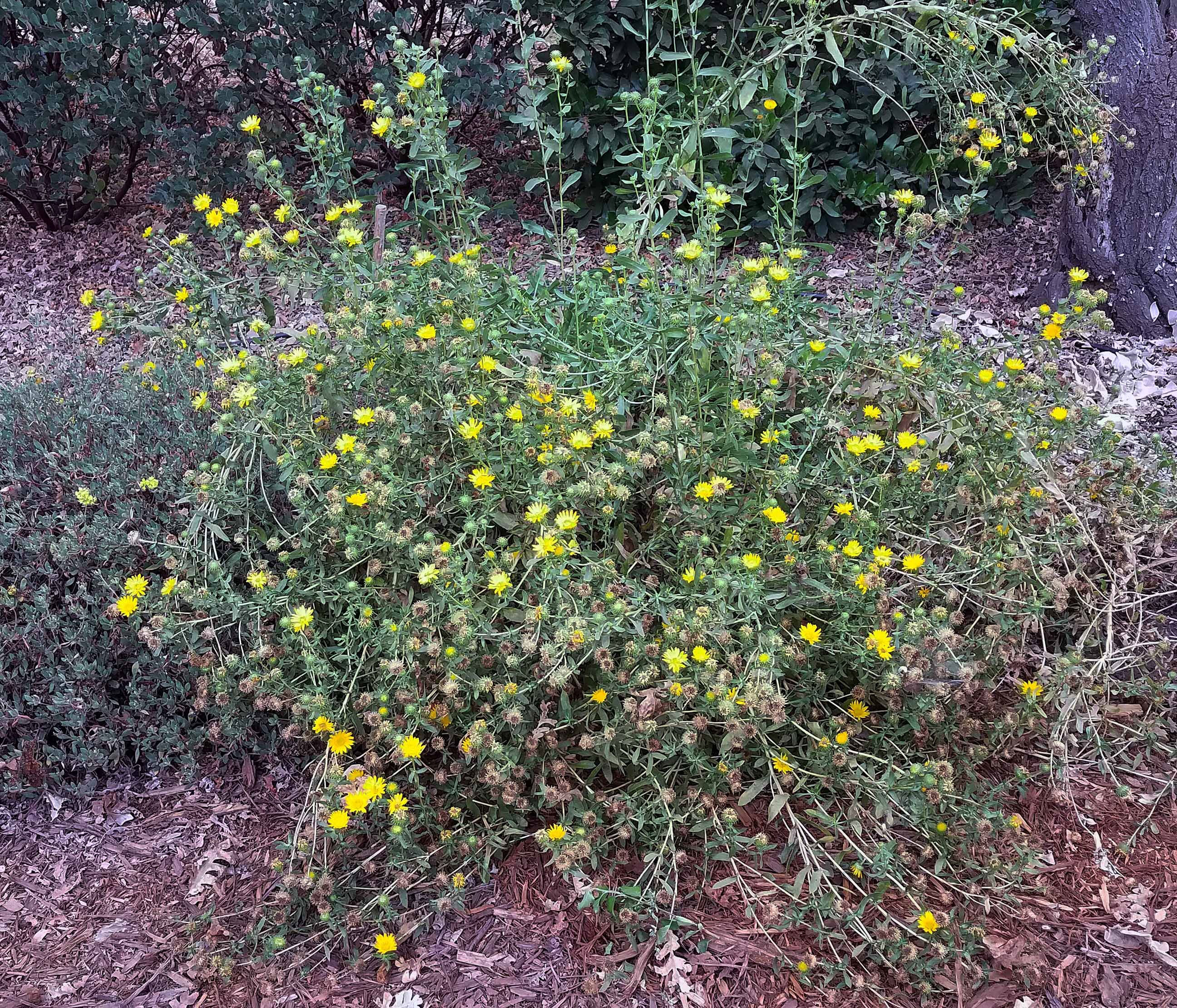
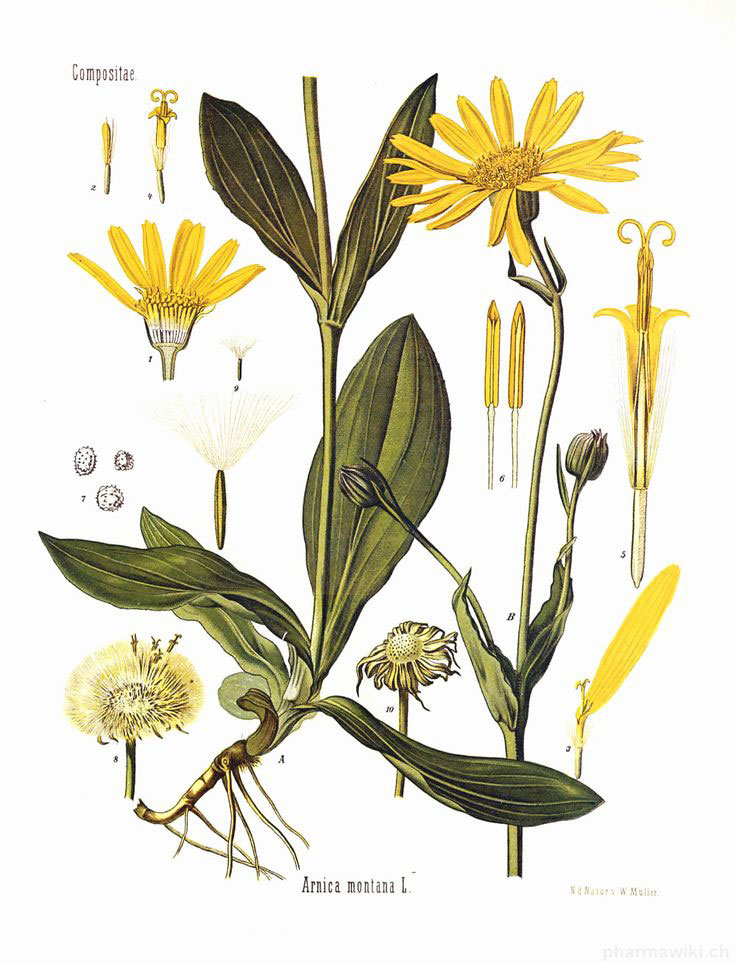
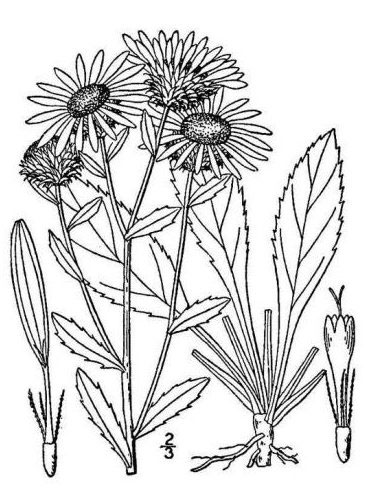
Gumplant is a drought-deciduous, herbaceous perennial or semi-woody sub-shrub normally growing about 1.2 to 2.0 meters tall and 80 cm wide. The plant is found growing in dry banks, rocky fields and plains, low alkaline ground, sandy or saline bottomlands, roadsides, ditches, chaparral, woodlands, arroyos and washes and along seasonal streams/wetlands. The plant prefers sunny areas with sandy or loamy, well-drained soil.
Stems
The entire plant is hairless and may feel sticky because of its resinous pores. Mature plant has half a dozen or more erect, stiff, stems that can grow up to 3 feet tall depending on the species. Each stem typically has 6 or more branches in the top 2/3 of the plant. These branches then have up to 4 secondary branches. All branches terminate with a single flower head.
Leaves
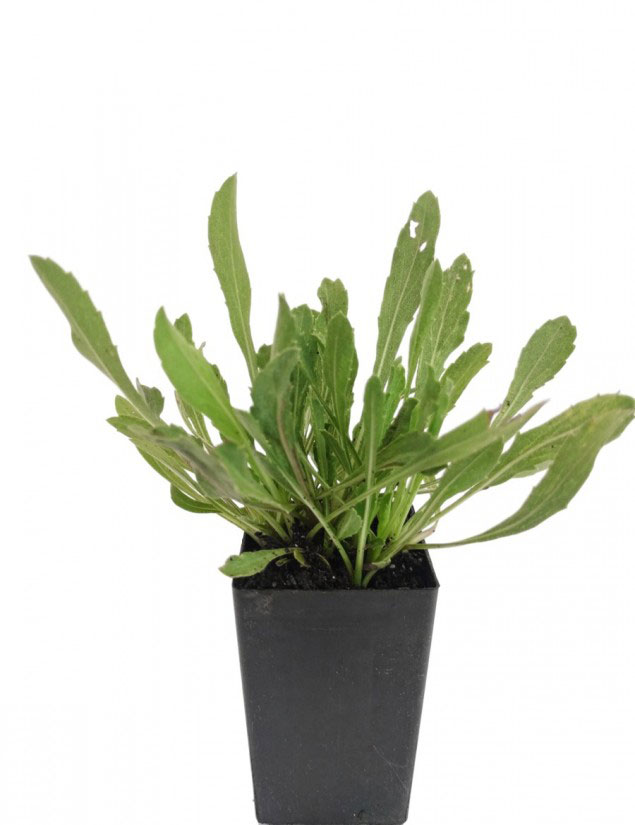
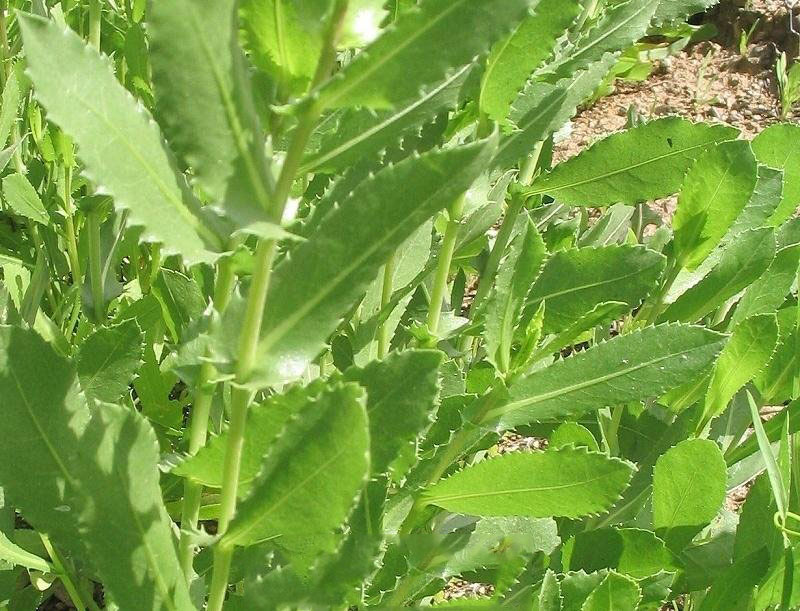
Leaves are medium green, alternate and clasp the stem. They are thick, leathery and quite sticky. Leaves are lance-shaped (lanceolate) to ovate, alternate, and stalkless, often with clasping bases. They have entire or serrate margins, grow up to 2½ inches long and ½ inch wide, are slightly wider near the tip, and are dotted with stalked glands that produce a sticky resin. Foliage and flowers all have a strong, distinctive, resin-like aroma. The basal leaves are largest (to 6 or 7 inches), oblong and usually sharply toothed. Leaves become smaller and more elongated further up the stem.
Buds and Flowers
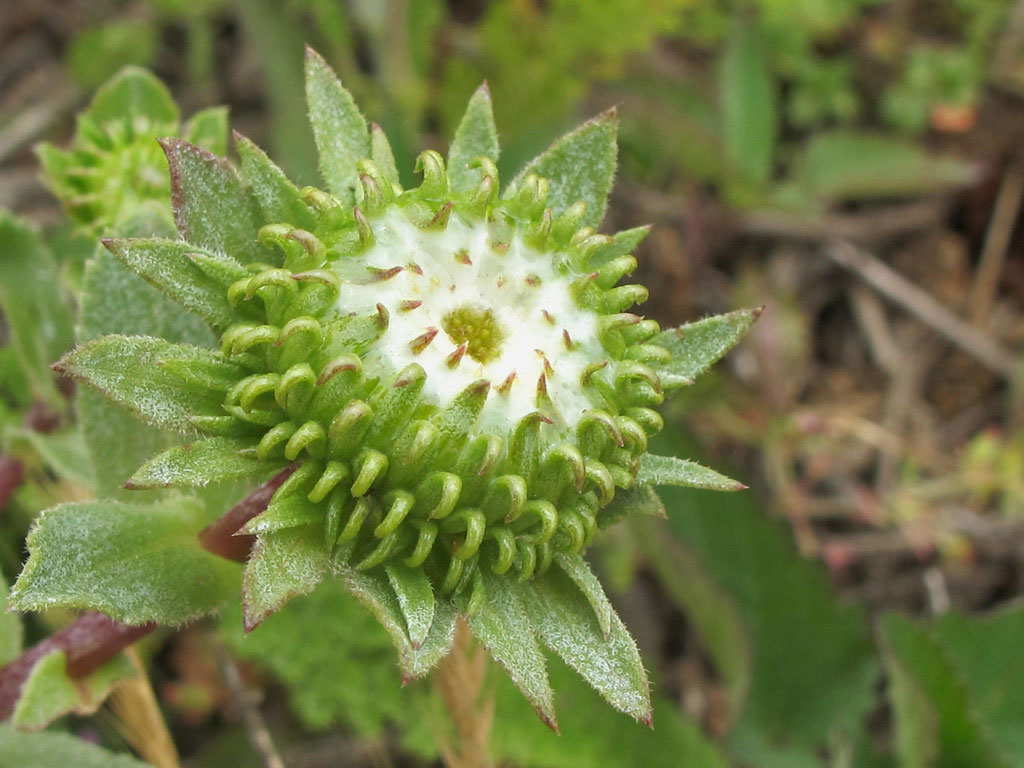
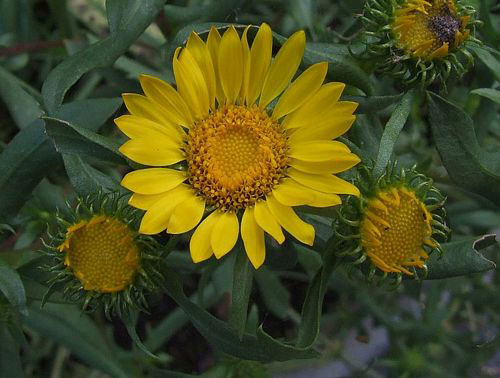
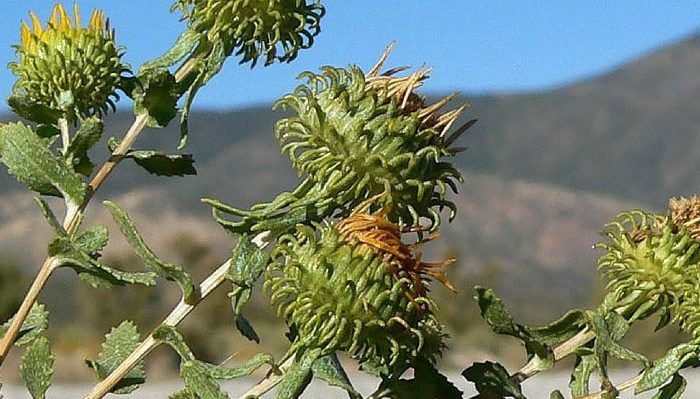
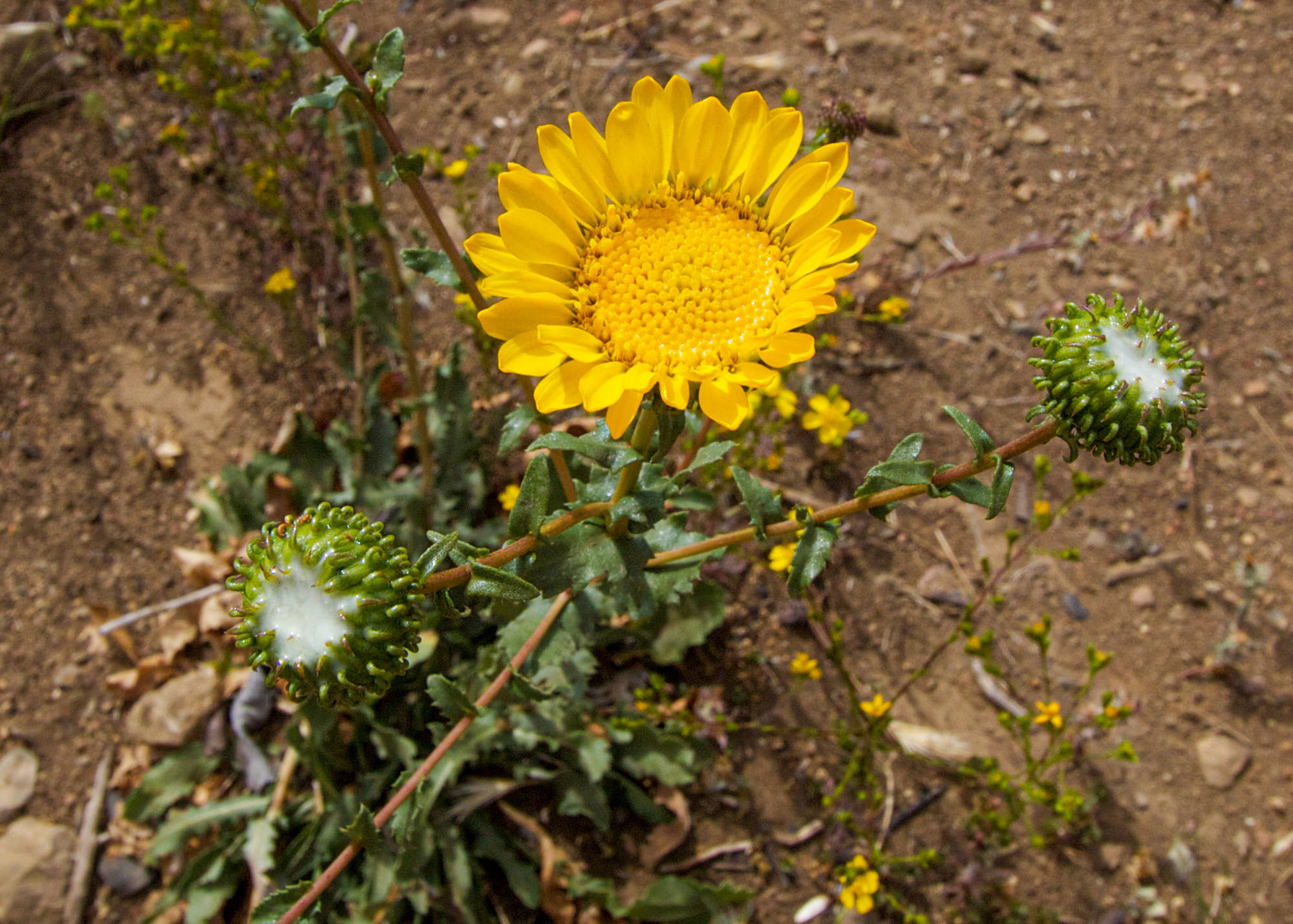
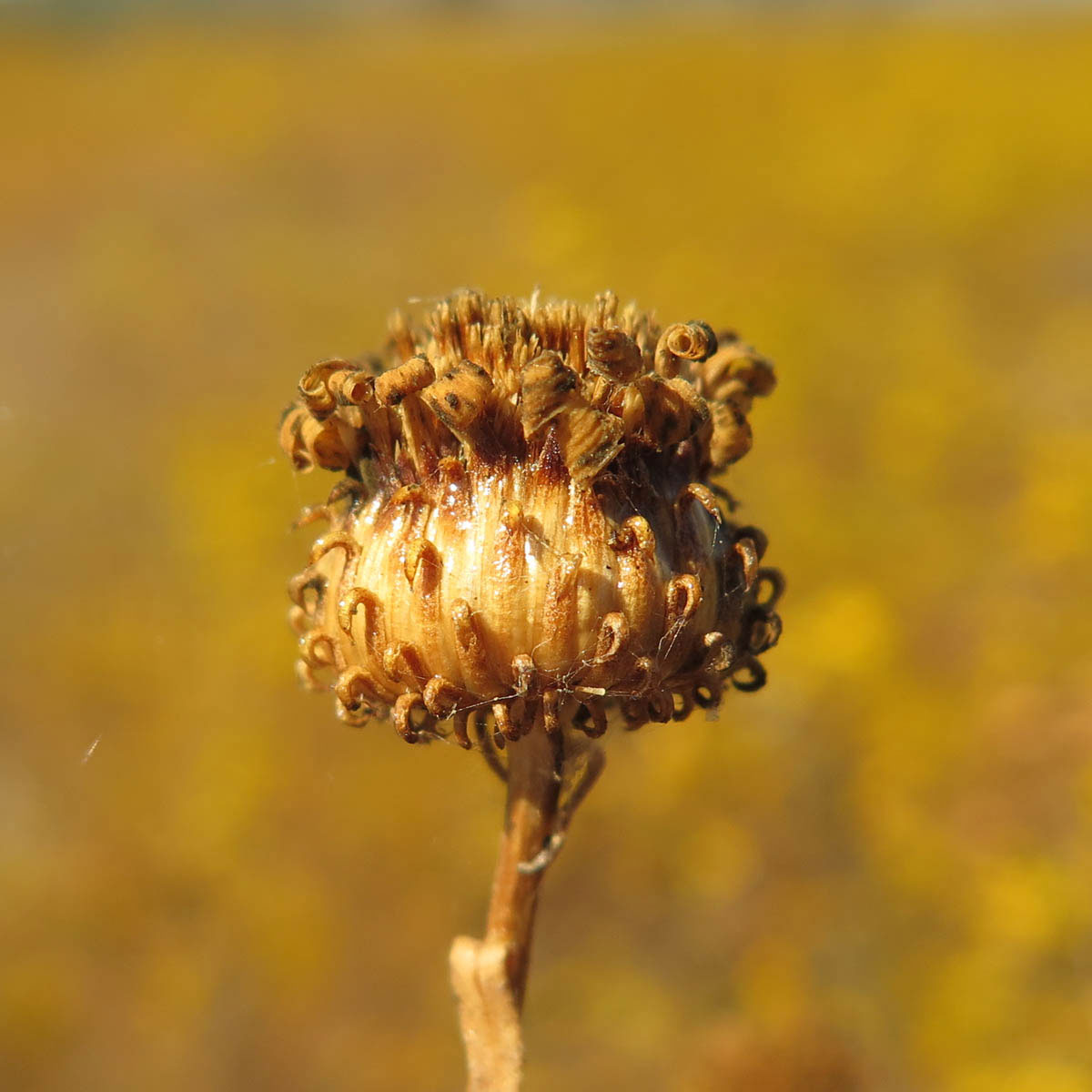
Composite flower heads begin as a tight bud with a spherical burr-like appearance due to a whorl or rosette of closely spaced, linear to lanceolate bracts. Immature flower heads are spheroid and ooze sticky, white latex that gives them a milky appearance. When open, the daisy-like flower heads are 1 to 2 inches across and are composed of 25–39 yellow petal like ray flowers 1/3 to 4/5 inch long surrounding the yellow disk flowers in the center. Below the flower heads is the involcre, a whorled cup of sticky-glandular, green bracts (phyllaries) with long, thin tips that are spreading or sometimes curved back from the flower head. Flowering occurs in mid to late summer, typically beginning in July and continuing into September or later depending on climate conditions. The flower heads are stickier than other parts of the plant and are difficult to dry. It is most easily identified by the recurved bracts on the cups that enclose the flower heads. Bracts are strongly curved back and highly resinous.
Fruits
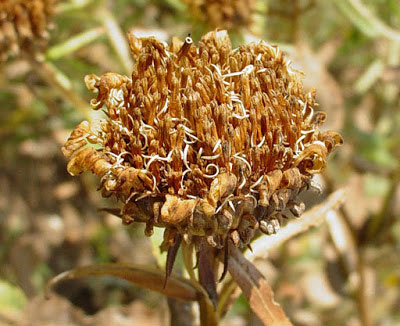
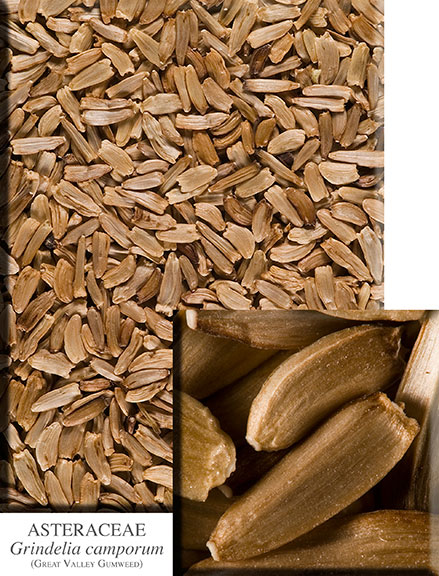
Fertile flowers are followed by small, wind-borne, dandelion-like achene with featherlike tufts of two to several firms, but deciduous, awns. The seeds themselves are somewhat flattened, 3/8 inch long, and 1/16 inch wide.
Health benefits of Gumplant
While there is not a great deal of scientific confirmation for the use of the herb, there is sufficiently of anecdotal evidence as well as many years of traditional use to rely on. Remember that the following uses are for information purposes and you should always consult your doctor before taking any herbal medications.
1. Cold and Cough
Gumplant herb has been used to treat congestion and other symptoms of the common cold like coughs and wheezing. It works as a natural expectorant and help break up the phlegm and mucus that frequently builds up when we have a cold. By loosening the mucus, it is easier for the body to expel through coughing. Grindelia also has anti-spasmodic properties that can help prevent spasms in the respiratory system and reduce the discomfort of coughing.
2. Bronchitis and Congestion
Gumplant has been used by the Native Americans as a natural remedy for bronchitis, emphysema as well as other conditions affecting the lungs. Little research has been carried out but it may work by allowing air to freely pass through the lungs of the patients. Furthermore, it aids in the elimination of obstructions of catarrh and phlegm. Which are in the passageway so to improve breathing.
3. Calming effects
Gumplant has also been used to help calm down the heart naturally and may have an effect similar to a beta blocker. By calming down the heart rate and improving its rhythm, the herb can also have a very positive effect on the mind.
Many people who suffer palpitations or irregular heart beat find themselves in a downward spiral when they start to feel anxious about their system. This can lead to uncomfortable feelings of anxiety. Natural beta blockers not only help you feel physically better but can also have a profound effect on your emotional well-being.
4. Relieves Tension
Gumplant herb has antispasmodic effect which can help relieve tension or spasms in the body’s muscles. This action can help soothe a range of bodily spasms including respiratory and digestive system spasms. It may also help soothe muscles in the limbs and help relieve cramping.
5. Skin Health
Gumplant can also be applied topically to help treat a range of skin complaints and has often been used as a natural remedy for dermatitis. Antibacterial and anti-inflammatory properties found in the plant make it an appropriate topical remedy for minor wounds, cuts, bites and stings. It can help prevent infection and soothe irritation and redness. The herb is also an effective remedy for reactions to poison ivy or poison oak.
6. Cures Inflammation
Research has found that Gumplant has anti-inflammatory actions. Research investigated the anti-inflammatory activities of an extract taken from Gumplant. They found that many of the compounds present in the herb exerted an anti-inflammatory activity including quercetin and kaempferol.
Inflammation is the heart of the majority of diseases including serious illness like cancer and heart disease. Natural anti-inflammatory herbs can help reduce the risk of illness and may even help treat certain inflammatory conditions.
7. Antioxidant Potential
Gumplant consists of numerous flavonoids with antioxidant potential including kaempferol and quercetin. These antioxidants can help protect us against disease caused by free radical damage or oxidative stress. Antioxidants also have an anti-aging effect that may be noticeable externally by helping keep your skin looking younger and healthier.
8. Antimicrobial benefits
Several researches have confirmed that Gumplant has both natural antibacterial and anti-fungal activities, which have confirmed effective against a range of bacterial and fungal strains.
Research has found that resin fractions and phenolic acids extracted from the herb were able to prevent the growth of various bacterial strains such as Bacillus subtilis and Staphylococcus aureus.
Studies have also found that Gumplant inhibited the growth of various fungi including Candida tropicalis, Trichoderma viride and Mucor mucedo. Other studies have found that the essential oil from Grindelia camporum was effective against many fungal species.
8. Urinary Tract Infection
Gumplant has traditionally been used to treat urinary tract infections and cystitis. There are no studies into its efficacy for UTIs but it may work because of its excellent antibacterial actions.
9. Treats Allergic Reaction to Poison oak
Gumplant prevents the growth of poison oak. This is due to the calming effects that it has on the skin.
Traditional uses and benefits of Gumplant
- Gumplant was used by the native North American Indians to treat bronchial problems and also skin afflictions such as reactions to poison ivy.
- It is still used in modern herbalism where it is appreciated particularly as a treatment for bronchial asthma and for states where phlegm in the airways obstructs respiration.
- It is supposed to desensitize the nerve endings in the bronchial tree and slow the heart rate, thus leading to easier breathing.
- Dried leaves and flowering tops are anti-asthmatic, anti-inflammatory, antispasmodic, expectorant and sedative.
- The main use of this herb is in the treatment of bronchial catarrh, especially when there is an asthmatic tendency; it is also used to treat whooping cough and cystitis.
- Externally, the plant is used to treat burns, poison ivy rash, dermatitis, eczema and skin eruptions.
- Homeopathic remedy is prepared from the leaves and flowering stems.
- It relieves dyspnea due to heart disease, has been successfully used in whooping cough, and as a local application in rhus poisoning, burns, genito-urinary catarrh, etc.
- It has been used in herbal remedies to treat respiratory maladies, dermatological conditions, blood disorders, and minor injuries.
- Gumplant is currently available from herbal supplement stores and is touted for its anti-inflammatory, expectorant, and pain relieving properties.
- The Costanoan Indians boiled leaves and flower heads of Gumplant for healing dermatitis caused by poison oak, and for wounds, burns, boils, and sores.
- The Kawaiisu people used a similar decoction as a general analgesic and orthopedic aid, applying the plant material to their sore muscles.
- Miwok Indians used fresh, resinous buds as a treatment for blood disorders.
- Poultice made from fresh flowers and/or foliage or an infusion of the dried plant is applied to skin rashes, minor burns, eczema, dermatitis and other superficial skin conditions.
- Big gumplant has also been used as an infusion and tincture to treat conditions associated with excess respiratory mucous: bronchitis, coughs and bronchial asthma.
- It is also thought that it desensitizes the nerve endings in the bronchial tubes and slows the heart rate, making it easier to breathe.
- The herb is used as a treatment for bronchitis, emphysema, whooping cough, hay fever, and cystitis.
- It is also used an herbal remedy for whooping cough and respiratory catarrh.
- It is used as an antispasmodic and a urinary tract disinfectant.
- Topical preparation of this herb can also be used to soothe burns, insect bites, and skin rashes.
- The Cahuilla used them to cure colds, and Hispanic people for colds, rheumatism, kidney disorders, paralysis and stomach disorders.
Ayurvedic Health benefits of Gumplant
- Asthma: Take sundew, grindelia and milk thistle. Prepare decoction. Drink 2-3 times a day.
- Asthma: Take Verbascum Thapsus and Grindelia. Prepare decoction. Drink 2-3 times a day.
- Bronchitis: Make a decoction of Ipecacuanha, White horehound, Coltsfoot and Grindelia. Take two times a day.
Other Facts
- Yellow and green dyes are obtained from the flowering heads and pods.
- It is a possible substitute for wood rosin, used in the manufacture of adhesives etc.
- Gumplant is an attractive ornamental for use in wildflower meadows and butterfly gardens.
- Gummy residue produced by the foliage can be used in a variety of industrial applications, such as soil amendments, rubber production, animal feed supplements, paper sizing, fermentation products, synthetic fuels, paints, varnishes, lacquers and adhesives.
- Entire plant emits odor of balsam.
Precautions
- Large doses used medicinally can irritate the kidneys.
- Gumplant may consist of high levels of selenium, which is toxic when ingested in large amounts.
- It should not be used at all by patients who are pregnant or breast-feeding,
- The herb should be avoided by those having kidney disease, hypertension or heart conditions.
- Those aged 55 and older need be particularly careful, since kidney function decreases with age, and many of the active chemicals are excreted in the urine.
- It should be consumed under the direction and supervision of a qualified healthcare provider.
References:
https://www.itis.gov/servlet/SingleRpt/SingleRpt?search_topic=TSN&search_value=37451#null
https://npgsweb.ars-grin.gov/gringlobal/taxon/taxonomydetail?id=104250
https://pfaf.org/user/Plant.aspx?LatinName=Grindelia+camporum
https://www.botanical.com/botanical/mgmh/g/grinde37.html
https://plants.usda.gov/core/profile?symbol=GRCA
https://plants.usda.gov/plantguide/pdf/pg_grca.pdf
https://en.wikipedia.org/wiki/Grindelia_camporum
http://germoplasma.iniaf.gob.bo/gringlobal/taxonomydetail.aspx?id=104250
https://www.bristolbotanicals.co.uk/pr-2093
https://gd.eppo.int/taxon/GRNCA