

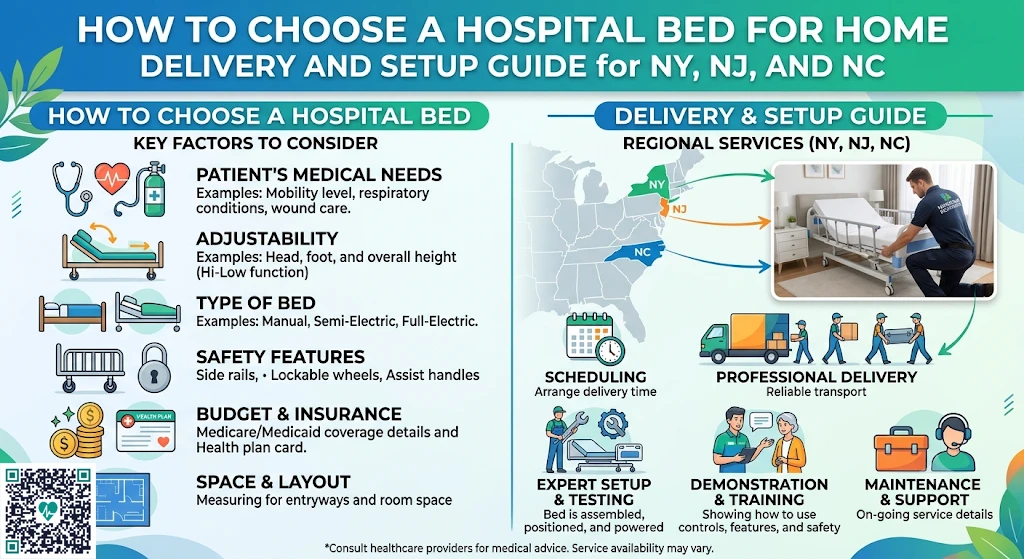
Instead of asking if a family member can stay at home, the conversation today revolves around how to achieve it. Family members are retaining their elderly parents or recovered relatives at home like never before in New York, New Jersey, and North Carolina, and the medical equipment allowing such a thing is increasingly becoming more advanced and available than ever before. At the heart of the equation, most of the time, lies the hospital bed.
Nine out of ten seniors in the United States state that they would rather age at home than enter any institution for such an end, as indicated by industry research conducted by North American Community Hub in 2026, with the home care market in the United States worth $107 billion in 2025, growing at a compound annual growth rate of 7.4 percent. And the choice of appropriate medical equipment is essential for that purpose.
Hospital Bed Information That Will Help Before You Purchase
The selection of a hospital bed for personal use is not like choosing a mattress. There are some considerations, both clinically and logistically and structurally that must be sorted out prior to delivery.
Manual Hospital Bed, Semi-Electric Hospital Bed, or Fully Electric Hospital Bed – The manual hospital bed uses a hand crank system. This is the least expensive hospital bed, and is acceptable for those who are largely mobile and who have an attendant who is always there. The semi-electric hospital bed has the head and foot raised using motors, but the bed height is raised manually. This is a very practical compromise for most home care situations. The fully electric hospital bed has all functions motorized, and is crucial where the back of the attendant is a concern in the sustainability of the care program.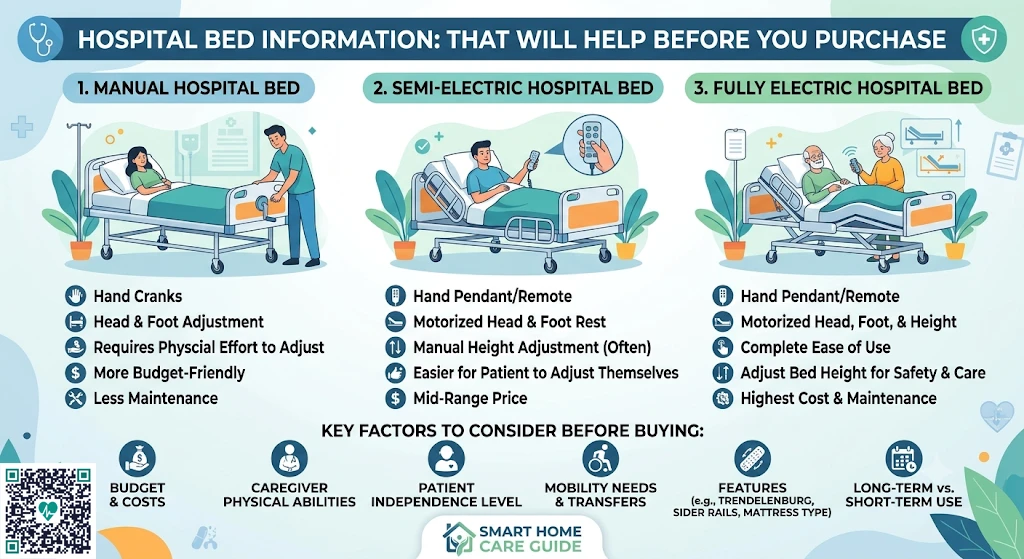
Weight Capacity and Bariatric Beds – Standard beds will hold a maximum of 450 lbs. Bariatric beds will go even further to support 600 to 1000 lbs and offer wider bed frames requiring extra floor space. Checking the weight of the patient and the dimensions of the room before ordering becomes a good practice avoiding lots of trouble during delivery.
Room Size and Access – The bed itself will be 36 by 80 inches. With side rails added, the dimensions increase. There should be clearance from all three sides for access to the bed. Bedroom doors of old houses in New York or New Jersey, especially pre-war constructions, can turn out to be narrower than it was expected. Bedroom door measurement is a must when ordering a bed.
Mattresses for Hospital Bed – A mattress provided within a hospital bed package usually is a simple foam one. People who have risk factors of pressure ulcers development definitely need a therapeutic foam or alternating pressure mattress. This is one of the most frequent mistakes while ordering home hospital bed system.
Hospital Bed Options and Estimated Costs
| Bed Type | Features | Estimated Price Range | Best For |
| Manual Hospital Bed | Hand crank adjustment, basic frame | $350 – $700 | Short-term recovery, mobile patients |
| Semi-Electric Bed | Motorized head/foot, manual height | $700 – $1,400 | Most home care situations |
| Full Electric Bed | Fully motorized including height | $1,200 – $2,500 | Long-term care, caregiver comfort |
| Bariatric Hospital Bed | Higher weight capacity, wider frame | $1,800 – $4,000+ | Patients over 450 lbs |
| Low Hospital Bed | Lowers to floor level | $900 – $1,800 | Fall risk patients |
| Therapeutic Mattress Add-On | Pressure relief foam or air alternating | $200 – $800 | Pressure injury prevention |
Pricing based on general U.S. home medical equipment market rates (2025-2026). Medicare and Medicaid may cover a portion of costs for qualifying patients.
Delivery and Assembly: Questions for Your Vendor
This is where things usually go awry in the purchase of a home hospital bed. Delivery happens and then there is no information on putting together the guardrails, the mattress doesn’t fit, the call button is not included. This is not an invented list of potential issues. This is a list of things that have gone wrong when people buy from a warehouse delivery vendor.
When a practice is purchasing new clinical products, choosing the right supplier can matter just as much as comparing product specifications. HSS Medical Supply offers surgical supplies and everyday clinical products for physician offices and other healthcare settings. Its catalog includes thousands of options, while its team provides ordering assistance, product recommendations, and troubleshooting when practices need help finding the right solution. The company serves facilities throughout New York, Massachusetts, North Carolina, and New Jersey. For healthcare buyers, that combination of product access and direct support can be useful when sourcing unfamiliar items or replacing products that are no longer available.
After the Bed Is Setup
The bed is part of the home care formula. The use of side rails, overbed tables, bed sheets, and positioning equipment determines how functional the bed becomes. Medicare Part B provides coverage for durable medical equipment, including hospital beds, to eligible patients through a written order by a doctor and proof of medical necessity. Being aware of the coverage before placing an order ensures families do not pay for what should have been covered.
A failure to take this step ensures the home care arrangement does not survive. A mistake results in readmission which nobody desires.
Editor Note:
This resource is presented in collaboration with SEO GURU, experts in SEO, Google Ads, social media, and web development.