


A foreign body in the ear refers to any external object or organism lodged within the ear canal. This condition is a frequent clinical emergency that primarily affects young children due to their natural curiosity, though it also occurs in adults through accidental introduction 1. Lodged objects are broadly classified as animate, such as living insects, or inanimate, which include organic materials like food seeds and inorganic items like beads, cotton swabs, or hearing aid fragments 2. While some individuals remain entirely asymptomatic, common clinical presentations include ear pain, abnormal drainage, localized swelling, hearing loss, or a persistent sensation of fullness 1. Prompt medical evaluation is strongly indicated, as delayed removal or improper at-home extraction attempts can lead to severe complications, including localized infections, excessive bleeding, or permanent damage to the eardrum 3.
Causes of Foreign Bodies in Ear
- Pediatric Exploration: Young children frequently insert small items such as beads, pebbles, dried beans, and toy parts into their ear canals out of natural curiosity, boredom, or during play 1.
- Improper Ear Cleaning Practices: Adults often accidentally lodge fragments of cotton swabs, matchsticks, or tissue paper in the ear canal while attempting to remove earwax or relieve itching, a practice medical professionals strongly advise against 2.
- Hearing Device Detachment: Small components of hearing aids, such as rubber domes or batteries, as well as pieces of sleeping or swimming earplugs, can accidentally break off and become trapped deep within the ear canal 1.
- Insect Intrusion: Live insects, including cockroaches, ants, and small flies, can independently crawl or fly into the ear canal, an event that most commonly occurs while an individual is sleeping or spending time outdoors 3.
- Cognitive and Psychiatric Factors: Individuals with developmental disabilities, advanced dementia, or certain psychiatric conditions are at an increased risk of intentionally or inadvertently placing foreign objects into their ear cavities 1.
Symptoms of Foreign Bodies in Ear
- Ear Pain and Discomfort: Individuals frequently experience sharp or aching pain within the ear, particularly if the object possesses sharp edges or is actively pressing against the highly sensitive eardrum 1.
- Hearing Loss and Fullness: A persistent sensation of blockage or pressure is a common indicator, which is often accompanied by a noticeable decrease in hearing ability because the object physically obstructs sound waves from traveling through the ear canal 1.
- Abnormal Drainage and Bleeding: If the lodged item scratches the delicate lining of the ear canal or remains trapped long enough to trigger a localized infection, the ear may secrete foul-smelling fluid, pus, or visible blood 2.
- Distressing Noises and Sensations: When a live insect becomes trapped in the ear canal, patients typically report an intense, loud buzzing or scratching sound, accompanied by severe distress and the physical sensation of movement 1.
- Asymptomatic Presentation: In many cases, particularly among young children, the foreign body produces absolutely no physical symptoms and is only identified when a caregiver spots the object or a healthcare provider conducts a routine physical examination 1.
How to Remove Foreign Bodies From Ears
1. Extracting Visible Objects with Medical Forceps
How it may help
Healthcare providers use specialized medical forceps to securely grip and pull out soft, irregular, or easily graspable objects, such as cotton, paper, or insects. This tool is most effective when the foreign body is clearly visible and situated in the outer portion of the ear canal.
What research says
Clinical evidence shows that forceps are highly effective for extracting non-spherical, graspable items. However, medical guidelines strongly advise against using forceps on smooth, round objects, like beads or seeds, because the instrument typically causes these items to slip and slide deeper into the ear canal 1.
How to use it safely
You must never attempt to use tweezers or forceps to remove an object from your own or a child’s ear. Always seek prompt medical care, as only trained professionals have the specific tools and direct lighting required to perform this extraction safely 4.
Potential precautions or side effects
Improper use can push the object deeper, scratch the ear canal, or puncture your eardrum, which may result in severe pain, bleeding, or permanent hearing loss 1.
2. Flushing the Ear Canal with Warm Water or Saline
How it may help
Ear irrigation uses a gentle, controlled stream of warm water or sterile saline to wash out small, inorganic objects or dead insects. The fluid flows behind the obstruction, creating mild pressure that safely pushes the foreign body outward without the need for physical instruments.
What research says
Clinical protocols establish irrigation as highly effective for removing inorganic items. However, medical guidelines strictly prohibit this method for organic materials, such as beans or seeds, because water exposure causes them to swell and become firmly impacted within the canal 1.
How to use it safely
You should have a healthcare professional perform ear irrigation to ensure the fluid is warmed exactly to body temperature. Never attempt at-home flushing if you have ear tubes, suspect a ruptured eardrum, or experience severe pain, as this requires immediate clinical evaluation 1.
Potential precautions or side effects
Using improperly heated fluid triggers severe vertigo and nausea. Excessive water pressure can rupture the eardrum, push the object deeper, or introduce serious localized bacterial infections 1.
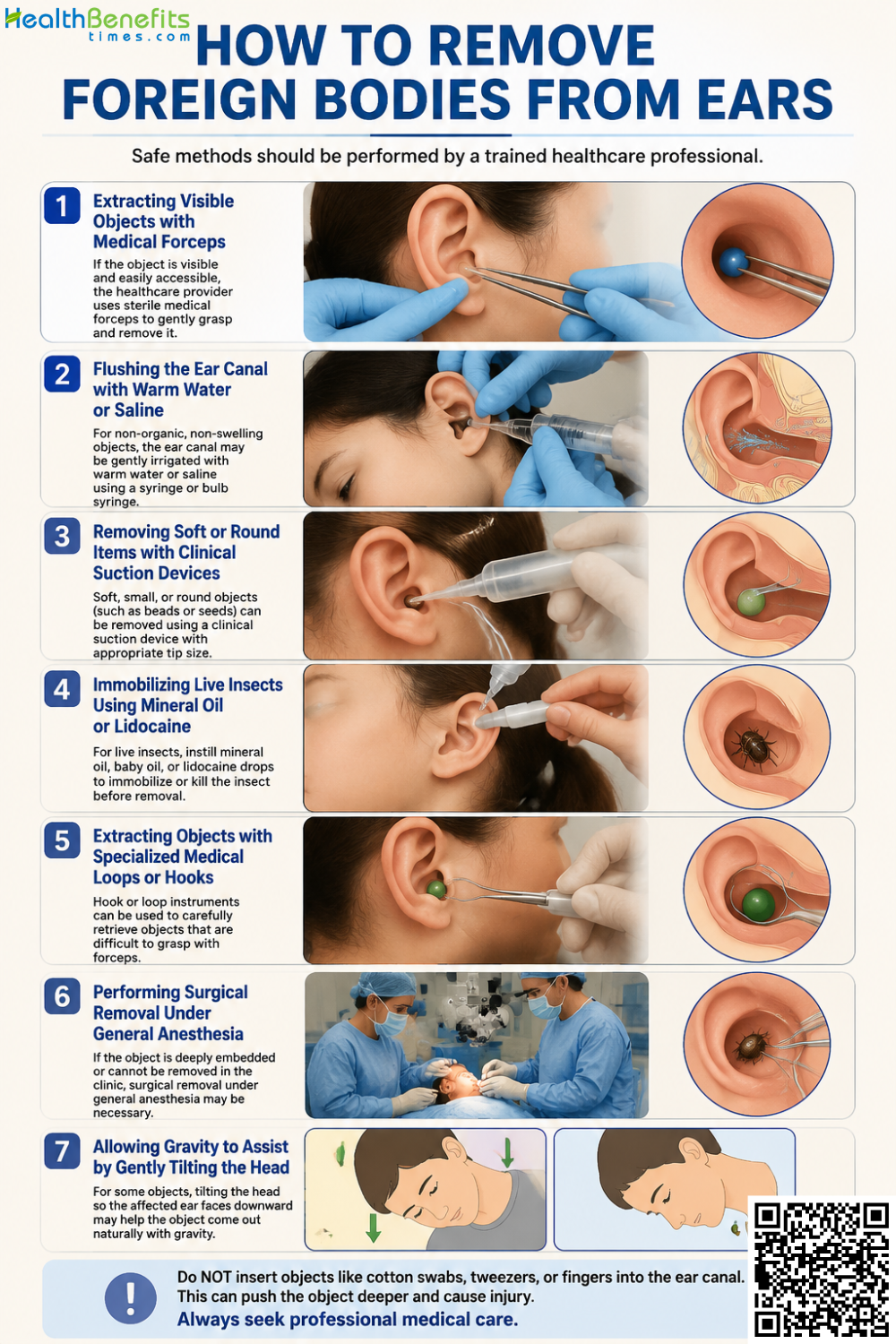
3. Removing Soft or Round Items with Clinical Suction Devices
How it may help
Medical professionals utilize small, specialized vacuum tubes to gently grasp and extract foreign objects. This technique is particularly effective for smooth, round, or easily breakable items, which often slip and slide deeper into the ear when using traditional medical forceps 2.
What research says
Clinical literature indicates that medical suction significantly reduces the risk of pushing spherical objects further into the ear canal. Research confirms this non-invasive method minimizes physical trauma and is highly successful when performed by trained physicians under proper magnification 1.
How to use it safely
You must never attempt to suction an object from an ear using household appliances. Always rely on a healthcare provider. During the procedure, you must remain entirely still, as sudden head movements can cause the medical device to scratch the delicate ear canal 1.
Potential precautions or side effects
The suction device produces a loud noise that may frighten children. Sudden patient movement can cause the metal tip to scratch the canal or accidentally puncture the eardrum 1.
4. Immobilizing Live Insects Using Mineral Oil or Lidocaine
How it may help
When a live insect is trapped in the ear, its movements cause severe pain and panic. Introducing liquid mineral oil or a numbing medication called lidocaine quickly suffocates or paralyzes the insect. This stops the distressing buzzing, prevents eardrum damage, and allows a doctor to safely remove it 1.
What research says
Clinical guidelines dictate that live insects must be immobilized before any extraction attempt to prevent severe ear trauma. Research confirms that applying topical lidocaine or mineral oil is a highly effective first-line treatment, as it rapidly kills the insect and provides immediate pain relief 3.
How to use it safely
If you suspect a live insect in your ear, you may gently pour a few drops of warm mineral oil into the canal to stop its movement. However, you must immediately visit a healthcare provider to have the dead insect completely extracted 4.
Potential precautions or side effects
You must never pour liquids into the ear if you have ear tubes, suspect a ruptured eardrum, or experience bleeding, as this causes severe pain and serious infection 1.
5. Extracting Objects with Specialized Medical Loops or Hooks
How it may help
Healthcare professionals utilize miniature right-angle hooks or wire loops, known as curettes, to slide carefully behind an object and gently pull it outward. This clinical method is highly effective for extracting smooth, spherical items, such as beads or beans, which are otherwise difficult to grasp with standard forceps 1.
What research says
Clinical protocols indicate that specialized hooks are the preferred medical instruments for removing spherical or firmly wedged foreign bodies. Evidence demonstrates that sliding a loop behind an object significantly reduces the risk of inadvertently pushing the item deeper into the ear canal compared to using grabbing tools 1.
How to use it safely
You must never insert household items like bobby pins or paper clips into your ear to hook an object. Only trained medical providers should perform this procedure, and you must remain completely still during the extraction to prevent the instrument from causing internal injury 1.
Potential precautions or side effects
Sudden head movements during the procedure can cause the metal instrument to severely scratch the ear canal lining or accidentally puncture the eardrum, resulting in pain and hearing loss 1.
6. Performing Surgical Removal Under General Anesthesia
How it may help
Putting a patient to sleep with general anesthesia ensures complete stillness. This allows specialized ear, nose, and throat (ENT) surgeons to safely extract foreign bodies that are deeply lodged near the eardrum, especially when previous removal attempts in a clinic have failed or caused severe pain 1.
What research says
Clinical guidelines recommend surgical removal in an operating room for uncooperative young children, objects resting directly against the eardrum, or sharp items posing a high injury risk. Evidence shows this approach significantly minimizes the risk of eardrum punctures and permanent ear canal trauma 2.
How to use it safely
You should rely on an ear, nose, and throat (ENT) specialist to determine if this complex procedure is necessary. If scheduled for surgery, you must strictly follow all pre-operative fasting guidelines and medical instructions provided by the surgical team to ensure a safe procedure 1.
Potential precautions or side effects
General anesthesia carries inherent medical risks, including temporary grogginess, nausea, and vomiting upon waking. Though rare, severe allergic reactions or breathing complications can occur during the procedure 5.
7. Allowing Gravity to Assist by Gently Tilting the Head
How it may help
Tilting the head relies on natural gravitational forces to dislodge small, loose items or trapped fluids from the outer ear canal. This non-invasive method allows objects that are not firmly wedged or sticky to simply fall out without requiring physical instruments 4.
What research says
Clinical guidelines recommend using gravity as the safest initial first-aid step for removing unimpacted foreign bodies. Medical evidence confirms this hands-off approach carries a negligible risk of mechanically pushing the object deeper or causing internal trauma to the eardrum 1.
How to use it safely
You should tilt your head sideways so the affected ear directly faces the ground. You may gently wiggle your outer ear or pull it slightly backward to straighten the ear canal, which helps the loose object drop out naturally 4.
Potential precautions or side effects
You must strictly avoid striking the side of your head forcefully to dislodge the object. If the item does not fall out easily, you must immediately seek professional medical evaluation 4.
Foods to Avoid When You Suffer from Foreign Bodies in Ears
A foreign body in the ear occurs when an external object, such as a bead, cotton swab, or insect, becomes trapped in the ear canal. Because this is a physical obstruction rather than an illness, your daily diet does not directly worsen or heal the condition. However, if the trapped object is deeply lodged, causes severe pain, or involves a young child, a doctor may need to perform the removal under sedation or general anesthesia. In these specific cases, you must strictly avoid eating or drinking prior to the procedure to prevent stomach contents from entering your lungs while unconscious 6. The following dietary restrictions apply strictly to the medical fasting period required for a safe removal procedure.
1. Heavy or Fatty Meals
Avoid fried foods, meats, and heavy meals for eight hours before receiving sedation to prevent stomach contents from entering the lungs during removal 7.

2. Light Solid Foods
Do not eat simple foods like toast, dry cereal, or crackers for a minimum of six hours before your medical procedure 7.
3. Dairy Products
Avoid drinking cow’s milk or eating cheese for six hours before sedation, as these digest slowly and pose breathing risks while unconscious 7.
4. Unclear Liquids
Stop drinking juice with pulp, alcohol, and thick soups at least six hours before the doctor removes the object from the ear 7.
5. Clear Fluids
Avoid all clear liquids, including water, apple juice, and black tea, for at least two hours before your scheduled sedation procedure 7.
When to See a Doctor When You Suffer from Foreign Bodies in Ears
A foreign body in the ear requires professional medical evaluation when the object poses an immediate risk to the ear canal or eardrum. Button batteries cause rapid liquefaction necrosis of the tissue and require emergent removal to prevent permanent structural loss and hearing damage 8. Live insects cause intense distress and require proper immobilization using mineral oil or lidocaine before extraction by a healthcare professional 8. You should immediately seek emergency care if you experience severe pain, bleeding, or sudden hearing loss, as these symptoms indicate potential damage to the tympanic membrane or middle ear structures 8.
1. Button Batteries
Seek emergency care immediately if a button battery is in the ear. These can cause severe chemical burns and tissue death within hours 8.
2. Live Insects
Visit a doctor if an insect is trapped. Professionals safely paralyze the insect before removing it, preventing further panic and scratching inside the ear canal 8.
3. Sharp Objects
Go to a clinic for pointed items. Sharp objects can puncture the eardrum, so a doctor must carefully extract them using specialized medical instruments 8.
4. Bleeding or Discharge
See a healthcare provider if you notice blood or unusual fluid draining from the ear, which suggests a severe injury or developing infection 8.
5. Failed Removal Attempts
Consult a doctor if the object remains stuck after basic first aid. Do not use tweezers or cotton swabs, as they often push items deeper 8.