

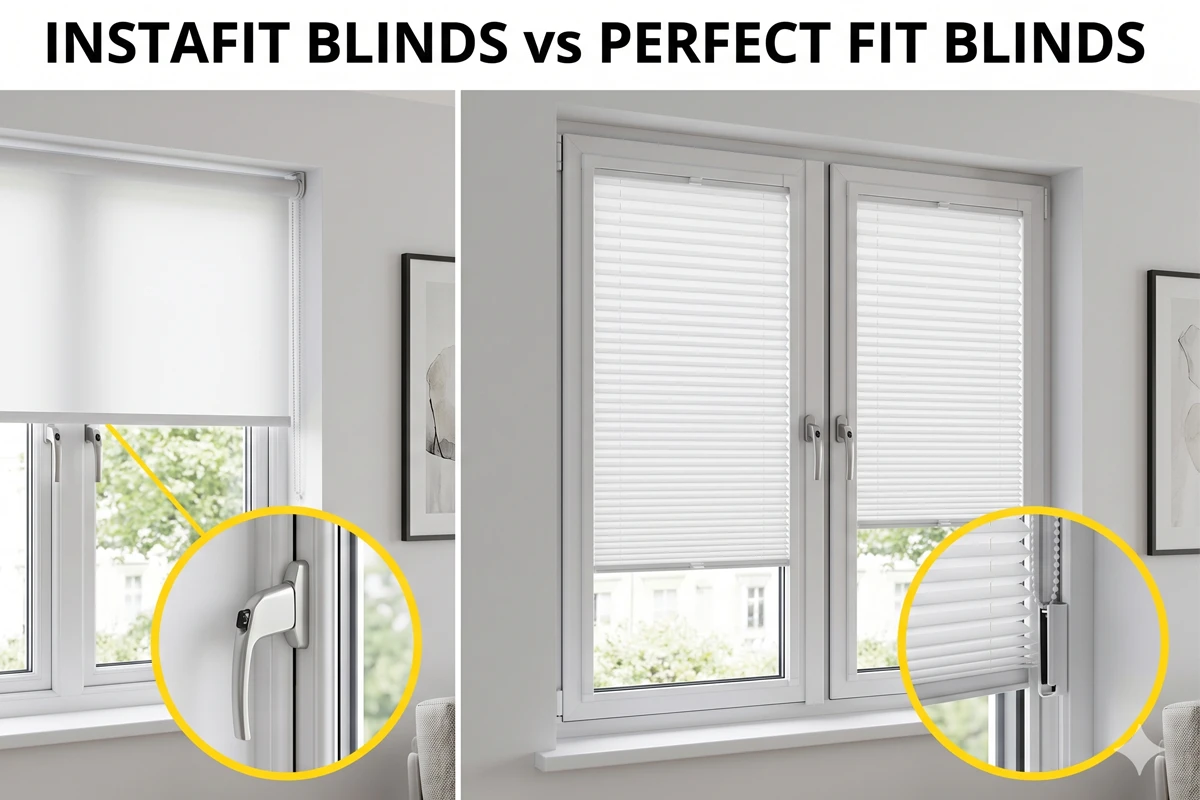
Both InstaFit and perfect fit blinds clip into the rubber bead of a uPVC or aluminium window frame. Neither requires drilling. Neither leaves any mark when removed. Both produce a finished result that is visually indistinguishable from a drilled installation. So why choose one over the other?
The difference is in the fitting mechanism, and that difference has practical consequences that are worth understanding before ordering.
How InstaFit Works
InstaFit blinds use a series of individual clips positioned at intervals along the top and sides of the blind’s frame. Each clip presses into the window bead and engages with a positive click. Fitting takes under two minutes for most windows. Removing the blind is equally instant — press the frame away from the bead at one point and work around until it releases.
The individual clip design makes the fitting process forgiving — there is no need to seat a continuous frame simultaneously on all four sides, and the tolerances on each clip are slightly looser than those on a perfect fit perimeter frame. InstaFit blinds are available as roller and Venetian styles and are made to measure to the dimensions of your window bead opening.
How Perfect Fit Works
A perfect fit blind uses a continuous perimeter frame that runs around all four sides of the window bead and seats simultaneously into the bead channel. The frame is manufactured to very precise tolerances — it must be exactly right for the bead opening, with no more than a few millimetres of variation across the full perimeter.
Because the frame is continuous, it creates a sealed edge on all four sides of the window. There are no individual clip points, no gaps between clip positions — just the frame running unbroken from corner to corner.
The Blackout Performance Difference
For light-filtering and privacy applications, the two systems perform equivalently. The sealed perimeter of a perfect fit frame becomes relevant specifically for blackout applications — and significantly so.
A standard blackout roller blind installed on brackets leaves gaps at the sides where light bleeds through. An InstaFit blackout roller reduces these gaps but does not eliminate them entirely — between the clip positions, the frame sits against the bead but is not continuously sealed. A perfect fit blackout blind eliminates the side gaps completely, because the continuous frame seals against the bead without interruption.
For bedrooms, nurseries or any room where genuine darkness is the goal, the perfect fit frame delivers meaningfully better blackout performance than an InstaFit system. For any other application — light filtering, privacy, day and night control — the two systems are practically equivalent.
Which to Choose
Choose InstaFit when: you want the fastest and simplest installation, blackout performance is not the priority, or you anticipate moving frequently and want maximum portability with minimal fuss.
Choose perfect fit when: you need genuine blackout performance, you want the most polished edge-to-edge appearance, or you are fitting in a conservatory or room where the sealed edge makes a visible difference.
Both qualify as no drill blinds in every meaningful sense. The choice between them is about blackout requirements and fitting precision, not about whether they will damage the window or the deposit.