


Ptosis, medically pronounced as TOE-sis, is a structural condition characterized by the abnormal drooping of the upper eyelid over the eye. This anatomical drop occurs when the levator muscle the primary muscle responsible for physically lifting and holding the eyelid in its proper open position stretches, weakens, or entirely detaches. It can also stem from damage to the specific cranial nerves that control this muscle’s movement. Depending on the severity, the drooping lid can fall just slightly or cover the entire pupil, significantly obstructing a person’s upper visual field and overall line of sight. While it can be present at birth due to improper muscle development, adult-onset ptosis is most commonly caused by natural aging, eye surgery, trauma, or underlying neurological disorders. Individuals with this condition frequently experience severe visual fatigue, tension headaches from constantly raising their eyebrows to clear their vision, and an asymmetrical facial appearance that often requires surgical muscle tightening to restore normal function and sight. 1. 2. 3. 4.
Causes of Ptosis (Droopy Eyelid)
Investigating the underlying reasons for eyelid descent reveals a variety of mechanical, muscular, and neurological culprits.
1. Aponeurotic Stretching and Detachment
Aging bodies frequently experience a natural weakening of connective tissues. The most common driver of acquired eyelid drooping is the slow stretching, thinning, or complete detachment of the levator aponeurosis tendon, which connects the main lifting muscle to the structural plate of the eyelid 5.
2. Neurological Interruption
Communication breakdowns between the brain and facial muscles directly halt eyelid elevation. Nerve pathways can be damaged or compressed by microvascular ischemia, strokes, or specific conditions like Horner’s syndrome and third cranial nerve palsy 6.
3. Myogenic Disease and Muscle Weakness
Certain systemic disorders attack the integrity of the muscle fibers themselves. Autoimmune diseases block essential neurotransmitters from reaching the muscle, while mitochondrial myopathies deprive the levator muscle of the cellular energy required to hold the eye open 7.
4. Mechanical Burden
Gravity plays a crucial role when additional mass burdens the eye area. Benign growths, heavy fat deposits, severe fluid retention, or tumors physically weigh the eyelid down, completely overpowering the natural lifting capacity of the retractor muscles 8.
5. Congenital Underdevelopment
Fetal development does not always proceed flawlessly. Some infants are born with isolated congenital ptosis because the primary lifting muscle fails to form correctly in the womb, often resulting in stiff, fibrous tissue replacing elastic muscle fibers 9.
Symptoms of Ptosis (Droopy Eyelid)
Recognizing the physical signs of this condition involves observing both the eye itself and the body’s compensatory behaviors.
- Visible downward sagging or inferior displacement of one or both upper eyelids beyond the normal resting position.
- A persistent, exhausting sensation of heaviness resting over the ocular region.
- Partial or complete obstruction of the visual field, specifically causing blurred vision when the tissue covers the pupil 10.
- Involuntary, chronic raising of the eyebrows in a subconscious effort to pull the heavy skin upward and clear the line of sight.
- Adopting a backward-tilting head posture, frequently described as a “chin-up” position, to physically look underneath the fallen eyelid 11.
- Frequent tension headaches, neck stiffness, and profound eyestrain resulting from the relentless overuse of the forehead and scalp muscles.
- Excessive tearing or poor tear distribution across the surface of the eye, sometimes leading to irritation 12.
- Double vision, crossed eyes, or generalized facial weakness when the drooping is tied to a larger autoimmune or neurological disease 13.
Ptosis (Droopy Eyelid) Facts Table
Reviewing the core details of this condition provides a clear, high-level understanding of how it operates and is managed.
| Category | Key Information |
| Symptoms 1 |
|
| Causes 14 |
|
| Types of Ptosis (Droopy Eyelid) 3 |
|
| How does it spread 2 |
|
| Age Group 15 |
|
| You might be at a higher risk for exposure of this disease if you:. 16 |
|
| How doctors diagnose 6 |
|
| Other facts 8 |
|
Natural Remedies for Ptosis (Droopy Eyelid)
Exploring alternative interventions offers supportive care for those dealing with specific nerve-based or muscle-fatigue variations of this condition.
1. Acupuncture and Meridian Stimulation
Activating the body’s natural healing pathways through traditional Eastern medicine has shown promising clinical applications for ischemic nerve damage. Fine needles are inserted into targeted facial regions, which helps to increase localized blood flow, normalize neurotransmitter levels, and lower internal ocular pressure 13. Patients suffering from isolated oculomotor nerve palsy have experienced significant rehabilitative progress in eyelid elevation following consistent acupoint therapy 17.
Note: You should visit a highly trained, certified acupuncturist who will carefully insert sterile needles into precise facial points to stimulate your nerve repair.

2. Coenzyme Q10 (CoQ10) Supplementation
Providing the cellular energy required for sustained muscle contraction is vital when the condition is rooted in metabolic distress. A specific myopathic form of eyelid drooping is directly linked to deficiencies in CoQ10, a crucial lipid-soluble antioxidant that powers the mitochondrial respiratory chain 18. Replenishing these levels internally has demonstrated remarkable efficacy in restoring muscular endurance and reducing the severity of myopathic fatigue 19.
Note: You can take this natural compound orally as a daily dietary supplement, preferably alongside meals containing healthy fats, to boost your muscle energy.
3. Chamomile Botanical Compresses
Calming localized inflammation can rapidly alleviate the mechanical weight dragging the delicate eyelid tissue downward. Chamomile is a potent medicinal herb loaded with over 120 biologically active constituents, including terpenoids that deliver strong anti-inflammatory and antimicrobial properties to surface tissues 20. Applying cool liquid preparations of this herb forces underlying blood vessels to constrict, efficiently shrinking puffiness and reducing the fluid burden on the lifting muscles 21.
Note: You can apply this remedy by soaking a sterile cloth in pure, chilled chamomile tea and resting it gently over your closed eyelids to draw out swelling.
4. Traditional Japanese and Chinese Herbal Medicine
Regulating the intricate fluid balance within the facial tissues helps combat persistent edema that physically forces the eye closed. Complex botanical formulations, particularly a Japanese herbal medicine known as Saireito, have been utilized to effectively modulate inflammatory responses and speed up recovery after tissue trauma 22. Integrating these specialized oral plant medicines works from the inside out to resolve chronic ocular surface inflammation and localized swelling 23.
Note: You must consume these specific medicinal teas or complex herbal extracts strictly under the guidance of a licensed practitioner of traditional botanical medicine.
5. Nutritional Optimization and Anti-Inflammatory Diets
Extinguishing an overactive immune system is the primary goal when autoimmune diseases like myasthenia gravis trigger eyelid failure. Systemic inflammation severely disrupts the communication at neuromuscular junctions, making it impossible for the levator muscle to receive lifting signals 24. Embracing a whole-food, plant-based dietary protocol rich in vitamin D, zinc, and polyphenols helps naturally suppress this inflammatory cascade, creating a healthier biological environment for nerve signaling 25.
Note: You can integrate this nutritional strategy by eating a diverse, whole-food diet rich in plant polyphenols and taking high-quality vitamin D drops.
Is there any exercise or physical activities for Ptosis (Droopy Eyelid)
Reactivating dormant muscle fibers and retraining neural pathways often require targeted, repetitive physical conditioning of the facial structures.
1. Mechanical Muscular Vibration
Sending rapid physical stimuli directly into the lazy tissue helps temporarily excite the neuromuscular junctions and push stagnant blood out of the area. Therapeutic mechanical stimulation of the levator and orbicularis oculi muscles is frequently utilized to lessen the severity of mild, transient eyelid drooping 26. Utilizing the high-frequency oscillation of an everyday household item serves as a practical, localized massage that can aid functional motor recovery over several weeks.
Note: You can safely perform this by gently pressing the smooth, unbristled back of a vibrating electric toothbrush against your upper eyelid crease for a few minutes daily.
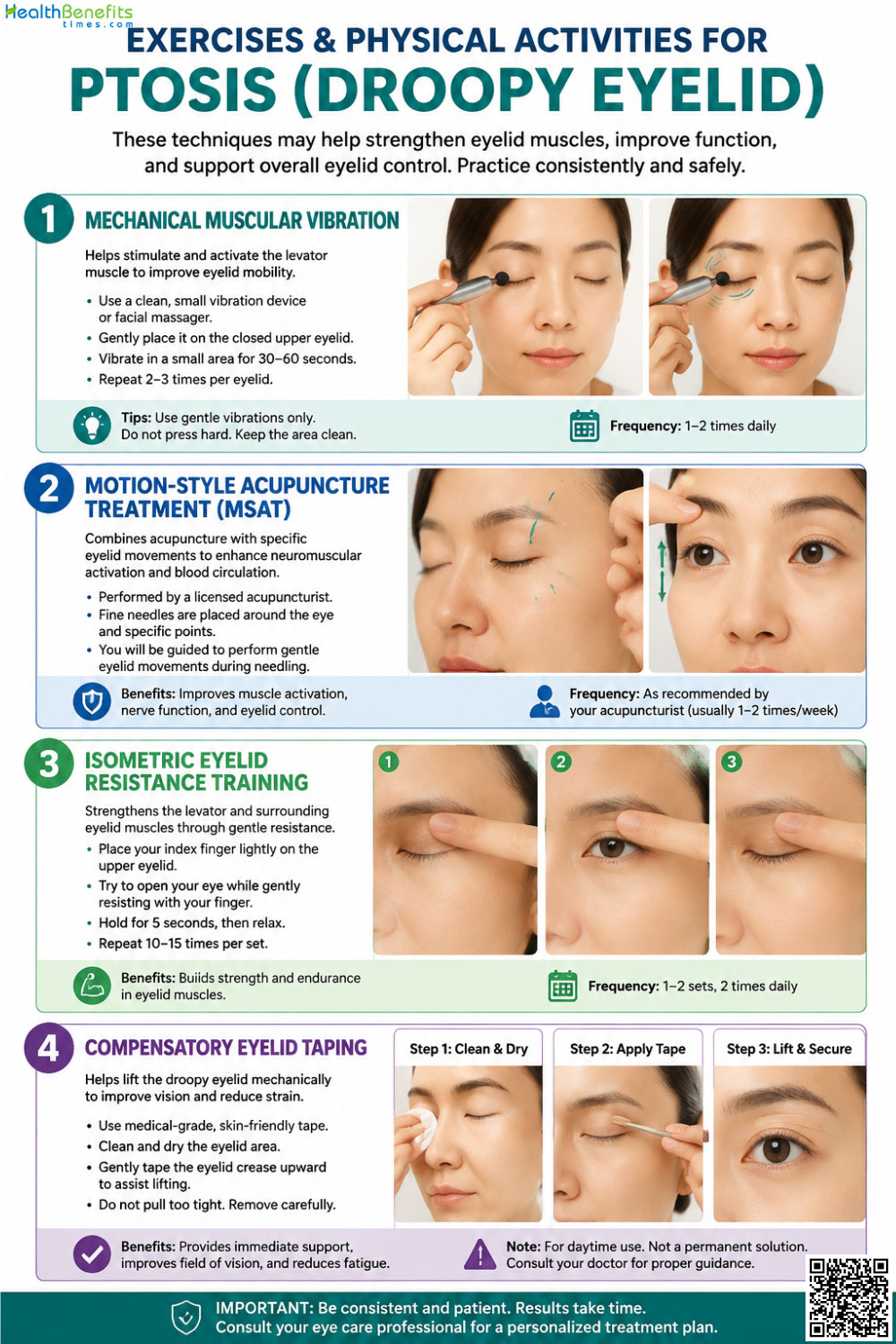
2. Motion-Style Acupuncture Treatment (MSAT)
Fusing traditional needle insertion with dynamic physical therapy forces the brain to actively rebuild broken neural connections. During this highly specialized integrative procedure, tiny needles are placed into the fascial zones surrounding the damaged extraocular muscles 27. Instead of remaining completely still, the patient undergoes guided physical exertion by aggressively moving their eyes into the very directions where their mobility is most impaired, accelerating the rehabilitation of the governing nerves.
Note: You will actively stretch and move your eyes left, right, up, and down following verbal commands while your clinical practitioner carefully maintains the inserted therapeutic needles.
3. Isometric Eyelid Resistance Training
Fighting against deliberate physical resistance forces the atrophied eyelid muscles to recruit deeper, previously inactive fibers. Structured facial exercises that demand forced eyelid closure followed by explosive, wide-eyed elevation help combat the muscular fatigue frequently seen after neurological strokes 28. Creating a manual barrier with the hands challenges the superior tarsal region to work harder, fundamentally mimicking traditional strength training for the face 29.
Note: You perform this physical activity by placing your clean fingertips firmly over your eyebrows to hold them perfectly still while intentionally forcing your eyes to open as wide as humanly possible.
4. Compensatory Eyelid Taping
Navigating the physical world safely becomes impossible when severe tissue sagging completely eliminates your field of vision. When the lifting muscles are entirely non-functional, mechanical support is required to prevent the onset of chronic tension headaches caused by the forehead muscles constantly trying to lift the load 30. Lifting the tissue physically out of the way is a crucial physical modification that allows individuals to participate in other rehabilitation programs without suffering from blindness.
Note: You can manage this by carefully applying a thin strip of breathable, hypoallergenic medical tape to the drooping lid and anchoring it upward onto your brow bone.
Foods to Avoid When You suffer from Ptosis (Droopy Eyelid) and you are prone to Ptosis (Droopy Eyelid)
Protecting your muscular stamina requires avoiding dietary triggers that provoke inflammation, fluid retention, or sudden energy crashes.
- High-Sodium Processed Foods: You must eliminate extremely salty meals, as excessive dietary sodium severely worsens fluid retention and exacerbates systemic inflammation directly linked to neuromuscular weakness 25.
- Heavy Saturated Fats and Red Meats: You should restrict your intake of heavy animal fats, as poor dietary fat profiles negatively influence autoimmune health and can trigger broader inflammatory responses that exhaust your lifting muscles 31.
- Refined Sugars and Sweets: You need to step away from candies because simple sugars fail to support the mitochondrial respiratory chain, depriving your facial muscles of the sustained CoQ10 energy required to hold your eyes open 32.
Activities to Avoid When You suffer from Ptosis (Droopy Eyelid)
Changing your daily mechanical habits prevents further physical degradation of the fragile aponeurotic connective tissues.
- Wearing Hard Contact Lenses: You should absolutely stop using rigid contact lenses, as the daily pulling and severe mechanical traction required to insert and remove them stretches the levator tendon to the breaking point 33.
- Aggressively Rubbing Your Eyes: You must avoid digging your knuckles into your eye sockets when tired or suffering from allergies, because this blunt physical trauma directly degrades the microscopic connective tissues holding your eyelid up 34.
- Smoking Tobacco Products: You need to quit smoking immediately; inhaled toxins aggressively destroy the collagen in your facial tissues while severely choking off the microvascular blood supply required to keep your facial nerves alive 35.
Myths and Misconceptions
Clearing up societal misunderstandings helps patients seek the correct diagnostic care rather than dismissing their symptoms.
| Myth | Reality |
| A drooping eyelid is strictly a cosmetic issue driven by vanity. | The reality is that significant tissue sagging physically blocks light from entering the pupil, causing immense visual impairment, and frequently serves as a crucial early warning sign for dangerous neurological or autoimmune diseases |
| This condition only happens to elderly people. | While tissue stretching is common in aging, ptosis afflicts individuals of all ages; infants can be born with congenital malformations, and young adults frequently develop it from nerve trauma or extensive contact lens usage. |
| Contact lenses are entirely safe for your eyelid anatomy. | Decades of clinical observation have definitively proven that the repetitive, daily mechanical pulling required to manipulate hard contact lenses radically increases the risk of physically tearing the eyelid’s lifting tendon. |
| Surgical intervention is the only way to fix a droopy eyelid. | Surgery is required for structurally torn tendons, but ptosis triggered by myasthenia gravis, metabolic deficiencies, or transient nerve swelling is primarily treated using oral medications, specialized nutrition, and targeted therapies. |
| All forms of eyelid sagging behave the exact same way. | Different underlying causes create vastly different symptoms; some forms fluctuate wildly throughout the day based on fatigue, while others remain entirely static or present alongside uneven pupil sizes. |
Special Considerations
Addressing this condition requires drastically different medical approaches depending on a person’s age and systemic health background.
1. Children
Facing a congenital droopy eyelid in an infant constitutes a severe developmental emergency. If the sagging skin permanently blocks the visual axis during the critical early windows of brain development, the child’s neurological system will actively suppress and ignore visual input from that eye 1. This sensory starvation rapidly leads to a permanent, irreversible form of visual impairment known as amblyopia, making immediate clinical intervention non-negotiable 12.
2. Pregnancy
Carrying a child introduces profound hormonal fluctuations, immune system modulation, and massive expansions in bodily fluid volume that can trigger unique vascular events. Documented cases reveal that acute oculomotor nerve palsies resulting in severe eyelid collapse and double vision can occur during the postpartum period, especially following high blood pressure complications like preeclampsia 27.
3. Chronic conditions
Living with an autoimmune anomaly fundamentally changes how this symptom behaves. Patients diagnosed with myasthenia gravis experience a highly distinct variant of the disease where the drooping is exceptionally mild upon waking but degrades severely as the afternoon progresses or after intense visual concentration 40. Meanwhile, individuals with chronic diabetes live with severely compromised vascular systems, making them highly susceptible to localized ischemic nerve deaths that trigger sudden ptosis 41.
4. Elderly
Growing older guarantees a natural, progressive thinning of the body’s connective tissues, making standard aponeurotic stretching incredibly common 42. However, geriatric populations are also statistically far more vulnerable to catastrophic cerebrovascular events such as brain aneurysms or acute strokes 43. Consequently, the sudden onset of an asymmetrical eyelid in an elderly patient must always be evaluated swiftly to rule out a central nervous system emergency.
Precaution before use of natural remedies when you have Ptosis (Droopy Eyelid)
Safeguarding your overall health is critical before experimenting with alternative therapeutic interventions for your eyes.
- Secure an Official Diagnosis First: You must consult a neurologist or ophthalmologist before treating your symptoms at home, because your drooping eyelid could be the only outward warning sign of a growing brain aneurysm or an impending stroke 4.
- Verify Complete Botanical Sterility: You need to be incredibly cautious when applying herbal poultices or tea bags to your face; placing unsterilized plant matter near your porous eye membranes introduces a massive risk of contracting a vision-destroying microbial infection 44.
- Check for Severe Plant Allergies: You should always perform a patch test before using botanical extracts like chamomile, as these specific plant families are notorious for triggering aggressive allergic contact dermatitis that will make your eyelid swelling significantly worse 45.
- Monitor Your Prescription Interactions: You must disclose any high-dose nutritional supplements or complex Chinese herbal teas to your primary doctor, as these powerful natural compounds can heavily alter your liver enzymes and interfere with your daily autoimmune or blood pressure medications 46.
- Acknowledge Physical Anatomy Limits: You need to understand that if a trauma or aging has completely severed the internal tendon connecting your eyelid to the muscle, no amount of facial exercise, brushing, or herbal tea will physically sew that tissue back together 47.
When to see Doctor
Knowing the precise red flags associated with ocular changes ensures you do not ignore a life-threatening medical event.
- Rapid and Sudden Onset: You need to seek emergency medical care immediately if your eyelid collapses suddenly over the course of a few hours, as this rapid progression is a hallmark indicator of a cerebrovascular stroke or toxic botulism exposure 48.
- Experiencing Double Vision: You must consult a specialist right away if your drooping is accompanied by crossed eyes or seeing double, because this proves the damage has spread deep into your cranial nerves 49.
- Noticing Unequal Pupil Sizes: You should go to the emergency room if the pupil underneath your dropped eyelid is visibly smaller than the other, as this combination points directly to Horner’s syndrome, which can be caused by massive chest tumors 50.
- Feeling Widespread Body Weakness: You must immediately contact a neurologist if your heavy eyes are paired with sudden difficulty swallowing, choking on water, or severe exhaustion in your arms and legs, signaling a systemic autoimmune crisis 51.
- Spotting Visual Obstructions in Infants: You need to rush your child to a pediatric ophthalmologist the moment you notice their drooping eyelid is covering the center of their pupil, preventing them from developing permanent blindness in that eye 52.