| Scup fish facts and nutritional value Quick Facts |
| Name: |
Scup fish facts and nutritional value |
| Scientific Name: |
Stenotomus chrysops |
| Origin |
It is found in Atlantic (from Massachusetts to South Carolina). Scup fishery is oldest in United States recording back to 1800. In 1929 the trawls was being started to use. Scup is caught with the use of otter trawl. |
| Colors |
Dull silvery, iridescent |
| Shapes |
Compressed body, ovate to elliptical, Length: 18 inches (450 mm) |
| Taste |
Mild |
| Calories |
115 Kcal./cup |
| Major nutrients |
Selenium (72.36%)
Vitamin B-12 (57.50%)
Isoleucine (56.70%)
Lysine (56.52%)
Tryptophan (52.27%)
|
| Health benefits |
Lowers fatigue, Treat Alzheimer's, Signalize nerves, Skin health, Supports digestion |
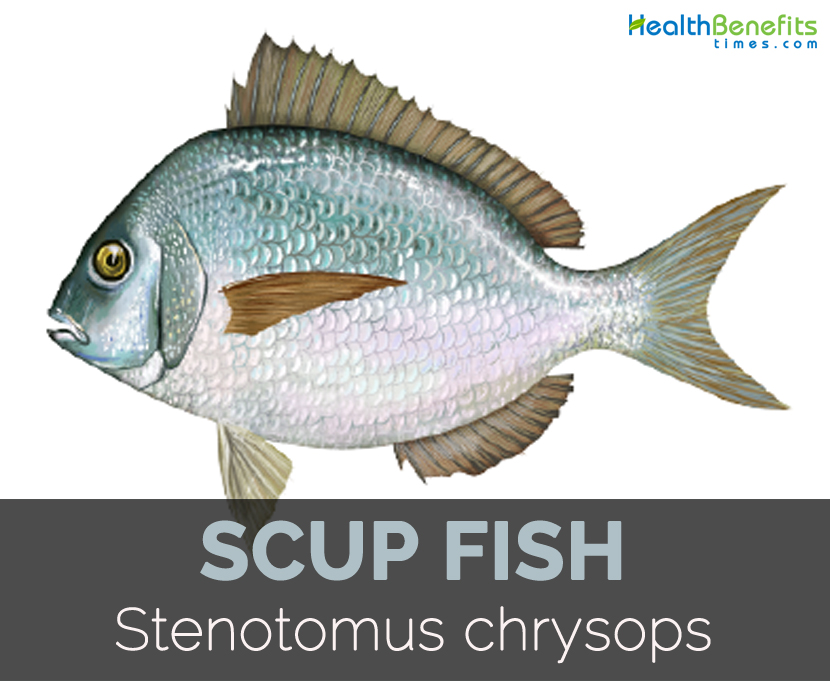
Scup fish (Stenotomus chrysops) also called Porgy, Northern porgy, Fair maid, Paugy and Scuppaug, do fish species that comprise the family Sparidae. They are usually found in Atlantic (from Massachusetts to South Carolina). Scup fishery is oldest in United States recording back to 1800. In 1929 the trawls was being started to use. Scup is caught with the use of otter trawl. It normally weighs about 4 lb (2 kg) measuring 18 inches (450 mm) long with compressed body which is ovate to elliptical. Its color ranges from dull silvery to iridescent with white belly. The head is concave dorsally and mark with dark patches. The mouth is covered with small, narrow elliptical to conical teeth. It has moderate dorsal fin having short fist spine and rounded rear corner. The fin usually fit in the groove with midline back. The anal fins are long as soft part of dorsal but are shorter in comparison to others. It has long pectoral fins that reach under soft part of dorsal fin that is pointed sharply. The scales are attached firmly. Below pectorals, the pelvic fins are moderate sized. The diet consists of barnacles, worms, mollusks and invertebrates. Elasmobranchs and bony fishes are its predators.
Nutritional value
Cooked scup fish of 85 grams offers 58.16 grams of moisture, 115 calories, 20.58 grams of protein, 2.98 grams of total lipid fat and 1.32 grams of ash. The same amount serves 72.36% of selenium, 57.50% of cobalamine, 56.70% of isoleucine, 56.52% of lysine, 52.27% of tryptophan, 51.25% of threonine, 50.19% of valine, 49.19% of histidine, 45.24% of leucine, 41.16% of protein, 28.71% of phosphorus, 26.53% of niacin, 22.62% of pyridoxine and 14.70% of Vitamin B5.
Health Benefits of Scup fish
Scup fish is loaded with ample amounts of nutrients which is essential for the maintenance of healthy body. The moderate intake of fish provides numerous health benefits to all whereas its excessive consumption provides various health problems.
- Lowers fatigue
The intake of fish helps to provide relief from weakness and fatigue. It promotes the stamina of the body to perform heavy work pressure.
- Treat Alzheimer’s
Cobalamine helps to treat Alzheimer’s disease effectively which results in symptoms such as cognitive degeneration and confusion. The medical experts say that the patients of Alzheimer’s disease have low presence of Vitamin B12 in their body. (1)
- Signalize nerves
Protein is essential for the function of nervous system. It triggers the nervous system to respond the appropriate reaction. Protein complex is contained in prompt response. Protein helps in nerve signal transmission in cells and regulate nervous system. (2)
- Skin health
Protein is essential for mechanical support and strengthening tissues from skin’s wear and tear. The collagen is vital which helps to strengthen tissues, organs and cells. The study shows the positive results of collagen. It makes the skin wrinkle free and youthful appearance. (3) (4)
- Supports digestion
Phosphorus is vital for stimulating digestion of niacin and riboflavin effectively. This vitamin is essential for metabolism of energy, emotional and neurological response systems. It also assists constipation, indigestion, tones digestive system and diarrhea. It also helps to eliminate toxins from the body. (5)
- Balance hormones
Phosphorus is essential to balance hormones. It stimulates hormones for the reproductive health. It interacts endocrine glands and regulates the release of hormones. (6)
- Lowers cholesterol
The high intake of niacin helps to lower the level of bad cholesterol and increase good cholesterol. It also prevent thickening of artery walls and health conditions such as atherosclerosis. (7)
- Kidney ailments
Pyridoxine helps to control the fat level in heart and prevents the cardiac problems. Vitamin B6 prevents the formation of kidney stones and maintains its shape. (8)
- Reduce stress
Pantothenic acid helps to lowers stress and mental ailments such as depression and anxiety. It ensures mind fitness and regulates hormones which are responsible for these conditions. (9)
Precautions
- The people allergic to seafood should avoid it.
- It should be consumed in moderate amounts.
- Pregnant or breast feeding women should consult a doctor for its consumption.
How to Eat
- It is eaten boiled, pan fried or baked.
- It could be added to soups and stews.
Scup fish facts
Scup fish has short head, small mouth and harmless teeth. It has large scales which are attached firmly with iridescent purple tones. It is dull brownish to silver having distinct longitudinal bands on side. The above part is darker in comparison to below. It resembles freshwater sunfish showing a long spiny section with small soft dorsal fin. It has 12 to 15 faint vertical stripes. It measures upto 12 to 14 inches long and weighs 3 to 4 pounds.
| Name |
Scup fish facts and nutritional value |
| Scientific Name |
Stenotomus chrysops |
| Native |
It is found in Atlantic (from Massachusetts to South Carolina). Scup fishery is oldest in United States recording back to 1800. In 1929 the trawls was being started to use. Scup is caught with the use of otter trawl. |
| Common/English Name |
Porgy, Northern porgy, Fair maid, Paugy, Scuppaug |
| Name in Other Languages |
Danish: Nordlig skælfisk;
French: Spare doré, Spare dorée;
Polish: Skap;
Portuguese: Sargo-da-América-do-Norte;
Russian: Skayp (Скап);
Spanish: Sargo de América del Norte |
| Lifespan |
20 years |
| Head |
Concave dorsally, mark with dark patches |
| Shape & size |
Compressed body, ovate to elliptical, Length: 18 inches (450 mm) |
| Teeth |
Small, narrow elliptical, conical |
| Weight |
4 lb (2 kg) |
| Color |
Dull silvery, iridescent |
| Belly |
White |
| Scales |
Iridescent |
| Taste |
Mild |
| Feed on |
Barnacles, worms, mollusks, invertebrates |
| Predator |
Elasmobranchs, bony fishes |
| Major Nutritions |
Selenium, Se 39.8 µg (72.36%)
Vitamin B-12 (Cobalamine) 1.38 µg (57.50%)
Isoleucine 0.948 g (56.70%)
Lysine 1.89 g (56.52%)
Tryptophan 0.23 g (52.27%)
Threonine 0.902 g (51.25%)
Valine 1.06 g (50.19%)
Histidine 0.606 g (49.19%)
Leucine 1.672 g (45.24%)
Protein 20.58 g (41.16%) |
| Health Benefits |
- Lowers fatigue
- Treat Alzheimer’s
- Signalize nerves
- Skin health
- Supports digestion
- Balance hormones
- Lowers cholesterol
- Kidney ailments
- Reduce stress
|
| Calories in 3 oz (85 gm) |
115 Kcal. |
| Precautions |
- The people allergic to seafood should avoid its consumption.
- One should consume it in moderate amounts.
- The pregnant or breastfeeding women should consult a doctor for its usage.
|
| How to Eat |
- It is boiled, pan fried or baked.
- It is also added to soups and stews.
|
Comments
comments