Health Benefits
    Facebook Twitter Instagram
    Sunday, December 14
    Facebook Twitter Pinterest
    Health Benefits
    • Home
    • Dental Health
    • Mental Health
    • Weight Loss
    • Health Wiki
    • Nutrition
    • Healthy Recipe
    • BMI Calculator
    Health Benefits
    Home»Herbs and Spices»Medicinal benefits of Sweetgum
    Herbs and Spices

    Medicinal benefits of Sweetgum

    By s mFebruary 19, 2020Updated:February 20, 2020No Comments4 Mins Read
    Facebook Twitter Pinterest LinkedIn Tumblr Email

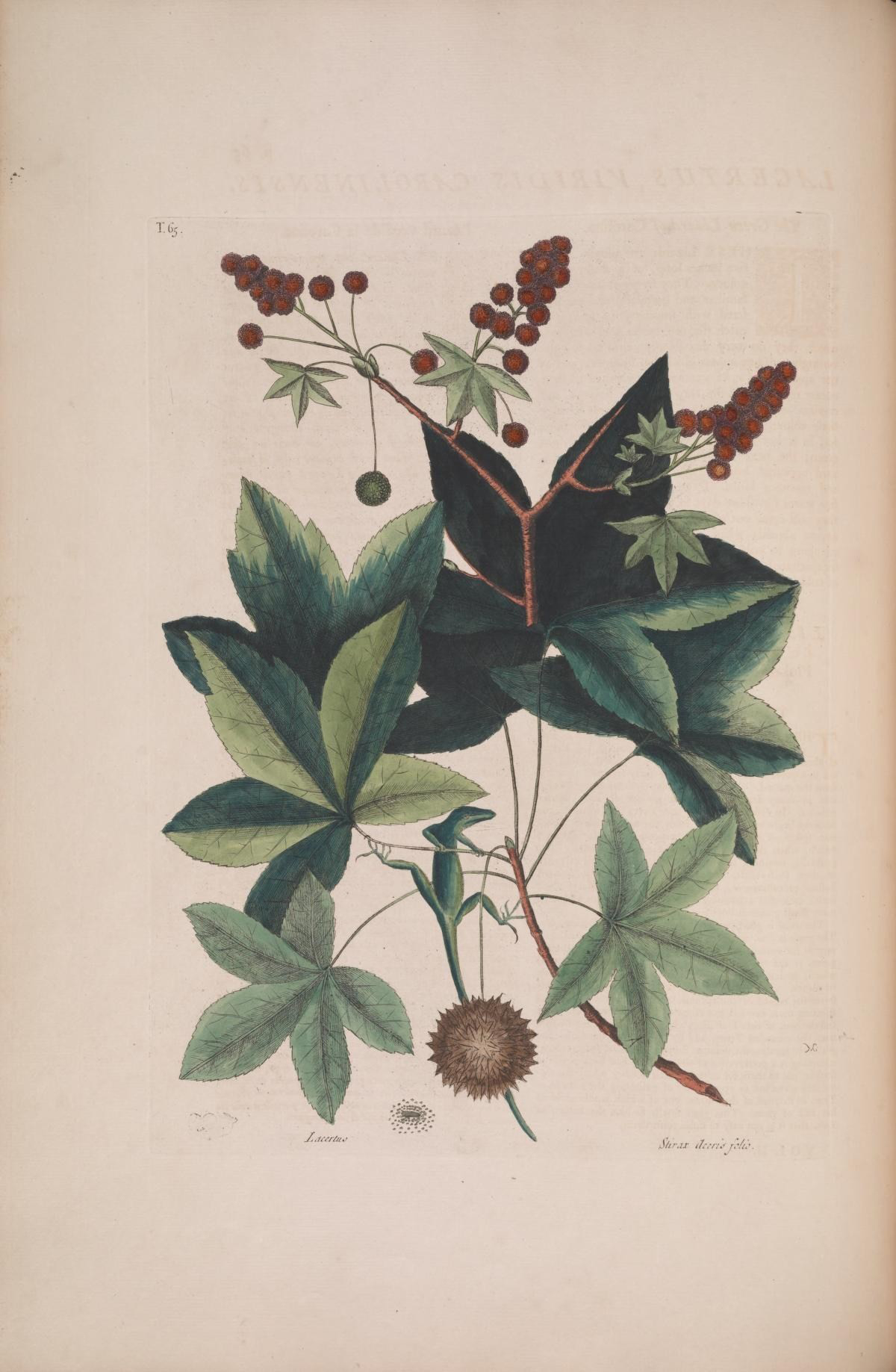
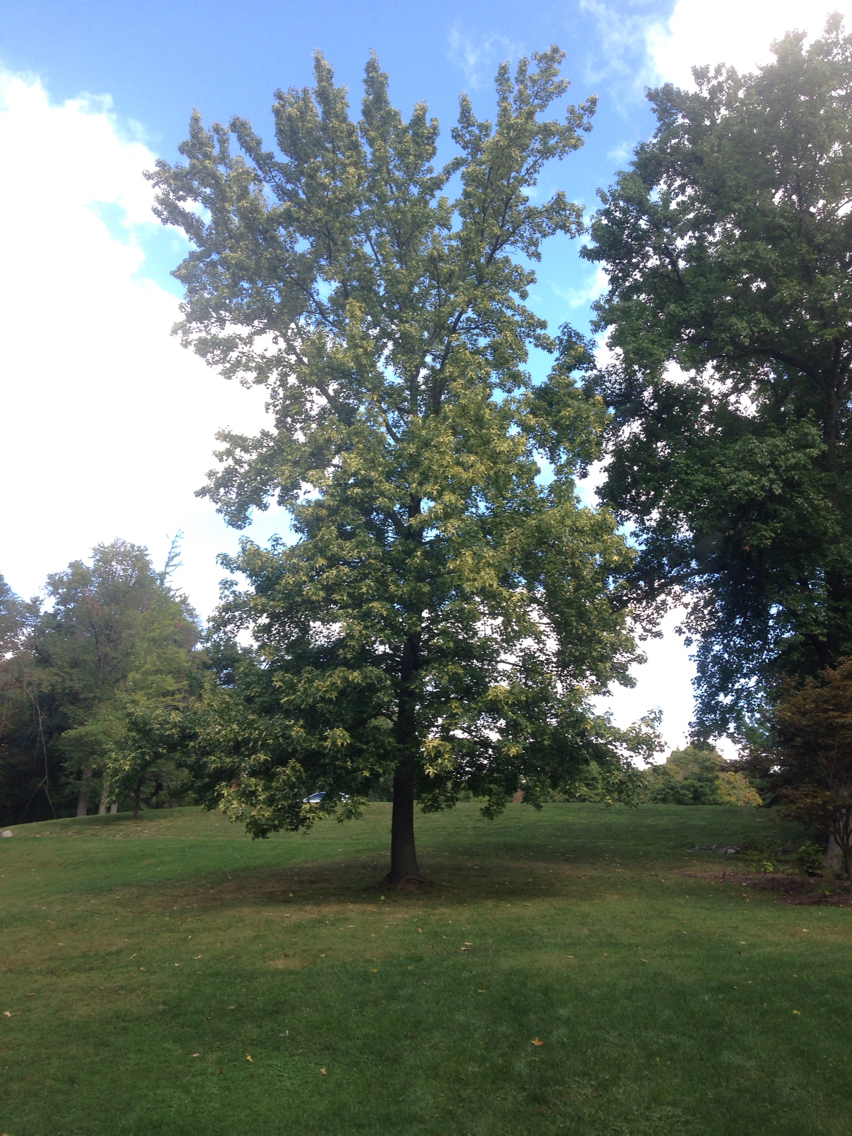
    Sweet gum, a tree of the Witch hazel family (Hamamelidaceae), native of the eastern United States, also Mexico and Central America. Along the rivers of the south-eastern United States, Sweet gums exceed 125 ft. in height and 4 ft. in diameter. The deeply cut grey or brownish-grey bark forms winged projections on the twigs. The alternate, palmate, shiny leaves have usually five pointed, finely toothed lobes, and are fragrant when bruised. In the autumn the star-shaped leaves turn brilliant red to purple, making a valuable ornamental tree. The staminate flowers are inconspicuous, the pistillate in spherical heads maturing into long-stalked, globose masses of spiky-tipped capsules. The wood is fine-grained, moderately hard and fairly strong; the heart wood is known as red gum and hazelwood, is variously coloured red and brown, the sapwood is paler. From incisions made in the tree a gum exudes which is resinous (storax) and adhesive, and somewhat like white turpentine in appearance, which finally hardens.

    Sweetgum Image Gallery
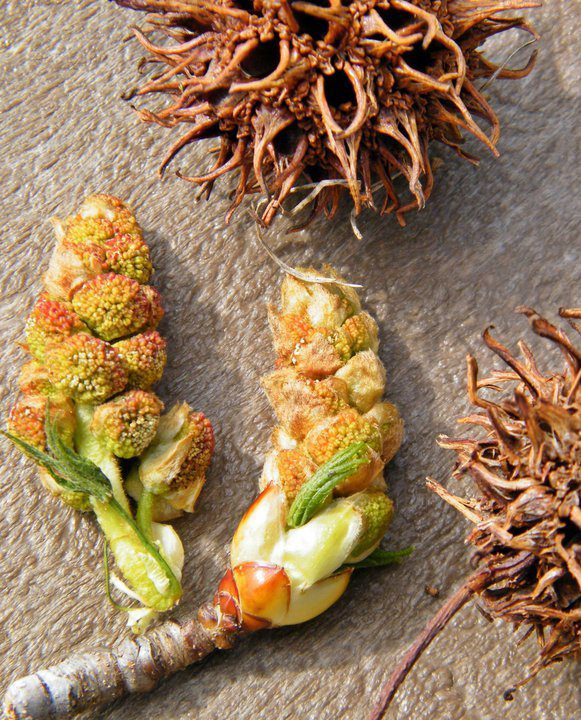
    Close-view-of-Sweetgum-flower Close-view-of-Sweetgum-flower
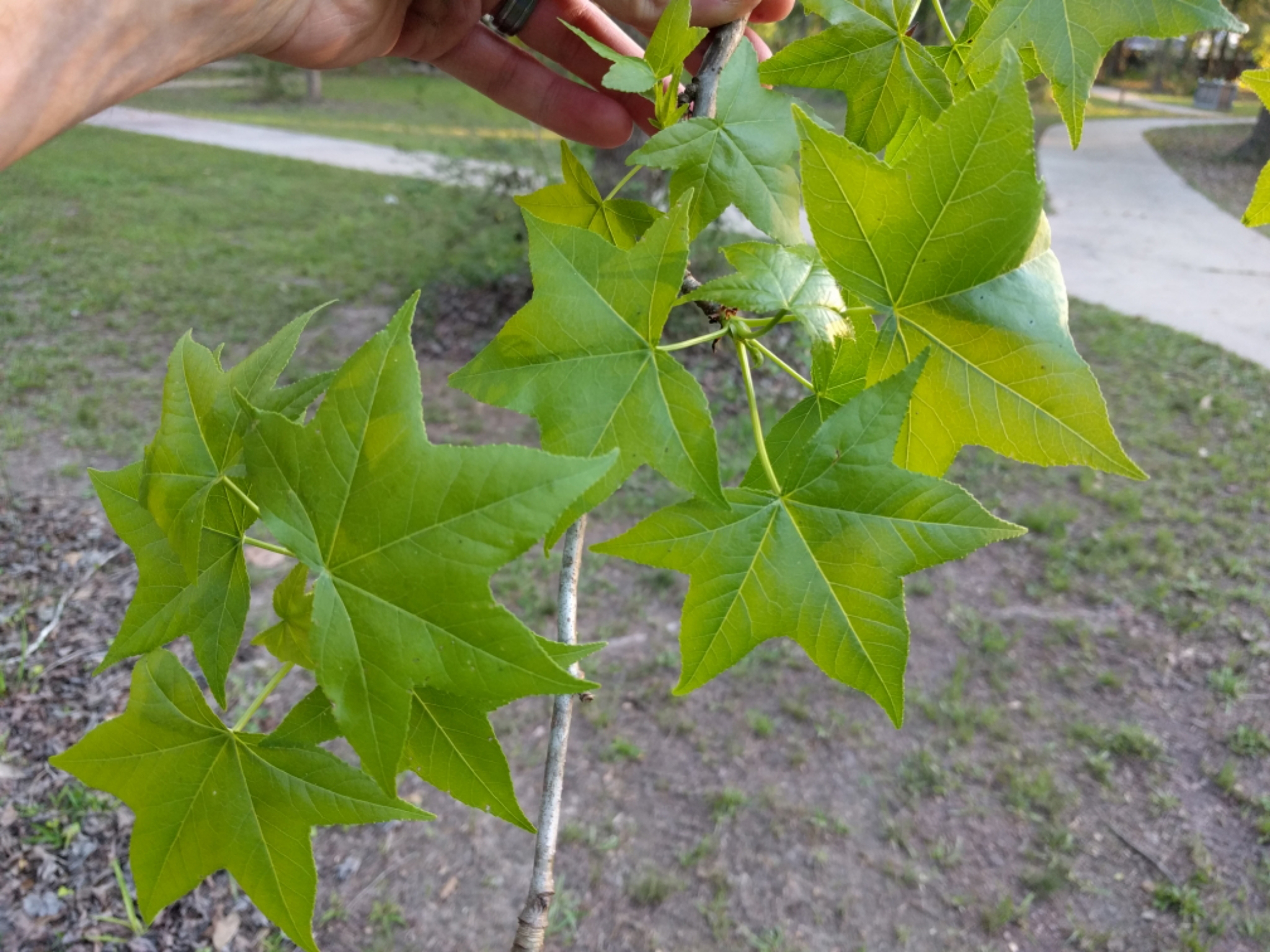
    Close-view-of-Sweetgum-leaf Close-view-of-Sweetgum-leaf
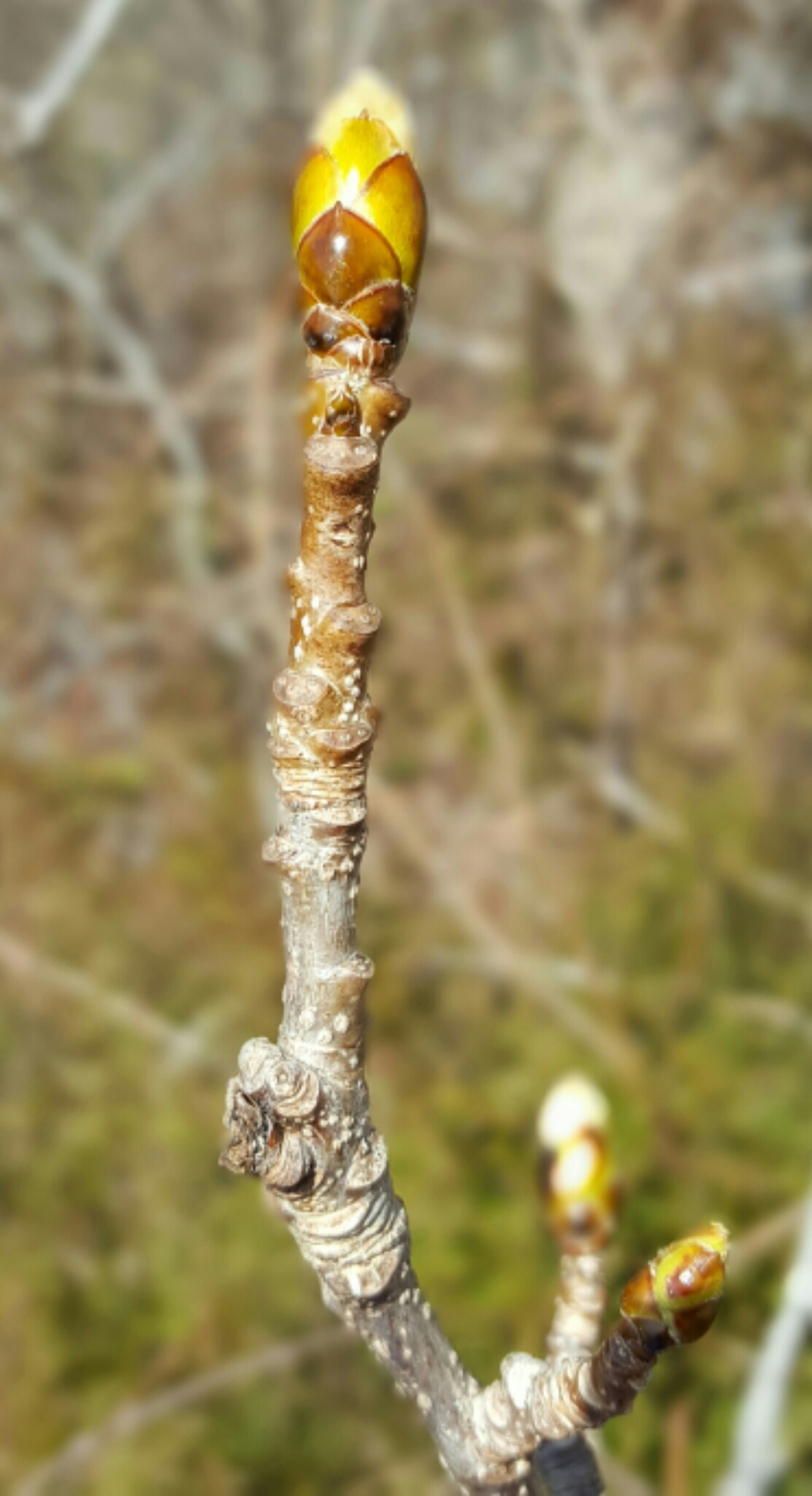
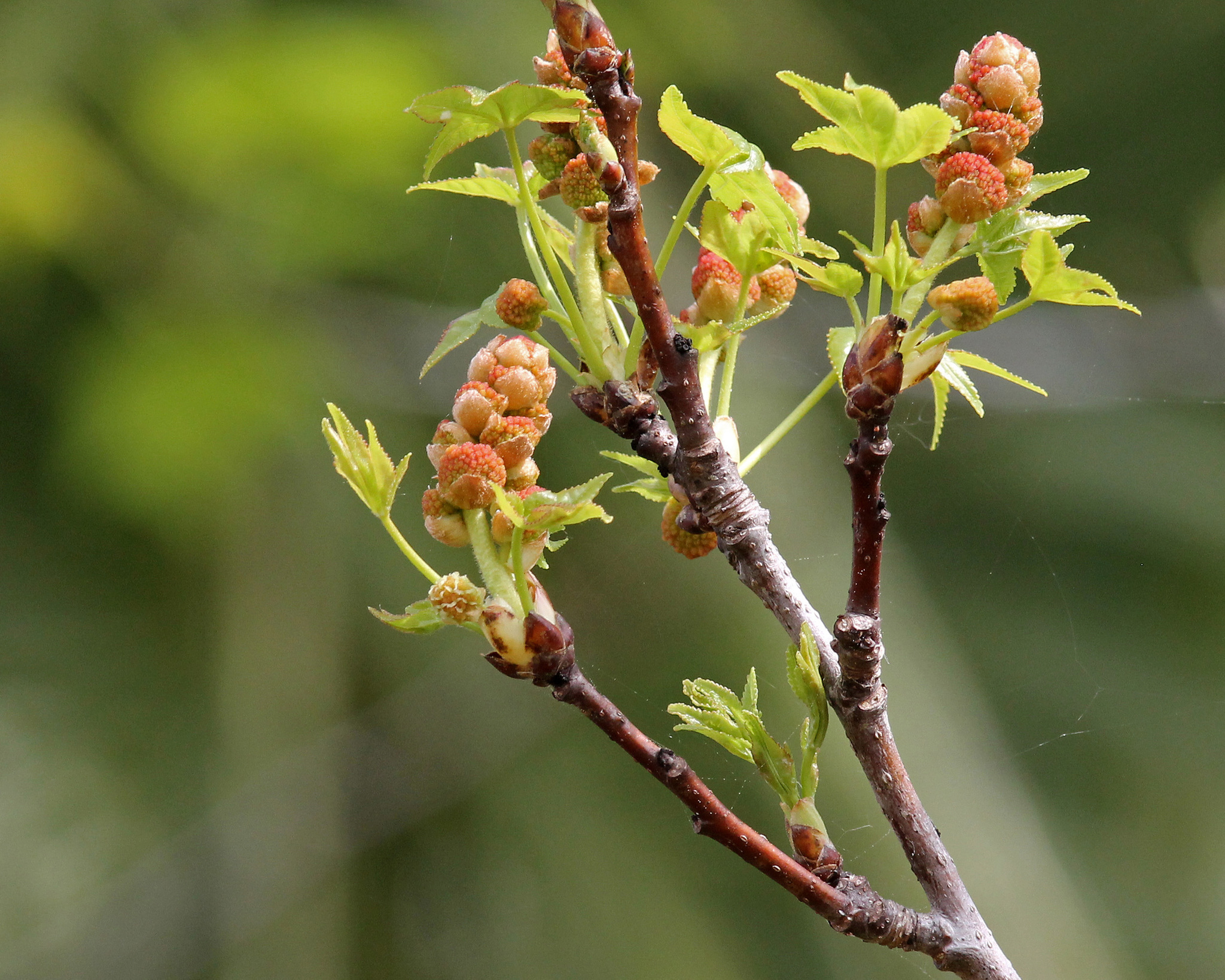
    Flower-buds-of-Sweetgum Flower-buds-of-Sweetgum
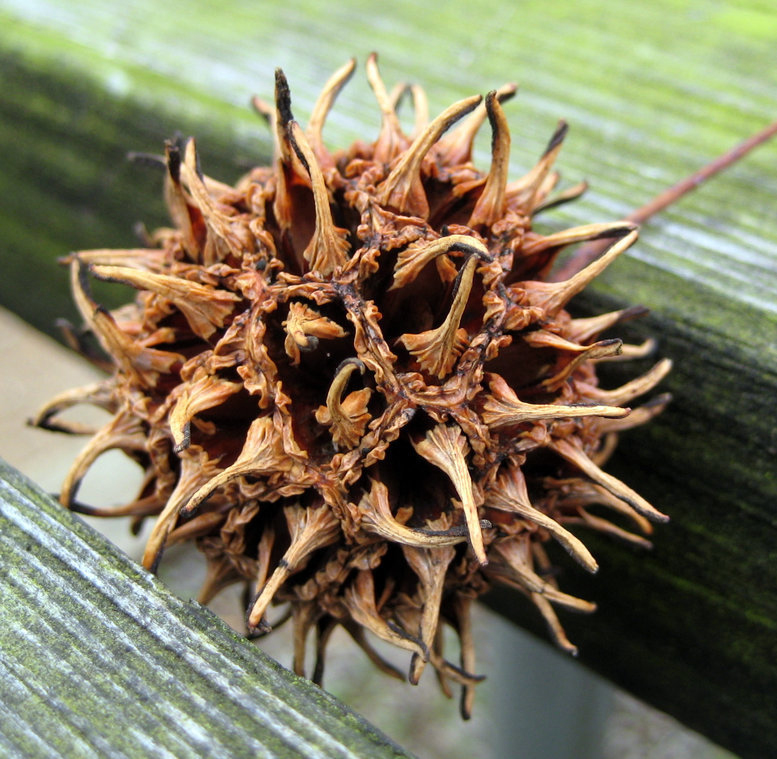
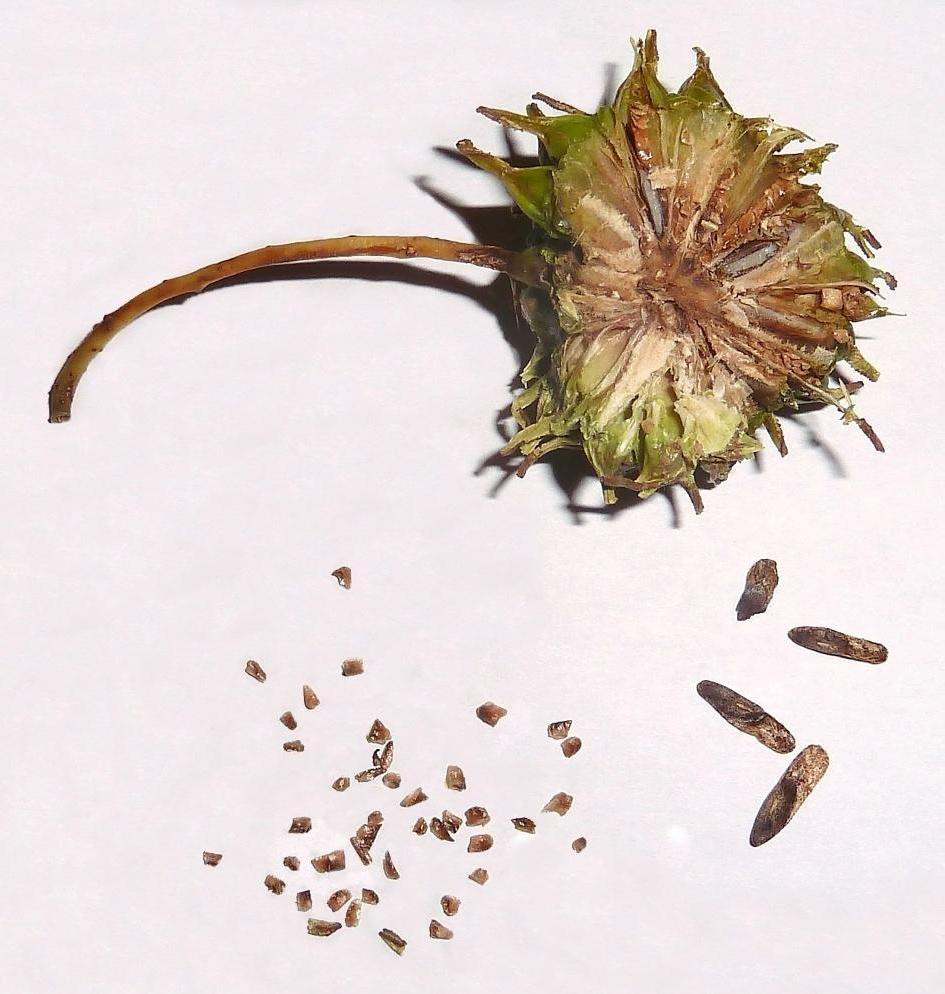
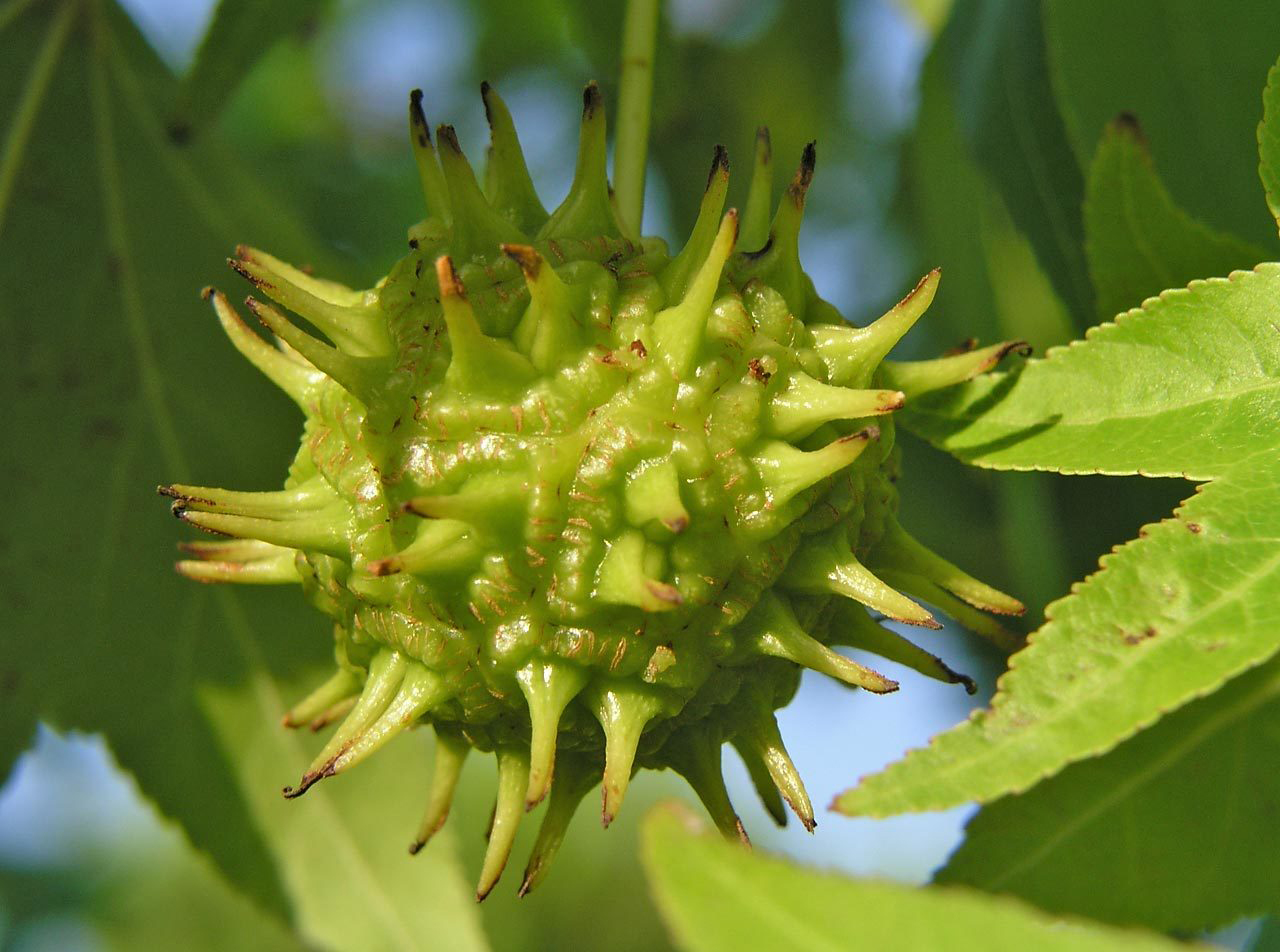
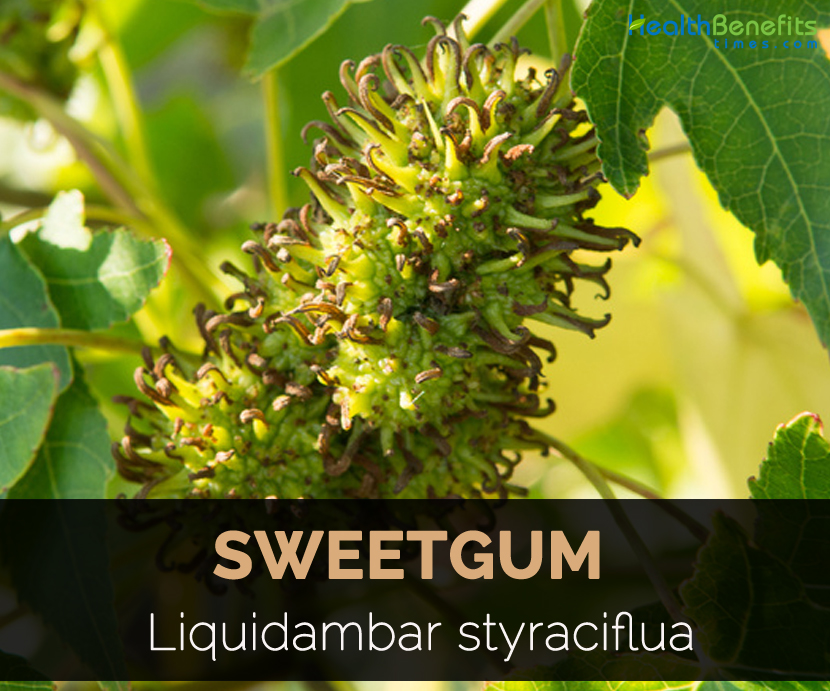
    Fruits-of-Sweetgum Fruits-of-Sweetgum
    Plant-illustration-of-Sweetgum Plant-illustration-of-Sweetgum
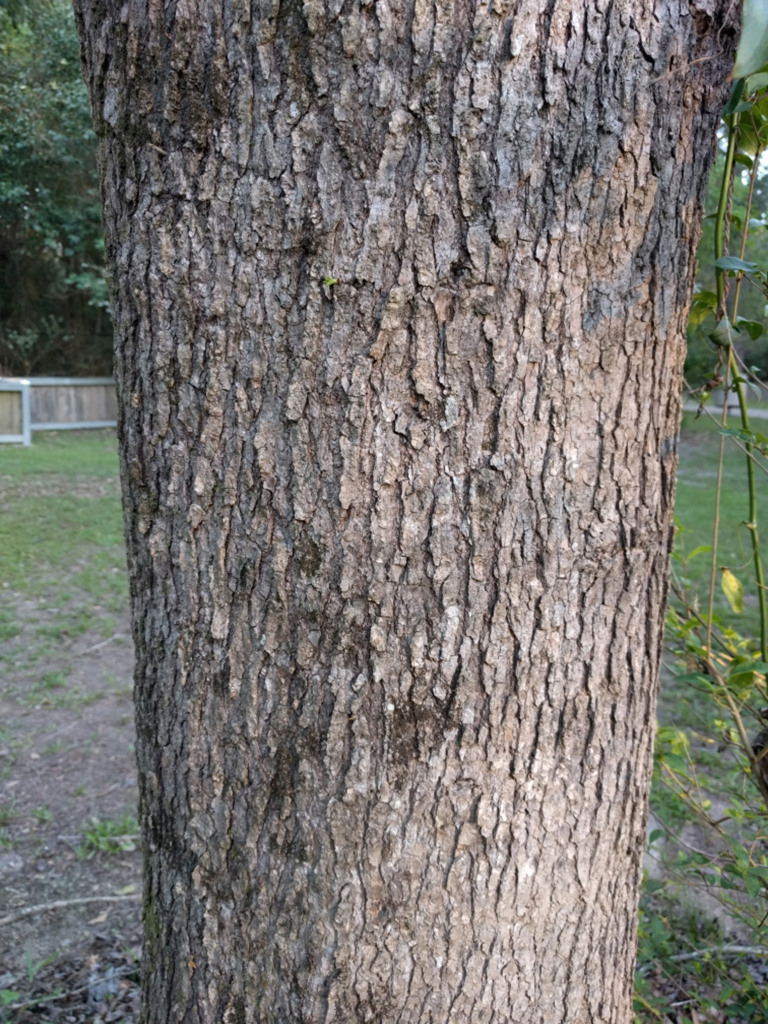
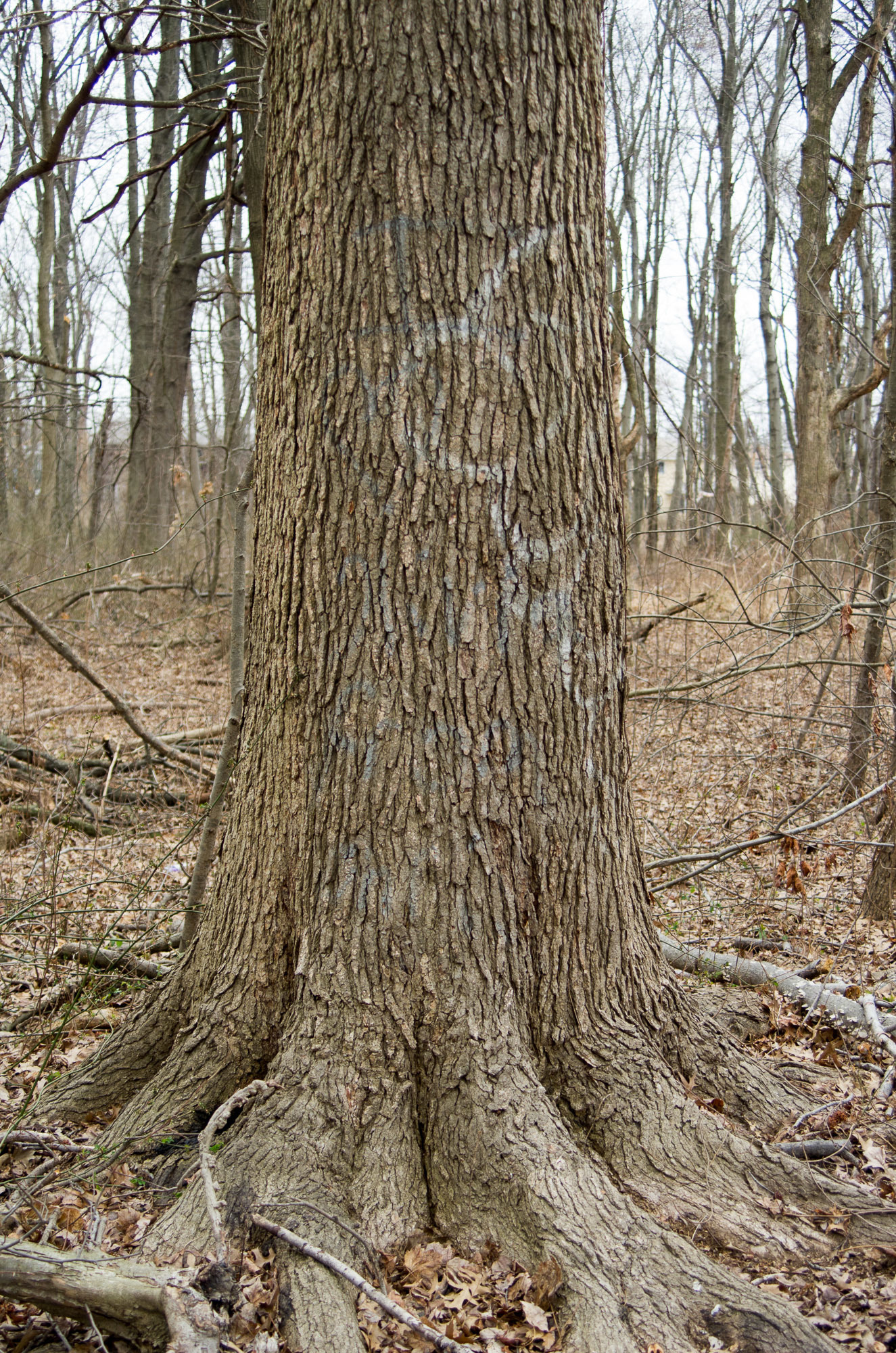
    Sweetgum-bark Sweetgum-bark
    Sweetgum-flowers Sweetgum-flowers
    Sweetgum-leaves Sweetgum-leaves
    Sweetgum-seeds Sweetgum-seeds
    Sweetgum-tree Sweetgum-tree
    Sweetgum-trunk Sweetgum-trunk
    Unripe-Sweetgum-fruit Unripe-Sweetgum-fruit
    Bark and branches

    The tree is peculiar appearance of its small branches and twigs. Bark attaches itself to these in plates edgewise instead of laterally and piece of leafless branch with aid of little imagination readily takes on reptilian form. Bark is a light brown tinged with red and gray with dark steaks weighs 37 lbs. per cubic foot.

    Leaves

    Leaves have five sharply pointed palmate lobes, 3-5 inches wide on average and have three distinct bundle scars. Leaves have 6-10 cm petiole. They are rich dark green, shiny, smooth and star shaped which turns brilliant orange, red and purple colors in autumn. Leaves are 3 to 7 inches broad with glandular serrate teeth. Base is truncate and slightly heart shaped.

    Facts About Sweetgum

    Sweetgum Quick Facts
    Name: Sweetgum
    Scientific Name: Liquidambar styraciflua
    Origin North America
    Colors Brown
    Shapes Round, globose, 1–1.5 inches (25–38 mm) in diameter
    Name Sweetgum
    Scientific Name Liquidambar styraciflua
    Native North America
    Common/English Name Star-Leaved Gum, Red Gum
    Name in Other Languages English: American-storax, Alligator-wood, Red-gum, Satin-walnut,
    Sweet-gum, Sweetgum;
    French: Copalme d’Amérique, Liquidambar;
    Swedish: Ambraträd;
    German: Amerikanischer Amberbaum
    Soil Deep, rich, moist, slightly acidic
    Plant Size 75 feet and spread to 50 feet
    Bark Dark and deeply furrowed
    Leaf Glossy, star-shaped,  turns bright red, purple, yellow or orange, 3-7 inches broad, 18 cm wide with long
    Flowering Season March to May
    Flower 1-1.5 inches (25-38 mm) in diameter
    Fruit shape & size Round, globose, 1–1.5 inches (25–38 mm) in diameter
    Fruit color Brown
    Medicinal parts The bark and concrete juice

    Flower

    Flowers bloom in March to May and are about 1 to 1.5 inches in diameter and are covered with rusty hairs. Flowers are unisexual and greenish in color. Staminate flowers form in terminal racemes about 2 to 3 inches long.

    Fruit

    Flowers are followed by dry, hard, globose fruit about 1-1.5 inches in diameter which comprises of numerous 40 to 60 capsules. Each capsule has one to two small seeds and a pair of terminal spikes. Woody capsules are filled with abortive seeds that resemble sawdust. Seeds are winged and one quarter of an inch thick and dispersed by wind. Winter buds are yellow brown and one fourth of an inch long. Inner scales enlarge with growing shoot and becomes half an inch long and green tipped with red.

    Uses

    As a remedy for catarrhs of genito-urinary passages, coughs of pulmonary affection generally, gonorrhoea, gleet, amenorrhoea, leucorrhoea, phthisis (wasting disease, tuberculosis of the lung, consumption) and asthma. Also excellent for bloody flux, dysentery and all bowel complaints of children.

    Dose

    1 teaspoonful of the cut or granulated bark to 1 cupful of boiling water; drink 1 or 2 cupfuls a mouthful at a time during the day; adjust to condition and age.

    Externally

    The balsamic juice may be melted with equal parts of olive oil or tallow as a detergent ointment when conditions of indolent ulcers, frost-bite, scabies, itch, ringworm, fistula, scrofula, fever sores and haemorrhoids are present.

    Culinary uses

    • Resin is used in chewing gum or as a stabilizer for cakes.
    • It is also chewed to sweeten breath.

    Medicinal uses

    • Resin extracted from trunk acts as antiseptic, diuretic, carminative, expectorant, poultice, parasiticide, stimulant, sedative, salve and vulnerary.
    • Chew the resin for treating sore throats, asthma, coughs, dysentery and cystitis.
    • Apply it externally for sores, piles, wounds, ringworm, piles and scabies.
    • Inner bark is used for treating diarrhea and childhood cholera.
    • Add the leaves to bathes for soothing or healing skin.

    References:

    https://www.itis.gov/servlet/SingleRpt/SingleRpt?search_topic=TSN&search_value=19027#null

    http://hort.ufl.edu/database/documents/pdf/tree_fact_sheets/liqstya.pdf

    https://en.wikipedia.org/wiki/Liquidambar_styraciflua

    http://tropical.theferns.info/viewtropical.php?id=Liquidambar+styraciflua

    https://plants.usda.gov/plantguide/pdf/cs_list2.pdf

    73%
    73%
    Awesome

    Comments

    comments

    Herbs and Spices S
    Share. Facebook Twitter Pinterest LinkedIn Tumblr Email
    Previous Article7 Foods with Serious Health Benefits for Seniors
    Next Article 10 Questions You Should Ask Before Getting Plastic Surgery

    Related Posts

    Uses of Monkey Pitcher plant

    April 16, 2024

    Traditional uses and benefits of Wild Marigold

    March 21, 2024

    Traditional uses and benefits of Drooping fig

    March 12, 2024

    Comments are closed.


    Sweetgum Scientific Classification

    Scientific Name: Liquidambar styraciflua

    Rank Scientific Name & (Common Name)
    Kingdom Plantae (Plants)
    Subkingdom Viridiplantae  (Green plants)
    Infrakingdom Streptophyta  (Land plants)
    Superdivision Embryophyta
    Division Tracheophyta (Vascular plants, tracheophytes)
    Class Magnoliopsida
    Order Saxifragales
    Family Altingiaceae
    Genus Liquidambar L. (Sweetgum)
    Species Liquidambar styraciflua L. (Sweetgum)
    Synonyms
    • Liquidambar barbata Stokes
    • Liquidambar gummifera Salisb.
    • Liquidambar macrophylla Oerst.
    • Liquidambar styraciflua f. rotundiloba Rehder
    • Liquidambar styraciflua var. mexicana Oerst.
    Categories
    • Beverages (78)
    • Dairy (28)
    • Dental Health (15)
    • Equipment (5)
    • Essential OIls (196)
    • Facts (2,938)
    • Foods (255)
    • Fruits (516)
    • Giveaway (1)
    • Grains and Cereals (36)
    • Health & Beauty (763)
    • Herbs and Spices (1,249)
    • Medicines (9)
    • Mental Health (19)
    • Nutritional value (27)
    • Nuts and seeds (73)
    • Oils (81)
    • Pets (4)
    • Poultry & Seafoods (67)
    • Pulses and Beans (16)
    • Reviews (25)
    • supplement (2)
    • Vegetables (304)
    • Weight Loss (22)

    What is Lupin Bean Flour?

    Science Backed Health Benefits of Durian (Durio zibethinus)

    Science Backed Health Benefits of Feijoa (Pineapple Guava) (Acca sellowiana)

    Science Backed Health Benefits of Gac Fruit (Momordica cochinchinensis)

    Science Backed Health Benefits of Amaranth Leaves (Amaranthus spp)

    Science Backed Health Benefits of Arrowhead (Sagittaria sagittifolia)

    ABOUT
    Home
    About us
    Contact us
    Privacy Policy
    Terms & conditions
    Disclaimer
    Direct Communication
    e-mail: [email protected]
    Gmail: [email protected]
    Whatsapp: +977-9841146511
    Viber: +977-9841146511
    Useful
    Health Wiki
    Nutrition
    Facebook Twitter Pinterest
    © 2025 www.healthbenefitstimes.com All rights reserved.

    Type above and press Enter to search. Press Esc to cancel.

    ×

    Log In

    Forgot Password?

    Not registered yet? Create an Account