Health Benefits
    Facebook Twitter Instagram
    Sunday, December 14
    Facebook Twitter Pinterest
    Health Benefits
    • Home
    • Dental Health
    • Mental Health
    • Weight Loss
    • Health Wiki
    • Nutrition
    • Healthy Recipe
    • BMI Calculator
    Health Benefits
    Home»Herbs and Spices»Facts about Trumpet Vine
    Herbs and Spices

    Facts about Trumpet Vine

    By SylviaAugust 30, 2019Updated:August 30, 2019No Comments5 Mins Read
    Facebook Twitter Pinterest LinkedIn Tumblr Email

    Campsis radicans commonly known as trumpet vine or trumpet creeper, also known in North America as cow itch vine or hummingbird vine, is a species of flowering plant of the family Bignoniaceae. The Plant is native to eastern, north-central, and south-central portions of the United States and has become naturalized in New England. Its natural range occurs from New Jersey to Ontario and Iowa, and south to Florida and Texas. It inhabits woodlands and riverbanks, and is also a popular garden subject. Cow Itch Vine, Hummingbird Vine, Trumpet Creeper, Trumpet Vine, common trumpet creeper, Cow vine, foxglove vine, hell vine and Devil’s shoestring are some of the popular common name of the Trumpet vine.

    Genus name comes from the Greek word kampe meaning bent in reference to the bent stamens on plant flowers. Specific epithet means having rooting stems. Trumpet vine is also commonly known as cow-itch vine because some people experience skin redness and itching after coming in contact with the leaves. Trumpet Creeper usually climbs up trees, shrubs, telephone poles, and other vertical structures using aerial rootlets, otherwise it sprawls across the ground.

    Plant Description

    Trumpet vine is a dense, vigorous, fast growing, multi-stemmed, deciduous, and woody, clinging vine that grows about 12 m or about 40 feet in height. The plant is found growing in low woods, thickets, open woods, savannas, thickets, riverbanks, disturbed fence rows, roadsides or neglected fields, bottomland forests, swamp forests, old fields, edges of floodplain forests, loess bluffs,  woodland edges, gravelly seeps with woody vegetation, limestone glades, lawn trees, telephone poles, railroads and abandoned fields. It is easily grown in a wide variety of soils. It is best planted in lean-to average soils with regular moisture in full sun to part shade. The plant has vigorous running roots and aerial roots are formed in 2 rows below nodes on the stem. Stem is green turning tan and are covered with hair-like aerial roots.  Old stems become woody and several inches in diameter. Bark of the mature vine is flaky and light tan. Once the vine climbs to a certain height it grows horizontal branches that reach away from the support in a quest for light and space.

    Leaves

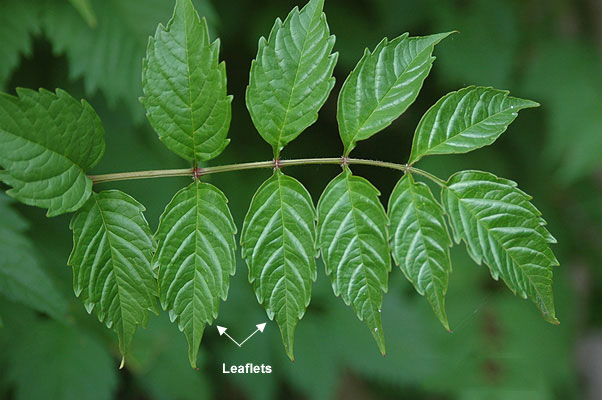
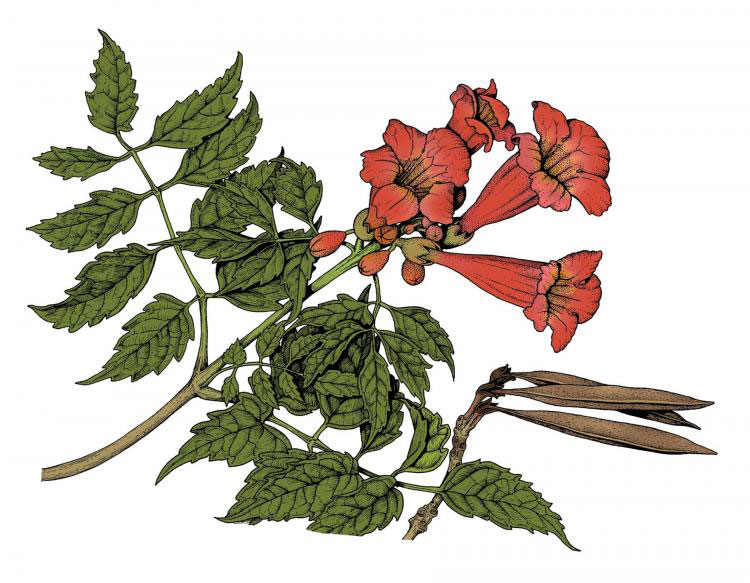
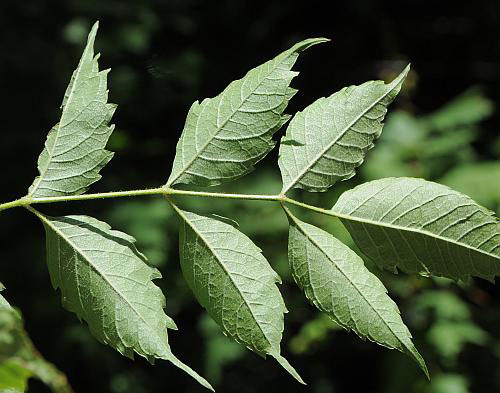
    Leaves are deciduous, opposite and pinnately compound that is 4-12 in long that cover the vine in a dense cloak of bright green foliage.  Each leaf consists of 7-11 ovate or elliptical coarsely toothed leaflets that have serrated edges.  The leaflets are about 1-4 in long and 0.5-1.5 in wide and are glossy, bright green and unpalatable to mammalian herbivores.

    Trumpet vine Quick Facts
    Name: Trumpet vine
    Scientific Name: Campsis radicans
    Origin Eastern, north-central, and south-central portions of the United States and has become naturalized in New England
    Colors Green when young turning to brown as they mature
    Shapes Long flat tapered (10-20 cm) capsules, 10-20 cm long which split open when ripe releasing flat winged seed
    Taste Sweet, Sour
    Leaf arrangement Opposite/sub opposite
    Leaf Type Odd-pinnately compound
    Leaf Margin Dentate
    Leaf Shape Ovate
    Leaf Venation Pinnate
    Leaf type and Persistence Deciduous
    Leaf blade length 2 to 4 inches
    Leaf Color Green
    Fall color Orange
    Fall characteristic Not Showy


    Flower

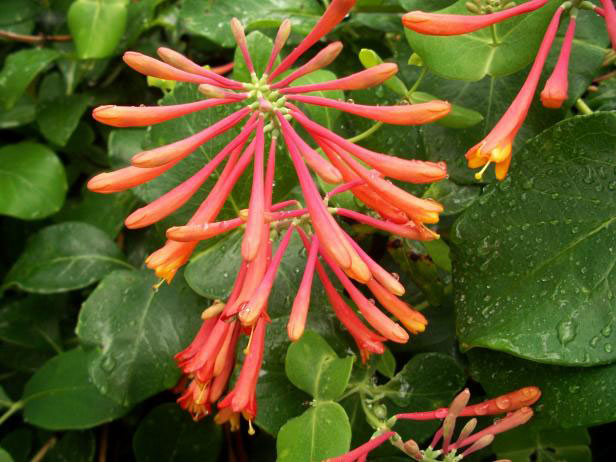
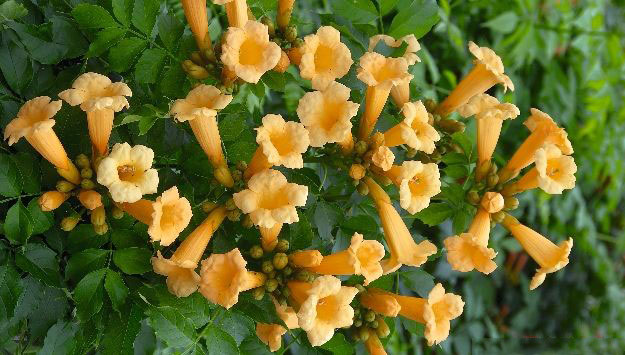
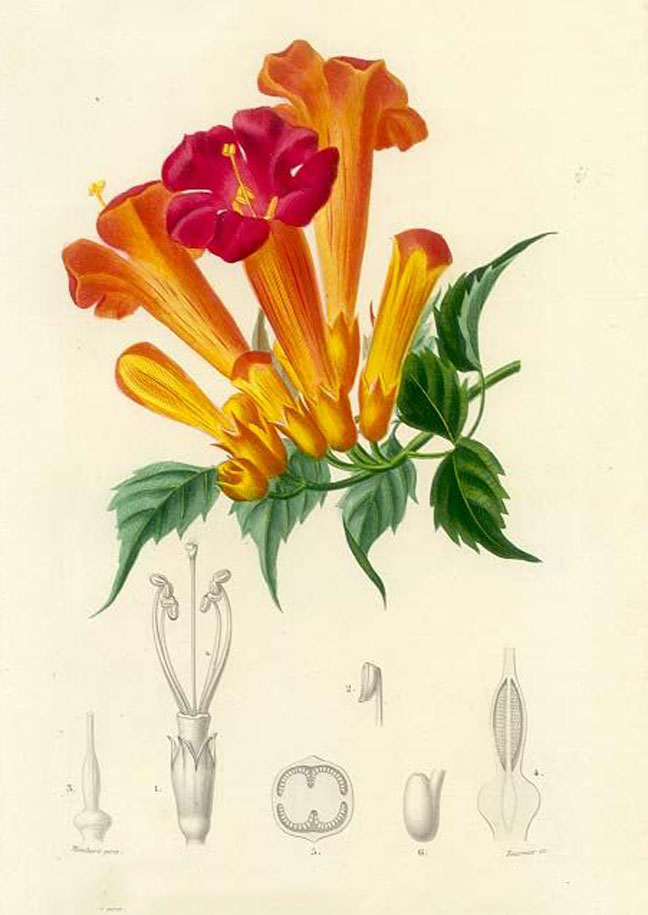
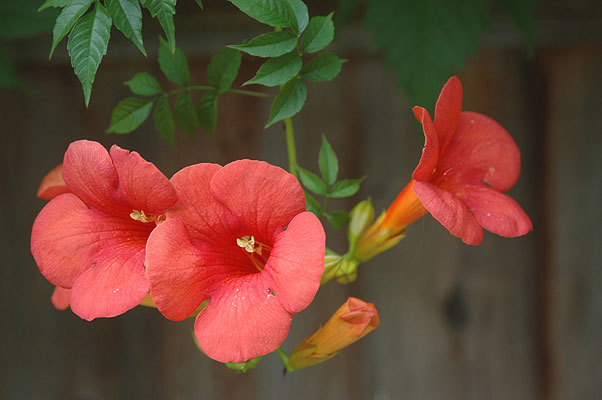
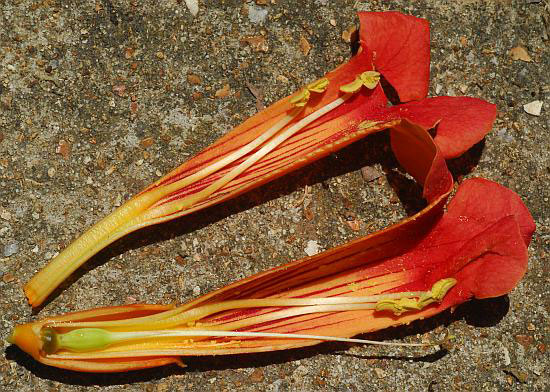
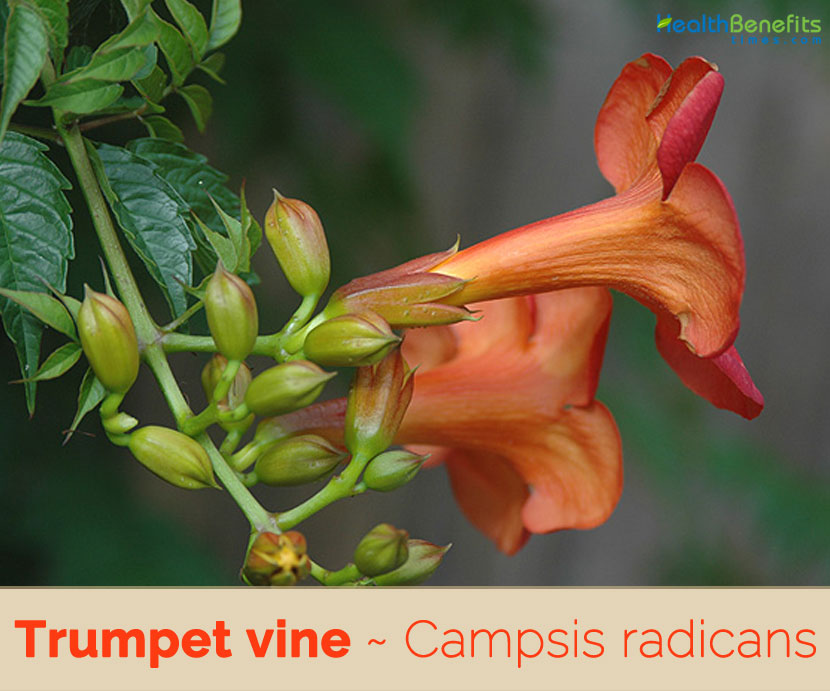
    Periodically, short cymes of 2-8 flowers are produced along the length of the vine. Flowers are up to 3½ inch long and have an elongated funnel form shape that is trumpet-like in appearance. The corolla is orange to reddish orange; along its outer rim there are 5 shallow lobes that curl backward. The tubular calyx is reddish orange, leathery in texture, and 5-toothed. It is much shorter than the corolla. Along the inner surface of the corolla, there are reddish lines that function as nectar guides and 4 inserted stamens. There are extra-floral nectaries at the base of each flower. The blooming period occurs during the summer and lasts about 2 months. The abundance of flowers is variable; there is no floral scent.

    Flower Color Yellow
    Flower Characteristics Summer flowering


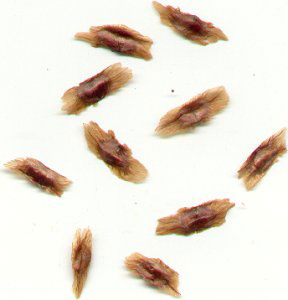
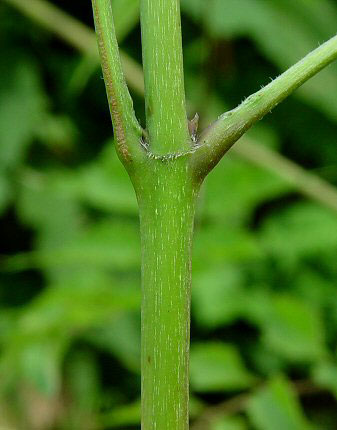
    Flower-buds-of-Trumpet-Vine Immature-Fruit-of-Trumpet-Vine Leaves-of-Trumpet-Vine Other-Variety-of-Trumpet-Vine Plant-Illustration-of-Trumpet-Vine Seeds-of-Trumpet-Vine Sketch-of-Trumpet-Vine Stem-of-Trumpet-Vine Trumpet-Vine-Flower Trumpet-Vine-Flower-cut-longitudinally Trumpet-Vine-growing-on-the-wall Ventral-view-of-leaves-of-Trumpet-Vine
    [Show thumbnails]
    Fruit

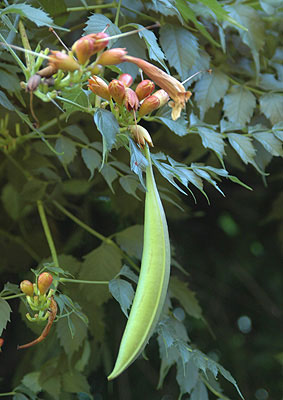
    Each flower is replaced by an linear elongated seed capsule about 6 inches long, 2-valved, slightly flattened, elliptic in cross-section with noticeable ridges along the sutures between the valves, the valves glabrous, with a leathery texture. As they matures this seed capsule dry and eventually splits apart into two sections to release hundreds of thin brown paper like seeds. The seeds are 6-9 mm long, flattened; the body is elliptic in outline, 2-lobed, brown, with a wing at each end, the wings is papery, light tan, with irregular margins. They are dispersed by the wind.

    Fruit Shape Pod or pod-like
    Fruit Length 3 to 6 inches
    Fruit Cover Dry or hard
    Fruit Color Brown
    Fruit Characteristic Persists on the plant


    Other Facts

    • It can be used as a ground cover plant in a sunny position.
    • They can be allowed to scramble on the ground and will form an effective ground cover, rooting at intervals along the branches.
    • They should be planted about 2.5 meters apart each way.
    • radicans is an occasional food source for large mammals and terrestrial birds.
    • Showy flowers of trumpet creeper make this plant appropriate for some gardening and landscaping needs.
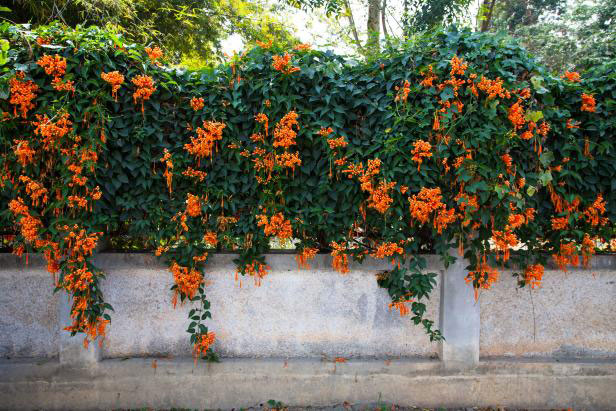
    • It is often used as a cover for fences, arbors, walls, pillars or large trellises and as a ground cover.
    • Cigar-like fruit may be considered decorative during winter.
    • Vines also provide habitat to ants.

    Precautions

    • There have been isolated cases reported of people suffering from dermatitis after handling the leaves.
    • Avoid its use during Pregnancy.
    • Avoid use in case of blood deficiency.
    • Eating leaves or flowers may result in minor skin irritation with redness and swelling.

    References:

    https://www.itis.gov/servlet/SingleRpt/SingleRpt?search_topic=TSN&search_value=34309#null

    https://davesgarden.com/guides/pf/go/644/

    https://npgsweb.ars-grin.gov/gringlobal/taxonomydetail.aspx?id=8799

    https://pfaf.org/user/Plant.aspx?LatinName=Campsis+radicans

    http://www.missouribotanicalgarden.org/PlantFinder/PlantFinderDetails.aspx?kempercode=b840

    https://plants.usda.gov/core/profile?symbol=CARA2

    https://courses.washington.edu/esrm412/protocols/CARA2.pdf

    https://edis.ifas.ufl.edu/fp099

    http://coastalplainplants.org/wiki/index.php/Campsis_radicans

    http://www.theplantlist.org/tpl1.1/record/kew-320348

    https://en.wikipedia.org/wiki/Campsis_radicans

    https://indiabiodiversity.org/species/show/265956

    https://gd.eppo.int/taxon/CMIRA

    http://www.naturalmedicinalherbs.net/herbs/c/campsis-radicans=trumpet-vine.php

    https://www.wildflower.org/plants/result.php?id_plant=cara2

    http://www.flowersofindia.net/catalog/slides/Trumpet%20Creeper.html

    https://plants.usda.gov/plantguide/pdf/pg_cara2.pdf

    76%
    76%
    Awesome

    Comments

    comments

    Herbs and Spices T
    Share. Facebook Twitter Pinterest LinkedIn Tumblr Email
    Previous ArticleFacts and benefits of Pistacia integerrima
    Next Article Step By Step: How To Become A Self-Employed Massage Therapist

    Related Posts

    Uses of Monkey Pitcher plant

    April 16, 2024

    Traditional uses and benefits of Wild Marigold

    March 21, 2024

    Traditional uses and benefits of Drooping fig

    March 12, 2024

    Comments are closed.


    Trumpet Vine facts

    Name Trumpet vine
    Scientific Name Campsis radicans
    Native Eastern, north-central, and south-central portions of the United States and has become naturalized in New England. Its natural range occurs from New Jersey to Ontario and Iowa, and south to Florida and Texas
    Common Names Cow Itch Vine, Hummingbird Vine, Trumpet Creeper, Trumpet Vine, common trumpet creeper, Cow vine, foxglove vine, hellvine, Devil’s shoestring
    Name in Other Languages Bulgarian: Kampsis (кампсис)
    Croatian: Tekoma
    Czech:  Křivouš kořenující, trubač kořenující
    Danish: Trompetblomst
    Dutch:  Trompetklimmer, trompetbloem
    English:  Cow itch vine, Hummingbird vine, Trumpet honeysuckle, Trumpet creeper, Trumpet vine, red trumpet vine
    French:  Bignone à fleurs jaunes, Bignone commune, Bignone de Virginie, Bignone radicante, Bois de frêne , Jasmin de Virginie, Jasmin-trompette, bignone, campsidie,
    German:  Amerikanische Trompetenwinde, Rote Klettertrompete, Virginischer Jasmin, Wurzelnde Jasmintrompete, kriechende Trompetenwinde, virginische Klettertrompete
    Greek:  Kampseis (Καμψίς), Vignónia (Βιγνόνια), Vignónia i̱ rizovólos (Βιγνόνια η ριζοβόλος)
    Hungarian: Trombitafolyondár
    Italian:  Bignonia della Florida, Gelsomino della Virginia, bignonia selvatica, gelsomino falso, tecoma di Virginia, tromba del giudizio
    Japanese:  Amerika nouzen gazura (アメリカノウゼンガズラ),    Amerika nouzen kazura (アメリカ凌霄花), amerika-no-uzenkazura-
    Korean:  Mi gu neung so hwa (미국능소 화)
    Polish: Milin amerykański
    Portuguese: Bignónia-vermelha, trombeta         
    Russian: Kampsis ukoreniaiushchijsia (Кампсис укореняющийся)
    Slovak: Trúbkovec koreňujúci
    Spanish:  Trompeta trepadora, bignonia roja, campsis, enredadera de trompeta, jazmín de Virginia, jazmín trompeta, trompetilla
    Swedish:  Trumpetranka
    Thai:  Rung arun (รุ่งอรุณ), trumpetranka
    Turkish:  Acem sarmaşığı, Boru sarmaşığı
    Ukrainian: кампсис повзучий
    Plant Growth Habit Dense, vigorous, fast growing, multi-stemmed, deciduous, woody, clinging vine
    Growing Climates Low woods, thickets, open woods, savannas, thickets, riverbanks, disturbed fence rows, roadsides or neglected fields, bottomland forests, swamp forests, old fields, edges of floodplain forests, loess bluffs,  woodland edges, gravelly seeps with woody vegetation, limestone glades, lawn trees, telephone poles, railroads, abandoned fields
    Soil It is easily grown in a wide variety of soils. It is best planted in lean-to average soils with regular moisture in full sun to part shade
    Plant Size Up to 12 m or about 40 feet in height
    Root Vigorous running roots and aerial roots are formed in 2 rows below nodes on the stem
    Bark Bark of the mature vine is flaky and light tan
    Stem Green turning tan and are covered with hair-like aerial roots.  Old stems become woody and several inches in diameter
    In Leaf June to October
    Leaf Deciduous, opposite and pinnately compound.  Each leaf consists of 7-11 ovate or elliptical coarsely toothed leaflets.  The leaflets are about 3” long and are glossy, bright green and unpalatable to mammalian herbivores
    Flowering season August to September
    Flower Flowers red to yellow-orange, tubular shape, lengths of up to 8 cm and width 4 cm at the mouth, and arranged in sets of 4-12.
    Fruit Shape & Size Long flat tapered (10-20 cm) capsules, 10-20 cm  long which split open when ripe releasing flat winged seed.
    Fruit Color Green when young turning to brown as they mature
    Seed 6-9 mm long, flattened; the body is elliptic in outline, 2-lobed, brown, with a wing at each end, the wings is papery, light tan, with irregular margins
    Propagation By seeds, cuttings, of both green and mature wood, root-cuttings, and air-layers
    Taste Sweet, Sour
    Plant Parts Used Flower
    Traditional Uses
    • The root is diaphoretic and vulnerary.

    Trumpet vine Scientific Classification

    Scientific Name: Campsis radicans

    Rank Scientific Name & (Common Name)
    Kingdom Plantae (Plants)
    Subkingdom Tracheobionta (Vascular plants)
    Infrakingdom Streptophyta  (land plants)
    Superdivision Spermatophyta (Seed plants)
    Division Magnoliophyta (Flowering plants)
    Subdivision Spermatophytina  (spermatophytes, seed plants, phanérogames)
    Class Magnoliopsida (Dicotyledons)
    Subclass Asteridae
    Superorder Asteranae
    Order Scrophulariales
    Family Bignoniaceae (Trumpet-creeper family)
    Genus Campsis Lour. (campsis)
    Species Campsis radicans (L.) Seem. ex Bureau (trumpet creeper)
    Synonyms
    •  
    • Bignonia coccinea Steud
    • Bignonia florida Salisb
    • Bignonia radicans L
    • Bignonia radicans var. coccinea Pursh
    • Bignonia radicans var. flammea Pursh
    • Bignonia radicans var. minor Castigl
    • Campsis curtisii Seem
    • Campsis radicans (L.) Bureau
    • Campsis radicans var. praecox C.K.Schneid
    • Gelseminum radicans (L.) Kuntze
    • Tecoma radicans (L.) Juss
    • Tecoma radicans var. minor DC Tecoma radicans var. praecox Rehder
    Categories
    • Beverages (78)
    • Dairy (28)
    • Dental Health (15)
    • Equipment (5)
    • Essential OIls (196)
    • Facts (2,937)
    • Foods (255)
    • Fruits (516)
    • Giveaway (1)
    • Grains and Cereals (36)
    • Health & Beauty (761)
    • Herbs and Spices (1,249)
    • Medicines (9)
    • Mental Health (19)
    • Nutritional value (27)
    • Nuts and seeds (73)
    • Oils (81)
    • Pets (4)
    • Poultry & Seafoods (67)
    • Pulses and Beans (16)
    • Reviews (25)
    • supplement (2)
    • Vegetables (304)
    • Weight Loss (22)

    What is Lupin Bean Flour?

    Science Backed Health Benefits of Durian (Durio zibethinus)

    Science Backed Health Benefits of Feijoa (Pineapple Guava) (Acca sellowiana)

    Science Backed Health Benefits of Gac Fruit (Momordica cochinchinensis)

    Science Backed Health Benefits of Amaranth Leaves (Amaranthus spp)

    Science Backed Health Benefits of Arrowhead (Sagittaria sagittifolia)

    ABOUT
    Home
    About us
    Contact us
    Privacy Policy
    Terms & conditions
    Disclaimer
    Direct Communication
    e-mail: [email protected]
    Gmail: [email protected]
    Whatsapp: +977-9841146511
    Viber: +977-9841146511
    Useful
    Health Wiki
    Nutrition
    Facebook Twitter Pinterest
    © 2025 www.healthbenefitstimes.com All rights reserved.

    Type above and press Enter to search. Press Esc to cancel.

    ×

    Log In

    Forgot Password?

    Not registered yet? Create an Account