


Most people assume a stiff back in the morning is just part of getting older. But that assumption doesn’t always hold up when the pain settles deep in your lower spine and refuses to leave for months. That kind of persistent ache may point to something more serious than a pulled muscle. Spondylitis is a chronic inflammatory condition that mainly affects your spine and the joints where your spine meets your pelvis. Over time, it can cause lasting pain, stiffness, and in more advanced cases, your vertebrae may actually fuse together. 1
What surprises many people is that spondylitis doesn’t stop at your back. It’s a systemic autoimmune disease, which means it can leave you deeply fatigued, cause unexpected weight loss, and disrupt your digestion. If the inflammation goes unchecked, your body essentially overreacts it tries to heal itself by building new bone tissue. But instead of helping, that extra bone can lock your vertebrae into a single, rigid column that no longer bends the way it should. 2 Catching the early signs gives you the best chance of preventing that kind of irreversible damage.
Types of Spondylitis
1. Ankylosing Spondylitis (Radiographic Axial Spondyloarthritis)
This is the most well-known form of spondylitis and for good reason. It shows up clearly on standard X-rays as visible structural damage to your sacroiliac joints and spine. The inflammation targets specific spots called entheses, where your ligaments and tendons attach to bone. Over time, if the inflammation isn’t controlled, it can cause sections of your spine to fuse together. 3
2. Non-Radiographic Axial Spondyloarthritis (nr-axSpA)
If you’ve ever dealt with serious spinal stiffness but been told your X-rays look normal, you know how frustrating that can be. With nr-axSpA, your symptoms and inflammation are the same as the radiographic form but the damage hasn’t progressed enough to show up on a standard X-ray yet. In most cases, an MRI is needed to detect the active inflammation. 4 The good news is that people with this form tend to experience less permanent structural damage over time. 5
3. Enteropathic Spondyloarthritis
If you’ve ever wondered why your joints flare up at the same time as your gut, the answer often comes back to a shared inflammatory process. Enteropathic spondyloarthritis mainly shows up in people who already have a chronic inflammatory bowel disease like Crohn’s disease or ulcerative colitis. The inflammation in your digestive tract doesn’t stay contained. It can spread to your joints, triggering pain and stiffness that mirrors what’s happening in your gut. 6
4. Psoriatic Spondyloarthritis
For people with psoriasis, joint pain carries implications that go beyond general inflammation. This form of spondylitis affects both your skin and your joints at the same time. You’ll likely feel the usual stiffness in your back and spine. But it doesn’t stop there. Your fingers or toes may swell up entirely a condition called dactylitis, sometimes described as “sausage digits” because of how puffy they become. You might also notice pitting or small dents forming on your nails, along with painful swelling in joints away from your spine, like your knees or ankles. 7
5. Reactive Arthritis
If you’ve ever wondered why your joints suddenly flare up after a bout of food poisoning or a urinary tract infection, the answer often comes back to your immune system misfiring. That’s the unusual nature of reactive arthritis it’s temporary, but it can be incredibly painful. Here’s what happens. Your body fights off certain bacteria, and in the process, your immune system gets confused. Instead of standing down after the infection clears, it launches an inflammatory attack on your own body. This response can hit your joints, urethra, and eyes all at once. 8
6. Juvenile Spondyloarthritis
Most people assume arthritis only affects older adults. But children can develop it too and when they do, it often looks quite different. In kids under sixteen, the disease usually starts with painful swelling in the knees or ankles rather than the lower back. Over time, it can gradually move upward into the spine as they grow. 9
Causes of Spondylitis
The relationship between your genes, your environment, and your immune system looks simple on the surface, but gets more complicated the deeper you look. Spondylitis doesn’t have a single cause. It develops when several factors collide your genetic makeup, the world around you, and how your immune system behaves.
1. Genetic Predisposition and the HLA-B27 Marker
Your family history often provides the first clue. A gene called HLA-B27 plays a major role in determining who is at risk for spondylitis. Most people diagnosed with this condition carry this gene. But having the gene doesn’t mean you’ll get the disease. In fact, fewer than 5% of people with HLA-B27 ever develop active spondylitis. 10 So genetics load the gun, but something else has to pull the trigger.
2. Gut Microbiome Dysbiosis
A growing body of research links spinal joint inflammation to gut health and the balance of bacteria in your digestive system plays a specific role in that connection. Your gut is home to trillions of bacteria. When they’re in balance, they help protect the lining of your intestines. But when that balance gets disrupted a condition doctors call dysbiosis problems can follow. The protective barrier in your gut weakens, and harmful bacterial byproducts can slip into your bloodstream. Once there, they may trigger your immune system to mistakenly attack your own spinal joints. 11
3. Immune System Hyperactivity and Cytokine Pathways
The way spondylitis attacks your joints comes down to a relatively simple mechanism: your immune system’s chemical messengers go haywire. Your body uses signaling proteins specifically interleukin-23 (IL-23) and interleukin-17 (IL-17) to coordinate immune responses. Sometimes, these pathways become overactive. When that happens, they start directing your white blood cells to attack healthy tissue in your spine and surrounding joints instead of actual threats. 12 That’s why the inflammation feels so persistent your own defense system is targeting the wrong cells.
4. Mechanical Stress and Entheseal Microtrauma
Your body responds to everyday stress on load-bearing joints in a specific way one that, for most people, resolves quietly on its own. But if you’re genetically predisposed to spondylitis, that same routine wear and tear can trigger something much harder to control. The disease mainly attacks the entheses the spots where your ligaments and tendons attach to bone. These connection points are under constant tension, so even small, repeated injuries can set off an inflammatory response. The problem is, your body doesn’t switch that inflammation off the way it normally would. Instead, it keeps going. 13
Section 4: Spondylitis Facts Table
| Symptoms |
|
| Causes |
|
| Types of Spondylitis |
|
| How does it spread |
|
| Age Group |
|
| You might be at a higher risk for exposure of this disease if you: |
|
| How doctors diagnose |
|
| Remedies for Spondylitis |
|
| Additional critical facts to remember |
|
Natural Remedies for Spondylitis
Managing spondylitis doesn’t always mean relying on medication alone. Simple changes to your everyday habits can make a real difference in how your body handles inflammation. Here are some natural, evidence-backed approaches worth considering.
1. Follow an Anti-Inflammatory Diet
The modern diet tends to be short on whole, nutrient-rich foods and that shortfall has real consequences for inflammatory conditions like spondylitis. A Mediterranean-style eating pattern, built around fresh vegetables, fruits, fish, and whole grains, has been shown to help reduce chronic inflammation and ease disease symptoms. The idea is straightforward: fill your plate with colorful, antioxidant-rich vegetables and cut back on refined sugars, trans fats, and excess sodium. When you do, your body produces less C-reactive protein a key marker of inflammation in your blood. 14
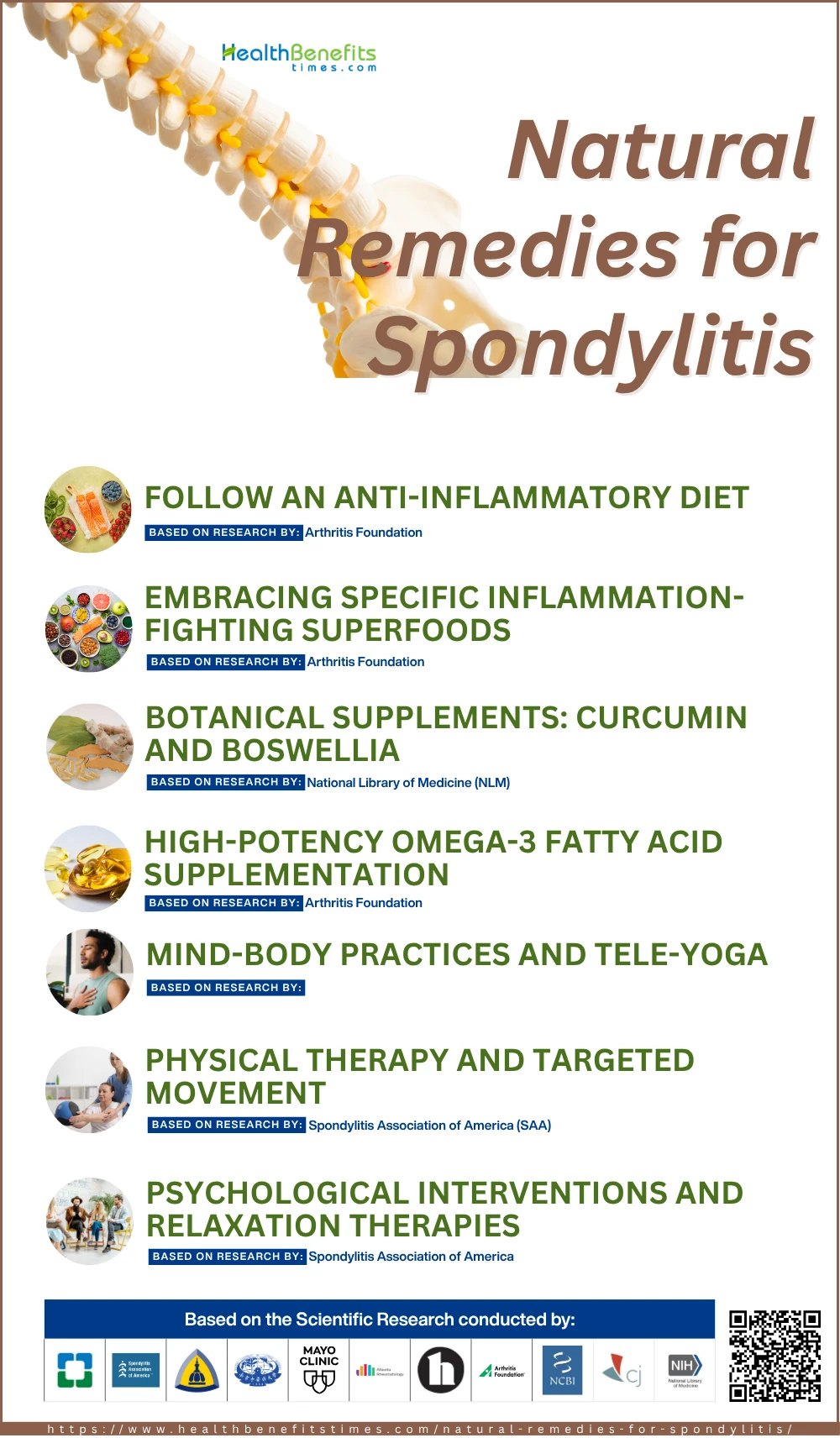
2. Embracing Specific Inflammation-Fighting Superfoods
Not all foods work the same way when it comes to inflammation. The ones listed here stand out because research shows they target some of the same biological processes your medications do. Adding them to your regular grocery list can make a real difference.
- Marine Fatty Fish: Wild-caught salmon, mackerel, and sardines are rich in omega-3 fatty acids. These healthy fats help reduce the production of inflammatory chemicals in your body, including leukocytes and cytokines. The result? Less morning stiffness in your joints. 15
- Cruciferous Vegetables: Broccoli, cauliflower, and Brussels sprouts whether raw or lightly cooked contain a sulfur-rich compound called sulforaphane. It works by slowing the production of TNF cytokines, one of the key drivers of inflammation in spondylitis. 16
- Anthocyanin-Rich Fruits: Tart cherries, blueberries, and blackberries get their deep color from compounds called anthocyanins. These act as antioxidants, helping neutralize oxidative stress and protecting your joint tissues from further damage. 17
- Plant-Based Lipids and Alliums: Extra virgin olive oil contains oleocanthal, a compound that mimics the pain-relieving action of ibuprofen. Meanwhile, garlic and leeks provide diallyl disulfide, which helps limit the enzymes that break down cartilage over time. 18
3. Botanical Supplements: Curcumin and Boswellia
Getting curcumin from turmeric and getting it from a supplement aren’t the same thing your body responds differently to each. Turmeric contains curcumin, a compound that helps calm overactive T-cells and blocks COX-2 enzymes both of which drive inflammation and pain. The problem is, your body absorbs very little curcumin from regular turmeric powder on its own. That’s where specialized supplements come in. Studies show that when highly absorbable forms of curcumin are combined with Boswellia serrata extract, the two work together more effectively than either alone. In one study, this combination significantly reduced neck-related disability and lowered interleukin levels key markers of inflammation within just a few weeks. 19
4. High-Potency Omega-3 Fatty Acid Supplementation
The real-world question isn’t whether omega-3s help with inflammation most evidence suggests they do but how much you actually need to see a difference. If you’re not eating fish regularly, a high-potency fish oil or krill oil supplement can fill that gap. These supplements deliver EPA and DHA, the two fatty acids your joints need most to manage inflammation. Research shows that taking omega-3s daily at therapeutic doses sometimes up to 2.6 grams for inflammatory arthritis can meaningfully reduce disease activity. It may also cut down how much you depend on NSAID painkillers. 20
5. Vitamin D Optimization
Most people don’t realize that vitamin D works less like a typical vitamin and more like a hormone one that controls your immune response and helps your body absorb calcium. That distinction matters when you have spondylitis. Your condition gradually weakens the density inside your spinal vertebrae, which puts you at higher risk for osteoporosis. A bit of daily sunshine helps, but it’s often not enough. Many people with spondylitis need supplemental doses well above the standard 600 IU recommended for healthy adults to keep their bones protected. 21
6. Physical Therapy and Targeted Movement
The real-world question isn’t whether exercise helps spondylitis most evidence strongly suggests it does but how to structure it so you actually protect your spine long-term. Daily movement is the single most powerful non-drug tool you have for preventing permanent spinal fusion and keeping your range of motion intact. Working with a physical therapist helps you build a routine that covers the basics: gentle stretching to keep your joints flexible, aerobic exercise to support lung capacity, and core strengthening to create a muscular support system around your spine. 22
7. Mind-Body Practices and Tele-Yoga
If you’ve ever wondered why you feel less stiff and more at ease after a good stretch, the answer often comes back to how your nervous system responds to slow, deliberate movement. Yoga works on this principle. It combines gentle physical poses with deep, steady breathing the kind that expands your rib cage and helps your body shift out of a stress response.
You don’t even need to leave your house to benefit. Tele-yoga programs now let you join guided sessions from your living room. A clinical study found that patients who practiced yoga remotely saw real improvements in spinal mobility and muscle endurance. They also reported lower stress and fewer symptoms of depression. 23
8. Psychological Interventions and Relaxation Therapies
If you’ve ever wondered why your pain feels worse on stressful days, the answer often comes back to cortisol your body’s main stress hormone. Practices like meditation, progressive muscle relaxation, or cognitive behavioral therapy can help lower cortisol levels and ease the unconscious muscle tension your body holds onto. These approaches work by calming your nervous system, pulling it out of that constant “fight or flight” mode that drains your energy. Over time, this can meaningfully reduce how much pain you feel and help with the mental exhaustion that often comes with living with a chronic condition. 24
Lifestyle Adjustments for Ergonomics and Sleep
How you prepare [your bed and workspace] has a greater impact on [your spine health] than most people realize. These are the two places where your body spends most of its time and getting them right can go a long way toward reducing repeated strain on your back.
Your mattress choice matters more than you might think. What you’re looking for is something firm enough to support your spine, but soft enough to follow the shape of your body. Memory foam and adjustable beds tend to work well for a lot of people they support the natural curve of your lower back without letting your hips sink too far down, which can throw your spine out of alignment. 25
Your pillow matters just as much. A thick, overstuffed pillow pushes your neck forward for hours at a time, which can gradually encourage a stooped posture. A thinner pillow or no head pillow at all, with a small cushion between your knees instead helps keep your spine in a more neutral position while you sleep. 26 And if you’re in the middle of a bad flare-up, sleeping in a recliner may actually help. The angled support can ease tension on your lower back when lying flat feels unbearable. 27
Precaution Before Use of Natural Remedies
The idea that something is safe just because it’s “natural” is so widespread that most people accept it without question. It’s also largely incorrect. Adding alternative or holistic practices to your routine calls for the same careful medical oversight as starting any new prescription drug.
Your spine needs special protection and certain physical therapies can put it at serious risk. As your vertebrae fuse and bone density drops because of disease-related osteoporosis, your spine becomes brittle. That’s why rheumatologists strongly advise against high-velocity spinal manipulation the kind of forceful adjustments used in many chiropractic clinics. 28 Letting someone apply sudden, intense force to an inflamed or partially fused spine can lead to spinal fractures, spinal cord injuries, or even permanent paralysis.
Getting omega-3s from fish oil and curcumin from supplements are common choices but bioavailability and drug interactions are where things get complicated. Both naturally thin your blood. If you’re already taking anticoagulants or standard anti-inflammatory drugs, stacking these supplements on top can quietly raise your risk of internal bleeding and serious gastrointestinal hemorrhaging. 29
If you’ve ever wondered why some mornings feel manageable while others feel alarming, the answer often comes back to knowing which symptoms are routine and which are red flags. Waking up with back stiffness is expected. But sudden, sharp chest pain or an inability to fully expand your rib cage to breathe may point to serious cardiovascular or respiratory complications and those aren’t situations turmeric and yoga can handle. 1 Think of natural remedies as a complement to your medical care, not a substitute for it.
Comments
This article is based on Scientific Research Conducted by following Research Organization:
- Ankylosing Spondylitis–Cleveland Clinic, United States
- Ankylosing spondylitis–National Library of Medicine, United States
- Overview of Ankylosing Spondylitis–Spondylitis Association of America, United States
- What Is Non-Radiographic Axial Spondyloarthritis?–Spondylitis Association of America, United States.
- Understanding the Progression of Non-Radiographic Axial Spondyloarthritis–CreakyJoints, United States
- Ankylosing Spondylitis–Johns Hopkins Arthritis Center, United States
- Spondyloarthritis (Spondyloarthropathy)–Cleveland Clinic, United States
- Yoga Study Finds Wealth of Physical and Mental Benefits for Older Adults–Spondylitis Association of America, United States.
- The Early Phases of Ankylosing Spondylitis: Emerging Insights From Clinical and Basic Science–National Center for Biotechnology Information (NCBI), United States
- Ankylosing Spondylitis–Johns Hopkins Medicine, United States
- Gut microbiota and ankylosing spondylitis: current insights and future challenges–National Center for Biotechnology Information (NCBI), United States
- The gut-bone axis in ankylosing spondylitis: mechanistic insights and the translational gap–Wuxi Affiliated Hospital of Nanjing University of Chinese Medicine, China
- How Ankylosing Spondylitis Progresses–WebMD Health Corp., United States
- Anti-Inflammatory Diet Do's and Don'ts–Arthritis Foundation, United States
- Best Fish for Arthritis–Arthritis Foundation, United States
- 6 Foods That May Help Your Arthritis–Arthritis Foundation, United States
- 12 Best Foods for Arthritis–Arthritis Foundation, United States
- Shopping for Arthritis-Friendly Foods–Arthritis Foundation, United States
- A full-spectrum Boswellia serrata extract with enhanced bioavailability, and its co-delivered system with curcumin alleviate pain and stiffness associated with moderate spondylitis: a randomized double-blind, placebo-controlled, 3-arm study–National Library of Medicine (NLM), United States (NIH, USA)
- Supplement and Herb Guide for Arthritis Symptoms–Arthritis Foundation, United States
- Vitamin D–Mayo Clinic, United States
- Exercise–Spondylitis Association of America (SAA), United States
- The Effects of Tele-Yoga in Ankylosing Spondylitis Patients: A Randomized Controlled Trial
- Integrative Medicine–Spondylitis Association of America, United States
- SAA’s Helpful Hints: Community Wisdom – Mattresses & Pillows–Spondylitis Association of America, United States
- Tips For Sleeping Better With Spondyloarthritis–Spondylitis Association of America, United States
- 11 Tips for a Better Night’s Sleep When You Have Ankylosing Spondylitis–Healthline Media, United States
- Non-Medicinal Approaches To Treating Spondyloarthritis–Spondylitis Association of America, United States
- Omega-3 Fatty Acid–Alberta Rheumatology, Canada