

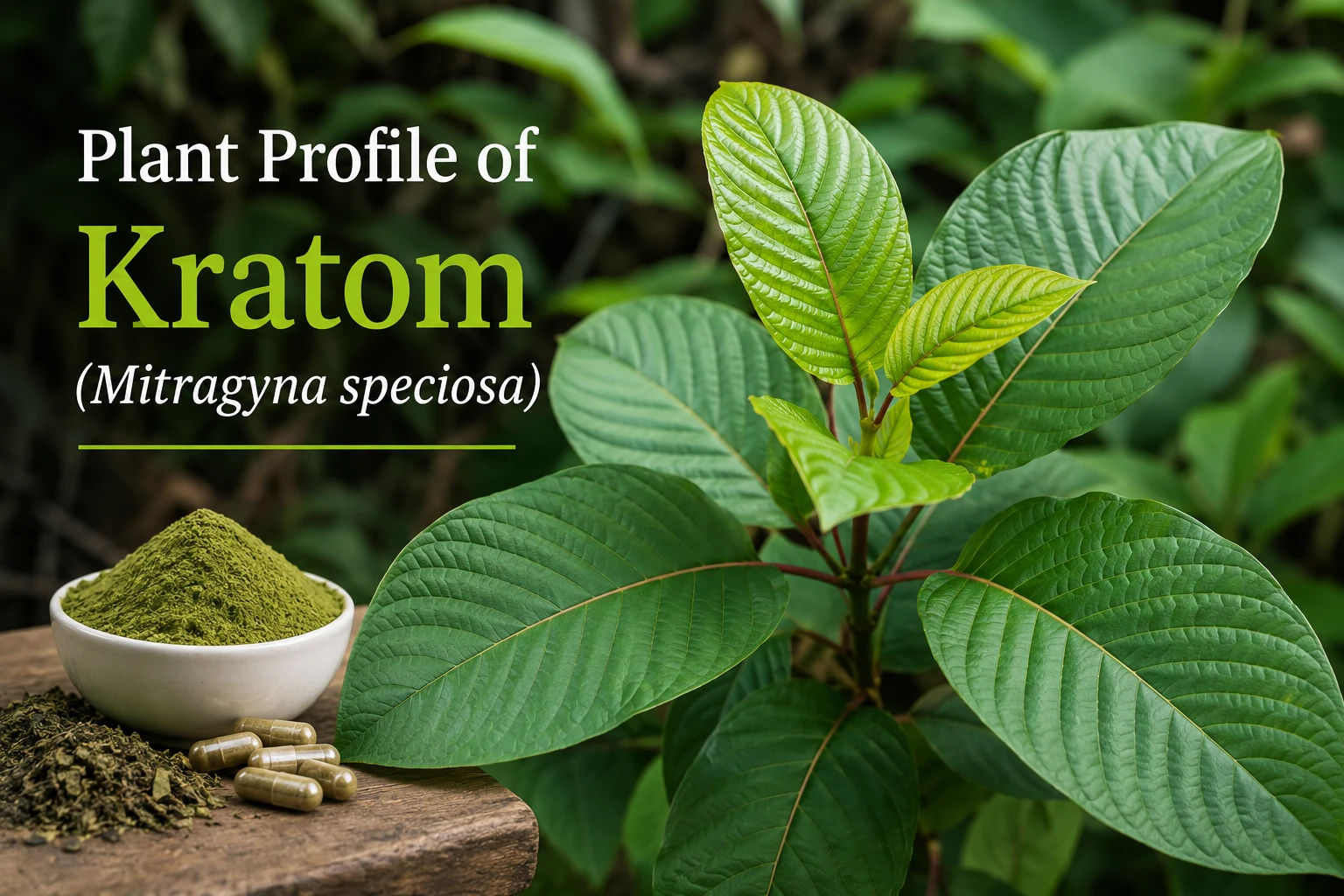
Kratom is the common name for Mitragyna speciosa, an evergreen tree in the coffee family (Rubiaceae) native to the tropics of Southeast Asia. For generations it has been part of daily life in countries such as Thailand, Malaysia, Indonesia, Myanmar, and Papua New Guinea, where the leaves have traditionally been chewed fresh or brewed into a tea. Over the last two decades it has moved well beyond its native range and is now sold worldwide as a dried botanical, most often in powdered form. This profile gives a factual overview of the plant: where it comes from, the compounds it contains, how its many varieties differ, what quality and sourcing look like, and where it currently sits from a regulatory standpoint.
Botanical background
Mitragyna speciosa is a large tropical tree that can reach 80 feet or more in the wild, with a straight trunk and a broad, leafy canopy. Its leaves are dark green, glossy, and ovate, often growing to the size of a hand. The tree thrives in the humid, fertile, marshy soils of equatorial Southeast Asia, where heavy rainfall and consistent warmth allow it to produce foliage year round. It belongs to the same botanical family as the coffee plant, Coffea, a relationship that is often noted because both are valued for the way their leaves and seeds have been used traditionally.
The genus name Mitragyna was assigned in the nineteenth century by the Dutch botanist Pieter Korthals, who thought the shape of the flower’s stigma resembled a bishop’s mitre. The species name speciosa simply means showy or beautiful, a reference to the plant’s clustered, globe-shaped yellow flowers.
Traditional use
In its native regions, kratom has a long history of folk use among rural and laboring communities. Farmers and manual workers historically chewed the fresh leaves or brewed them into a tea while working long hours in hot fields, and the plant has also featured in local customs and traditional preparations. Because the leaves were used in a cultural and occupational context rather than a clinical one, much of what is known about traditional use comes from ethnographic and survey records rather than controlled study. This long history of use is part of what has made the plant a subject of growing scientific and consumer interest, while also being a reason it is easy to oversimplify.
The main alkaloids
The leaf of Mitragyna speciosa contains a complex mix of naturally occurring plant compounds known as alkaloids, with more than forty identified to date. The two that are most studied and most abundant are mitragynine and 7-hydroxymitragynine. Mitragynine is by far the most plentiful, typically making up the majority of the total alkaloid content, while 7-hydroxymitragynine is present only in small amounts. Other minor alkaloids found in the leaf include speciogynine, speciociliatine, paynantheine, and corynantheidine. The relative balance of these compounds varies from leaf to leaf and is influenced by the tree’s genetics, growing conditions, the maturity of the leaf at harvest, and how the leaf is dried and processed after picking. This natural variability is one reason that no two batches of raw leaf are ever identical.
Strains and vein colors
Anyone browsing kratom products quickly encounters a vocabulary of “strains” and “vein colors,” and it helps to understand what these terms describe. The colors refer to the central vein and stem of the leaf, which can appear red, green, or white depending largely on the maturity of the leaf at the time of harvest and the way it is subsequently dried. White vein is generally associated with younger leaves, red vein with more mature leaves and longer drying, and green vein with a middle stage. Additional market terms such as yellow or gold usually describe specific drying or blending methods rather than a naturally occurring fourth vein color.
“Strain” names, meanwhile, are often a combination of geographic origin and vein color. Names such as Bali, Borneo, Maeng Da, Malay, Thai, and Indo point loosely to a region of origin or a style of leaf, although in a global supply chain these names function more as product categories than strict botanical designations. For readers who want a fuller breakdown of how these varieties are named and how they differ, this guide to kratom strains lays out the categories side by side. The key point for a reference reader is that vein color and strain naming describe the leaf and its processing, not a difference in species.
Quality, sourcing, and testing
Because kratom is sold as an unregulated botanical in much of the world, quality varies enormously from one seller to another. The single most important variable a consumer can evaluate is third-party laboratory testing. Reputable suppliers send each batch to an independent lab and publish a Certificate of Analysis, which documents the alkaloid content and screens for contaminants such as heavy metals, microbial pathogens like salmonella and E. coli, and residual solvents. Several of the most widely reported safety problems historically linked to kratom were later traced to contaminated or adulterated product rather than to the leaf itself, which is why sourcing from vendors who publish lab results is widely regarded as the most meaningful quality signal. Good manufacturing practices, proper storage, and transparent labeling are additional markers of a responsible supplier.
Regulatory status
The legal status of kratom is a patchwork that differs by country and, within the United States, by state. At the federal level in the United States, kratom is not a controlled substance, and the Food and Drug Administration has not approved it for any use. A number of individual states and municipalities have passed their own restrictions, while others have adopted Kratom Consumer Protection Acts that set labeling and purity standards rather than banning the plant outright. Internationally, the picture ranges from full prohibition in some countries to unrestricted sale in others, and regulations continue to evolve. Anyone considering kratom should confirm the current rules in their own jurisdiction, since the situation can change from one legislative session to the next.
A balanced summary
Mitragyna speciosa is a botanically interesting tree with a long folk history, a distinctive and variable alkaloid profile, and a global market full of strain and vein-color terminology that can confuse newcomers. It is not a regulated medicine, and the scientific literature on it remains limited compared with the rigor applied to approved pharmaceuticals. For a reference reader, the most useful takeaways are practical: kratom is a single plant sold in many processed forms, its quality depends heavily on sourcing and laboratory testing, and its legal status varies by place and is still changing. Treating it as the complex, variable botanical it is, rather than reducing it to a single label, is the most accurate way to understand it.