

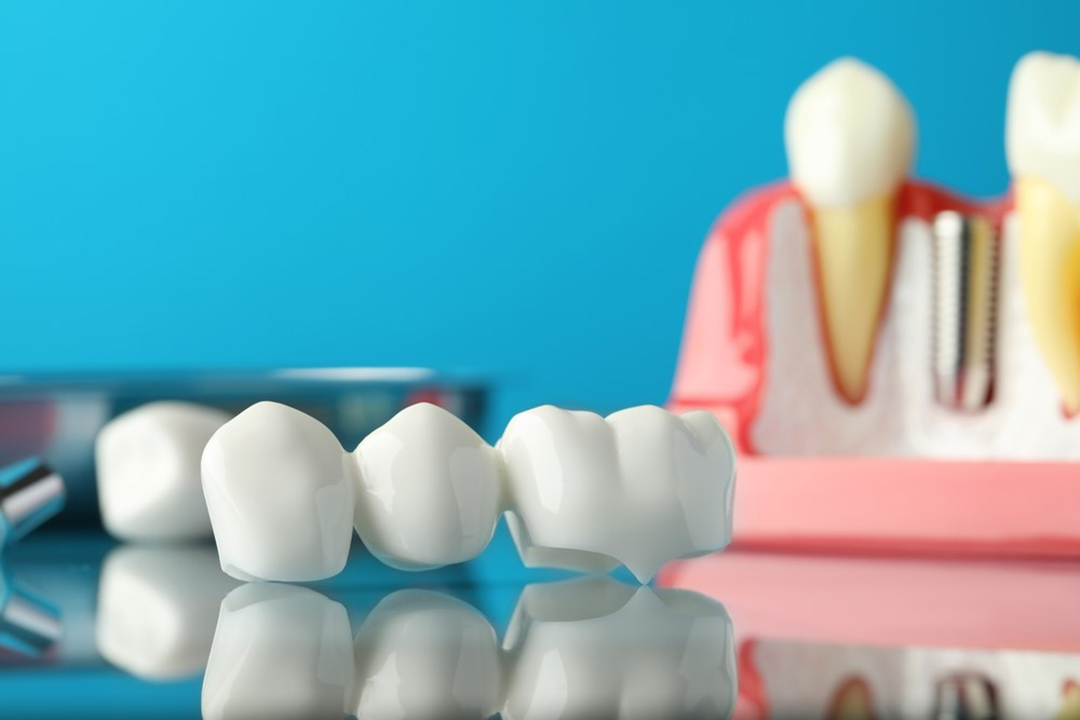
Whether caused by decay, gum disease, or injury, a missing tooth is often the entry point to advanced oral health problems long-term. Over time, the surrounding teeth begin to drift into the empty space, the bite becomes uneven, chewing force drops, and the jawbone slowly shrinks. This is why dentists recommend replacing missing teeth as soon as possible, and why the two most popular solutions, dental bridges and dental implants, deserve a close look.
What Is a Dental Bridge?
A dental bridge consists of an artificial tooth that is held in place by the natural teeth on either side of the gap. It literally “bridges” a missing tooth. Its main advantages are speed and simplicity. There is no surgery, the process is completed in a couple of weeks, and it costs relatively little; typically, from £800 to £2,500 ($1,075 to $3,360).
The disadvantage, however, is neighboring teeth are permanently filed down. Bridges require the removal of healthy enamel from the supporting teeth. They also do not replace the tooth root, so the jawbone continues to shrink. Most bridges need to be replaced after 5 to 15 years, too.
A Conservative Alternative: The Maryland Bridge
The Maryland bridge is one of the best options for patients wishing to preserve as much natural tooth enamel as possible. In this case, the prosthetic tooth is attached to the adjacent teeth using thin metal or ceramic wings. At an average £500 ($670), it is also the most affordable type of bridge. Its main limitation, however, is strength: it is not suitable for molars or areas under heavy chewing force.
What Is a Dental Implant?
Implant consist of a small titanium screw surgically placed into the jawbone. They remain the most durable solution for missing teeth worldwide. They stimulate jawbone, actively prevent bone loss and can last a lifetime. They also look entirely natural.
Their advantages are formidable, but so are their caveats. Implants have a treatment period of 3-6 months and high costs for edentulous patients. A full-arch treatment, for example, can exceed £12,000–£15,000 (around $15,000–$19,000) per jaw. No wonder many patients opt for full mouth dental implants in Turkey. But even while traveling abroad, a full-mouth treatment (mandible and maxilla) stands at £6,000 ($8,000) with all costs factored in.
Bridges vs. Implants at a Glance
Invasiveness and treatment time: Bridges are non-surgical and quick, usually completed within two to three weeks. Implants require minor surgery and several months of healing, though the results are more permanent.
Impact on neighboring teeth: Traditional bridges require reshaping healthy adjacent teeth. Maryland bridges minimize this, while implants leave neighboring teeth completely untouched.
Bone health: Only an implant replaces the tooth root and preserves the jawbone. With a bridge, gradual bone shrinkage under the missing tooth is unavoidable and can eventually affect facial appearance, making you look older.
Longevity and long-term cost: A bridge is cheaper initially but will likely need replacing at least once or twice over a lifetime. An implant costs more upfront but often proves more economical over decades.
Candidacy: Implants require enough jawbone and good health; heavy smokers, uncontrolled diabetics, and patients with bone loss may not be suitable. Bridges only require healthy, strong teeth on both sides of the gap.
How to Choose the Right Option
Ultimately, the best decision is made together with a qualified dentist after an examination, X-rays, and a discussion of your goals. There is no single answer that suits everyone, but a few guiding questions can help you choose:
- How many teeth are missing?A single front tooth may be well served by a Maryland bridge or a single implant. Multiple missing teeth, or a full arch, generally favor full-arch implants.
- What is the condition of your neighboring teeth?If they already have large fillings or crowns, a traditional bridge may make practical use of them. If they are perfectly healthy, an implant avoids sacrificing them.
- What is your priority: speed or longevity?A bridge restores your smile in weeks; an implant is a longer journey with a longer-lasting result.
- What does your budget allow?Consider both the initial cost and replacements down the line.
Whichever option you choose, replacing a missing tooth is a valuable decision for your long-term oral health, your nutrition, and your confidence.