Health Benefits
    Facebook Twitter Instagram
    Sunday, December 14
    Facebook Twitter Pinterest
    Health Benefits
    • Home
    • Dental Health
    • Mental Health
    • Weight Loss
    • Health Wiki
    • Nutrition
    • Healthy Recipe
    • BMI Calculator
    Health Benefits
    Home»Vegetables»Pea pumpkin
    Vegetables

    Pea pumpkin

    By s mJuly 5, 2019Updated:July 7, 2019No Comments3 Mins Read
    Facebook Twitter Pinterest LinkedIn Tumblr Email

    Peapumpkin is an annual scandant or trailing herb that grows upto 4 m long of not forested, localities throughout West African region and is widely spread in tropical Africa, Australia and Asia. It is common in village hedges and other open habitats as well as disturbed sites of semi-evergreen and deciduous forests. It is administered throughout the tropics and subtropics of Old World where various parts of plant are used for health care needs of human beings. Tender shoots and leaves are used as the part of South Indian cuisine.

    Animal experiments have shown various traditional or folkloric medicinal claims that include hypolipidemic, hypotensive, hypoglycaemic, hepatoprotective, immunomodulatory, antiulcer, antimicrobial, local anaesthetic and anxiolytic characteristics of plant extracts.

    Plant

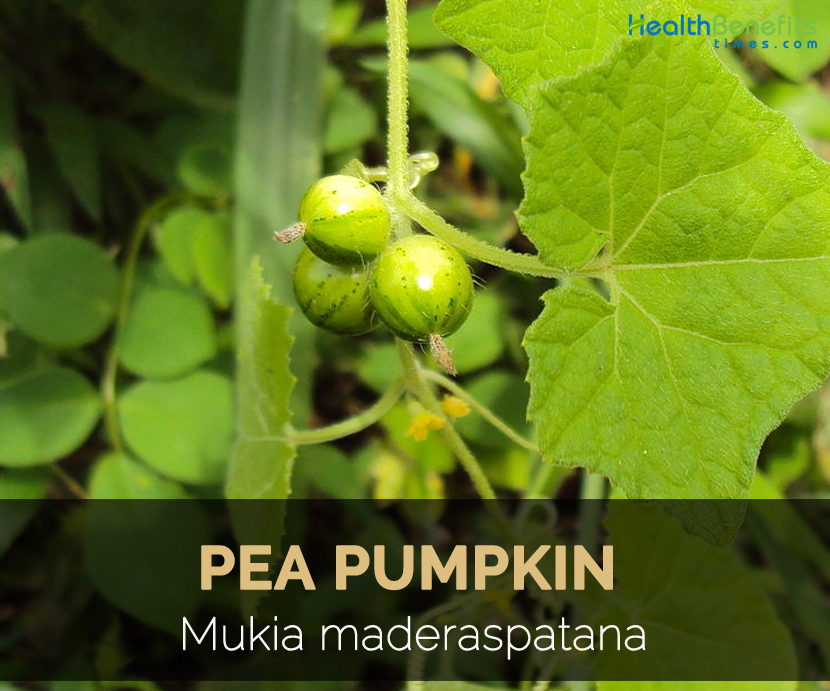
    Pea pumpkin is a prostate or climing scabrid herbs. Stems are branched, robust and sulcate. Leaves are ovate-deltoid measuring 4-8 x 3-7 cm, angular or shallowly 3-5 lobed, margin denticulate, base cordate, apex acuminate, scabrid on both sides. Petioles are 6 cm. Flowers (male) are in axillary and sessile clusters. Calyx tube is villous about 2 mm and lobes are erect and subulate. Petals are 3 mm long which is obtuse, ovate to oblong and yellow. Female flowers are solitary and in clusters. Berries are red, globose about 1.2 cm across. Seeds are rugose and lenticular.

    Traditional uses

    • In Nigeria, the decoction of young shoots and leaves are used as aperient for children.
    • In India, bitter leaves and tender shoots are used for vertigo and biliousness.
    • Leaf sap is used in Tanganyika as a dressing for wounds, amoebiasis and leaves are used as a poultice for burns.
    • In Nigeria, seed are chewed or used in decoction to induce perspiration.
    • In Senegal, fruits are used as a vermifuge.
    • In Nigeria, roots are used to provide relief from toothache and facial neuralgia.
    • Mix small quantity of pointed gourd with pinch of turmeric with 4/5 garlic added to water in form of concoction. It is helpful for sore throat due to cold.
    • Use the leaves for maintaining normal glycemic index.
    • The daily intake of Nugu dasari provides relief from cough.
    • Add grinded fenugreek seeds with Patol to promote strength and stamina in both genders.
    • Add dry grapes to musumusukai for controlling vomiting.
    • To treat bile related diseases, grinded amla fruit with the plant for healing bile problems.
    • For asthma, soak musumusukai juice with long pepper for few hours. Dry it in the sun and powder it. Take two grams of this powder with honey on betal leaf.
    • In Siddha, leaf and roots are used for treating dyspnea, fever, hepatic disorders, abdominal disorders, vomiting and cough.
    • Leaf decoction is used for treating hypertension and nasobronchial diseases.
    • The herb is useful in treating allergic bronchitis, bronchial asthma, bronchiectasis, chronic bronchitis, cold, productive cough, upper or lower respiratory tract infections and difficulty in breathing.
    • It controls endless cough, wheezing, cold, dry cough, allergic, tuberculosis and asthma.

    References:

    http://www.plantnames.unimelb.edu.au/Sorting/Mukia.html

    https://davesgarden.com/guides/pf/go/228170/

    https://plants.jstor.org/stable/10.5555/al.ap.upwta.1_1212

    https://www.zimbabweflora.co.zw/speciesdata/species.php?species_id=156990

    http://wildedibles.teriin.org/index.php?album=Wild-edibles/Fruits/Mukia-maderaspatana

    http://www.theplantlist.org/tpl/record/kew-2371639

    https://spinachwonders.blogspot.com/p/mukia-maderaspatanamusumusukai.html

    77%
    77%
    Awesome

    Comments

    comments

    P Vegetables
    Share. Facebook Twitter Pinterest LinkedIn Tumblr Email
    Previous ArticleFacts about Ceriman
    Next Article Facts about Kwini Mango

    Related Posts

    Health benefits of African dream bean

    January 23, 2024

    Health benefits of Patchouli

    December 22, 2023

    Health benefits of Prickly Caterpillar Plant

    November 22, 2023

    Comments are closed.


    Pea pumpkin Quick Facts
    Name: Pea pumpkin
    Scientific Name: Mukia maderaspatana
    Colors Green, turning to orange and red
    Shapes Globose, 6-11 mm in diameter
    Name Pea pumpkin
    Scientific Name Mukia maderaspatana
    Common/English Name Headache Vine, Rough Bryony, Madras Pea Pumpkin, Hong Gua, Aganaki, Agumaki, Bilari, Melon-gubat
    Name in Other Languages Bengali: Bilari;
    Chinese: Hong gua, Mao er gua (帽儿瓜),    Mao hua ma  jiao er (毛花马姣儿);
    English: Rough bryony Madras pea pumpkin;
    Gujarati: Tindori;
    Hindi: Agumaki, Aganaki, Bilari (बिलाड़ी), Musmusa (मुसमुसा), Paripushkara (परिपुष्करा);
    Japanese:  Sango ju suzume uri;
    Kannada: Chitrati;
    Konkani: Chirati (चिरटी);
    Malayalam: Chitrati, Mukkalpeeram, Mukkpeeram, Mukkalpiram;
    Marathi:  Bilavi, Chirati (चिरटी);
    Nepalese: Matyangre kankri (मट्याङग्र काँक्री);  
    Punjabi: Gwala kakri;
    Sanskrit:  Kritarandra, Musimusikkay, Krtarandhrah, Paripushkara (परिपुष्करा), Trikosaki;
    Tamil: Muchumuchukkai (முசுமுசுக்கை), Musumusukkai , Musumuskkai, Musumuskkai, Nagilangiai;
    Telugu: Musumusukaya, Nugudosa (నూగుదోస),  Potti budamu;
    Thai: Taeng nok, Taeng phi pluk, Taeng nu;
    Urdu:  Musmusa (مسمسا)
    Plant Growth Habit Annual scandant or trailing herb
    Plant Size 4 m long
    Leaves Broadly ovate to triangular or palmately 3(-5) lobed, 3-9 cm long
    Flower Small, yellow, 1 cm across
    Fruit shape & size Globose, 6-11 mm in diameter
    Fruit color Green, turning to orange and red, as they mature
    Fruit peel Smooth, hairless

    Pea pumpkin Scientific Classification

    Scientific Name: Mukia maderaspatana

    Rank Scientific Name & (Common Name)
    Kingdom Plantae (Plants)
    Division Sermatophyta
    Class Dioctyledonae
    Subclass Polypetalae
    Order Passiflorales
    Family Cucurbitaceae
    Genus Mukia
    Species Maderaspatana
    Synonyms
    • Bryonia althaeoides Ser.
    • Bryonia callosa Rottler   
    • Bryonia gracilis Wall.      
    • Bryonia hispida Salisb.    
    • Bryonia maderaspatana (L.) Lam.              
    • Bryonia micrantha Hochst. ex Cogn.         
    • Bryonia micropoda E.Mey.           
    • Bryonia rottleri Spreng.  
    • Bryonia scabra Rottler ex Wight & Arn.
    • Bryonia scabrella L. f.     
    • Cucumis maderaspatanus L.        
    • Melothria altaeoides (Ser.) Nakai              
    • Melothria maderaspatana (L.) Cogn.        
    • Mukia althaeoides (Ser.) M. Roem.           
    • Mukia rottleri M.Roem. 
    • Mukia scabrella (L. f.) Arn.            
    • Trichosanthes dioica Wall.
    Categories
    • Beverages (78)
    • Dairy (28)
    • Dental Health (15)
    • Equipment (5)
    • Essential OIls (196)
    • Facts (2,937)
    • Foods (255)
    • Fruits (516)
    • Giveaway (1)
    • Grains and Cereals (36)
    • Health & Beauty (761)
    • Herbs and Spices (1,249)
    • Medicines (9)
    • Mental Health (19)
    • Nutritional value (27)
    • Nuts and seeds (73)
    • Oils (81)
    • Pets (4)
    • Poultry & Seafoods (67)
    • Pulses and Beans (16)
    • Reviews (25)
    • supplement (2)
    • Vegetables (304)
    • Weight Loss (22)

    What is Lupin Bean Flour?

    Science Backed Health Benefits of Durian (Durio zibethinus)

    Science Backed Health Benefits of Feijoa (Pineapple Guava) (Acca sellowiana)

    Science Backed Health Benefits of Gac Fruit (Momordica cochinchinensis)

    Science Backed Health Benefits of Amaranth Leaves (Amaranthus spp)

    Science Backed Health Benefits of Arrowhead (Sagittaria sagittifolia)

    ABOUT
    Home
    About us
    Contact us
    Privacy Policy
    Terms & conditions
    Disclaimer
    Direct Communication
    e-mail: [email protected]
    Gmail: [email protected]
    Whatsapp: +977-9841146511
    Viber: +977-9841146511
    Useful
    Health Wiki
    Nutrition
    Facebook Twitter Pinterest
    © 2025 www.healthbenefitstimes.com All rights reserved.

    Type above and press Enter to search. Press Esc to cancel.

    ×

    Log In

    Forgot Password?

    Not registered yet? Create an Account