

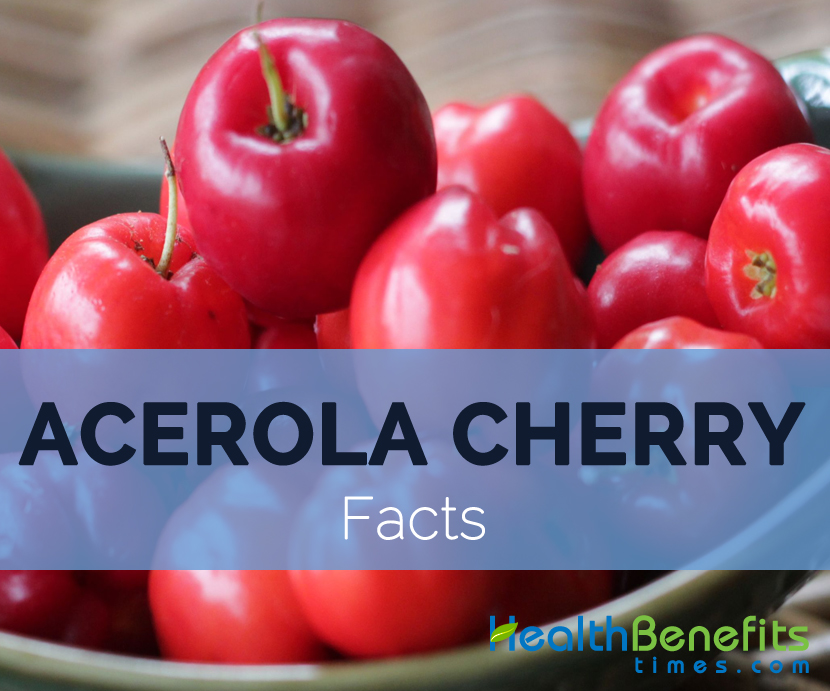
Acerola cherry possess 65 times more Vitamin C than orange. The single fruit provides the minimum requirement of Vitamin C of the recommended amount. It looks like a cherry with acidic and sweet flavor. Fruit loses its flavor as well as nutritional content very fast.
| Name | Acerola cherry |
|---|---|
| Scientific Name | Malpighia emarginata |
| Native | South America, Central America and Mexico, but now is being grown on Texas, India. |
| Common/English Name | Acerola, Dwarf Barbados Cherry, Barbados Cherry, Garden Cherry, Indian Cherry, Huesito, Native Cherry, Manzanita, Surinam Cherry, Puerto Rico Cherry, West Indian Cherry |
| Name in Other Languages | Brazil: Acerola, Cereja-Do-Pará; Barbados (Spanish): Buesito, Acerola; Czech: Malipigie Lysá; Danish: Barbadoskirsebær; Dutch: Geribde Kers; Eastonian: Sile Malpiigia; French: Acerolier, Cerise De Cayenne; German: Acerola-Kirsche, Barbados-Kirsche; India: Vallaria Simeyaranelli; Panama (Spanish): Cereza, Grosella; Papiamento: Whimaruku Machu; Philippines (Tagalog): Malpi; Portuguese: Cerejeira, Cereja Do Pará; Spanish: Acerola, Cereza De Jamaica; Surinam (Dutch): Shimarucu; Thai (Bangkok): Choeri ; Venezuela (Spanish): Semeruco, Cemeruco; Vietnamese: So’ri |
| Plant Growth Habit | Evergreen, semi deciduous and fast growing |
| Growing Climate | Tropical and subtropical climate |
| Soil | Loamy and well-drained |
| Plant Size | 3-6 m (6.6–9.8 ft.) |
| Root | Shallow |
| Branchlets | Brittle and woody branches |
| Leaf | Glossy, elliptical and dark green, length: 5–10 cm, width: 2.5–5.5 cm |
| Flowering Season | Summer-fall |
| Flower | Pink, Size: 1-2 cm, Diameter: 1–2 cm (0.39–0.79 inch) |
| Fruit shape & size | Oblate- round, small, Diameter: 1.5 to 4 cm |
| Fruit weight | 5-7 g |
| Fruit color | Bright red |
| Flesh color | Yellow to orange |
| Fruit peel | Thin |
| Flavor/aroma | Sweet, tart |
| Fruit Taste | Sour |
| Seed | Small, rounded, three seeds |
| Varieties/Types | Sweet varieties: Tropical Ruby, Hawaiian Queen, and Manoa Sweet Sour varieties: J.H. Beaumont, C.F. Rehnborg, and Haley. |
| Fruit Season | Summer-Autumn |
| Major Nutritions | Vitamin C (Ascorbic acid) 1644 mg (1826.67%) Copper, Cu 0.084 mg (9.33%) Vitamin B5 (Pantothenic acid) 0.303 mg (6.06%) Carbohydrate 7.54 g (5.80%) Vitamin A 37 µg (5.29%) Vitamin B2 (Riboflavin) 0.059 mg (4.54%) Magnesium, Mg 18 mg (4.29%) Vitamin B9 (Folate, Folic acid) 14 µg (3.50%) Potassium, K 143 mg (3.04%) Total dietary Fiber 1.1 g (2.89%) Iron, Fe 0.2 mg (2.50%) Vitamin B3 (Niacin) 0.392 mg (2.45%) Vitamin B1 (Thiamin) 0.02 mg (1.67%) Phosphorus, P 11 mg (1.57%) Calcium, Ca 12 mg (1.20%) |
| Health Benefits |
|
| Calories in 1cup (98 gm) | 31 Kcal |
| Traditional uses | Fruits: Diarrhoea, dysentery and problems related to liver, cold and cough are treated with the use of fruits. Puree: Used as topping on ice cream, cake, pudding or sliced bananas |
| Precautions |
|
| How to Eat |
|
| Other Facts |
|