

| Almond willow Quick Facts | |
|---|---|
| Name: | Almond willow |
| Scientific Name: | Salix triandra |
| Origin | Europe and Western and Central Asia |
| Health benefits | It is used as an anodyne and febrifuge. |
| Name | Almond willow |
|---|---|
| Scientific Name | Salix triandra |
| Native | Europe and Western and Central Asia. It is found from south-eastern England east to Lake Baikal, and south to Spain and the Mediterranean east to the Caucasus, and the Alborz Mountains |
| Common Names | Almond willow, Almond-leaf willow, Almond-leaved willow, Black maul, French willow |
| Name in Other Languages | Albanian: Shelg Aragonese: Sarga, sarga negra, sarguera Armenian: Urreni yerrarrej (Ուռենի եռառէջ) Asturian: Salguera mariella Azerbaijani: Ağçubuq söyüd Belarusian: Viarba trochtyčynkavaja (Вярба трохтычынкавая) Bulgarian: Tritichinkova vŭrba (тритичинкова върба) Catalan: Salze triandre, salsa Chinese: Sān ruǐ liǔ (三蕊柳), Máo liǔ (毛柳) Croatian: Vrba žuta, Bademasta vrba Czech: Vrba trojmužná Danish: Mandel-pil, Skør-Pil x Mandel-P Dutch: Amandelwilg English: Almond willow, Almond-leaf willow, Almond-leaved willow, Black maul, French willow Estonian: Loogapaju, Vesipaju Finnish: Jokipaju French: Osier brun, Osier franc, Osier rouge, Saule discolore, Saule à trois étamines, Saule-amandier, saule à feuilles d’amandier Galician: Salgueiro de follas de amendoeiro, salgueiro de follas de amondoeira German: Kottenheider Weide, Mandelweide, Mandel-Weide, Prossweide, dreimännige Weide, dreistaubblättrige Weide, Pfirsichweide Greek: Amygdaloïtiá (Αμυγδαλοϊτιά), itiá (ιτιά) Hebrew: Arvat sheloshet-ha’avkanim (עַרְבַת שְׁלוֹשֶׁת-הָאַבְקָנִים) Hungarian: Mandulalevelű fűz Irish: Saileach na dtrí bhall Italian: Salice da ceste, Salico da farceste, salice triandro Japanese: Seiyou tachi yanagi (セ イヨウタチヤナギ ), tachi-yanagi (タチヤナギ) Latvian: Vicu vītols Lithuanian: Krantinis gluosnis Northern Sami: Johkasieđga Norwegian: Mandelpil, Fager-via Persian: بید بادامی Polish: Wierzba migdałowa , Wierzba trójpręcikowa Portuguese: Salgueiro-com-folhas-de-amendoeira, salgueiro-folhas-de-amendoeira, vimeiro-folhas-de-amendoeira, salgueiro de folha larga azulada Russian: Beloloz (Белолоз), Belotal (Белотал), Loza (Лоза), iva mindalelistnaya (ива миндалелистная), iva mindal’naya (ива миндальная), iva trokhtychinkovaya (ива трёхтычинковая) Serbian: Bademasta vrba (бадемаста врба) Slovak: Vŕba trojtyčinková Slovene: Mandljasta vrba Spanish: Salice di mandorla / Salgueiro de amêndoa, Sarga, Sauce almendro, mimbrera oscura, sarga negra, sargatilla borde, sargatilla branca, sargatilla negra, sauce negro Swedish: Mandelpil, Jokipaju Turkish: Badem yapraklı söğüt, bağ söğüdü Udmurt: Kuin’ tychinkayem bad’ (Куинь тычинкаем бадь) Ukrainian: Verba trytychynkova (верба тритичинкова) Upper Sorbian: Mandlowa wjerba Valencian: Vimenera Welsh: Helygen beraroglaidd, Helyg Tribrigerog, Helygen Deir-Gwryw Hirddail, Helygen Dri-Gwryw Hirddail, Helygen Dribrigerog, Helygen Drigwryw |
| Plant Growth Habit | Upright, multi-stemmed, deciduous shrub or small tree |
| Growing Climates | Usually grows in riparian habitats, on sides of river, ponds, marshes, stream banks, in wetlands, waste places and along shorelines of lakes or large rivers |
| Plant Size | 10 m (33 ft) tall |
| Bark | Young bark is smooth grey-brown, becoming scaly on older stems with large scales exfoliating (like a plane tree) to leave orange-brown patches. |
| Leaf | Leaves are broad, lanceolate, 4–11 cm long and 1–3 cm wide, with a serrated margin |
| Flowering season | March to May |
| Flower | Male and female flowers are in catkins and are found on separate trees. Male catkins are up to 5cm and each flower has 3 stamens. Female catkins are shorter. |
| Fruit Shape & Size | Capsule |
| Propagation | By Seed, Semi-ripe cuttings and by layering |
| Season | June |
Plant Description
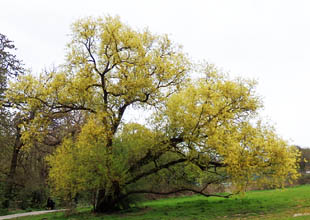
Almond willow is an upright, multi-stemmed, deciduous shrub or small tree that normally grows about 10 m (33 ft) tall. The plant is usually multi-stemmed, with an irregular, often leaning crown. The bark is smooth grey-brown at first, becoming scaly on older stems with large scales exfoliating (like a plane tree) to leave orange-brown patches. The twigs are olive-brown or brown, shiny and hairless. The ridges flake off leaving a smooth grey bark. The plant usually grows in riparian habitats, on sides of river, ponds, and marshes, stream banks, in wetlands, waste places and along shorelines of lakes or large rivers.
The plant does best in deep, moist soil in sun. It does not tolerate shade or shallow chalk. It also tolerates pollution and strong winds except strong coastal winds. The plant develops an aggressive root system so site at least 10 m away from buildings. This tree is often cut low as the young branches are used in basket work; they are sharp and pointed a red-brown or olive color. They are usually planted along waterways and around ponds and lakes, either alone or in groups.
Leaves
The leaves are elongated, broad lanceolate, 4-11 cm long and 1-3 cm wide, with a strongly serrated margins. The finely toothed leaves are weakly shiny and dark green on the upper side, while the underside is dull and greenish grey. Young leaves may be weakly pubescent, older ones are glabrous. On the underside, leaf veins are slightly elevated from the surface. Large rounded stipules with strongly serrated margins are present around the petiole bases, and persist on the shoots after the growing season. Petiole is normally 1-2 cm long with two conspicuous basal stipules.
 Almond-willow-tree
 Closer-view-of-flower-of-Almond-willow
 Flower-of-Almond-willow
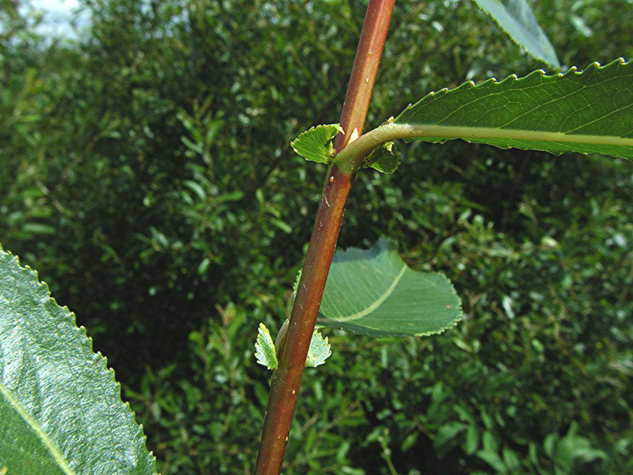 Branch-of-Almond-willow
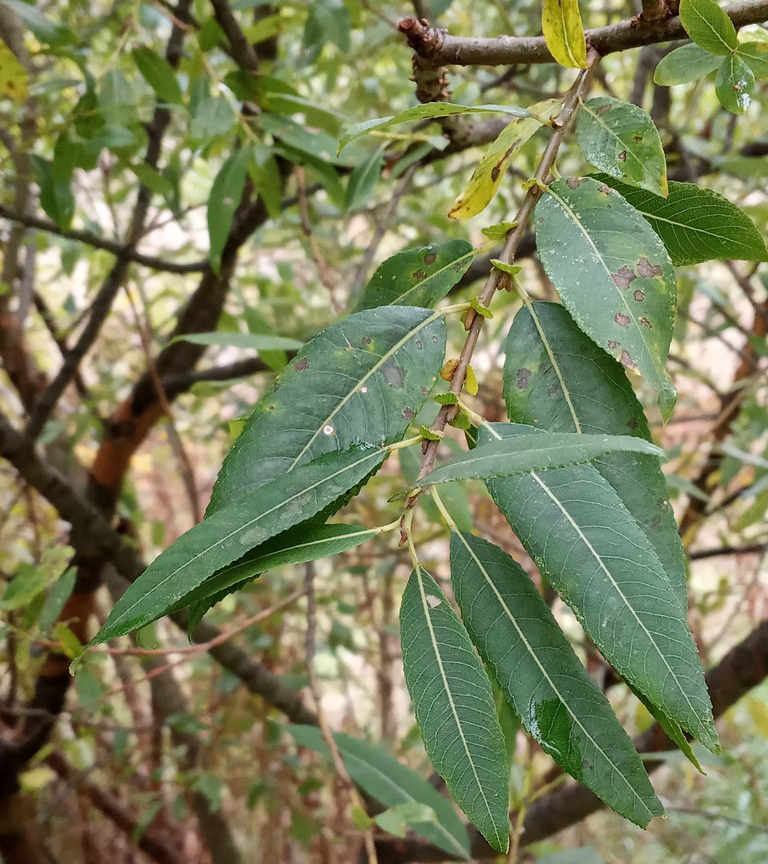 Leaves-of-Almond-willow
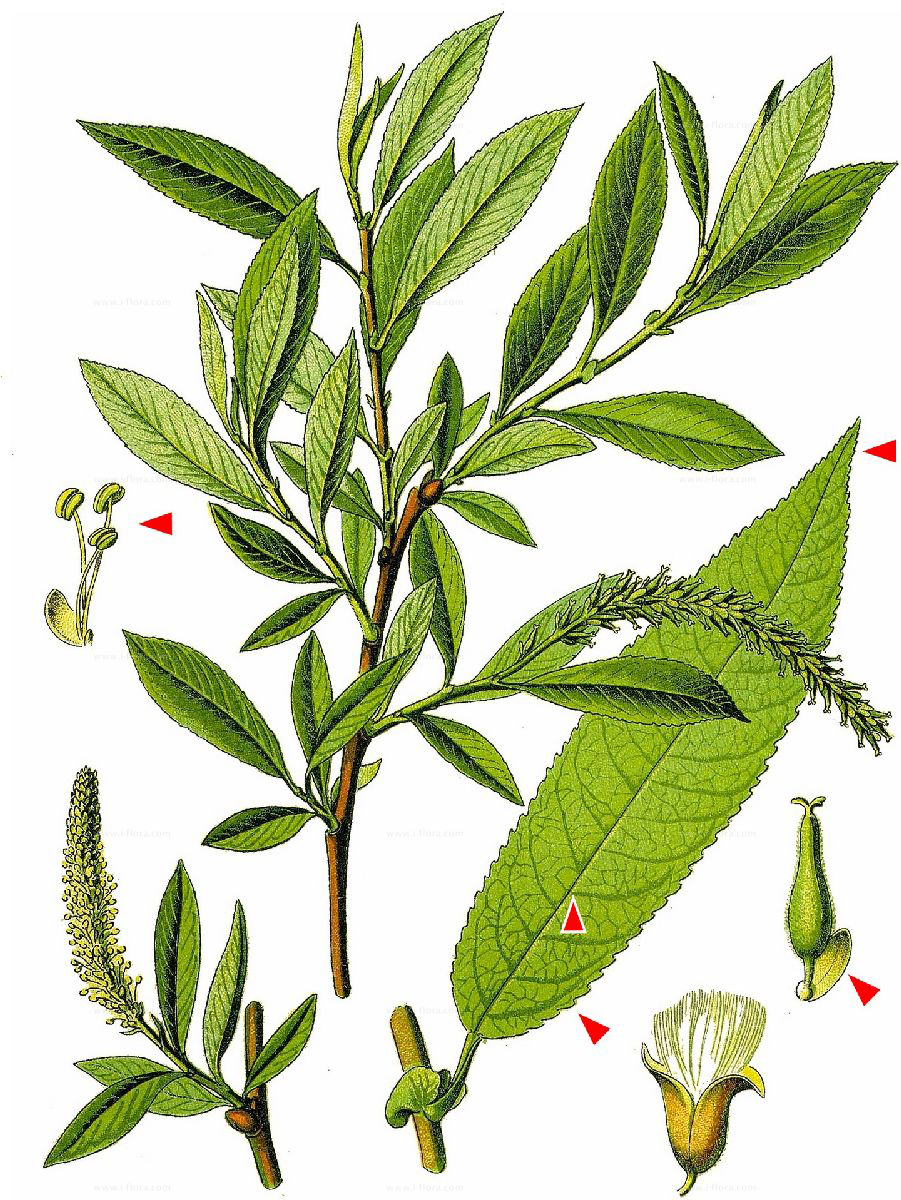 Plant-illustration-of-Almond-willow
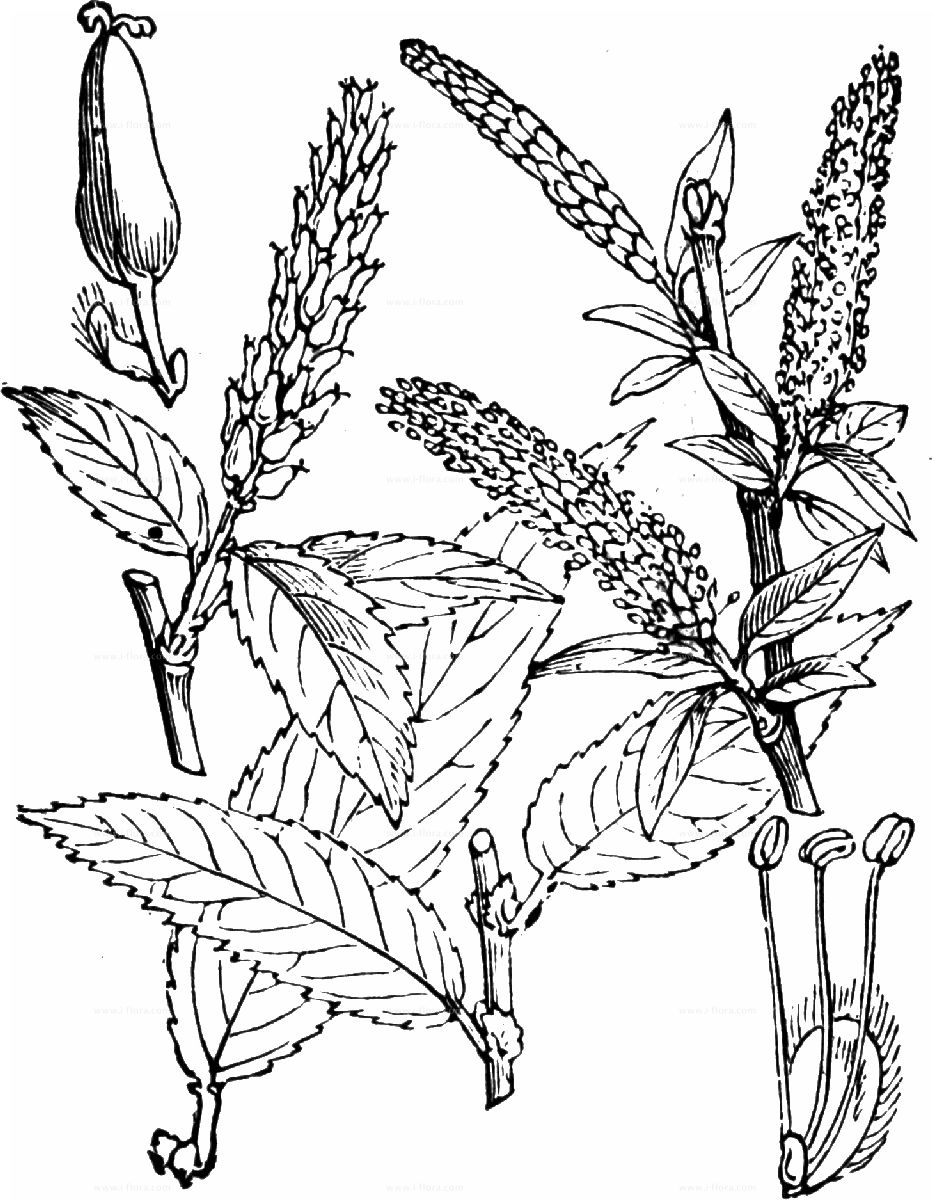 Sketch-of-Almond-willow
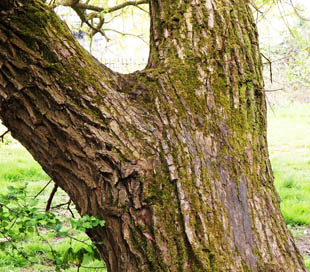 Trunk-of-Almond-willow
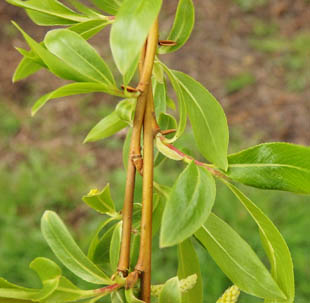 Young-leaves-of-Almond-willow
Flowers & Fruits
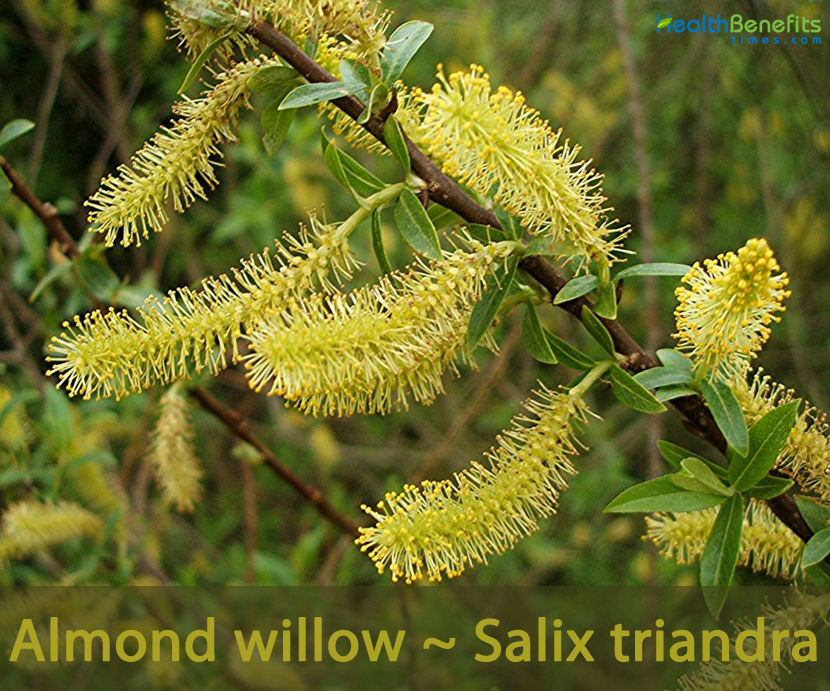
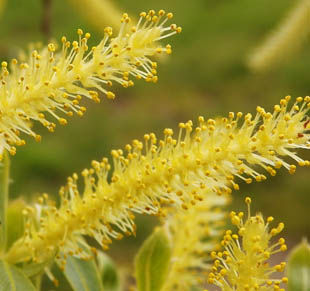
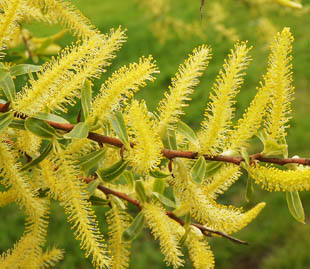
The flowers are produced in catkins in early spring at the same time as the new leaves, and pollinated by insects. They are dioecious, with male and female catkins on separate trees; the male catkins are narrowly cylindrical, 2.5 to 5 cm long and 0.3 to 1.2 cm wide, dense flowered, showy and fragrant, uniformly pale yellow while the female catkins are usually rather shorter about 2–4 cm long and denser than the male. The male flowers have three stamens, a useful identification feature with most other willows having two or five stamens. Flowering normally takes place in between March to May.
Fertile flowers are followed by capsules from the elongated mature catkins that are relatively short, green, and glabrous.
Traditional uses and benefits of Almond willow
- The fresh bark of all members of this genus contains salicin, which probably decomposes into salicylic acid (closely related to aspirin) in the human body.
- This is used as an anodyne and febrifuge.
Culinary uses
- Inner bark can be consumed raw or cooked.
- It can be dried, ground into a powder and then added to cereal flour for use in making bread etc.
- It has a very bitter flavor, it is a famine food that is only used when all else fails.
- Young shoots can be cooked, but not very palatable.
Other Facts
- The stems are very flexible and are used in basket making.
- They are highly valued.
- The plant is usually coppiced annually when grown for basket making, though it is possible to coppice it every two years if thick poles are required as uprights.
- A yellow dye is obtained from the bark and young leaves.
- It succeeds in wet, ill-drained or intermittently flooded soils.
- The plant is a potential biomass source for biofuel energy generation.
- In the Russian honey industry, the plant is used as a nectar source for honeybees.
References:
https://gd.eppo.int/taxon/SAXTR
https://www.itis.gov/servlet/SingleRpt/SingleRpt?search_topic=TSN&search_value=837764#null
https://npgsweb.ars-grin.gov/gringlobal/taxon/taxonomydetail?id=32776
https://pfaf.org/user/Plant.aspx?LatinName=Salix+triandra
http://www.theplantlist.org/tpl1.1/record/kew-5002239
https://en.wikipedia.org/wiki/Salix_triandra
https://www.wikidata.org/wiki/Q157532
https://plants.usda.gov/home/plantProfile?symbol=SATR14