

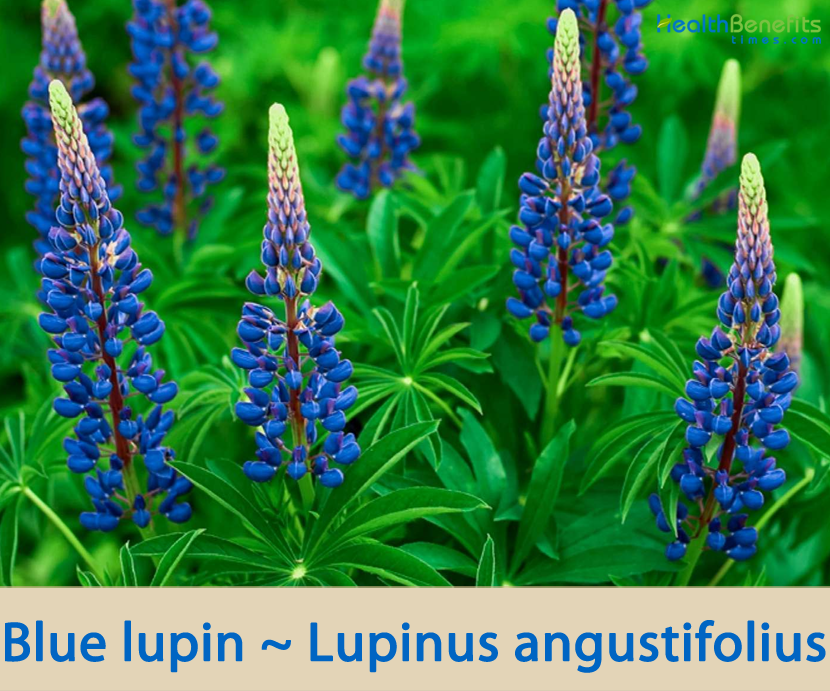
| Blue lupin Quick Facts | |
|---|---|
| Name: | Blue lupin |
| Scientific Name: | Lupinus angustifolius |
| Origin | Northern Africa, southern Europe and western Asia. |
| Colors | Initially green turning to brown as they mature |
| Shapes | Oblong, slightly inflated pods that are 35–50 mm long and 7–10 mm wide. |
| Name | Blue Lupin |
|---|---|
| Scientific Name | Lupinus angustifolius |
| Native | Northern Africa (i.e. Algeria, Egypt and Morocco), southern Europe (i.e. Bulgaria, Greece, Italy, France, Portugal and Spain) and western Asia. |
| Common Names | Australian lupin, Australian sweet lupin, bitter lupin, blue lupin, blue lupine, European blue lupine, lupin, narrow leaf lupin, narrow leafed lupin, narrow leaved lupin, narrow-leaf lupin, narrowleaf lupin, narrowleaf lupine, narrow-leafed lupin, narrow-leaved blue lupin, narrow-leaved lupin, New Zealand blue lupin, sweet lupinseed, Altramuz azul, foxtail lupin |
| Name in Other Languages | Afrikaans: Bloulupien Albanian: Lupini i kaltër Arabic: Turmus shaytânî, tarmis diq al’awraq (ترمس ضيق الأوراق) Azerbaijani: Ensizyarpaq acıpaxla Belarusian: Lubin vuzkalisty (Лубін вузкалісты) Bulgarian: Lubin vuzkalisty (теснолистна лупина), tyasnolistna lupina (тяснолистна лупина) Catalan: Llobí bord Chinese: Zhai ye yu shan dou, Xia ye yu shan dou (狭叶羽扇豆) Croatian: Vučika uzkolistna Czech: Lupina úzkolistá, vlčí bob úzkolistý , Vlčí Bob Úzkolistý, lupina úzkolistá Danish: Småbladet lupin, Smalbladet lupin Dominican Republic: Yuca Dutch: Blauwe lupine English: Blue lupine, Blue lupin, Narrow leaf lupin, Narrow-leaved lupin, New Zealand blue lupin, European blue lupine, Altramuz azul, Sweet lupinseed, foxtail lupin, Narrow leaf lupine Estonian: Ahtalehine lupiin Finnish: Sinilupiini French: Lupin bleu, Lupin petit bleu, Lupin à feuilles ètroites, Lupin à folioles étroites, lupin réticulé German: Blaue Lupine, Bitterlupine, Schmalblättrige Lupine, schmalblättrige Wolfsbohne Greek: Loúpino (λούπινο) Hebrew: Turmus tzar-‘alim, trmus tsr-elim (תֻּרְמוּס צַר-עָלִים) Hungarian: Kék csillagfürt, Keskenylevelü csillagfürt, Kék Csillafürt Icelandic: Lensulúpína Italian: Lupino azzurro, Lupino selvatico, lupino a fogliole strette, lupino azzurro, lupino selvatico Jamaica: Lupin Japanese: Ao bana ruupin Korean: Bul ru ru p’in, Ka neun ip mi seon kong, ga neun ip mi seon kong, ganeun-ipmiseonkong (가는잎미선콩) Latvian: Šaurlapu lupine Navajo: Azeediilchʼílii Netherlands: Blauwe lupine Norwegian: Smallupin Polish: Lubin waskolistny Portuguese: Tremoceiro azul, Tremoceiro de folha estreita, Tremoçao bravo, Tremoço amargo, Tremoço des folhas estreitas, Tremoço-azul, tremoceiro-bravo Russian: Ljupin uzkolistnyj, lupin uzkolistnyy (лупин узколистный) Slovak: Lupina úzkolistá, vlčí bôb úzkolistý Spanish: Altramuz azul, Altramuz amargo, Lupino azul, lupino australiano, alberjón, altramuz de hoja estrecha, haba de lagarto, haba loca, titones Swedish: Blålupin, Fingerlupin, Smallupin Turkish: Mavi aci bakla, Yabani turmus, acıbakla Ukrainian: Lyupyn vuzʹkolystyy (люпин вузьколистий) Upper Sorbian: Wulkołopjenata lupina Welsh: Bysedd-y-Blaidd Culddail Other: Modra lupina, Ozkolistna |
| Plant Growth Habit | Erect, annual, deeply tap rooted, fast growing, robust, much-branched, annual herb |
| Growing Climates | Disturbed sites, wastelands, roadsides, sandy coastal habitats, open woodlands, degraded shrub lands, abandoned fields, shrub steppes, parks, gardens, cultivated and rocky ground, secondary forests, ruderal areas, fields, gardens, harbors, meadows, in bushes and near reservoirs |
| Soil | Does well on low to moderately fertile, well-drained, light or medium textured, and mildly acidic to neutral sands and sandy loams. It does not withstand waterlogged soils but has tolerance of transient waterlogging |
| Plant Size | Mostly 50 cm high or less |
| Root | Roots reaching a depth of 2.5 m. |
| Stem | Robust and hairy, with profuse lateral branching |
| In Leaf | April to October |
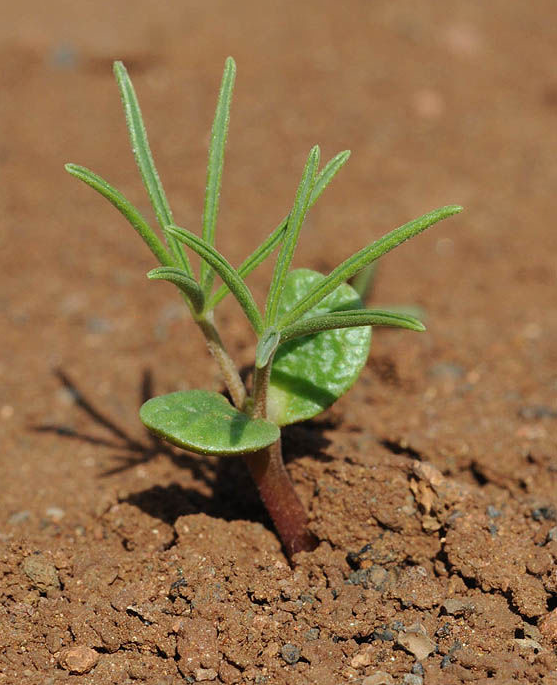
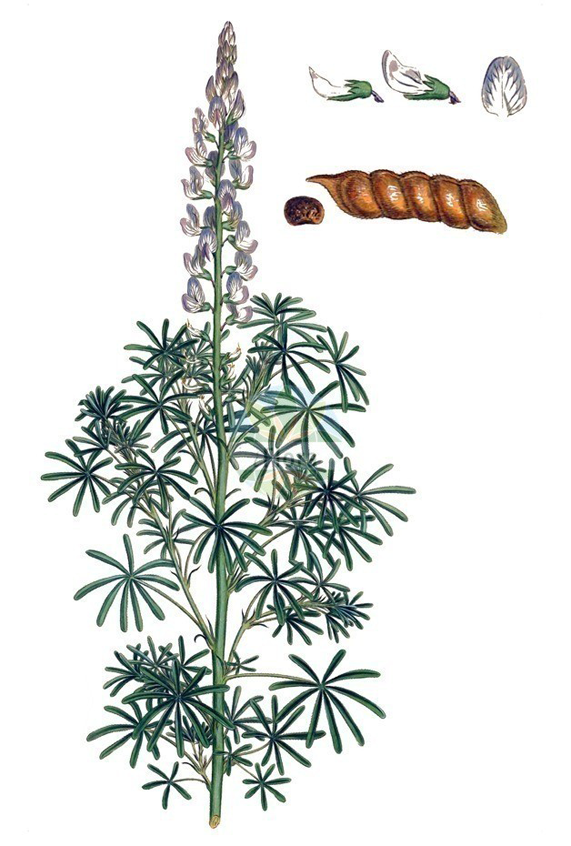
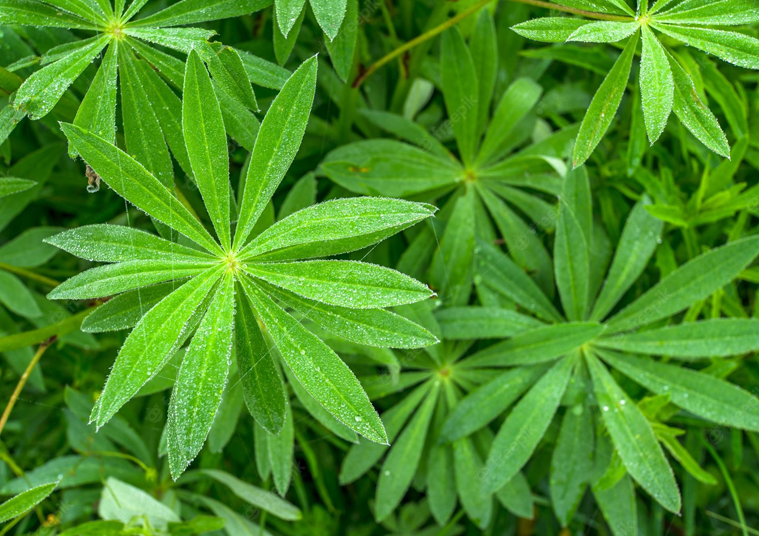
| Leaf | Dark-green colored leaves are developed from 5–9 linear-lanceolate or narrow-linear leaflets, 20–40 mm long and 2.5 mm wide. The leaves are digitate and the leaflets are narrower |
| Flowering season | June to August |
| Flower | Flowers are 11–15 mm long, almost sedentary; lower flowers are alternate, upper ones more or less sub-verticilate inside. Floral bracts are small-sized, easily falling. The calyx is bilabiate, profoundly bipartite; the lower lip is longer, entire or irregularly two- or three-toothed. The corolla is blue, violet, or, less frequently, pink and white. |
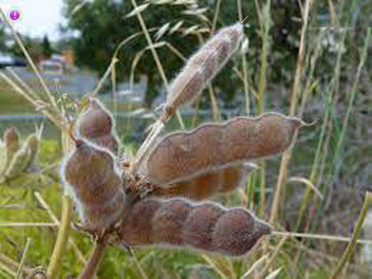
| Fruit Shape & Size | Oblong, slightly inflated pods that are 35–50 mm long and 7–10 mm wide. They are 4- or 7-seeded, with oblique partitions between seeds |
| Fruit Color | Initially green turning to brown as they mature |
| Seed | Seeds are 4–8 mm long, 3–7 mm wide and 3‒6 mm high, globular, with smooth testa, variously coloured mostly dark gray and brown to white, or speckled or mottled |
| Season | October-November |
Plant Description
Blue lupin is an erect, deeply tap rooted, fast growing, robust, much-branched, annual herb that mostly grows about 50 cm or less in height. The plant is found growing in disturbed sites, wastelands, roadsides, sandy coastal habitats, open woodlands, degraded shrub lands, abandoned fields, shrub steppes, parks, gardens, cultivated and rocky ground, secondary forests, ruderal areas, fields, gardens, and harbors, meadows, in bushes and near reservoirs. The plant does well on low to moderately fertile, well-drained, light or medium textured and mildly acidic to neutral sands and sandy loams. It does not withstand waterlogged soils but has tolerance of transient waterlogging. L. angustifolius is able to suppress native plant species by altering soil characteristics through its nitrogen fixing activity, allowing the spread of other non-native species. It is listed as invasive in Australia. The plant has robust and hairy stem, with profuse lateral branching.
Leaves
Dark-green colored leaves are developed from 5–9 linear-lanceolate or narrow-linear leaflets, 20–40 mm long and 2.5 mm wide. The leaves are digitate and the leaflets are narrower (hence the name “narrow-leaf lupin”) than in white lupin. The upper surface is glabrous, and the lower surface is sericeous. Stipules are linear and linear-lanceolate.
Flowers
The inflorescence is dense, almost sedentary, 5–20 cm long, placed on a short floral pedicle. Flowers are 11–15 mm long, almost sedentary; lower flowers are alternate, upper ones more or less sub-verticilate inside. Floral bracts are small-sized, easily falling. The calyx is bilabiate, profoundly bipartite; the lower lip is longer, entire or irregularly two- or three-toothed. The corolla is blue, violet, or, less frequently, pink and white. Flowering normally takes place in between June to August.
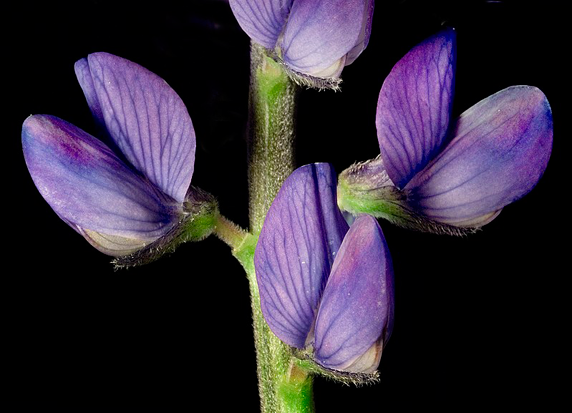 Closer-view-of-flower-of-Blue-lupin
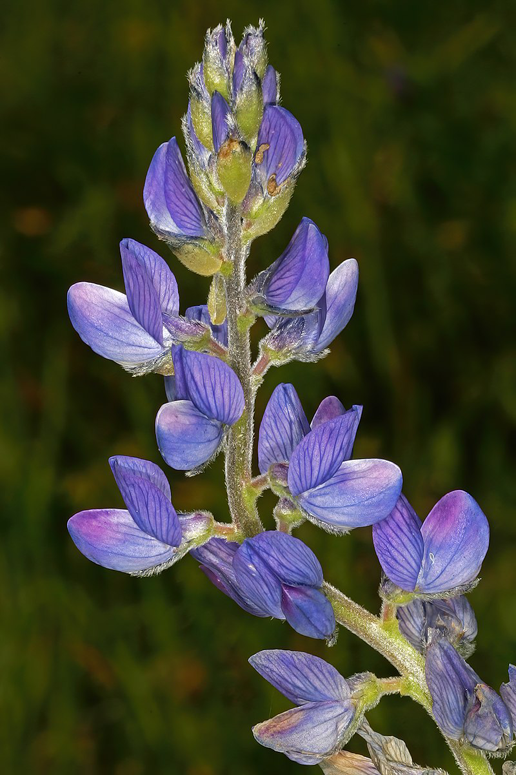 Flower-of-Blue-lupin
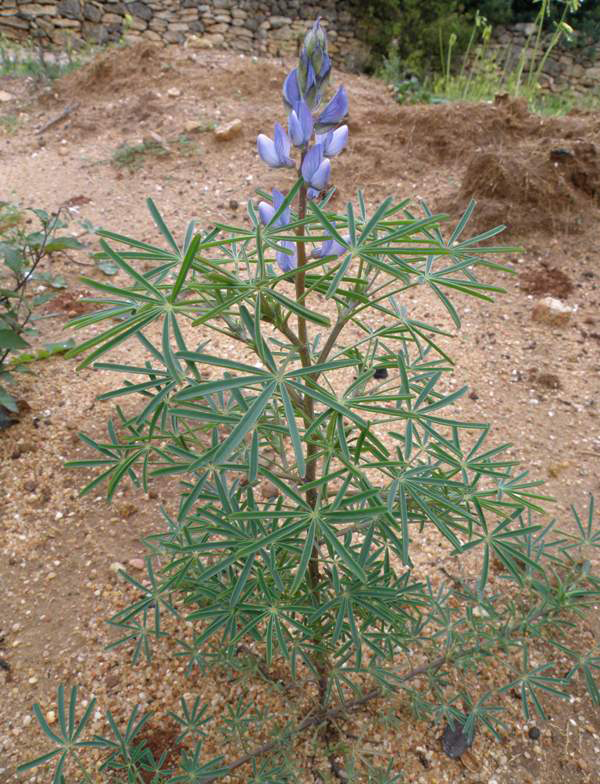 Blue-lupin-Plant
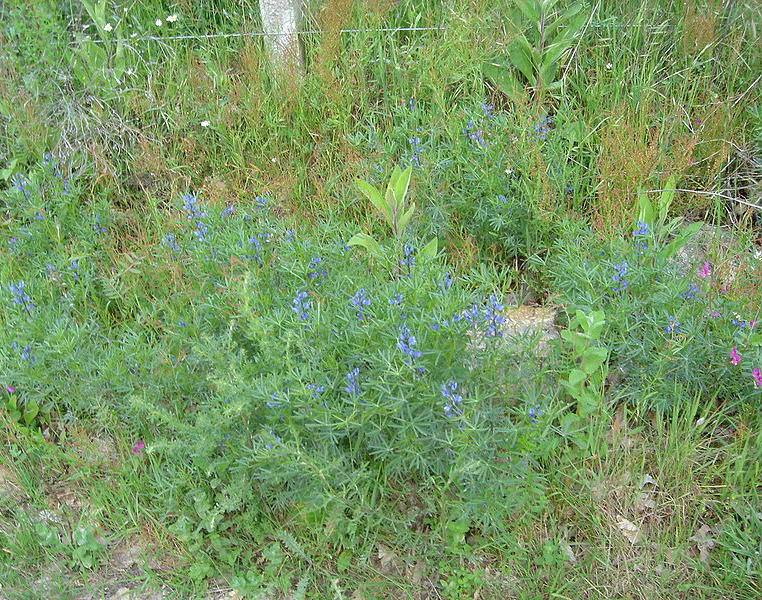 Blue-lupin-plants-growing-wild
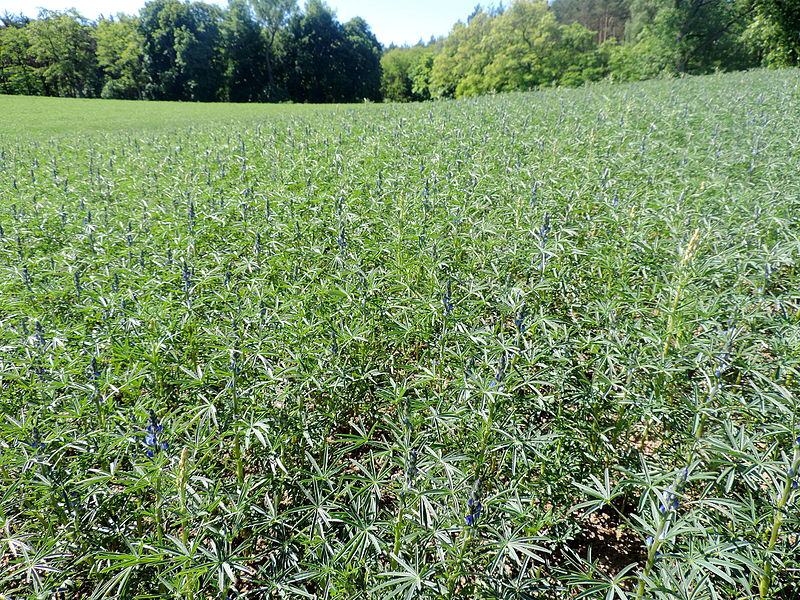 Blue-lupin-grown-on-field
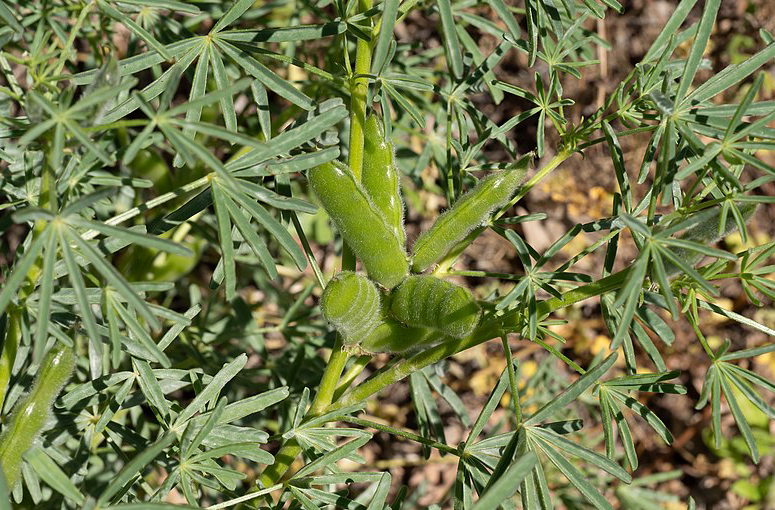 Immature-fruits-of-Blue-lupin
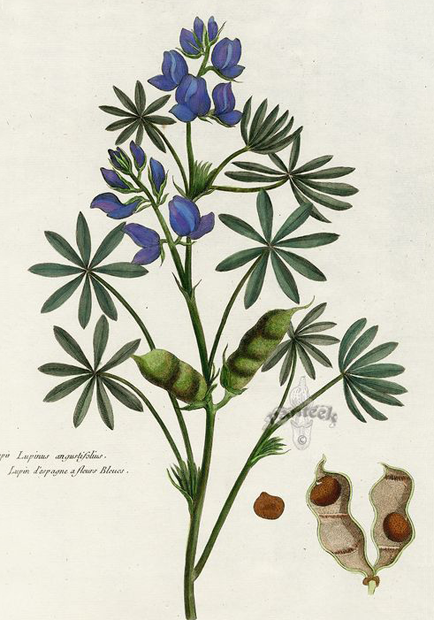 Plant-Illustration-of-Blue-lupin
 Mature-fruits-of-Blue-lupin
 Saplings-of-Blue-lupin
 Sketch-of-Blue-lupin
 Leaves-of-Blue-lupin
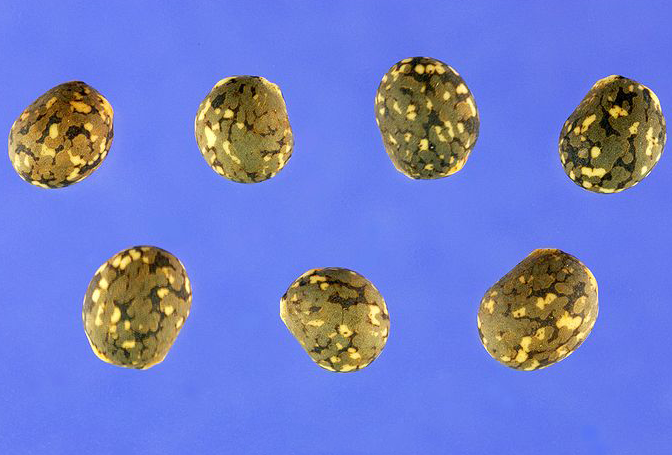 Seeds-of-Blue-lupin
Fruits
Fertile flowers are followed by oblong, slightly inflated pods that are 35–50 mm long and 7–10 mm wide. They are 4- or 7-seeded, with oblique partitions between seeds. Seeds are 4–8 mm long, 3–7 mm wide and 3‒6 mm high, globular, with smooth testa, variously colored mostly dark gray and brown to white, or speckled or mottled, with a triangular spot and a stria close to the hilum.
History
Lupinus species have an ancient history in agriculture that can be traced back more than 4000 years. Domestication first occurred in the Mediterranean region, American continent, occurring in southern Europe, northern Africa and western Asia but the breakthrough that established Lupinus species as modern agricultural crops occurred in Europe and Australia. From the 1930s to 1970s, several varieties were developed and cultivated in Australia and Germany, where it is also listed as invasive. It is listed as ‘possibly invasive’ in the Dominican Republic.
Culinary Uses
- Seed can be consumed after being cooked.
- It is used as a protein-rich vegetable or savory dish in any of the ways that cooked beans are used; they can also be roasted or ground into a powder.
- If the seed is bitter this is due to the presence of toxic alkaloids and the seed should be thoroughly leached before being cooked.
- The seed of low-alkaloid varieties is used in making ‘tempeh’.
- In France, it was formerly used as a coffee replacer.
- Lupins are mainly consumed as fermented foods, bread and pasta products, milk products or sprouts.
- Lupins were consumed by humans, with the majority used as stock feed.
Other Facts
- A good green manure plant, it produces a good bulk of organic matter and fixes atmospheric nitrogen.
- It also makes phosphorus in the soil more available to other plants.
- Plant is used as a green manure or as a grain legume for animal feed or human consumption.
- Lupins have strong roots that can reduce the compaction of a soil.
- The whole plant, including the seeds, is widely used as a fodder for livestock, due to its high protein and energy content.
- Lupin beans are growing in use as a plant-based protein source in the world marketplace.
- Stems and seed are bitter due the presence of alkaloids.
References:
https://www.itis.gov/servlet/SingleRpt/SingleRpt?search_topic=TSN&search_value=25937#null
https://npgsweb.ars-grin.gov/gringlobal/taxon/taxonomydetail?id=22805
https://pfaf.org/user/plant.aspx?LatinName=Lupinus+angustifolius
http://www.theplantlist.org/tpl1.1/record/ild-8552
https://keyserver.lucidcentral.org/weeds/data/media/Html/lupinus_angustifolius.htm
https://gd.eppo.int/taxon/LUPAN
https://en.wikipedia.org/wiki/Lupinus_angustifolius
https://www.cabidigitallibrary.org/doi/10.1079/cabicompendium.31706
https://grinczech.vurv.cz/gringlobal/taxon/taxonomydetail.aspx?id=22805
https://plants.usda.gov/home/plantProfile?symbol=LUAN4