

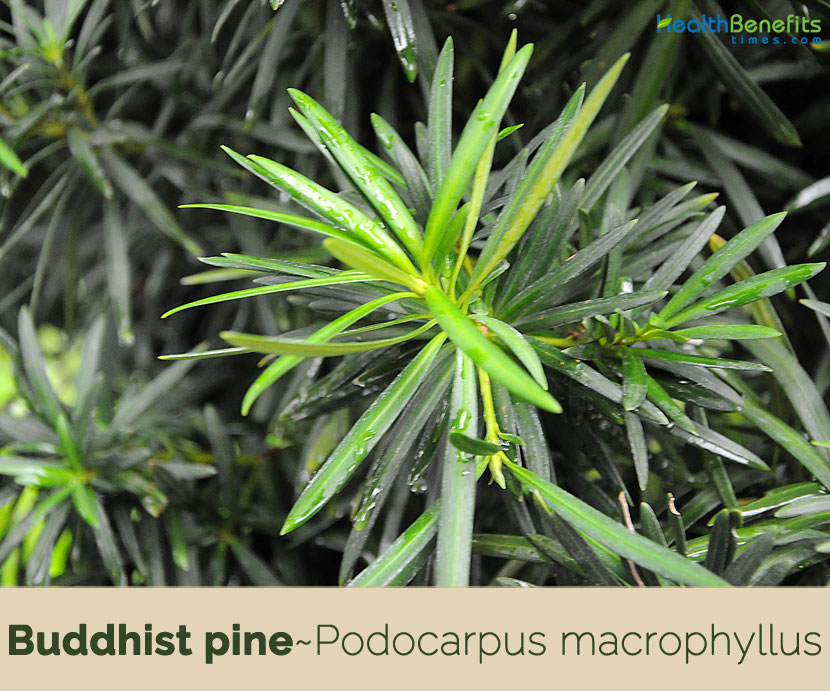
| Buddhist pine Quick Facts | |
|---|---|
| Name: | Buddhist pine |
| Scientific Name: | Podocarpus macrophyllus |
| Origin | China (Anhui, Chongqing, Fujian, Guangxi, Guizhou, Hong-Kong, Hubei, Hunan, Jiangsu, Jiangxi, Sichuan, Yunnan, Zhejiang), Japan, Myanmar and Taiwan |
| Colors | Olive-green, berry-like cones ripen to purple |
| Shapes | Cones are borne on a short stem, and have 2-4 scales, usually only one (sometimes two) fertile, each fertile scale bearing a single apical seed 10–15 mm. |
| Health benefits | Beneficial for heart, kidneys, lungs, fevers, asthma, coughs, stomach diseases, sweaty feet, gonorrhea and syphilis |
| Name | Buddhist Pine |
|---|---|
| Scientific Name | Podocarpus macrophyllus |
| Native | China (Anhui, Chongqing, Fujian, Guangxi, Guizhou, Hong-Kong, Hubei, Hunan, Jiangsu, Jiangxi, Sichuan, Yunnan, Zhejiang), Japan, Myanmar and Taiwan |
| Common Names | Big-leaf podocarp, Buddhist pine, Japanese yew, Shrubby yew, Shrubby podocarpus, Yew plum pine, Broad-leaved podocarp, Southern yew, Long-leaved podocarp, big leaf podocarp, yew plum pine, kusamaki, yew podocarp, Chinese Podocarpus, Chinese Yew Pine |
| Name in Other Languages | Arabic: Mielaqat kabirat al’awraq (معلاقة كبيرة الأوراق) Chinese: Da ye luo han song (大葉羅漢松), Luo han song (罗汉松 ), Luo han song (羅漢松) Danish: Sydtaks English: Big-leaf podocarp, Buddhist pine, Japanese yew, Shrubby yew, Shrubby podocarpus, Yew plum pine, Broad-leaved podocarp, Southern yew, Long-leaved podocarp, big leaf podocarp, yew plum pine, kusamaki, yew podocarp French: Podocarpe à grandes feuilles Finnish: Japaninpodokarpus German: Großblättrige Steineibe Hungarian: Nagylevelu kínai kotiszafa Italian: Podocarpo a grandi foglie Japanese: Quǎn diān (犬槇) Inu maki (イヌマキ), Kusamaki (クサマキ), Maki Portuguese: Podocarpus-de-folha-grande Russian: Nogoplodnik krupnolistnyj (Ногоплодник крупнолистный), Podokarpus krupnolistnyy (Подокарпус крупнолистный ) Spanish: Podocarpo de hoja grande, Tejo chino, podocarpo Swedish: Storbladig podokarp Vietnamese: Thông La hán |
| Plant Growth Habit | Dense upright, large size evergreen shrub or small tree |
| Growing Climates | Forests, open thickets and roadsides |
| Soil | Best grown in rich, slightly acidic, well-drained soils in full sun to part shade. Tolerant of shade. Intolerant of wet soils. May develop chlorosis (yellowing of the leaves) in alkaline soils. |
| Plant Size | About 20 m tall and 60 cm trunk diameter |
| Bark | Gray or grayish brown bark |
| Leaf | Arranged spirally round the shoot, crowded, erect to spreading, linear, tapering at both ends 6–12 cm long, and about 1 cm broad, obtuse or slightly acute at the apex, of firm, rather leathery texture |
| Flowering Season | April to May |
| Flower | Male and female cones are in separate plants |
| Fruit Shape & Size | Cones are borne on a short stem, and have 2-4 scales, usually only one (sometimes two) fertile, each fertile scale bearing a single apical seed 10–15 mm. |
| Fruit Color | Olive-green, berry-like cones ripen to purple |
| Propagation | By seed |
| Season | October |
| Culinary Uses |
|
Leaves & fruits
Leaves are arranged spirally round the shoot, crowded, erect to spreading, linear, tapering at both ends 6–12 cm long, and about 1 cm broad, obtuse or slightly acute at the apex, of firm, rather leathery texture, the midrib prominently raised above and below, yellowish green when young, becoming dark green above. Foliage is pleasantly fragrant when bruised. The cones are borne on a short stem, and have 2-4 scales, usually only one (sometimes two) fertile, each fertile scale bearing a single apical seed 10–15 mm. They are fleshy, olive-green, berry-like cones that ripen in the second year to purple. When mature, the scales swell up and become reddish purple, fleshy and berry-like, 10–20 mm long.
Fruits may be eaten out of hand or used in pies and cakes. They are then eaten by birds, which disperse the seeds in their droppings. Kusamaki is the state tree of Chiba Prefecture, Japan. It is a popular large shrub or small tree in gardens, particularly in Japan and the southeastern United States. The ripe cone arils are edible, though the seed should not be eaten. Because of its resistance to termites and water, it is used for quality wooden houses in Okinawa Prefecture, Japan.
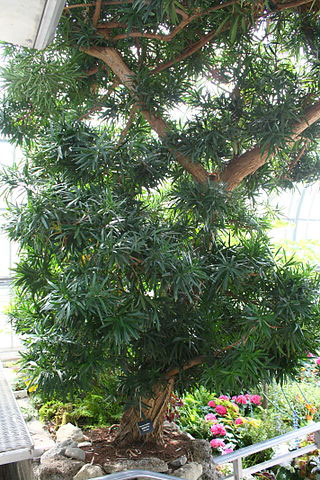 Buddhist-pine-Tree
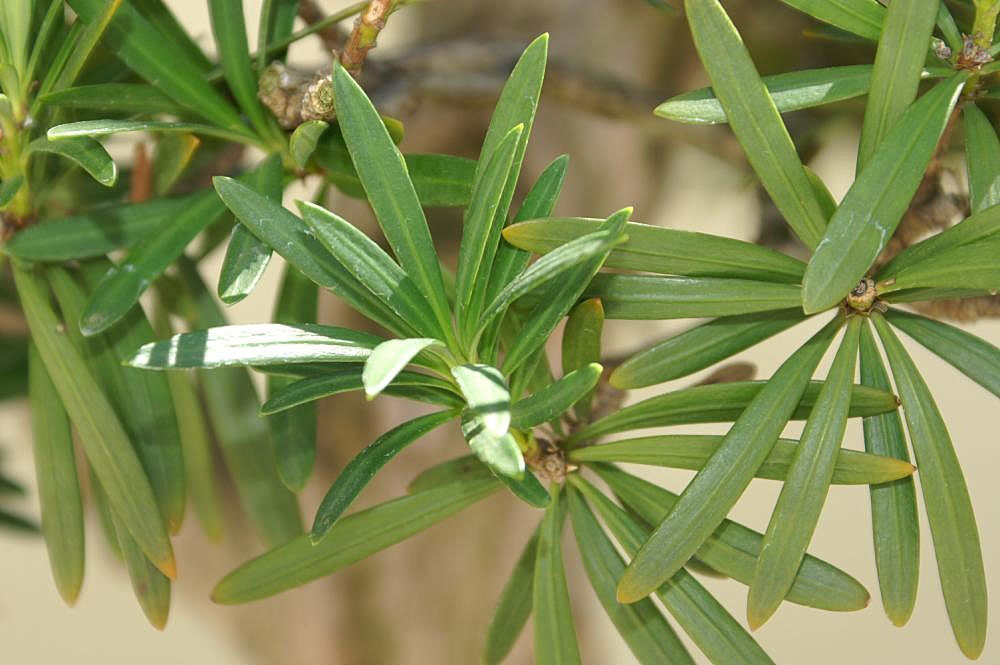 Closer-view-of-leaves-of-Buddhist-pine
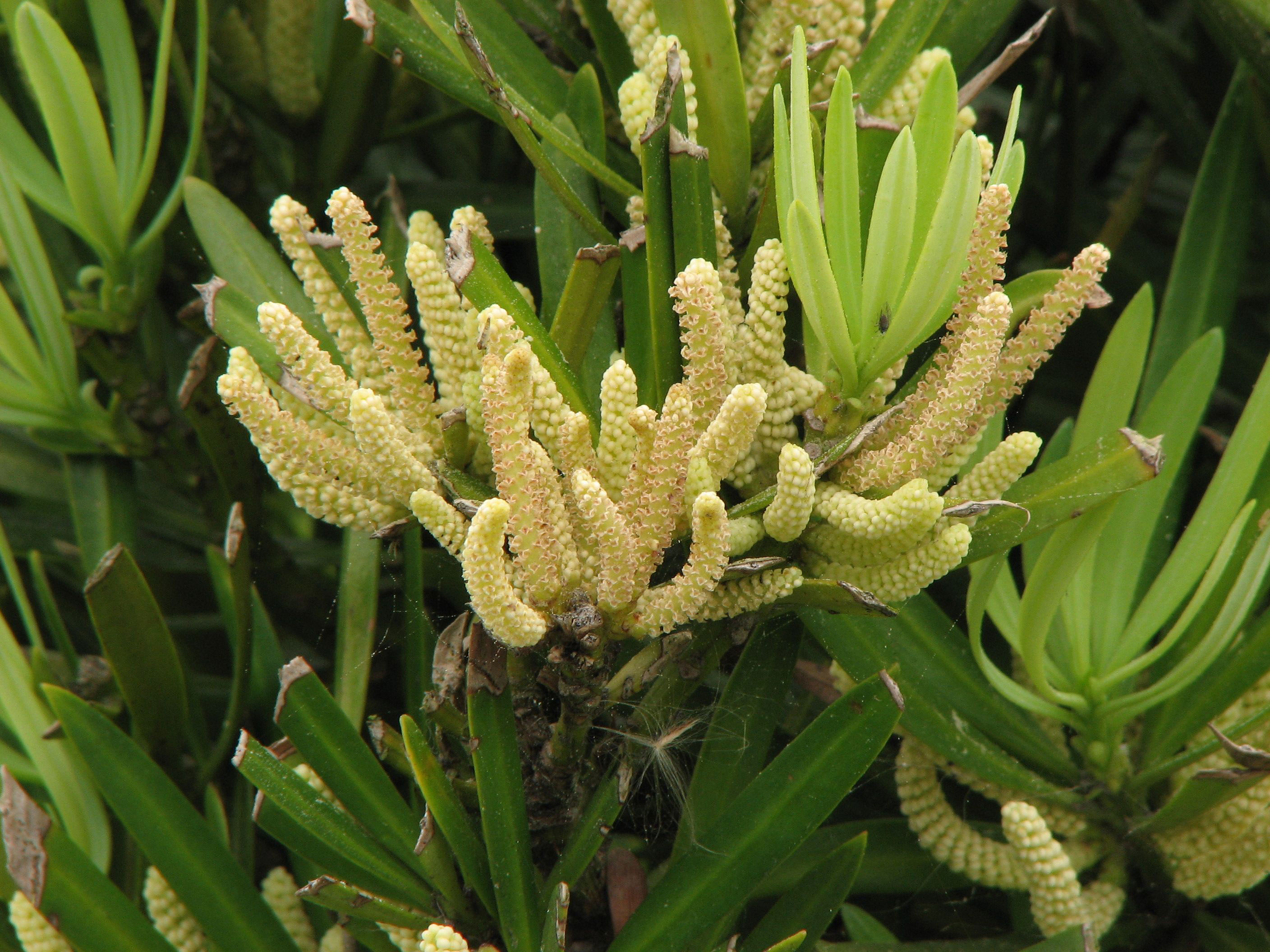 Flowers-of-Buddhist-pine
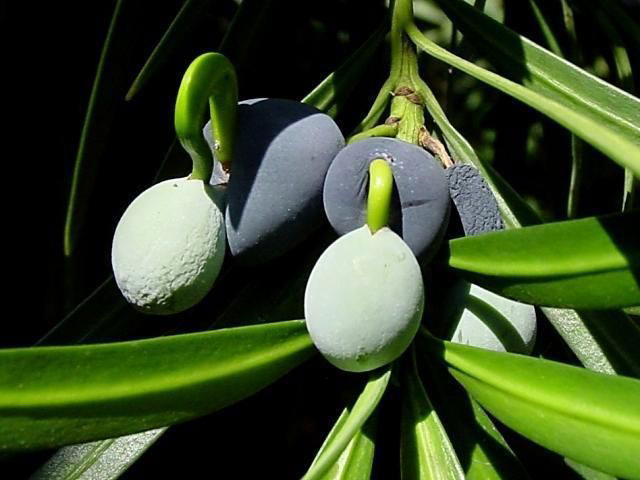 Fruits-of-Buddhist-pine
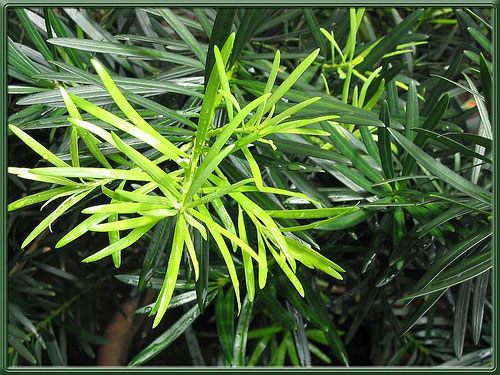 Leaves-of-Buddhist-pine
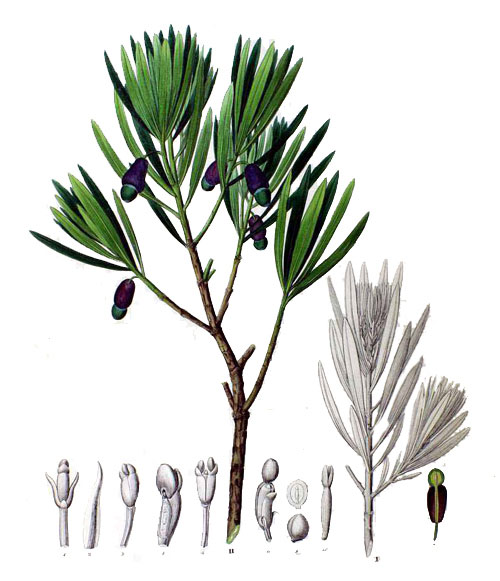 Plant-illustration-of-Buddhist-pine
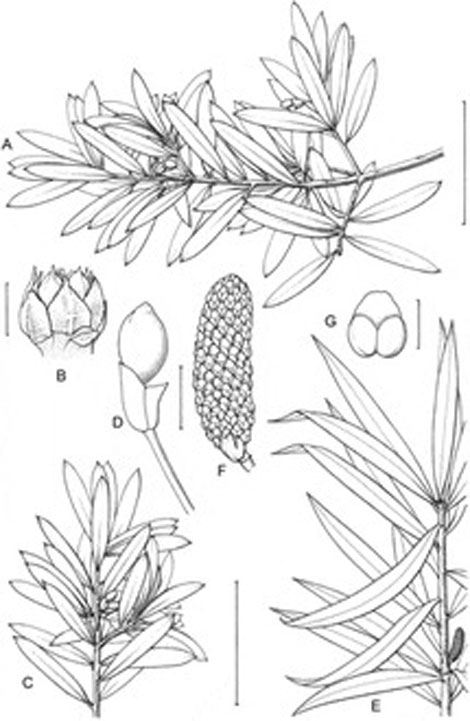 Sketch-of-Buddhist-pine
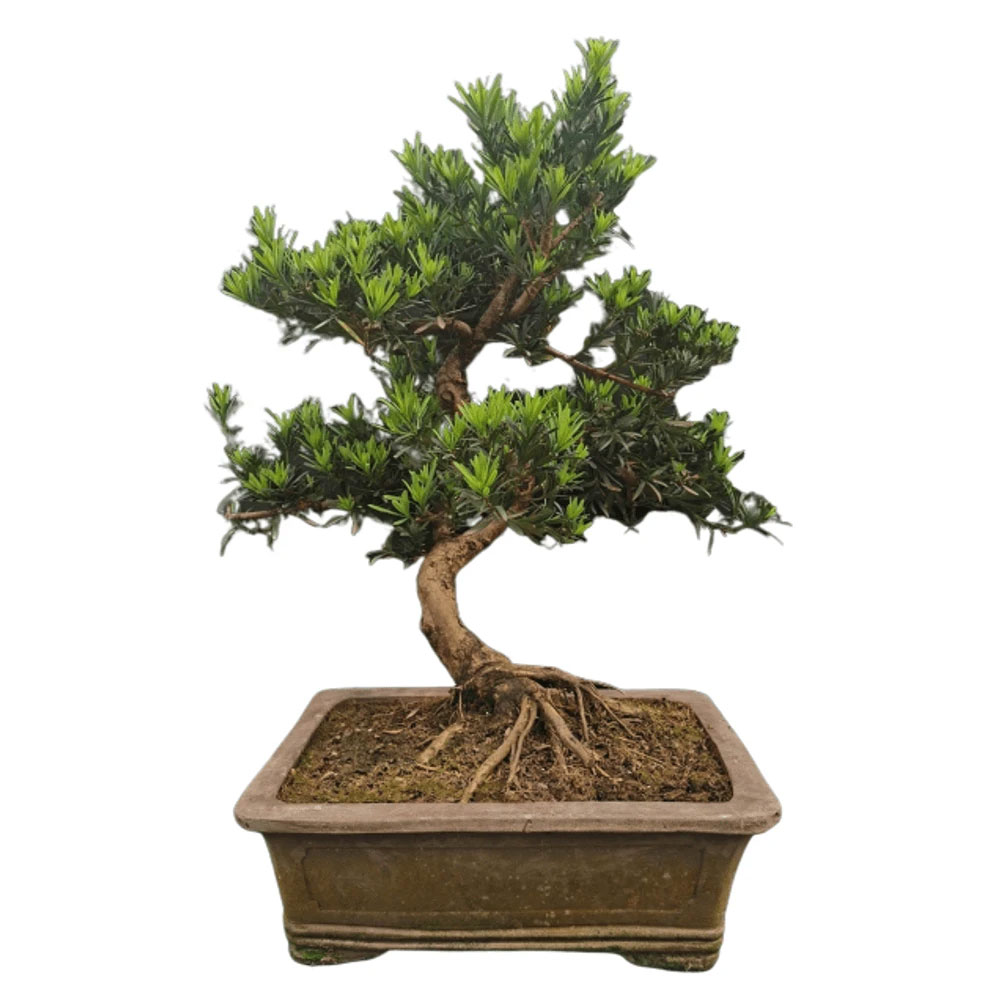 Small-Buddhist-pine-tree-on-the-pot
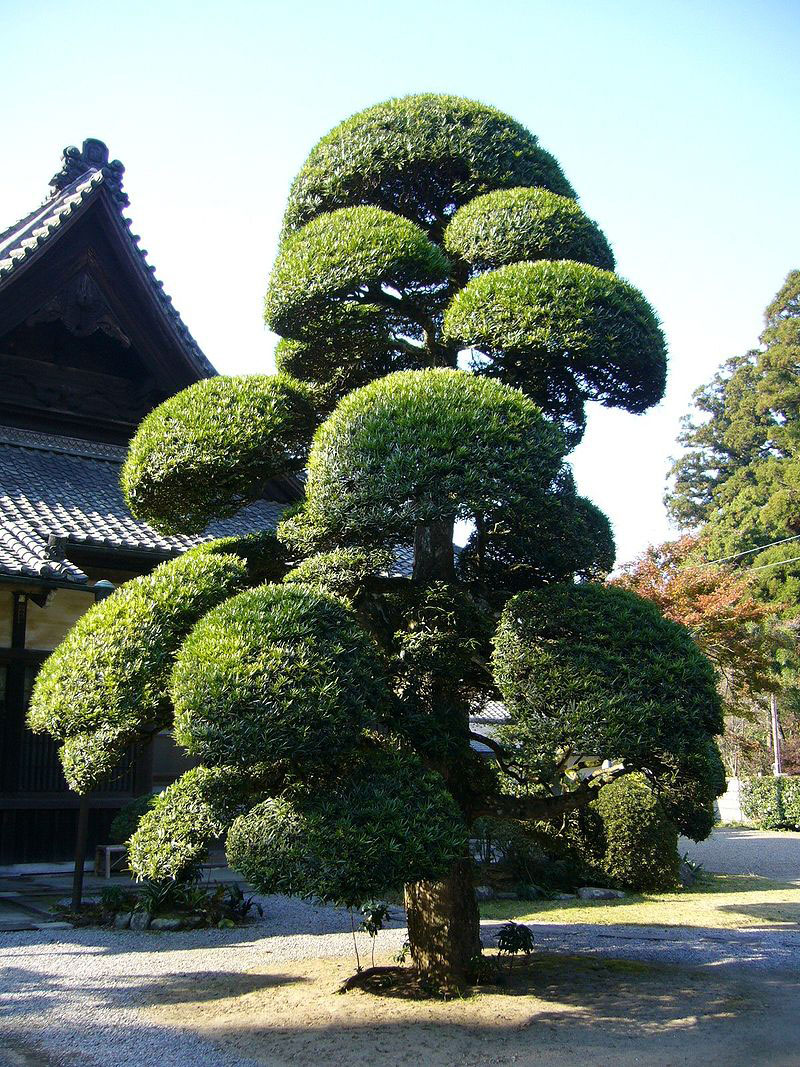 Trimmed-Buddhist-pine-tree
- Stem bark is used in the treatment of worms (especially ringworm) and blood disorders.
- Decoction of the fruit is tonic for the heart, kidneys, lungs and stomach.
- The bark is used traditionally in Ayurvedic medicine as an antiseptic, astringent and carminative and has proved to be useful in the treatment of fevers, asthma and coughs.
- Mixed with ginger, it is used as a rubefacient in the treatment of cholera.
- Stem bark is used as a wash in the treatment of arsenic poisoning, skin diseases and ulcers in China.
- Fruit is carminative, pectoral and stomachic.
- Seed is used in the treatment of cholera, heart ailments, and stomach diseases and for sweaty feet.
- Smoke from shavings of totara is used to treat venereal diseases such as gonorrhea and syphilis.
- Leaves and smoke from the leaves is used to treat piles, sores and lesions.
- Berries are consumed as laxative and unknown parts of the plant to treat constipation in women.
- Stem bark of Podocarpus macrophyllus D. Don is used in the treatment of worms and blood disorders in Ayurvedic medicine.
- Decoction of the leaves is used in Ayurvedic medicine for the treatment of rheumatism and painful joints.
Other Facts
- Plants are used for hedging in N. America.
- Erect cultivar ‘Maki’ is commonly used.
- Wood is used in making furniture, utensils, paper, and farm implements.
- This species can be trained as a bonsai.
- Kusamaki is the state tree of Chiba Prefecture, Japan.
References:
https://www.itis.gov/servlet/SingleRpt/SingleRpt?search_topic=TSN&search_value=183490#null
https://npgsweb.ars-grin.gov/gringlobal/taxonomydetail.aspx?id=29121
https://pfaf.org/user/Plant.aspx?LatinName=Podocarpus+macrophyllus
http://www.missouribotanicalgarden.org/PlantFinder/PlantFinderDetails.aspx?taxonid=285416
https://plants.usda.gov/core/profile?symbol=POMA32
http://www.phytoneuron.net/2016Phytoneuron/37PhytoN-PodocarpusArkansas.pdf
http://www.theplantlist.org/tpl1.1/record/kew-2567622
https://gd.eppo.int/taxon/PODMA