

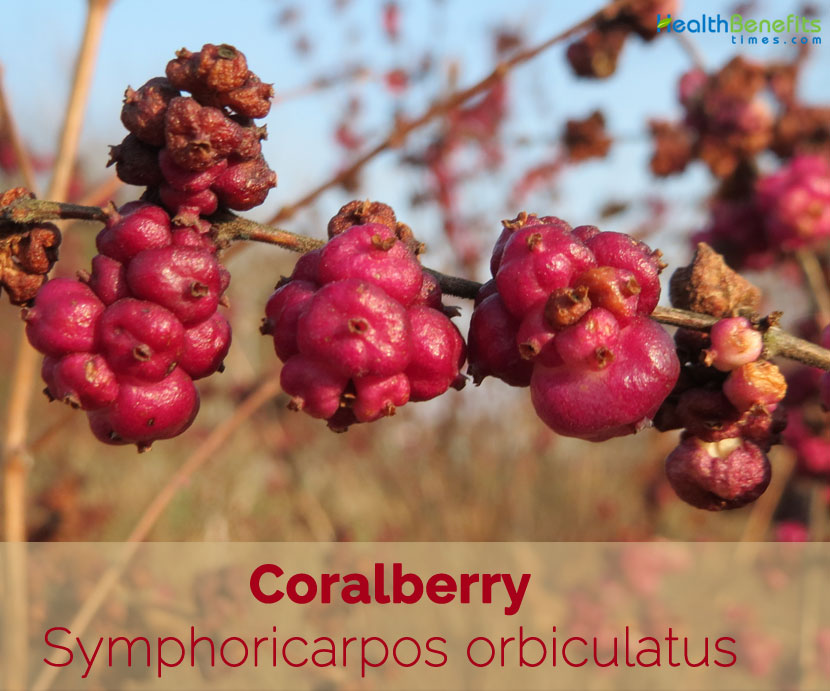
| Coralberry Quick Facts | |
|---|---|
| Name: | Coralberry |
| Scientific Name: | Symphoricarpos orbiculatus |
| Origin | Eastern and central United States as well as central Canada (Ontario) and northeastern Mexico (Coahuila, Nuevo León) |
| Colors | Pink to coral red to reddish-purple in color |
| Shapes | Ovoid to globose berry-like drupe about 1/4 inch long |
| Taste | Bitter |
| Health benefits | Good for weak, inflamed or sore eyes, tonsillitis, toothaches, arthralgia, respiratory infections, menstrual disorders, fever and earaches. |
| Name | Coralberry |
|---|---|
| Scientific Name | Symphoricarpos orbiculatus |
| Native | Eastern and central United States as well as central Canada (Ontario) and northeastern Mexico (Coahuila, Nuevo León) |
| Common Names | Coralberry, Indian Current, Snowberry, Waxberry, snapberry, buckleberry, wolfberry, turkey bush, Indiancurrant Buck brush, Round snowberry |
| Name in Other Languages | Afrikaans: Coralberry Albanian: Coralberry Amharic: Koralibēr (ኮራልቤሪ) Arabic: Kuralbiri (كورالبيري), huba althalj almudur (حب الثلج المدور) Armenian: Marjan (մարջան), Dzyunaptghik sovorakan (Ձյունապտղիկ սովորական) Azerbaijani: mərcan, Adi qargiləmeyvə Bengali: Coralberry-ˈkär-,ˈkôrəlˌberē Bulgarian: Coralberry-ˈkär-,ˈkôrəlˌberē Burmese: Kyawwathcaim (ကျောက်စိမ်း) Chinese: Shānhú méi (珊瑚莓), Yun chi zi jin niu, Chu sar gun Croatian: Coralberry, koraljni biserak Czech: Coralberry, Pámelník, pámelník červenoplodý Danish: Coralberry Dutch: Koraalbes, Koraalbes English: Coralberry, Indian-currant, Indiancurrant coralberry, Buck brush, Round snowberry Esperanto: Koralberry Estonian: Korallikas Filipino: Coralberry Finnish: Coralberry French: Coralberry, Symphorine à baies-de-corail, Symphorine orbiculaire, Groseillier des Indien, Symphorine à baies de corail, Symphorine à feuilles rondes, arbousier d’Amérique, groseillier des Indes, Georgian: Coralberry-ˈkär-,ˈkôrəlˌberē German: Korallenbeere, Korallenbeerstrauch, Korallenschneebeere Greek: Korálli (κοράλλι) Gujarati: Kōrabērī (કોરબેરી) Hausa: Murjani Hebrew: אלמוג Hindi: Coralberry-ˈkär-,ˈkôrəlˌberē Hungarian: Coralberry, Piros bogyóslonc Icelandic: Kóralbe Indonesian: Coralberry Irish: Coiréil Italian: Coralberry Japanese: Kōraruberī (コーラルベリ) Javanese: Kembang ijo Kannada: Kōralberi (ಕೋರಲ್ಬೆರಿ) Kazakh: Marjan (маржан) Korean: Koleol beli (코럴 베리) Kurdish: Coralberry Lao: Pa la bon (ປາລາບອນ) Latin: Coralberry Latvian: Koraļģes Lithuanian: Spanguolių Macedonian: Jagoda (јагода) Malagasy: Coralberry Malay: Coralberi Malayalam: Kēāṟalbeṟi (കോറൽബെറി) Maltese: Coralberry Marathi: Koralaberee (कोरलबेरी) Mongolian: Shüren (шүрэн) Navajo: Tsétsohkʼįįʼ Nepali: Koralaberee (कोरलबेरी) Norwegian: Coralberry Oriya: କରାଲବେରୀ Pashto: مرجان Persian: مرجانی توت هندی, مروارید قرمز Polish: Koralowiec, Śnieguliczka koralowa Portuguese: Coralberry Punjabi: Kōralabērī (ਕੋਰਲਬੇਰੀ) Romanian: Coralberry Russian: Coralberry (kôrəlˌberē), Snezhnoyagodnik okruglyy (Снежноягодник округлый), snezhnoyagodnik kruglolistnyy (снежноягодник круглолистный), snezhnoyagodnik obyknovennyy (снежноягодник обыкновенный) Serbian: Coralberri (цоралберри) Sindhi: مرلي Sinhala: Koralberi (කොරල්බෙරි) Slovak: Pámelník červenoplodý Slovenian: Koralnica Spanish: Coralberry, baya de coral Sudanese: Kembang garing Swedish: Coralberry, Petersbuske Tajik: Macron (марҷон) Tamil: Pavaḷappāṟai (பவளப்பாறை) Telugu: Coralberry-ˈkôrəlˌberē Thai: Coralberry-ˈkôrəlˌberē Turkish: Coralberry Ukrainian: Brusnitsya (брусниця) Urdu: مرجانبیری Uzbek: Zangori Vietnamese: Dâu tây Welsh: Coralberry, llusen gwrel Zulu: Ikhorali |
| Plant Growth Habit | Erect, slender, low-growing, spreading, evergreen, glabrous, thicket-forming shrub |
| Growing Climates | Thin rocky woodlands, woodland openings, woodland borders, powerline clearances in wooded areas, thickets, and limestone glades, freshwater wetland, treed swampy wetland, lowland forest, foothills forest, forby forest, damp forest, granitic hillslopes, rocky outcrop shrub land, western plains woodland, semi-arid woodland, alluvial plains woodland, freshwater wetland, shaded woods, stream banks, river banks, post oak woodlands, bottomland forests, bases, ledges, and tops of bluffs and pastures, old fields, fencerows, railroads, and roadsides |
| Soil | Prefers sandy, loamy and clay soils; can grow in heavy clay and nutritionally poor soils. Normally it prefers acid, neutral and alkaline soils |
| Plant Size | 6 ft. (180 cm) tall and 4-8 feet wide, but is typically 3–4 ft. (90–120 cm) tall |
| Root | Root system consists of a woody branching taproot |
| Bark | Light brown to purplish bark on young stems and brownish-gray and shreddy on old stems |
| Twigs | Slender and at first scruffy brownish green, later darkening to a reddish brown with very fine peeling strips; scales present where new branches emerge; single bundle scars |
| Leaf | Leaves are alternate, simple, dark green, leathery, elliptic lanceolate or oblanceolate with crenate or undulate margins |
| Flowering season | July to September |
| Flower | Flowers have a bell shaped corolla with five lobes, which may be whitish, yellowish or tinged in purple; the lobes do not spread widely when the flower is open |
| Fruit Shape & Size | Ovoid to globose berry-like drupe about 1/4 inch long |
| Fruit Color | Pink to coral red to reddish-purple in color |
| Seed | Hard, egg-shaped, flattened on one side, white, smooth |
| Propagation | By seed or by softwood or semi-hardwood cuttings in spring |
| Taste | Bitter |
| Season | September–October |
Plant Description
Coralberry is an erect, slender, low-growing, spreading, evergreen, glabrous, thicket-forming shrub that normally grows about 6 ft. (180 cm) tall and 4-8 feet wide, but is typically 3–4 ft. (90–120 cm) tall. The plant is found growing in thin rocky woodlands, woodland openings, woodland borders, power line clearances in wooded areas, thickets, and limestone glades, freshwater wetland, treed swampy wetland, lowland forest, foothills forest, forby forest, damp forest, granitic hill slopes, rocky outcrop shrub land, western plains woodland, semi-arid woodland, alluvial plains woodland, freshwater wetland and shaded woods.
The plant performs well in sandy, loamy and clay soils and can grow in heavy clay and nutritionally poor soils. Normally it prefers acid, neutral and alkaline soils. The root system consists of a woody branching taproot. Twigs of slender and at first scruffy brownish green, later darkening to a reddish brown with very fine peeling strips; scales present where new branches emerge and single bundle scars. The branches are erect to ascending and arching, slender with light brown to purplish bark on young stems and brownish-gray and shreddy on old stems. Young twigs have soft hair.
Leaves
The leaves are oval or ovate shaped, and arranged oppositely along the branches. The blades of the opposite leaves are up to 2 inches long and 1¼ inches across. They are oval-ovate and the margins are without lobes or teeth but the margin may be wavy. Both tip and base are of obtuse shape. The upper surface of each leaf blade is medium green and hairless to slightly pubescent, while the lower surface is whitish green and usually has fine hair, particularly on the veins and the leaf edge. Each leaf has a short petiole up to ¼ inches long. Leaf venation is pinnate.
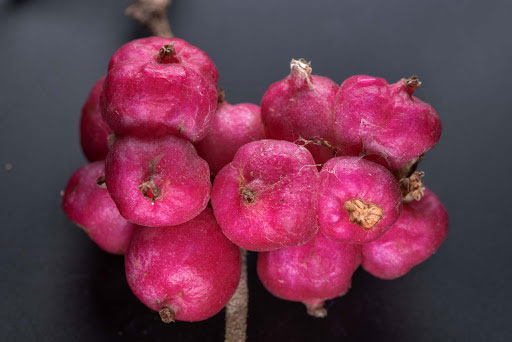 Closer-view-of-fruit-of-Coralberry
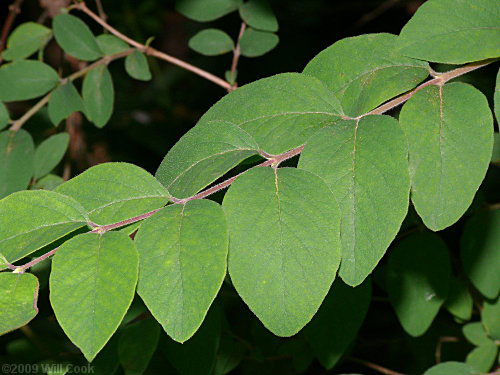 Closer-view-of-leaves-of-Coralberry
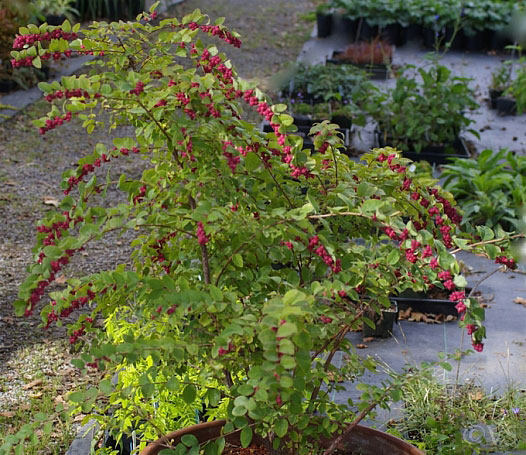 Coralberry-plant
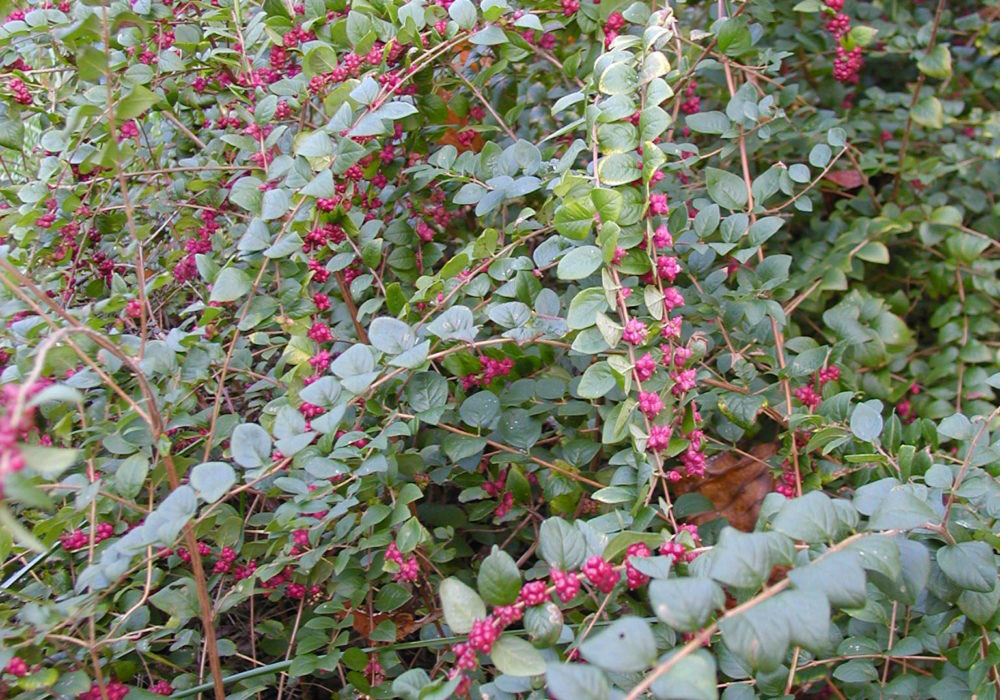 Coralberry-plant-growing-wild
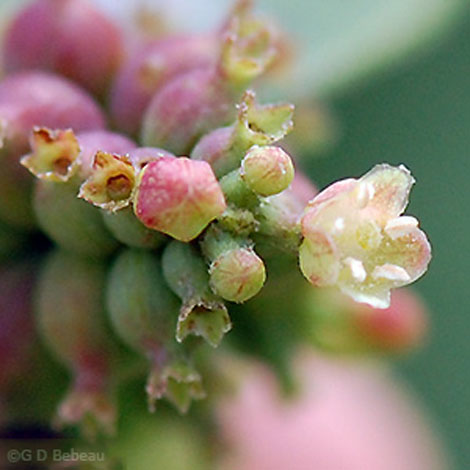 Flower-of-Coralberry
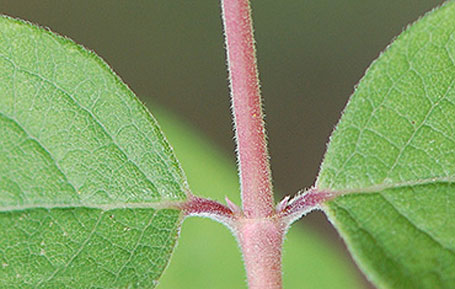 Immature-Stem-of-Coralberry
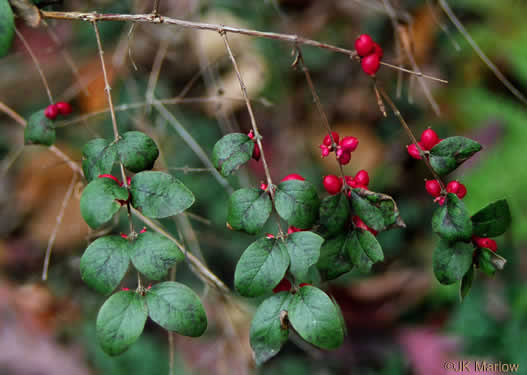 Leaves-of-Coralberry
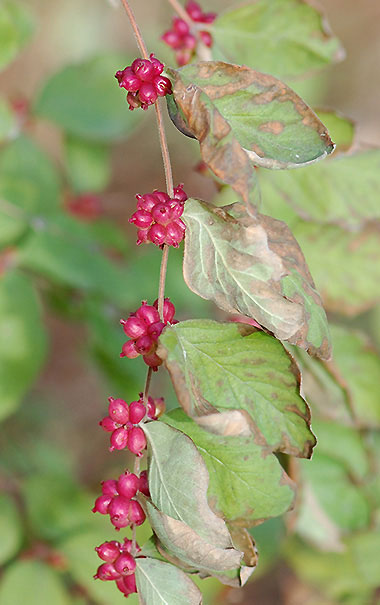 Mature-fruits-of-Coralberry
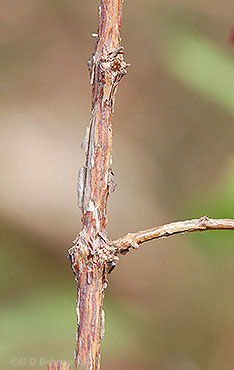 Mature-stem-of-Coralberry
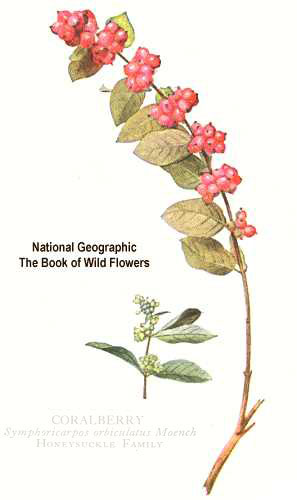 Plant-Illustration-of-Coralberry
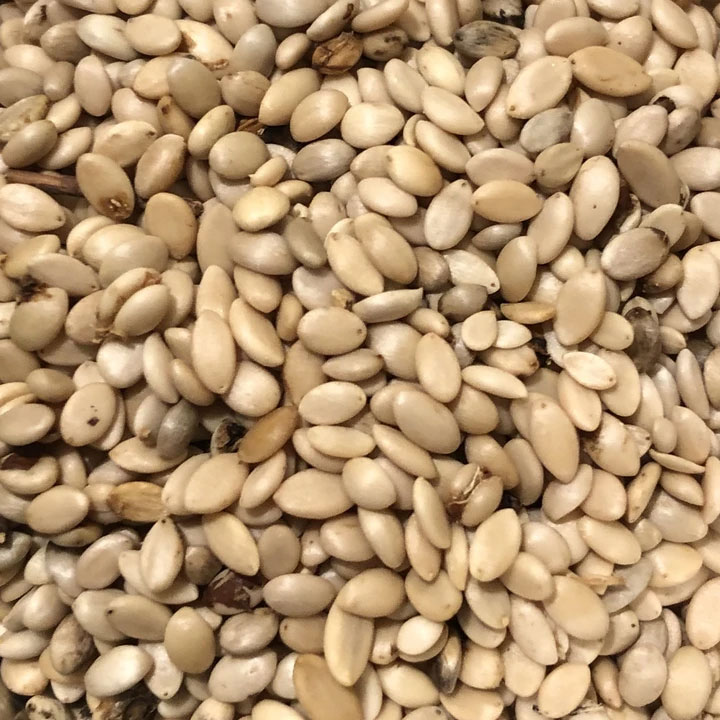 Seeds-of-Coralberry
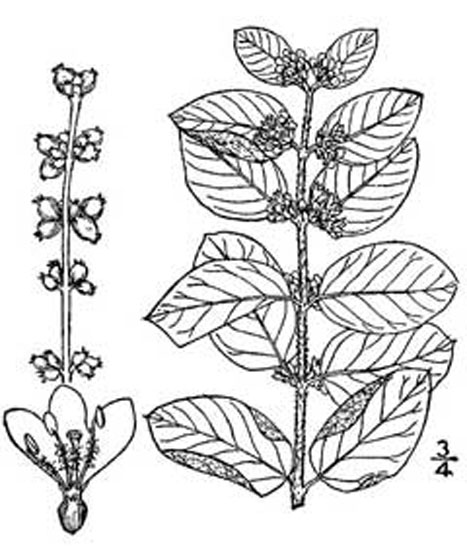 Sketch-of-Coralberry
Flower
The inflorescence is tight cluster of very small flowers in the axils of some of the leaf pairs – generally toward the tips of the stems. The flowers have a bell shaped corolla with five lobes, which may be whitish, yellowish or tinged in purple; the lobes do not spread widely when the flower is open. The calyx is green with five pointed teeth which persist onto the drupes. The reproductive parts include 5 stamens which surround a bearded (hairy) style. Each flower is about 1/4 inch long.
Fruit
Each fertile flower is replaced by an ovoid to globose berry-like drupe that is pink to coral red (from which comes the common name) to reddish-purple in color, and about 1/4 inch long. The drupes are usually so densely packed that the shape is often flattened. The top end of the drupe has a short beak. The texture of their flesh is fleshy but not juicy. Fruit sometimes persists through the winter. Each drupe contains a single stony seed. Seeds are hard, egg-shaped, flattened on one side, white and smooth. Rarely, you might find a plant that bears white fruits.
Traditional uses and benefits of Coralberry
- A decoction of the inner bark or leaves has been used as a wash in the treatment of weak, inflamed or sore eyes.
- A cold decoction of the root bark has been used as an eye wash to treat sore eyes.
- Root is considered anodyne, depurative, and febrifuge and is used to stimulate blood circulation.
- In traditional Chinese medicine, roots used for treatment of tonsillitis, toothaches, arthralgia, respiratory infections, and menstrual disorders.
- In Kampung Bawong, Perak, West Malaysia, juice from crushed whole plant used to treat fever and earaches.
Few Interesting Facts
- Plants can be grown as a hedge or informal screen.
- Plants have an extensive root system and also sucker freely; they can be used for soil stabilization.
- The flowers provide nectar for bees, wasps, and flies.
- Foliage supports a number of moth caterpillars. The berries provide winter food for birds, including the Bobwhite and Robin.
- Coralberry can be a problem plant in pastures, hay fields, and roadsides.
- Native Americans apparently crushed this plant, pushed it into stream water, and used it to stun fish that could then be collected downstream from the water’s surface.
Precautions
- Fruits are toxic to people, causing nausea and vomiting if eaten in large enough quantities.
- Pregnant and breastfeeding women should avoid using the herb.
References:
https://www.itis.gov/servlet/SingleRpt/SingleRpt?search_topic=TSN&search_value=35337#null
https://npgsweb.ars-grin.gov/gringlobal/taxon/taxonomydetail?id=36010
https://pfaf.org/user/Plant.aspx?LatinName=Symphoricarpos+orbiculatus
http://www.missouribotanicalgarden.org/PlantFinder/PlantFinderDetails.aspx?kempercode=f730
https://en.wikipedia.org/wiki/Symphoricarpos_orbiculatus
http://gringlobal.iita.org/gringlobal/taxonomydetail.aspx?id=36010
https://gd.eppo.int/taxon/SYPOR
https://plants.usda.gov/core/profile?symbol=SYOR
https://www.wildflower.org/plants/result.php?id_plant=syor
http://vro.agriculture.vic.gov.au/dpi/vro/vrosite.nsf/pages/weeds_coralberry
http://temperate.theferns.info/plant/Symphoricarpos+orbiculatus
http://dendro.cnre.vt.edu/DENDROLOGY/syllabus/factsheet.cfm?ID=466
https://www.illinoiswildflowers.info/savanna/plants/coralberry.htm
https://davesgarden.com/guides/pf/go/56481/#b