| Name |
Elderberry |
| Scientific Name |
Sambucus nigra |
| Native |
Native to Europe, but has been naturalized to the Americas. The plant is native around arctic regions of Northern hemisphere and is now grown in commercial scale throughout the world. Elderberry is very common in most of Europe which includes Scandinavia and northwest, Asia Minor, Africa, Caucasus to Western Siberia. Its accepted distribution area reaches in Norway, Lithuania. |
| Common/English Name |
Black Elder, Common Elder, Pipe Tree,European Elderberry, Bore Tree, Tree Of Music, Danewort, Tree Of Medicine,Elder Bush, Elder, Elderberry, European Alder, European Black Elderberry, European Elder, European Black Elder, Pipe Tree, Sambu, Bour Tree. |
| Name in Other Languages |
Brazil: Sabugueiro
Slovencina: Baza Čierna
Dutch: Gewone Viler
Norwegian: Hyll, Hærsbutre, Svarthyll; Papiamento: Sauku
Eastonian: Must Leeder
Portuguese: Sabugueiro-Negro;
Finnish: Mustaselja Noir
German: Flieder, Fliederbeerbusch, Hollerbusch, Schwarzer Holunder
Danish: Almindelig Hyld, Hyld, Hyldebær
Hungarian: Fekete Bodza
French: Grand Sureau, Seu, Sus, Sureau, Sureau
Icelandic: Svartyllir
Italian: Sambuco, Sambuco, Commune, Sambuco Negro, Sambuco Nero, Zambuco
Lithuanian: Juoduogis Šeivamedis
Latvia: Melnais Plūškoks
Czech: Bez Černý
Russian: Buzina Černaja;
Slovašcina: Črni Bezeg, Bezeg, Bezeg Črni
Spanish: Cañiler, Canillero, Caúco Negro, Sabuco, Sauch, Saúco
Polish: Bez Czarny, Czarny Bez, Dziki Bez Czarny, Dziki Czarny Bez
Swedish: Äkta Fläder, Fläder, Hyll, Sommarfläder, Vanlig Fläder |
| Description |
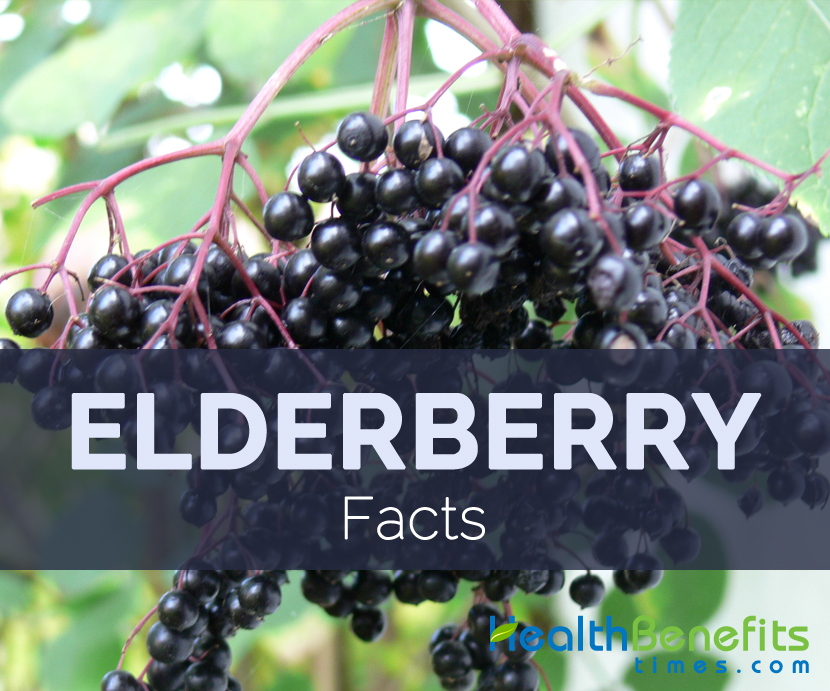
Elderberry is actually the edible black or red berrylike drupe of a tree or shrub of the genus Sambucus which can be consumed raw or processed into preserves or wines. It is in fact a storeroom of various health promoting nutrients, vitamins and minerals. |
| Plant Growth Habit |
Deciduous branching shrub to small tree |
| Growing Climate |
Sunny areas |
| Soil |
Tolerates an extensive variety of wet to dry soils however prefers moist, rich, somewhat acid soil. |
| Plant Size |
6 m (20 ft) tall and wide (rarely 10m tall). |
| Root |
Tap Root |
| Bark |
Bark, light grey when young, gradually modify to a rough grey outer bark along with lengthwise furrowing |
| Branch |
Woody and herbaceous branches to 12 ft. |
| Leaf |
Pinnately-compound leaves up to 12 inches long, opposite, consisting of a central axis with 4 to 10 usually 4 to 6, paired leaflets and a terminal one often larger. |
| Leaflets |
Leaflets are ovate to elliptic or even narrower, up to seven inches long, with prolonged tip and a broadly wedge shaped base and margins toothed except at the tip and toward the base, the teeth narrow and pointed toward the tip |
| Flowering Season |
From May to July |
| Flower |
Bisexual, Pentamerous, actinomorphic, calyx lobes small, corolla rotate, with a short tube and spreading lobes, white, 3/16 to 1/4 inch across, in broad, flat, noticeable clusters up to 10 inches or more in diameter, somewhat rancid odor. |
| Fruit shape & size |
Drupe, 8 to 10 mm, globose |
| Fruit color |
Green berries while young that turn red then dark purple to black berry as soon as they ripen. |
| Flavor/aroma |
| Distinctly tart and acidic flavor |
|
| Fruit Taste |
Tart taste |
| Seed |
3–5 small, compressed seeds |
| Varieties/Types |
- Adams No. 2
- York
- Johns
- Scotia
- Beauty
- Black Lace
- Nova
- Variegated
- American elderberry
- European elderberry
|
| Season |
| During July through September |
|
| Major Nutrition |
Nutrients
Water 115.71 g
Energy 106 Kcal
Energy 442 kJ
Protein 0.96 g (1.92%)
Total Fat (lipid) 0.72 g (2.06%)
Ash 0.93 g
Carbohydrate 26.68 g (20.52%)
Total dietary fiber10.2 g (26.84%)Minerals
Iron 2.32mg (29%)
Copper 0.088mg (9.78%)
Potassium 406mg (8.64%)
Phosphorus 57mg (8.14%)
Calcium 55mg (5.50%)
Magnesium 7mg (1.67%)
Selenium 0.9 µg (1.64%)
Zinc 0.16mg (1.45%)
Sodium 9mg (0.60%)Vitamins
Vitamin C (ascorbic acid) 52.2 mg (58.00%)
Vitamin B6 (Pyridoxine) 0.334 mg (25.69%)
Vitamin B1 (Thiamin) 0.102 mg (8.50%)
Vitamin B2 (Riboflavin) 0.087 mg (6.69%)
Vitamin A 44 µg (6.29%)
Vitamin B3 (Niacin) 0.725 mg (4.53%)
Vitamin B5 (Pantothenic acid) 0.203 mg (4.06%)
Vitamin B9 (Folate) 9 µg (2.25%)Lipids
Saturated Fatty acids 0.033 g (0.05%)
palmitic acid 0.026 g
Stearic acid 0.007 gMonounsaturated Fatty acids
Oleic acid 0.116 gPolyunsaturated Fatty acids 0.358 g (2.11%)
Linoleic acid 0.235 g
Linolenic acid 0.123 gAmino Acids
Phenylalanine and Tyrosine 0.132 g (4.55%)
Tryptophan 0.019 g (4.32%)
Methionine and Cystine 0.042 g (2.51%)
Leucine 0.087 g (2.35%)
Isoleucine 0.039 g (2.33%)
Valine 0.048 g (2.27%)
Threonine 0.039 g (2.22%)
Histidine 0.022 g (1.79%)
Lysine 0.038 g (1.14%)
Arginine 0.068 g
Alanine 0.044 g
Aspartic acid 0.084 g
Glutamic acid 0.139 g
Glycine 0.052 g
Proline 0.036 g
Serine 0.046 gPhytochemicals
Anthocyanidins
Cyanidin 703.63 mg
Flavonols
Isorhamnetin 7.9 mg
Kaempferol 0.8 mg
Quercetin 38.8 mg
Proanthocyanidin
Proanthocyanidin dimers 15.4 mg
Proanthocyanidin trimmers 8.2 mg
Proanthocyanidin 4-6mers 15.7 mg |
|
| Health Benefits |
- Protection from Cold
- Beneficial for Skin
- Rich in Antioxidant
- Healthy Immune Functions
- Brain Function
- Vision Supports
- Gingival effects
- Digestive Health
- Bone Health
- Heart Health
|
| Calories in 1cup (145gm) |
106 Kcal |
| Traditional Uses |
- ‘Elder Flower Water’ is made from the fresh flowers by distillation. The water is slightly astringent and a gentle stimulant.
- It is used as a vehicle for eye and skin lotions.
- An infusion made from elderberry is used in the treatment of chest complaints and as a wash for inflamed eyes.
- Tea made from flowers is used to cure cold, high temperature and scarlatina.
- The flowers are used externally in poultices to ease pain and relieve inflammation; used as an ointment, it treats scalds, chilblains, wounds, burns.
- A tea made from the dried berries is effective for colic and diarrhea.
- The juice is claimed to be an excellent cure for inflamed eyes.
- An ointment made from the leaves is used in the treatment of wounds, sprains, chilblains, bruises.
- The inner bark is utilized for the treatment of constipation as well as arthritic conditions.
- An soothing cream is made from the green inner bark.
- The pith of young stems is used in curing burns and scalds.
- The root is effective for dropsy yet is no longer used in herbal medicine.
- Fruits are used to encourage urination.
|
|
| Precautions: |
- Even though elderberry is not generally considered toxic, isolated cases of poisoning in animals and man have been stated after eating the bark, leaves, berries, roots and stems.
- The dark blue/purple berries can be eaten when completely ripe but are slightly fatal in their unripe state.
- Almost all green parts of the plant are poisonous because it contains cyanogenic glycosides.
- Allergic reaction is noticed occasionally with the use of Elderflowers and elderberries.
- Elderberry may have a risk of causing birth defects, premature labor and miscarriage. It is not recommended for Breastfeeding and pregnant women.
- Severe diarrhea, nausea and vomiting are cause by using Uncooked or unripe elderberries. Only the blue/black berries of elder are palatable.
- Because of elder flower’s probable diuretic effects, use caution if taking it along with drugs that increase urination.
- Syrup made from Elderberry may have the tendency to decrease the level of blood sugar. Therefore, those who are using medicines like metformin to control their sugar level must be conscious regarding taking the syrup. Taking the syrup together with these medicines may result in hypoglycemia (low blood sugar)
|
| How to Eat |
- Tea
- Wine
- Brandy
- Jelly and jams
- Soup
- Fritters
- Syrup
- Infusions
- Food Coloring
- Pies
- Ointments
- Astringent
- Juice
- Sprays
- Lozenges
- Pills
- Liquid
- Powder
- Capsules
|
| Other Facts |
- Extracts from elderberry are used in horticulture as a repellent against insects.
- Elderberry shoots are placed into the soil to fright off mice and moles.
- Elderberry has also been grown for erosion control.
- It is not valued as a timber because of its small dimensions, yet the wood is appropriate for making pegs and other small wooden items simply because of its whiteness, good cutting, close grain and polishing properties.
- The pith of 1-year-old branches is used for making plant sections in microscopy.
|