


Elbow pain is discomfort, soreness, or stiffness in or around the hinge that connects the upper arm bone (humerus) to the two forearm bones (radius and ulna). Anatomically, the elbow is a complex synovial hinge joint with three articulations, the humeroulnar, humeroradial, and proximal radioulnar joints that together allow bending, straightening, and forearm rotation. 1 Pain can come from tendons, muscles, ligaments, nerves, bursae, or the joint surfaces themselves, and it is one of the most frequent reasons adults consult a clinician for upper-limb complaints. 2 Population studies estimate that lateral epicondylitis (commonly called “tennis elbow”) affects around 1–3% of adults each year, with peak occurrence between ages 35 and 54. 3 Most cases are not dangerous, and the majority improve with simple, conservative care.
Causes of Elbow Pain
Elbow pain rarely comes out of nowhere it usually traces back to one of these common sources:
- Lateral epicondylitis (tennis elbow): An overuse injury of the common extensor tendon, especially the extensor carpi radialis brevis, where the forearm muscles attach to the outer elbow. 4
- Medial epicondylitis (golfer’s elbow): A degenerative tendinopathy of the flexor-pronator tendons on the inner elbow, typically driven by repetitive wrist flexion or forearm rotation. 5
- Olecranon bursitis: Inflammation of the fluid-filled sac at the tip of the elbow, often from leaning on hard surfaces, direct trauma, gout, or infection. 6
- Cubital tunnel syndrome: Compression of the ulnar nerve as it passes behind the medial epicondyle, the second most common nerve entrapment in the upper limb. 7
- Elbow osteoarthritis: Cartilage wear, more common with aging, prior trauma, and heavy manual labor.
- Repetitive occupational strain: A systematic review reported that handling tools heavier than 1 kg (odds ratios 2.1–3.0), lifting loads over 20 kg at least ten times a day (OR 2.6), and performing repetitive movements for more than two hours per day (ORs 2.8–4.7) are all linked with lateral epicondylitis. 8
- Little League elbow: A growth-plate injury in young throwing athletes between roughly ages 8 and 15. 9
- Acute trauma: Falls onto an outstretched hand, dislocations, and fractures.
- Smoking and obesity: Independent risk factors for both lateral and medial epicondylitis. 10
Symptoms of Elbow Pain
The way elbow pain shows up depends on the cause, but watch for these familiar signs:
- A dull ache or sharp pain on the outer side (tennis elbow) or inner side (golfer’s elbow) of the elbow
- Pain that radiates down the forearm when gripping, lifting, or twisting
- Weak grip strength, especially when shaking hands or opening jars
- Tenderness when pressing on the bony bumps of the elbow
- Stiffness, especially in the morning or after rest
- Swelling or a soft “egg” at the tip of the elbow (suggestive of olecranon bursitis)
- Tingling, numbness, or “pins and needles” in the ring and little fingers (suggestive of cubital tunnel syndrome) 11
- Pain that worsens with repetitive wrist or finger movement
- Trouble fully straightening the elbow
Elbow Pain Facts Table
| Symptoms | • Outer or inner elbow pain • Weak grip • Tenderness over bony bumps • Tingling into fingers (ulnar nerve) • Swelling at the tip of the elbow |
| Causes | • Tendon overuse (lateral/medial epicondylitis) • Bursitis • Nerve compression (cubital tunnel) • Osteoarthritis • Acute injury |
| Types of Elbow Pain | • Tennis elbow (lateral) • Golfer’s elbow (medial) • Olecranon bursitis • Cubital tunnel syndrome • Elbow osteoarthritis • Little League elbow |
| How It Spreads | • Pain can radiate from the elbow into the forearm, wrist, or hand • Ulnar nerve compression sends symptoms toward the ring and little fingers • Referred pain from the neck or shoulder can mimic elbow pain |
| Age Group | • Peak prevalence between ages 40–60 for epicondylitis • Little League elbow in children 8–15 • Osteoarthritis more common after age 50 |
| Risk Factors | • Repetitive gripping and forceful work • Racquet, throwing, or tool-based sports • Smoking and obesity • Female sex (for lateral epicondylitis in some populations) |
| How Doctors Diagnose |
• History and physical exam • Provocative tests (e.g., Cozen’s test for tennis elbow) • Ultrasound or MRI when diagnosis is unclear • Nerve conduction studies for suspected cubital tunnel |
| Other Facts | • Within one year, 70%–90% of lateral epicondylitis cases show spontaneous resolution or respond to conservative management • Lateral epicondylitis is far more common than medial • Most cases never require surgery |
Exercise and Natural Remedies for Elbow Pain
Exercises are the backbone of recovery for almost every type of overuse elbow pain. A 2021 meta-analysis of 30 randomized trials covering more than 2,000 patients concluded that exercise interventions for lateral elbow tendinopathy produce better outcomes than passive treatments, even though the effects are modest. 16 Start gently, stay consistent, and stop any movement that produces sharp pain.
1. Eccentric Wrist Extensor Strengthening (The “Tyler Twist”)
You will need a soft rubber bar (often called a FlexBar). Hold one end with the painful arm in maximum wrist extension and grip the other end with your healthy hand. Twist the bar with the healthy wrist, bring both arms straight in front of you, and then very slowly let the painful wrist roll down into flexion over 3–4 seconds. Perform 3 sets of 15 repetitions, once a day. In a randomized trial published in the Journal of Shoulder and Elbow Surgery, adding this isolated eccentric exercise to standard therapy produced markedly better outcomes than standard therapy alone over seven weeks, with the eccentric group seeing an 81% reduction in visual-analog pain versus 22% in controls, and a 76% improvement in DASH disability scores versus 13%. 17
Note: Eccentric loading is thought to stimulate collagen remodeling at the injured tendon, encouraging it to heal rather than simply masking the pain.
2. Eccentric Wrist Flexor Strengthening (for Golfer’s Elbow)
Sit with your forearm supported on a table, palm facing up, holding a light dumbbell or a filled water bottle. Use your healthy hand to lift the weight into wrist flexion, then slowly lower it back down over 4–5 seconds using only the painful side. Aim for 3 sets of 10–15 reps. Eccentric strengthening of the flexor-pronator tendons is the mirror image of the Tyler Twist and is the cornerstone of medial epicondylitis rehabilitation. 18
Note: Slow, controlled lowering creates beneficial mechanical stress that helps the tendon’s fibers reorganize and become more resilient.
3. Wrist Extensor and Flexor Stretches
Straighten your sore arm in front of you with the palm facing the floor. Use the opposite hand to gently pull the fingers down and toward your body until you feel a comfortable stretch in the top of your forearm. Hold for 30–45 seconds and repeat three times, twice daily. Flip the palm upward and repeat for the flexor side. In a randomized comparison of home programs (Martinez-Silvestrini et al., J Hand Ther 2005), stretching alone, stretching plus eccentric strengthening, and stretching plus concentric strengthening all produced significant six-week gains in pain-free grip strength and patient-rated forearm function, with no significant difference among the three groups. 19
Note: Tight forearm muscles tug on the tendon insertions at the elbow, so regular stretching reduces the constant mechanical pull on already-irritated tissue.
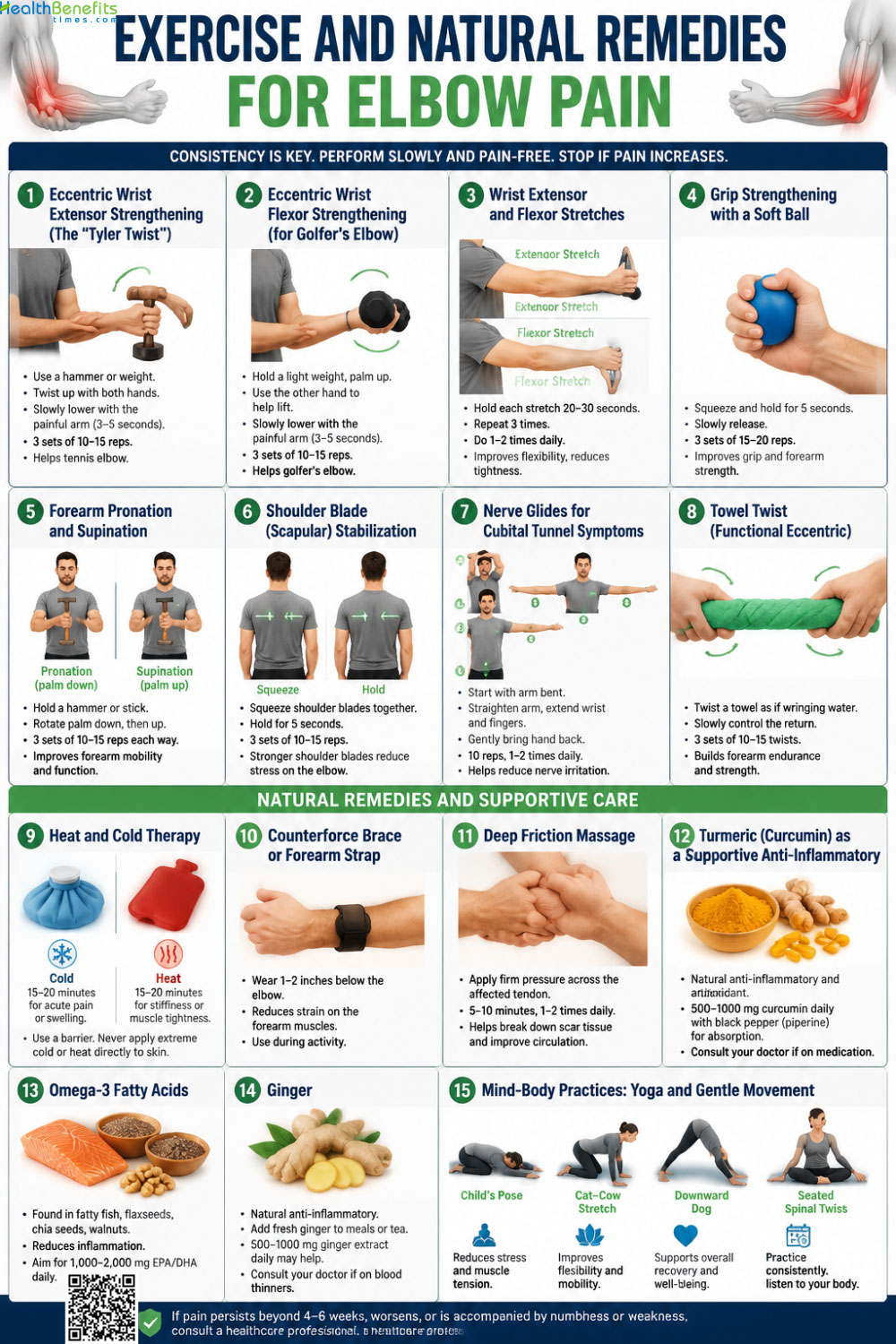
4. Grip Strengthening with a Soft Ball
Hold a soft stress ball, tennis ball, or rolled sock in your hand and squeeze for 5–10 seconds, then release. Perform 10–15 reps a few times each day. As pain settles, progress to putty or therapy bands. Grip-strength deficits are a hallmark of both lateral and medial epicondylitis, and recovery of pain-free grip strength is one of the most reliable markers of healing.
Note: Squeezing builds the deep forearm muscles that support the tendons at the elbow, sharing the workload during everyday gripping tasks.
5. Forearm Pronation and Supination
Rest your forearm on a table with the wrist hanging over the edge. Hold a light hammer or a half-filled water bottle by one end. Rotate the forearm slowly so the palm faces down, pause, then rotate so it faces up. Complete 2–3 sets of 10 reps. This movement specifically targets the pronator teres and supinator muscles often overworked in tool-using occupations.
Note: Restoring smooth, pain-free forearm rotation is essential for handshakes, doorknobs, and lifting a coffee mug without flare-ups.
6. Shoulder Blade (Scapular) Stabilization
Stand tall and gently squeeze your shoulder blades together and slightly down, as if tucking them into your back pockets. Hold for 5 seconds and release. Try 2 sets of 10–15. A randomized study found that adding shoulder stabilization to direct elbow treatment produced significantly greater gains in grip strength and tenderness thresholds than wrist eccentric work alone. 20
Note: The arm functions as a kinetic chain, and a stable shoulder reduces compensatory strain that otherwise lands on the elbow.
7. Nerve Glides for Cubital Tunnel Symptoms
If your symptoms include tingling into the ring and little fingers, gentle ulnar nerve glides may help. Start with your arm out to the side, elbow straight, palm facing forward. Slowly bend the elbow and bring your hand toward your face as if making the “OK” sign by your ear. Repeat 5–10 times, slowly, without provoking numbness.
Note: Light gliding helps the ulnar nerve move freely through the cubital tunnel and is preferred over aggressive stretching, which can worsen nerve irritation.
8. Towel Twist (Functional Eccentric)
Hold a rolled hand towel with both hands. Twist it as if wringing out water one hand turning forward, the other backward. Hold for 5 seconds, then slowly release. Do 10 reps in each direction. This is a low-cost alternative to the FlexBar.
Note: The towel twist mimics real-world gripping and twisting motions, helping retrain the tendons under controlled load.
9. Heat and Cold Therapy
Ice packs applied for 10–20 minutes can ease sharp pain after activity, particularly within the first 48–72 hours of a flare-up. 21 For chronic stiffness, a warm compress before exercise can loosen tendons and improve mobility. Avoid placing ice directly on skin.
Note: Cold reduces nerve conduction velocity and local blood flow, blunting pain signals; heat increases tissue elasticity, making stretching safer and more comfortable.
10. Counterforce Brace or Forearm Strap
A simple band worn just below the elbow can offload the inflamed tendon while you continue daily activities. A randomized placebo-controlled trial reported significant reductions in pain frequency and severity, plus improved grip strength, in users of a counterforce brace at six months. 22 A 2020 systematic review of 17 trials concluded that counterforce bracing is a reasonable short-term strategy for pain relief, especially in adults 45 or younger. 23
Note: The strap acts like a “second tendon insertion,” redirecting force away from the irritated attachment at the elbow.
11. Deep Friction Massage
Using firm fingertip pressure across the painful tendon (perpendicular to its fibers) for 5–10 minutes a few times a week can stimulate local blood flow and mobilize adhesions. A randomized clinical trial found deep friction massage produced significant pain improvement in lateral epicondylitis. 24
Note: Cross-fiber friction is thought to convert a stalled, chronic tendon problem into an active healing response.
12. Turmeric (Curcumin) as a Supportive Anti-Inflammatory
Curcumin, the active compound in turmeric, has been studied in laboratory and clinical models of tendinopathy and joint pain and shows modest anti-inflammatory effects. 25 It can be taken as a supplement (often 500–1,000 mg/day of standardized extract) or added generously to food.
Note: Curcumin appears to dampen the NF-κB inflammatory signaling pathway implicated in tendon irritation, though absorption is improved when paired with black pepper or fats.
13. Omega-3 Fatty Acids
Fatty fish, flaxseed, and walnuts provide EPA and DHA, two omega-3s with documented anti-inflammatory effects. A randomized controlled trial in rotator cuff tendinopathy found a modest benefit of omega-3 supplementation on shoulder pain and function when combined with exercise. 26
Note: Omega-3s compete with pro-inflammatory omega-6 fatty acids in the diet, gently shifting the body’s overall inflammatory balance.
14. Ginger
Ginger root contains gingerols and shogaols with documented anti-inflammatory and analgesic activity in clinical trials of musculoskeletal pain. 27 It can be enjoyed as tea, fresh root, or capsule.
Note: Ginger inhibits some of the same pain-producing enzymes (COX and LOX) targeted by NSAIDs, but without the gastrointestinal side-effect profile.
15. Mind-Body Practices: Yoga and Gentle Movement
Regular gentle yoga and breath-based relaxation have been shown to reduce chronic musculoskeletal pain and improve function in randomized trials. 28 Avoid weight-bearing poses on the hands during a flare; favor breath, gentle range-of-motion, and shoulder-opening postures.
Note: Yoga reduces sympathetic nervous system overactivity, which can amplify chronic pain perception, and helps restore balanced muscle tone across the arm and shoulder girdle.
Foods and Activities to Avoid When You Have Elbow Pain
You can help your elbow heal faster by stepping away from the triggers below:
- Repetitive heavy lifting and forceful gripping until pain settles
- Racquet sports, golf, and throwing sports during the flare phase
- Long stretches of typing or mousing without breaks; adjust your workstation so wrists stay neutral
- Leaning on the elbows on hard desks or armrests, which aggravates the ulnar nerve and the olecranon bursa
- Ultra-processed foods, sugary drinks, and excess refined carbohydrates, which can promote systemic inflammation
- Excess alcohol, which can interfere with tissue repair and sleep
- Smoking, an independent risk factor for both lateral and medial epicondylitis 29
- Aggressive “no pain, no gain” stretching, which can re-injure healing tendon fibers
Myths and Misconceptions
| Myth | Reality |
| Only tennis players get tennis elbow. | Tennis players make up only a small share of cases; most patients are plumbers, mechanics, office workers, and homemakers. |
| Elbow pain means the joint is inflamed. | Most chronic tennis and golfer’s elbow is actually tendinosis, a degenerative process not classic inflammation. |
| Rest alone will fix it. | Complete rest can worsen stiffness; graded exercise outperforms passive care. |
| Cortisone shots cure tennis elbow. | In a 198-patient randomized trial (Bisset et al., BMJ 2006), corticosteroid injection showed significantly better effects at six weeks but a 72% recurrence rate by 52 weeks, versus 8% with physiotherapy and 9% with wait-and-see leading to significantly poorer long-term outcomes than either alternative. |
| Surgery is usually needed. | The vast majority of cases resolve with conservative care within a year. |
| Heat is always better than ice. | Ice is preferred during acute flares; heat helps chronic stiffness. |
| Pain medication is the only quick fix. | Bracing, exercises, ice, and ergonomic adjustments often work as well or better. |
Special Considerations
1. Children
Young throwing athletes can develop Little League elbow, a stress injury of the growth plate on the inner elbow most common between ages 8 and 15. 9 If your child reports elbow pain after pitching or gymnastics, you should stop the activity and seek a pediatric sports evaluation rather than push through. Strict pitch counts and rest days during the season help prevent permanent damage.
2. Pregnancy
Hormonal shifts (especially rising relaxin) and fluid retention loosen ligaments and increase the risk of nerve compression around the elbow and wrist. 32 If you are pregnant, you should favor gentle stretching, neutral wrist posture, supportive splints at night, and avoid NSAIDs unless cleared by your obstetrician. Most symptoms ease within weeks after delivery.
3. Chronic Conditions
Diabetes, rheumatoid arthritis, gout, and thyroid disease all raise the risk of tendinopathy, bursitis, and nerve entrapment around the elbow. If you live with one of these, you should pace activity, manage your underlying condition tightly, and watch for warning signs of septic bursitis (warmth, redness, fever).
4. Elderly
Cartilage wear, reduced tendon elasticity, and a higher chance of falls all matter here. Radiographic elbow osteoarthritis is present in a substantial share of adults over 50, although many remain asymptomatic. 33 Older adults should focus on low-load strengthening, balance training to prevent falls, and chair-based or pool-based exercises that minimize joint stress.
Precautions before Use of Natural Remedies
Before you start any new remedy, take a moment to consider the following:
- Talk to your clinician if you take blood thinners, diabetes medication, or immune-suppressants, turmeric, ginger, and omega-3s can interact with several drugs.
- Patch-test topicals (ginger oil, capsaicin cream, arnica) on a small skin area for 24 hours to check for irritation.
- Respect dose limits — high-dose curcumin can occasionally cause gastrointestinal upset.
- Pregnant and breastfeeding women should clear all herbal supplements with their obstetrician.
- Apply ice with a barrier (thin towel) for no more than 20 minutes at a time to avoid skin damage or nerve injury.
- Choose reputable supplement brands with third-party testing, since the supplement industry is loosely regulated.
- Stop any exercise that produces sharp, radiating, or numb pain — soreness during eccentric work is acceptable, but nerve symptoms are a red flag.
- Do not delay medical care for what looks like a “minor” elbow when warmth, redness, fever, or sudden weakness is present, as septic bursitis and nerve compression need timely treatment. 6
When to See a Doctor
Most elbow pain calms down with the steps above, but you should seek professional evaluation if you notice any of the following:
- Pain that does not improve after 4–6 weeks of consistent home care
- Visible deformity, severe swelling, or inability to bend or straighten the elbow after an injury
- Warmth, redness, or fever accompanying elbow swelling (possible septic bursitis)
- Persistent numbness, tingling, or weakness in the ring and little fingers
- Muscle wasting in the hand
- Pain that wakes you from sleep
- Locking, catching, or popping in the joint
- Elbow pain along with neck pain or symptoms radiating from the shoulder
- Elbow pain in a child who throws or plays overhead sports 34
- Symptoms that interfere with work, sleep, or everyday activities like dressing or brushing teeth
With patience, gentle exercise, simple home remedies, and the occasional helping hand from a clinician, most people fully recover from elbow pain and return to the activities they love.