


Neck pain, medically known as cervicalgia, refers to discomfort, soreness, or stiffness in the region between the base of the skull and the top of the shoulders. According to the Global Burden of Disease framework, neck pain is defined as pain in the cervical spine area, with or without radiation into one or both arms, lasting for at least one day. 1 This part of the spine carries the weight of the head and allows movement in nearly every direction, which makes it especially vulnerable to strain and injury. Neck pain is one of the most common musculoskeletal complaints worldwide and ranks among the leading causes of years lived with disability. It affects roughly 10% to 20% of adults at any given time and is more common in women than men. 2 While most episodes are short-lived and harmless, some can become long-term problems that interfere with sleep, work, and quality of life.
Causes of Neck Pain
A surprising number of things can trigger neck pain, ranging from everyday habits to medical conditions. The most common causes include:
1. Muscle strain and overuse– Long hours at a computer, reading in bed, or repeating the same motion can tire out the neck muscles.
2. Poor posture– Slouching, forward head posture, and hunching over phones place extra load on the cervical spine.
3. Age-related wear and tear (cervical spondylosis)– By age 60, about 9 in 10 people have some degree of cervical spondylosis, where the discs and joints in the neck gradually degenerate. 3
4. Herniated disc or pinched nerve (cervical radiculopathy)– When a spinal disc bulges, it can press on nearby nerves and cause pain that radiates into the arm. Cervical radiculopathy affects roughly 85 out of every 100,000 people. 4
5. Whiplash and injuries– Car accidents, falls, or sports collisions can suddenly stretch and damage neck tissues.
6. Stress and tension– Emotional stress causes muscles in the neck and shoulders to tighten.
7. Sleeping position– Using too many pillows or sleeping on an unsupportive mattress can leave the neck stiff in the morning.
8. “Text neck”– Constantly looking down at a phone or tablet adds significant load to the cervical spine; tilting the head forward 60 degrees can put up to 27 kg of force on the neck. 5
9. Underlying medical conditions– Osteoarthritis, rheumatoid arthritis, fibromyalgia, and rarely meningitis or tumors can also be responsible.
Symptoms of Neck Pain
People experience neck pain in many different ways. Common symptoms include:
- A dull ache or sharp pain in the neck
- Stiffness that limits how far the head can turn
- Muscle spasms or knots in the neck and shoulders
- Headaches, especially at the base of the skull
- Pain that worsens when holding the head still for long periods, like during driving or computer work
- Pain, numbness, tingling, or weakness that travels into the shoulder, arm, or hand
- A “popping” or grinding feeling when moving the neck
- Trouble swallowing or a feeling of pressure (less common)
- Dizziness or balance issues in some cases of cervical-related vertigo 6
Neck Pain Facts Table
| Category | Details |
| Symptoms | • Dull ache or sharp pain in the neck • Stiffness and limited range of motion • Muscle spasms • Headaches at the base of the skull • Pain radiating to the shoulder, arm, or hand • Numbness, tingling, or weakness in the arms |
| Causes | • Muscle strain from overuse • Poor posture • Cervical spondylosis (age-related wear and tear) • Herniated disc or pinched nerve • Whiplash or trauma • Stress and muscle tension • Poor sleeping position • Prolonged phone or screen use |
| Types of Neck Pain | • Acute (less than 6 weeks) • Subacute (6 weeks to 3 months) • Chronic (more than 3 months) • Axial (pain stays in the neck) • Radicular (pain radiates down the arm) |
| How It Spreads | • Not a contagious condition; it does not spread person to person • Within the body, pain can radiate from the neck into the shoulders, upper back, arms, and hands when nerves are involved |
| Age Group | • Risk rises from young adulthood, peaking between ages 35–49 • By age 60, about 90% of people show signs of cervical spondylosis 3 • Up to 69% of school-aged children using smartphones report neck pain 7 |
| You Might Be at Higher Risk If You: | • Spend long hours at a computer or on a phone • Work in jobs requiring repetitive neck movements or heavy lifting • Have poor posture or weak neck and shoulder muscles • Have suffered whiplash or a previous neck injury • Are female (higher prevalence reported) • Are under high emotional stress • Smoke or are overweight • Sleep on unsupportive pillows or mattresses |
| How Doctors Diagnose | • Detailed medical history and physical exam • Range of motion and neurological tests • X-rays for bone changes • MRI or CT scan for soft tissues, discs, and nerves • Electromyogram (EMG) to test nerve function 8 |
| Other Facts | • Annual prevalence ranges between 30% and 50% of adults 9 • It is one of the top five chronic pain conditions worldwide • Most cases improve with conservative care (rest, exercise, physical therapy) • About one-third to two-thirds of cases resolve within a year, but relapses are common |
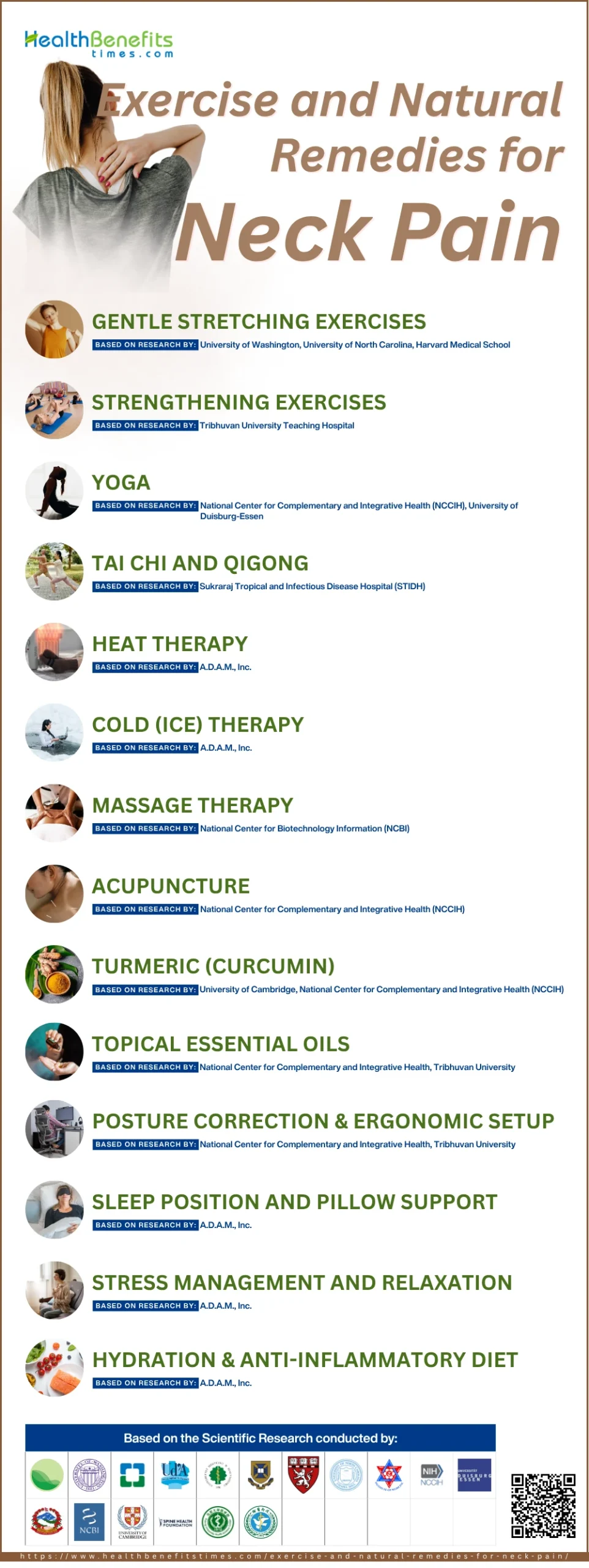
Exercise and Natural Remedies for Neck Pain
1. Gentle Stretching Exercises
Slow, controlled stretches are often the first step in easing a stiff or sore neck. Common stretches include the chin tuck, side-to-side head tilts, ear-to-shoulder stretches, and gentle neck rotations. Research on office workers showed that a four-week program of neck and shoulder stretching exercises performed twice a day, five days a week, significantly reduced pain and improved neck function and quality of life. 10 A separate randomized trial found that low-cost stretching exercises were as effective as manual therapy for women with chronic non-specific neck pain. 11
Note: Stretches are commonly performed two or three times a day, holding each position for about 15–30 seconds, to relax tight muscles and improve flexibility.
2. Strengthening Exercises
Strong neck and upper back muscles help support the head and protect the cervical spine from strain. Deep neck flexor training, isometric holds, and resistance-band exercises for the upper back are often recommended. Active strengthening exercises have been shown to improve strength, function, and quality of life while reducing pain scores in people with chronic neck pain. 12
Note: Strengthening is usually done a few times a week, with controlled, slow movements, to build long-term resilience in the neck and shoulder muscles.
3. Yoga
Yoga combines gentle movement, stretching, breathing, and relaxation, making it a popular choice for neck pain. A meta-analysis of 10 randomized controlled trials involving 686 participants concluded that yoga may relieve neck pain intensity, improve pain-related disability, increase cervical range of motion, improve quality of life, and boost mood. 13 A separate trial comparing Iyengar yoga to home-based exercise found that yoga was more effective in relieving chronic non-specific neck pain and also improved the functional status of the neck muscles. 14
Note: Yoga is typically practiced one to three times a week, with gentle poses that emphasize alignment and breath, for both pain relief and stress reduction.
4. Tai Chi and Qigong
These slow, flowing martial-arts-inspired practices are gentle enough for older adults and beginners. A meta-analysis of randomized trials reported that traditional Chinese exercises such as Tai Chi, Qigong, and Baduanjin produced positive complementary effects in relieving pain and improving disability in middle-aged and elderly patients with neck pain. 15
Note: Tai Chi and Qigong are usually practiced for 20–45 minutes, two to three times a week, in a calm setting, both for physical relief and mental relaxation.
5. Heat Therapy
Warmth helps relax tight muscles, improve blood flow, and ease stiffness. A warm shower, a moist warm towel, or a heating pad applied to the neck can bring quick comfort, especially for chronic or ongoing soreness. Health authorities suggest using heat after the first 48–72 hours of pain. 16
Note: Heat is usually applied for about 15–20 minutes at a time, with a cloth barrier between the skin and the heat source, to safely soothe stiff and tense muscles.
6. Cold (Ice) Therapy
Cold packs work best in the first 48–72 hours after a fresh injury or sudden flare-up because cold helps reduce swelling and numbs sharp pain. Ice should always be wrapped in a thin cloth to protect the skin and never applied while sleeping. 17
Note: Cold packs are commonly applied for 15–20 minutes every two to three hours during the first day or two, to calm inflammation and dull pain.
7. Massage Therapy
Massage relaxes tense muscles, improves circulation, and may reduce neck pain in the short term. A systematic review and meta-analysis found moderate evidence that massage therapy provided better immediate pain relief for people with neck pain compared to inactive therapies. 18
Note: Gentle self-massage or a session with a trained therapist, usually 20–30 minutes long, is commonly used to loosen knots and ease tension in the neck and shoulders.
8. Acupuncture
Acupuncture, a traditional Chinese practice involving thin needles placed at specific points, has been studied for many types of pain. According to the National Center for Complementary and Integrative Health, available evidence indicates that acupuncture for neck pain may provide better pain relief compared to no treatment. 19 A large 2018 review found acupuncture was more effective than no treatment and slightly more effective than sham acupuncture for back or neck pain. 20
Note: Acupuncture is typically given in weekly sessions over several weeks by a licensed practitioner, and is generally considered safe when performed with sterile needles.
9. Turmeric (Curcumin)
Turmeric is a yellow spice long used in Indian and Ayurvedic medicine, and its active compound curcumin has anti-inflammatory properties. Reviews on safety and activity have demonstrated that curcumin is generally safe and shows anti-inflammatory activity in human trials. 21 A 2021 systematic review of 10 studies found that turmeric may have a beneficial effect, similar to that of nonsteroidal anti-inflammatory drugs, on osteoarthritis pain and function. 22
Note: Turmeric is commonly added to cooking or taken as a supplement under medical guidance, and is often used to help calm inflammation in joints and muscles.
10. Topical Essential Oils (Peppermint, Lavender, Rosemary)
Topical essential oils are sometimes used to ease muscle aches. Limited evidence suggests that peppermint oil applied to the skin may relieve tension headaches that often accompany neck pain. 23 A systematic review and meta-analysis of randomized controlled trials reported that topical essential oils such as lavender, peppermint, and rosemary may help reduce pain intensity in musculoskeletal disorders, including neck pain. 24
Note: Essential oils are usually diluted in a carrier oil (such as almond or coconut oil) before being gently massaged into the neck and shoulders, and should not be applied to broken skin.
11. Posture Correction and Ergonomic Setup
Sitting and standing tall with the ears aligned over the shoulders takes pressure off the cervical spine. Ergonomic adjustments at work, such as raising a screen to eye level, using a chair with good back support, and keeping the keyboard close, can prevent and reduce pain. Research shows that ergonomic training combined with therapeutic exercise effectively reduces pain and disability and improves posture in people with chronic neck pain. 25
Note: Posture and ergonomic habits are best practiced throughout the day, with short standing or stretching breaks every 30–60 minutes, to prevent strain from building up.
12. Sleep Position and Pillow Support
A supportive pillow that keeps the neck aligned with the spine helps avoid waking up sore. Health authorities recommend sleeping on a firm mattress with a pillow that supports the neck, and many people benefit from a specially designed cervical pillow. 17
Note: Sleeping on the back or side with a properly contoured pillow is generally encouraged, while sleeping on the stomach is usually discouraged because it twists the neck.
13. Stress Management and Relaxation
Because stress causes the neck and shoulder muscles to tighten, learning to relax can directly reduce pain. Deep breathing, meditation, and mindfulness practices can quiet the body’s stress response.
Note: A few minutes of relaxation or breathing exercises each day can help loosen tense neck muscles and lower the chance of stress-related flare-ups.
14. Hydration and an Anti-Inflammatory Diet
Staying well hydrated keeps the spinal discs healthy, and eating foods rich in omega-3 fats, fruits, vegetables, and whole grains can reduce overall inflammation in the body.
Note: A balanced, mostly plant-based diet with plenty of water is commonly recommended to support joint, muscle, and overall musculoskeletal health.
Foods and Activities to Avoid When You Suffer from Neck Pain
When the neck is sore, certain habits and foods can slow healing or make things worse. You should try to limit or avoid:
- Processed and sugary foods– These can increase inflammation in the body.
- Excess salt and packaged snacks– Too much sodium may worsen swelling.
- Fried foods and trans fats– These promote inflammation and weight gain.
- Heavy alcohol use– It disrupts sleep, dehydrates the body, and may interfere with healing.
- Smoking and tobacco use– Nicotine reduces blood flow to spinal discs and slows healing.
- Excess caffeine– Large amounts may interfere with sleep, which is important for muscle recovery.
- Heavy lifting or carrying heavy bags on one shoulder– These can strain the neck further.
- High-impact activities and contact sports– Such as football, rugby, or boxing, especially during a flare-up.
- Long hours hunched over phones, laptops, or books– This is the leading cause of “text neck.”
- Sleeping on too many or too few pillows– Both can leave the neck twisted or unsupported.
- Cracking your own neck forcefully– Sudden twisting may worsen joint or nerve problems.
- Skipping movement and lying still for long periods– Complete bed rest can stiffen muscles and slow recovery.
Myths and Misconceptions
| Myth | Reality |
| Neck pain always means something is seriously wrong with the spine. | Most neck pain is caused by simple muscle strain or posture, not a serious disease. The vast majority of people improve with conservative treatment. 26 |
| You should rest completely until the pain goes away. | Health authorities recommend gentle range-of-motion exercises early on, as prolonged inactivity can stiffen the neck further. 16 |
| Cracking your neck is harmful and causes arthritis. | Occasional, gentle self-cracking is usually harmless, but forceful or repeated twisting is not recommended. |
| Imaging like MRI is needed for every neck pain case. | In the absence of red-flag symptoms, advanced imaging is generally not required before trying conservative care. |
| A firm mattress and no pillow are best for neck pain. | A supportive mattress and a pillow that keeps the neck aligned with the spine are usually recommended, not “no pillow.” |
| Only older adults get neck pain. | Neck pain affects all age groups, and rates among children and teens have risen sharply due to smartphone use. |
| Exercise will make neck pain worse. | The opposite is usually true; gentle exercise is one of the most effective treatments. |
| Surgery is the only way to fix chronic neck pain. | Most chronic neck pain improves with non-surgical care like exercise, posture changes, and physical therapy. |
Special Considerations
Children
Neck pain in children is more common than many parents realize, largely because of long hours spent looking down at smartphones, tablets, and gaming devices. A scoping review reported that around 69% of school-aged children studied showed signs of text neck syndrome, with risk rising sharply for those using devices more than three hours per day. 7 Limiting screen time, encouraging outdoor play, supporting good posture, and ensuring a properly fitting school backpack can make a big difference. Sudden, severe neck stiffness in a child—especially with fever, headache, or vomiting—needs urgent medical attention, as it may signal meningitis.
Pregnancy
Pregnancy brings hormonal shifts, weight gain, and changes in posture, all of which can contribute to neck pain. Studies on musculoskeletal complaints during pregnancy report a significant increase in neck, back, and other joint pain, especially in the third trimester. 27 Many medications are restricted during pregnancy, so gentle stretching, warm (not hot) showers, supportive pillows, and posture awareness become especially valuable. Pregnant women should always consult their obstetrician before starting any exercise program, taking supplements like turmeric, or using essential oils.
Chronic Conditions
People living with conditions such as osteoarthritis, rheumatoid arthritis, fibromyalgia, or cervical spondylosis often have ongoing neck pain. For these patients, the goal is usually long-term management rather than a quick fix. A combination of physical therapy, gentle exercise, stress management, and medication prescribed by a doctor often works best. Notably, research using a national health database found that chronic neck pain was associated with increased mortality in individuals with osteoarthritis, underscoring how important careful management is. 28
Elderly
Older adults face age-related changes such as disc degeneration, arthritis, and weaker neck muscles. By age 60, about 9 in 10 people show signs of cervical spondylosis on imaging. Gentle low-impact activities like Tai Chi, Qigong, water exercises, and walking are often safer than vigorous exercise. Falls, balance problems, and dizziness associated with neck pain should always be reported to a doctor, as they can signal something more serious.
Precautions Before Use of Natural Remedies When You Have Neck Pain
Before starting any natural remedy, you should take some sensible steps to stay safe:
- Talk to your doctor first, especially if your pain is severe, recent, or follows an injury.
- Tell your doctor about every supplement and herb you plan to take, since products like turmeric can interact with blood thinners and other medications.
- Start slow with new exercises.If a stretch or pose increases your pain or causes tingling in the arms, stop immediately.
- Avoid essential oils on broken or irritated skinand always dilute them in a carrier oil before applying.
- Patch-test any new topical producton a small area of skin before applying it to the neck.
- Do not apply heat or ice directly to bare skin; always use a cloth barrier and limit each session to 15–20 minutes.
- Avoid forceful neck crackingor aggressive self-massage, especially if you have a history of disc problems or osteoporosis.
- Pregnant women, breastfeeding mothers, children, and people with chronic illnessesshould get medical clearance before trying acupuncture, herbal supplements, or essential oils.
- Choose qualified professionalsfor massage, acupuncture, yoga, and physical therapy. Aggressive cervical manipulation has been linked, in rare cases, to cervical artery dissection. 29
- Stop any remedy that worsens your symptomsand seek medical advice if pain persists more than a few days despite home care.
When to See a Doctor
While most neck pain improves on its own, certain “red flag” signs mean you should not wait. See a doctor or seek emergency care if you experience:
- Neck pain after a fall, car accident, or other trauma– there is a risk of fracture or serious injury.
- Severe, sudden, or “thunderclap” painthat comes on out of nowhere.
- Neck stiffness with fever, headache, nausea, or sensitivity to light– these can be signs of meningitis. 30
- Numbness, tingling, or weakness in your arms, hands, or legs.
- Trouble walking, problems with balance, or loss of coordination.
- Loss of bladder or bowel control– this is a medical emergency.
- Pain that radiates down one arm, especially with weakness or pins-and-needles sensations.
- Unexplained weight loss, night sweats, or feveralong with neck pain.
- Pain that lasts longer than a few weeksor keeps getting worse despite home care.
- Trouble swallowing, slurred speech, double vision, or sudden dizziness with neck pain– these may signal a stroke or vascular problem and need urgent evaluation.
- A history of cancer, recent infection, or weakened immune systemcombined with new neck pain.
- Pain so severe that it interferes with sleep, work, or daily activities.
Specialists generally recommend a more detailed evaluation when neck pain persists for more than six weeks, continues to worsen, or is accompanied by neurological symptoms. 31
Taking neck pain seriously, while also knowing that most cases are mild and treatable, is the best path forward. Gentle exercise, good posture, simple natural remedies, and timely medical care together offer the strongest protection for a healthy, pain-free neck.
Comments
This article is based on Scientific Research Conducted by following Research Organization:
- Global, regional, and national burden of neck pain, 1990–2020, and projections to 2050: a systematic analysis of the Global Burden of Disease Study 2021–University of Washington, United States, Institute for Health Metrics and Evaluation, United States
- Neck Pain–Cleveland Clinic, United States
- Cervical Spondylosis–Cleveland Clinic, United States
- Cervical Radiculopathy (Pinched Nerve)–Cleveland Clinic, United States
- Text Neck Syndrome in Children and Adolescents–University of Chieti, Italy
- Cervical Vertigo–Cleveland Clinic, United States
- Physiotherapy in Text Neck Syndrome: A Scoping Review of Current Evidence and Future Directions–Medical University of Białystok, Poland
- Cervical Neck Pain–Cleveland Clinic, United States
- The epidemiology of neck pain–University of Queensland, Australia
- The effectiveness of a neck and shoulder stretching exercise program among office workers with neck pain: a randomized controlled trial–University of Washington, United States, University of North Carolina, United States, Harvard Medical School, United States
- Stretching exercises vs manual therapy in treatment of chronic neck pain: a randomized, controlled cross-over trial–Journal of Institute of Medicine Nepal, Nepal
- Chronic neck pain and exercise interventions: frequency, intensity, time, and type principle–Tribhuvan University Teaching Hospital, Nepal
- Yoga for Pain: What the Science Says–National Center for Complementary and Integrative Health (NCCIH), United States
- Randomized-controlled trial comparing yoga and home-based exercise for chronic neck pain–University of Duisburg-Essen, Germany
- Traditional Chinese Exercises on Pain and Disability in Middle-Aged and Elderly Patients With Neck Pain: A Systematic Review and Meta-Analysis of Randomized Controlled Trials–Sukraraj Tropical and Infectious Disease Hospital (STIDH), Nepal
- Neck pain–A.D.A.M., Inc., United States
- Neck pain or spasms - self care–A.D.A.M., Inc., United States
- Efficacy of Massage Therapy on Pain and Dysfunction in Patients with Neck Pain: A Systematic Review and Meta-Analysis–National Center for Biotechnology Information (NCBI), United States
- Complementary Health Approaches for Chronic Pain: What the Science Says–National Center for Complementary and Integrative Health (NCCIH), United States
- Acupuncture: Effectiveness and Safety–National Center for Complementary and Integrative Health (NCCIH), United States
- Safety and anti-inflammatory activity of curcumin: a component of tumeric (Curcuma longa)–University of Cambridge, United Kingdom
- Nutritional Approaches for Musculoskeletal Pain and Inflammation: What the Science Says–National Center for Complementary and Integrative Health (NCCIH), United States
- Peppermint Oil–National Center for Complementary and Integrative Health (NCCIH), United States
- Efficacy of Topical Essential Oils in Musculoskeletal Disorders: Systematic Review and Meta-Analysis of Randomized Controlled Trials–Tribhuvan University Teaching Hospital (TUTH), Nepal
- The Effectiveness of Ergonomic Training and Therapeutic Exercise in Chronic Neck Pain in Accountants in the Healthcare System: A Review
- Neck pain: Causes, Treatments, and Myths–National Spine Health Foundation (SpineHealth.org), United States
- Musculoskeletal pain and symptoms in pregnancy: a descriptive study
- Chronic neck pain is associated with increased mortality in individuals with osteoarthritis: results from the NHANES database prospective cohort study–Peking University Fourth School of Clinical Medicine, China
- Mind and Body Approaches for Chronic Pain: What the Science Says–National Center for Complementary and Integrative Health (NCCIH), United States
- Stiff Neck–Cleveland Clinic, United States
- An approach to neck pain in primary care–Affiliated Hospital of Xuzhou Medical University, China