

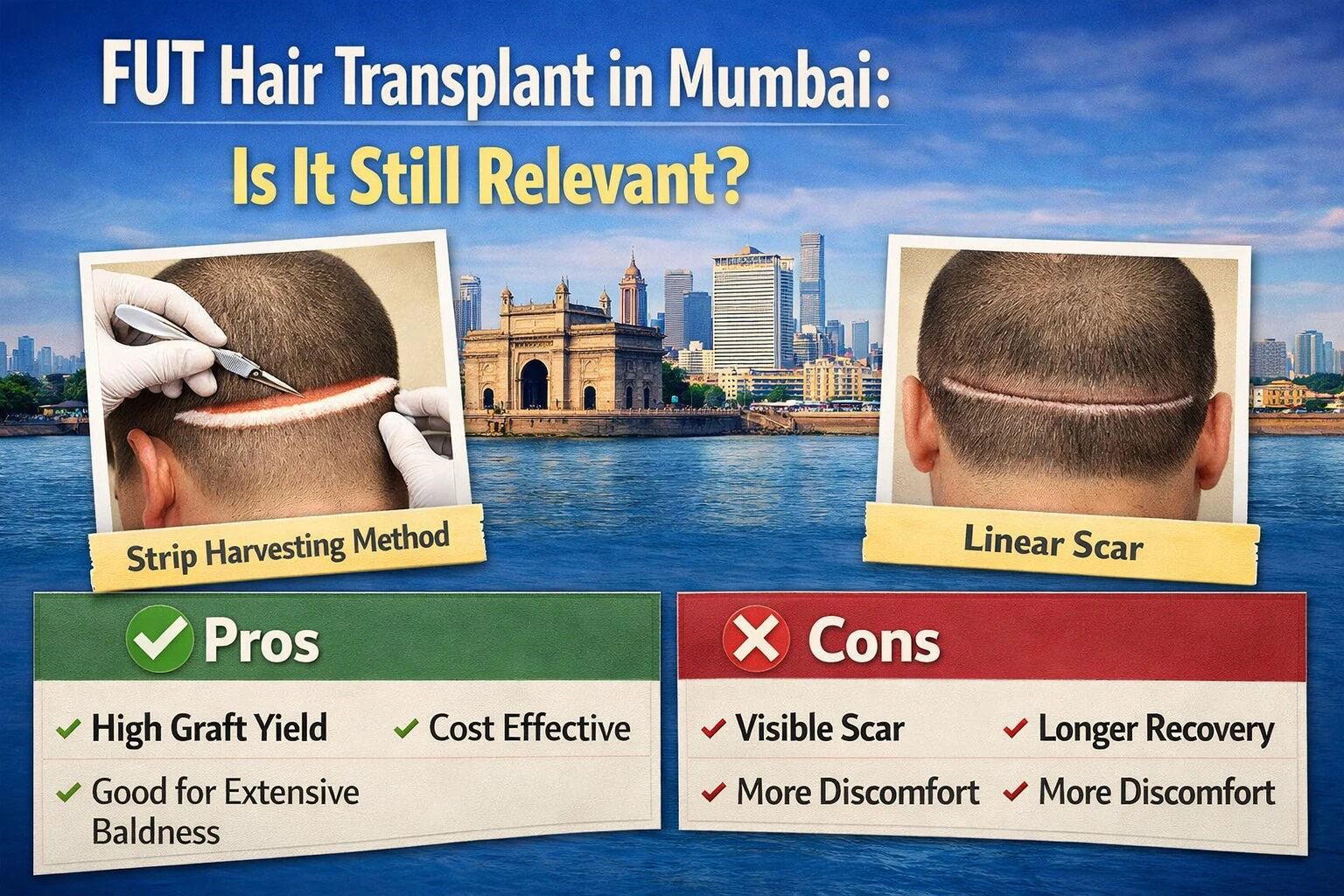
Many people researching hair transplants in Mumbai come across two main options: FUT and FUE. Most of the online content today leans heavily toward FUE, leaving patients wondering whether FUT is outdated, less effective, or simply not worth considering. The reality is more nuanced than that. Understanding what FUT actually involves — and when it may still be a clinically appropriate choice — can help patients make more informed decisions without feeling pressured toward any single approach.
What Is FUT and How Does It Work?
FUT stands for Follicular Unit Transplantation. It is a surgical hair restoration technique in which a strip of skin containing hair follicles is removed from the donor area — typically the back of the scalp — and then divided into individual follicular units under a microscope. These units are then implanted into the areas experiencing hair loss.
The process requires a small linear incision in the donor region, which is sutured after the strip is harvested. The resulting scar is linear and, in most cases, can be concealed by surrounding hair when kept at a moderate length. The dissected grafts are carefully prepared by a skilled team and placed into recipient sites created by the surgeon.
This approach has been used in hair restoration for several decades. Its long history in clinical practice means there is a substantial body of evidence supporting its outcomes when performed correctly.
Why FUT Is Still Considered in Certain Cases
Despite the rise of FUE, FUT has not been abandoned by experienced hair restoration specialists. There are clinical situations where it may remain a suitable option:
- When a large number of grafts are needed in a single session, FUT can yield a high graft count efficiently
- Patients with limited donor density may retain more follicles in reserve for future sessions with FUT compared to extensive FUE harvesting
- The transection rate — meaning the rate at which grafts are accidentally damaged during extraction — can be lower in FUT when performed by an experienced surgeon, since grafts are dissected under magnification rather than extracted blindly
- For patients who do not plan to shave their head, the linear scar may be less of a concern than the scattered dot scars that can sometimes occur with FUE
None of this means FUT is universally superior. It simply means the procedure continues to have a defined role in specific clinical contexts.
Understanding the Scar and Recovery
One of the most common concerns patients raise about FUT is the linear scar. This is a legitimate consideration, and patients should be aware of it before making a decision.
The scar is permanent, though its visibility depends on several factors: how well the wound is closed, the patient’s skin type and healing response, and whether the hair in that area is kept long enough to cover it. In many patients, the scar is not visible when the surrounding hair is at a normal length. However, patients who prefer very short haircuts at the back of the scalp may find the scar more noticeable.
Recovery after FUT typically involves a few days of relative rest, wound care at the donor site, and a follow-up schedule to monitor healing. Swelling and mild discomfort are common in the first week. Most patients return to routine activity within ten to fourteen days.
What Results Look Like and How Long They Take
Hair transplant results — whether from FUT or FUE — do not appear immediately. The transplanted grafts typically shed within the first few weeks after surgery, which is a normal part of the cycle. New hair growth generally begins around three to four months post-procedure. Meaningful density is usually visible by six to nine months, with full results often assessed at the twelve-month mark.
Results depend on graft survival, the quality of the donor hair, the extent of hair loss, and the skill of the surgical team. No technique guarantees a specific outcome, and patients with active or progressive hair loss may need additional sessions over time.
Finding the Right Evaluation Before Deciding
Choosing between FUT and FUE is not always a straightforward decision. It depends on the individual’s degree of hair loss, donor area characteristics, future hair loss trajectory, and personal preferences around scarring and recovery.
Clinics like Kibo Clinics approach this by evaluating the underlying cause and pattern of hair loss before recommending any specific technique. That kind of structured assessment helps patients understand not just which procedure might suit them, but also whether they are good candidates for surgery at all.
Final Thoughts
FUT is not an outdated technique. It remains a clinically relevant option for select patients, particularly those requiring larger graft sessions or those who want to preserve their donor area for long-term planning. Like any medical procedure, it comes with trade-offs — particularly around the linear scar — and those trade-offs need to be weighed individually.
Patients in Mumbai exploring hair transplant options are best served by seeking a thorough consultation rather than deciding based on online trends alone. The right technique is the one that suits your specific condition, your realistic expectations, and your long-term hair restoration goals.