

Chances are, you’ve caught yourself scrolling through your phone at 2 AM wondering where the last three hours went. You’re not alone, an estimated 210 million people worldwide suffer from social media and internet addiction, with roughly 5–10% of Americans meeting the criteria for problematic social media use. 1 Although social media addiction is not yet recognized as a formal diagnosis in the DSM-5 or ICD-11, mounting clinical evidence shows it behaves remarkably like substance abuse at the neurological level. 2
So what exactly is it? The Cleveland Clinic defines social media addiction as an uncontrollable urge to use social media, even when it leads to negative consequences in your life, affecting your mental health, relationships, and work performance. 3 The American Psychiatric Association describes it as problematic and compulsive use that creates an obsessive need to check and update platforms, often disrupting real-world relationships and daily functioning. 2
Here’s what happens inside your brain. Every like, comment, and notification triggers a release of dopamine, the same neurotransmitter involved in substance addictions. Dr. Anna Lembke, Chief of Addiction Medicine at Stanford, explains that social media apps can cause the release of large amounts of dopamine into the brain’s reward pathway all at once, similar to how drugs like heroin or alcohol affect the brain. 4 Over time, your brain compensates by reducing its baseline dopamine production, creating a chronic deficit state that drives you back to the platform for relief. fMRI studies from UCLA demonstrated that adolescents’ reward circuitry showed significantly increased activation when receiving many “likes” on Instagram photos. 5 A separate study found that just 20 minutes of social media engagement produced a 22% reduction in prefrontal cortex activity, impairing decision-making. 6
Platforms exploit this through variable ratio reinforcement, the same unpredictable reward pattern used by slot machines, where an unexpected like or viral post generates stronger compulsive behavior than predictable rewards. 7 As Dr. Adam Borland of the Cleveland Clinic puts it, over time you become desensitized, and you need even more dopamine to produce the same effect. 3
Social Media Addiction Facts
| Symptoms 1 8 9 | – Anxiety and irritability when unable to access platforms – Reaching for your phone immediately upon waking – Losing track of time while scrolling – Neglecting work, school, or personal responsibilities – Repeatedly failing to cut back despite wanting to – Low self-esteem driven by social comparison – Persistent fear of missing out (FOMO) – Disrupted sleep from late-night scrolling – Eye strain, headaches, and sedentary lifestyle effects – Withdrawal symptoms including boredom, mood disturbances, and urges when abstaining |
| Causes 4 10 11 | – Dopamine-driven reward loops triggered by likes, comments, and notifications
– Platform design features like infinite scroll, autoplay, and algorithmic feeds – Variable ratio reinforcement mimicking slot machine mechanics – Social comparison and validation-seeking behavior – Pre-existing mental health conditions like depression or anxiety |
| Types 12 | – Passive scrolling addiction (consuming content without interacting)
– Validation-seeking addiction (posting for likes and approval) – Connection addiction (compulsive messaging and social monitoring) – Information addiction (compulsive news or trend checking) |
| How It Spreads 3 13 | – Platforms employ mental health professionals to maximize engagement
– Infinite scroll and autoplay eliminate natural stopping points – Push notifications create constant re-engagement triggers – Algorithmic personalization deepens dependence on curated feeds – Social pressure and peer norms normalize excessive use |
| Age Groups Most Affected 14 15 32 | – Teens aged 13–17: up to 95% use social media; over a third use it “almost constantly”
– Young adults aged 18–22: 40% report feeling addicted – Gen Z adults: 82% believe they are addicted to social media – Girls report higher rates than boys (13% vs. 9% problematic use) |
| You Might Be at Higher Risk If You: 11 15 | – Have pre-existing depression, anxiety, or low self-esteem
– Score high on trait impulsivity or neuroticism – Experience chronic loneliness or social isolation – Have narcissistic personality traits – Are female (32% of women globally report addiction vs. 6% of men) – Have a history of other addictive behaviors |
| How Doctors Diagnose | – Bergen Social Media Addiction Scale (BSMAS): a 6-item questionnaire measuring salience, tolerance, mood modification, relapse, withdrawal, and conflict; scores of 19+ suggest problematic use
– Social Media Use Disorder Scale for Adolescents (SOMEDIS-A), adapted from ICD-11 gaming disorder criteria – Clinical interviews assessing behavioral patterns and functional impairment – No formal DSM-5 diagnostic criteria currently exist |
| Treatment and Medications 19 2 20 21 | – Cognitive Behavioral Therapy (CBT) is the most recommended treatment, focusing on controlled use rather than total abstinence
– CBT-IA: a specialized three-phase variant (behavior modification, cognitive restructuring, harm reduction) – Dialectical Behavior Therapy (DBT) and motivational interviewing – Family therapy, especially for adolescents – No medications are specifically approved; naltrexone and antidepressants may address co-occurring conditions – Support groups like Internet and Technology Addicts Anonymous (ITAA) |
| Methods of Prevention 22 23 | – Limit social media to 30 minutes per day
– Turn off non-essential push notifications – Use built-in screen time trackers on your device – Create phone-free zones (bedroom, dinner table) – Schedule specific times for social media rather than browsing all day – Self-monitoring alone reduces anxiety and FOMO |
| Key Statistics 15 24 25 9 | – Average person spends 2 hours 23 minutes per day on social media
– TikTok leads with 53.8 minutes per day per user – 77% of employees use social media during work hours – Children spending 3+ hours daily face double the risk of depression and anxiety – 60% of people in abstinence studies relapsed within seven days |
How to Overcome Social Media Addiction
Breaking free from social media addiction doesn’t mean you have to throw your phone in a river. It means building a healthier, more intentional relationship with technology. Here are research-backed strategies that work.
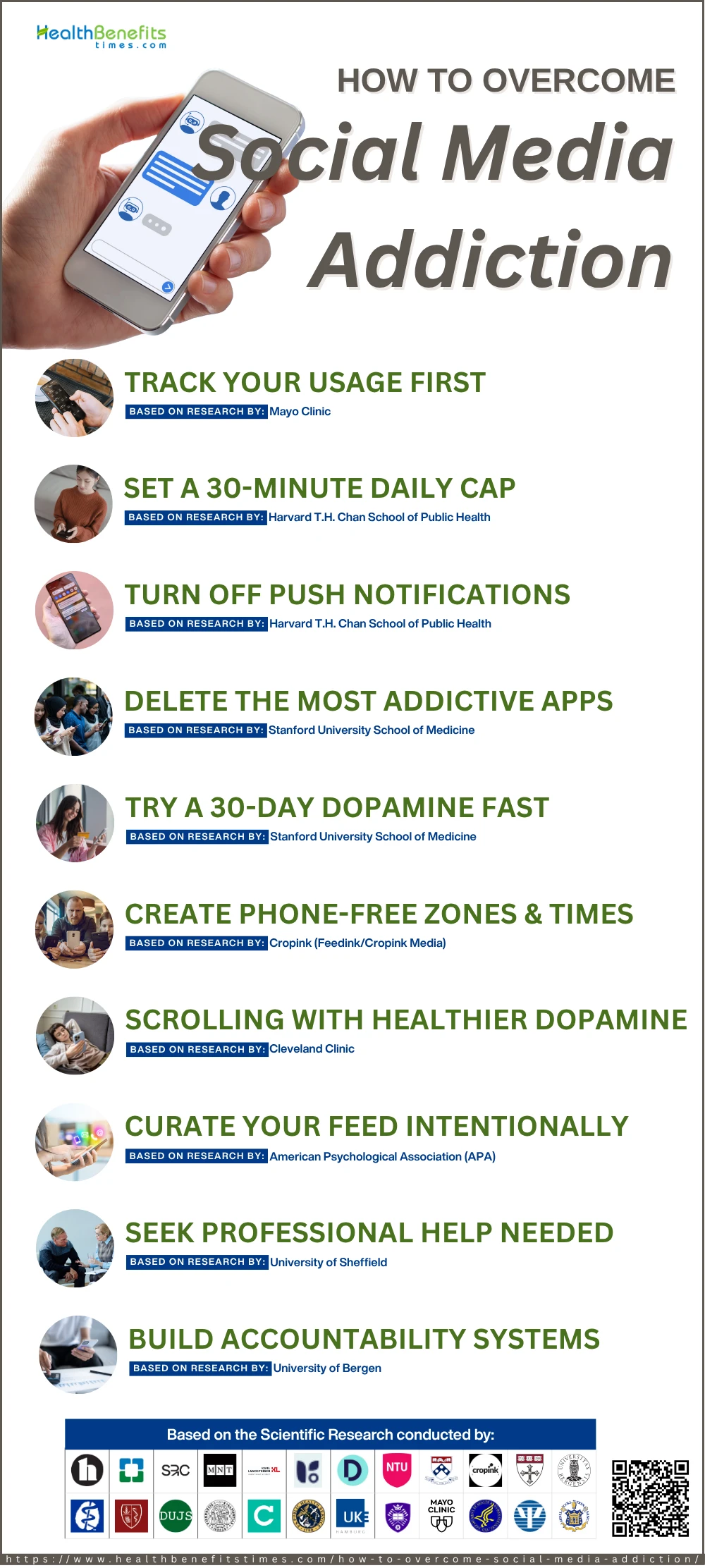
1. Track Your Usage First
Before you change anything, you need to see the problem clearly. Use your phone’s built-in screen time tracker to monitor exactly how many hours you spend on each app daily. Even the control group in the landmark University of Pennsylvania study, participants who merely monitored their usage without limits, showed decreased anxiety and FOMO, suggesting that self-awareness alone has therapeutic value. 22
 2. Set a 30-Minute Daily Cap
The same Penn study provides a clear benchmark: participants who limited social media to 30 minutes per day experienced significant reductions in loneliness and depression over just three weeks. Try setting a 10-minute limit per platform, you can use built-in tools like Apple’s Screen Time or Android’s Digital Wellbeing to enforce it. 26
3. Turn Off Push Notifications
Every buzz and ping is a carefully designed re-engagement hook. Turning off non-essential notifications removes one of the most powerful triggers for compulsive checking. The European Commission specifically identified push notifications as one of the addictive design features that fuel compulsive scrolling. 10
4. Delete the Most Addictive Apps
Dr. Anna Lembke recommends a “self-binding” approach that includes physical strategies like deleting apps from your phone. You can still access platforms through a browser if needed, but removing the one-tap convenience creates a friction barrier that interrupts automatic behavior. 4
5. Try a 30-Day Dopamine Fast
Lembke recommends a minimum 30-day abstinence period to allow your brain’s dopamine system to recalibrate back to baseline. After this reset, you can return to social media with structured boundaries, consolidating use to specific times, avoiding the most compulsive apps, and prioritizing platforms that connect you with real people rather than anonymous scrolling. 4
6. Create Phone-Free Zones and Times
Designate spaces in your home, particularly the bedroom and dining table, as completely phone-free. The Mayo Clinic recommends keeping social media off-limits during meals and at least one hour before bed, as emotional engagement with content can delay sleep onset by up to 90 minutes. 23 Charge your phone in another room at night.
7. Replace Scrolling with Healthier Dopamine Sources
Your brain craves dopamine give it a healthier supply. Exercise is one of the most effective natural dopamine boosters, and it directly counteracts the sedentary effects of screen time. Mindfulness meditation helps manage compulsive urges, and deliberately building in-person social connections addresses the underlying loneliness that often drives excessive use. 3
8. Curate Your Feed Intentionally
Not all social media use is equally harmful. Unfollow accounts that trigger social comparison, envy, or negative self-talk. Replace them with educational, uplifting, or community-oriented content. Harvard researchers recommend shifting from passive consumption to active, purposeful engagement commenting meaningfully, sharing helpful resources, and connecting with people you know in real life. 27
9. Seek Professional Help When Needed
If you’ve tried self-help strategies and still cannot control your usage, cognitive behavioral therapy is the most effective clinical treatment. Dr. Mark Griffiths identifies CBT as the most successful type of treatment for online addictions, with the therapeutic goal being controlled use rather than total abstinence. 19 A specialized variant called CBT-IA uses a three-phase approach: behavior modification, cognitive restructuring, and harm reduction therapy for relapse prevention. 20
10. Build Accountability Systems
Tell someone you trust about your goal. Whether it’s a family member, friend, or therapist, having someone who checks in on your progress dramatically improves follow-through. For teens, parental monitoring is especially critical, the APA advises ongoing supervision for children aged 10–14 with gradually increasing autonomy as they develop self-regulation skills. 28
The Mental Health Toll You Should Know About
Maybe you’ve noticed your mood tanking after a long scrolling session, that’s not coincidental. Children and adolescents spending more than three hours daily on social media face double the risk of depression and anxiety symptoms. 25 A meta-analysis found a pooled odds ratio of 1.59 for the association between social media time and depression risk in adolescents, with the effect being significantly larger for girls. 29 The APA reports that teens in the highest social media use category were twice as likely to express suicidal intent or self-harm compared to the lowest-use group. 30
Sleep takes a serious hit too. Approximately 40% of young people report that social media has impaired their sleep, and research shows that emotional engagement with content, not just screen brightness, is the primary sleep disruptor. 31 Workplace productivity also suffers, with 77% of employees admitting to using social media during work hours. 24
Precautions Before Using Natural Remedies
Natural approaches to overcoming social media addiction, like digital detoxing, mindfulness meditation, exercise, and herbal supplements for anxiety are generally safe, but they come with important caveats you should keep in mind.
First and foremost, a digital detox is not a substitute for professional mental health treatment. If you’re experiencing severe anxiety, depression, or suicidal thoughts linked to social media use, please consult a licensed mental health professional before attempting self-guided interventions. Research shows that 60% of people relapse within a week of attempting cold-turkey abstinence and abrupt withdrawal can worsen mood disturbances in individuals with pre-existing mental health conditions. 9
Be cautious with herbal supplements marketed for anxiety or focus (such as ashwagandha, valerian root, or St. John’s Wort). These can interact with prescription medications particularly antidepressants, anti-anxiety drugs, and ADHD stimulants and should not be taken without consulting your doctor.
Mindfulness and meditation practices are well-supported by research, but if you have a history of trauma or dissociative disorders, certain intense meditation techniques may trigger distress. Start with short, guided sessions and work with a trained instructor if needed.
For parents managing a child’s social media use, the APA cautions against using social media restrictions as punishment, as this can backfire by increasing the perceived value of the platforms. Instead, frame boundaries as a family-wide health practice. 23
Finally, recognize that social media addiction rarely exists in isolation. It frequently co-occurs with depression, anxiety, ADHD, eating disorders, and other behavioral addictions. 11 Treating only the social media habit without addressing underlying conditions typically leads to relapse or symptom substitution. A comprehensive approach that combines natural strategies with professional guidance offers the best chance of lasting recovery.
When to Seek Immediate Help
If social media use is contributing to thoughts of self-harm or suicide, reach out to a crisis service immediately. You can contact the 988 Suicide and Crisis Lifeline by calling or texting 988 (in the U.S.), or reach the Crisis Text Line by texting HOME to 741741. These services are free, confidential, and available 24/7.
Comments
This article is based on Scientific Research Conducted by following Research Organization:
- What Is Social Media Addiction?–Healthline Media, United States
- Technology Addictions: Social Media, Online Gaming, and More–American Psychiatric Association, United States
- Is It Possible To Become Addicted to Social Media?–Cleveland Clinic, United States
- Addictive potential of social media, explained–Stanford University School of Medicine, United States
- What the brain ‘Likes’: neural correlates of providing feedback on social media
- Modern Day High: The Neurocognitive Impact of Social Media Usage–Satani Research Centre, India
- Social Media, Dopamine, and Stress: Converging Pathways–Dartmouth Undergraduate Journal of Science (Dartmouth College), United States
- What to know about social media addiction–Medical News Today, United Kingdom
- Even brief abstinence from social media causes withdrawal symptoms–Karl Landsteiner University of Health Sciences, Austria, University of Vienna, Austria
- EU says TikTok must disable ‘addictive’ features like infinite scroll, fix its recommendation engine
- Risk Factors Associated With Social Media Addiction: An Exploratory Study
- Understanding Social Media Addiction: A Deep Dive–Cureus Inc., United States
- Social Media Addiction–Addiction Center, United States
- Social Media and Youth Mental Health–Office of the Surgeon General, U.S. Department of Health and Human Services (HHS), United States
- Social Media Addiction Statistics 2026 (Facts & Data)–DemandSage, United States
- ICD-11-Based Assessment of Social Media Use Disorder in Adolescents: Development and Validation of the Social Media Use Disorder Scale for Adolescents–University Medical Center Hamburg-Eppendorf, Germany
- Determination the cut-off point for the Bergen social media addiction (BSMAS): Diagnostic contribution of the six criteria of the components model of addiction for social media disorder–University Medical Center Hamburg-Eppendorf, Germany
- Addicted to Social Media?–Mark D. Griffiths, Nottingham Trent University, United Kingdom
- Treatment outcomes using CBT-IA with Internet-addicted patients–University of Sheffield, United Kingdom
- Treatment For Social Media Addiction
- Social media use increases depression and loneliness–University of Pennsylvania, United States
- Teens and social media use: What's the impact?–Mayo Clinic, United States
- 30+ Social Media Distraction Statistics: How It Affects Work, Study & Daily Life [2026]–Cropink (Feedink/Cropink Media), United States
- Social Media and Youth Mental Health–U.S. Department of Health and Human Services, United States
- No More FOMO: Limiting Social Media Decreases Loneliness and Depression–Center for Internet Addiction Recovery, United States
- How to use social media healthfully–Harvard T.H. Chan School of Public Health, United States
- Health advisory on social media use in adolescence–American Psychological Association (APA), United States
- Time Spent on Social Media and Risk of Depression in Adolescents: A Dose–Response Meta-Analysis–University of Bergen, Norway
- Teens are spending nearly 5 hours daily on social media. Here are the mental health outcomes–American Psychological Association (APA), United States
- Why Social Media Screen Time Is So Bad for Sleep–Brian N. Chin, Trinity College, United States