

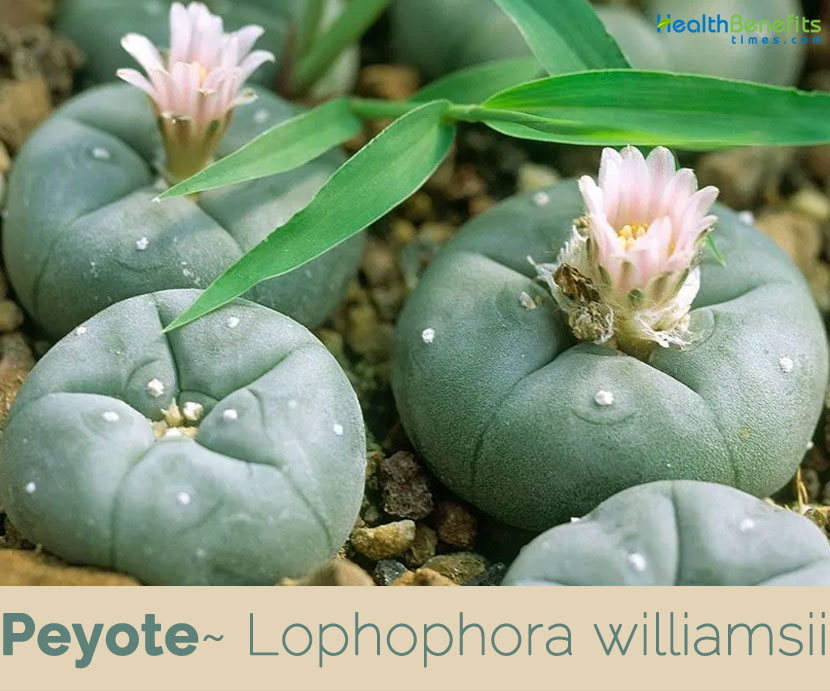
| Peyote Quick Facts | |
|---|---|
| Name: | Peyote |
| Scientific Name: | Lophophora williamsii |
| Origin | Mexico and southwestern Texas |
| Colors | More or less rosy colored, at maturity, they are brownish-white |
| Shapes | Club-shaped to elongated, fleshy fruits |
| Taste | Extremely bitter |
| Health benefits | Good for toothache, pain in childbirth, fever, breast pain, skin diseases, rheumatism, diabetes, colds, blindness, asthma, aching muscles, anxiety, depression, PTSD and addiction |
| Name | Peyote |
|---|---|
| Scientific Name | Lophophora williamsii |
| Native | Mexico and southwestern Texas. It is found primarily in the Sierra Madre Occidental, the Chihuahuan Desert and in the states of Nayarit, Coahuila, Nuevo León, Tamaulipas, and San Luis Potosí among scrub |
| Common Names | Medicine of God, Devil’s root, Divine herb, Dry whiskey, Cactus pudding, Devil’s-root, Diabolic-root, Divine cactus, Dry-whiskey, Dumpling cactus, Indian-dope, Mescal-buttons, Turnip cactus, Peyote, Pellote, Mescal Buttons, Whiskey cactus, White-mule, Peyotl, cactus pudding, Divine cactus |
| Name in Other Languages | Afrikaans: Peyote Albanian: Peyote Amharic: Yoyitayi (yoይታይ-) Arabic: Albuyut (البيوت), sabaar walimz (صبار وليمز) Armenian: Peyote Azerbaijani: Peyote Basque: Peiote Bengali: Mēksikō dēśēra phanimanasā jātīẏa gācha (মেক্সিকোদেশের ফণীমনসা জাতীয় গাছ) Bulgarian: Peĭot (пейот) Burmese: Kwmhkyaankone (ကွမ်းခြံကုန်း) Catalan: Peiot Chinese: Pí ào tè (皮奥特), Wū yǔ yù (烏羽玉) Croatian: Kaktusa Czech: Peyote, Peyotl Danish: Peyote, Elefantfodkaktus Dutch: Peyote, Peyotl English: Peyote, Indian-dope, Cactus pudding, Devil’s-root, Diabolic-root, Divine cactus, Dry-whiskey, Dumpling cactus, Mescal-button, Mescal-buttons, Turnip cactus, Whiskey cactus, White-mule, Esperanto: Peyote Estonian: Peyote, Peioote-uimakaktus Filipino: Peyote Finnish: Peyote, myrkkykaktus, Meskaliinikaktus French: Peyote, Peyotl Galician: Peyote Georgian: Peyote German: Peyote, peyotl Greek: Peyote Gujarati: Pīyōṭē (પીયોટે) Hausa: Leyote Hebrew: פיוטה Hindi: Peyote Huichol: Hikuri Hungarian: Peyote, Pejotl, Meszkalinkaktusz, Pejot Icelandic: Peyote IIocano: Peyote Indonesian: Peyote Irish: Peyote, Péóité Italian: Peyote, Mescal Japanese: Peyōte (ペヨーテ), Ubatama (ウバタマ) Javanese: Peyote Kannada: Piyōṭ (ಪಿಯೋಟ್) Kazakh: Peĭot (пейот) Korean: Pe yote (페 요테) Kurdish: Peyote Lao: Peyote Latin: Peyote Latvian: Peijots Lithuanian: Peyote, Kvaitulinis pejotlis Macedonian: Peyote, пејот Malagasy: Peyote Malay: Peyote Malayalam: Piyēāṭṭ (പിയോട്ട്) Maltese: Peyote Marathi: Peyote Mongolian: Peyote Nahuatl: Peyōtl Nepali: Peyote Norwegian: Peyote Occitan: Peïot Oriya: Peyote Pashto: Peyote Persian: پیام, پیوت polish: Pejotl, Jazgrza Williamsa Portuguese: Peiote Punjabi: Peyote Pushto: پيوټ Romanian: Peyote Russian: Meskalin (мескалин), Lofofora Uil’yamsa (Лофофора Уильямса), Peyótl (Пейо́тль), Peyót (Пейо́т) Serbian: Peyote (пеиоте) Sindhi: پيشو Sinhala: Peyote Slovenian: Peyote, Pejotl Spanish: Peyote, Peyotl, Mescal Sudanese: Suuk Swedish: Peyote Tagalog: Peyote Tajik: Pijola (пиёла) Tamil: Peyote Tarahumara: Híkuri wanamé, Híkuli wanamé Telugu: Br̥ndagāna (బృందగాన) Thai: Peyote Turkish: Peyote Ukrainian: Peĭot (пейот) Urdu: پییوٹ Uzbek: Peyote Vietnamese: Peyote Welsh: Peyote Zulu: Peyote |
| Plant Growth Habit | Long-lived, slow growing, spineless flowering perennial cactus |
| Growing Climates | Primarily in desert scrub, particularly thorn scrub, common on or near limestone hill, mountain scrublands, on rocky slopes, or in dried river beds |
| Soil | Prefers gravelly clay and loam soils on gentle slopes |
| Plant Size | Can reach heights of 2 to 7 centimeters (0.79 to 2.76 in) and diameters of 4 to 12 cm (1.6 to 4.7 in) |
| Root | Napiform, usually 8-11 cm long |
| Areoles | Round spineless, bearing flowers only when young with some bunches of long erect, matted, wooly greyish hairs, up to 1 cm long |
| Stem | Flattened spherical, up to 3 inches (7.5 cm) tall, and up to 5 inches (12.5 cm) diameter |
| Flowering season | March to May, and sometimes as late as September |
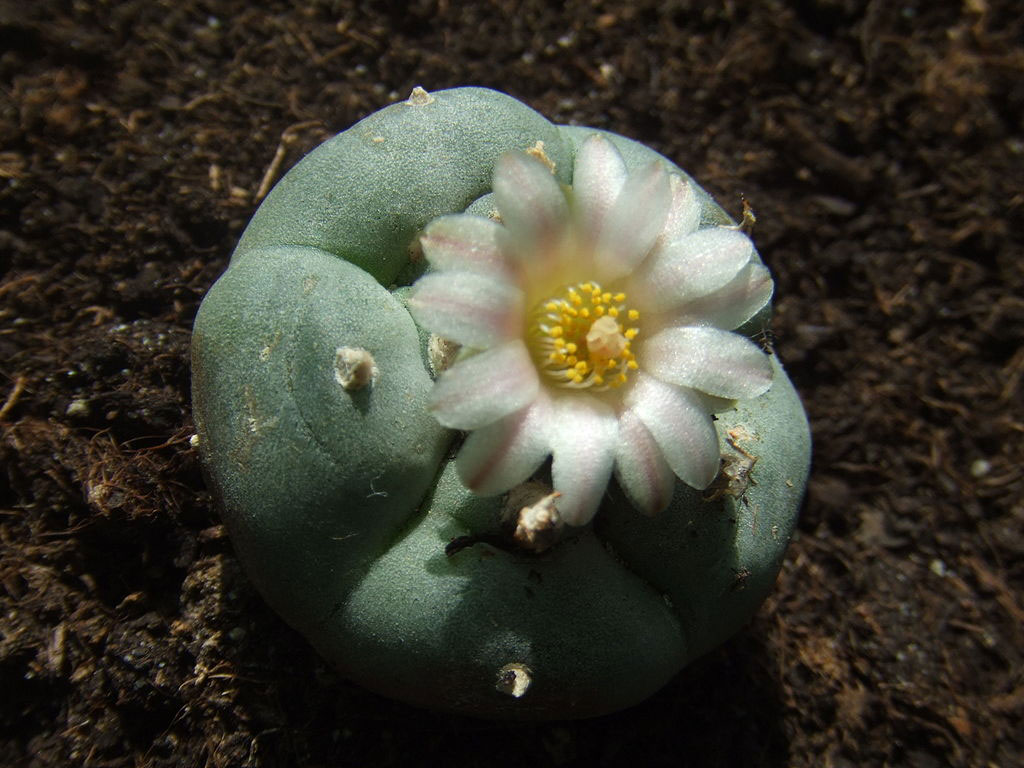
| Flower | Flowers are pink or white to slightly yellowish, sometimes reddish. They open during the day, are from 1 to 2.4 cm long, and reach a diameter from 1 to 2.2 cm. |
| Fruit Shape & Size | Club-shaped to elongated, fleshy fruits are bare and more or less rosy colored. At maturity, they are brownish-white and dry. The fruits do not burst open on their own and they are between 1.5 and 2 cm long |
| Fruit Color | More or less rosy colored, at maturity, they are brownish-white |
| Seed | Black, pear-shaped seeds that are 1 to 1.5 mm long and 1 mm wide |
| Propagation | From seeds |
| Taste | Extremely bitter |
| Plant Parts Used | Buttons, whole plant |
| Other Facts |
|
Plant Description
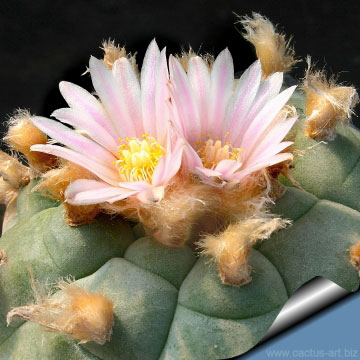
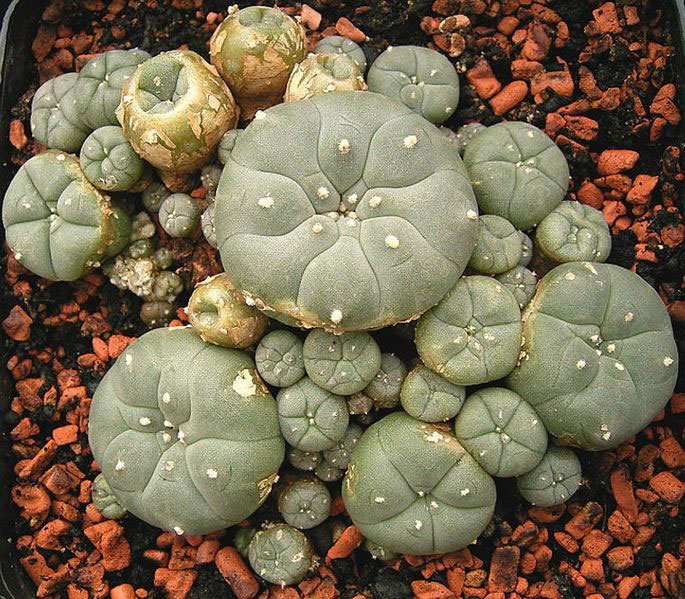
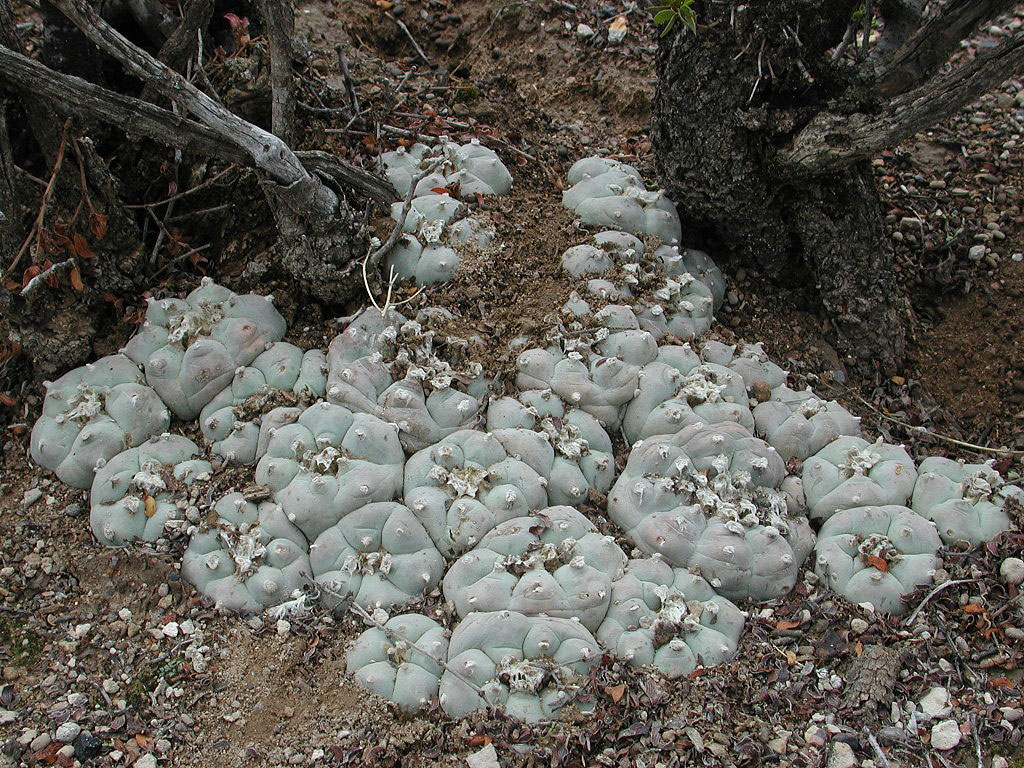
Peyote is a long-lived, slow growing, spineless flowering perennial cactus that normally can reach heights of 2 to 7 centimeters (0.79 to 2.76 in) and diameters of 4 to 12 cm (1.6 to 4.7 in). The plant is found growing primarily in desert scrub, particularly thorn scrub, common on or near limestone hill, mountain scrublands, on rocky slopes, or in dried river beds. The plant prefers gravelly clay and loam soils on gentle slopes. The roots are napiform, usually 8-11 cm long. A tuft of up to 0.4 inches (1 cm) long, yellowish or whitish, woolly hairs arises from the areoles. There are often significant, vertical ribs consisting of low and rounded or hump-like bumps. From the cusp areoles arises a tuft of soft, yellowish or whitish woolly hairs. Spines are absent.
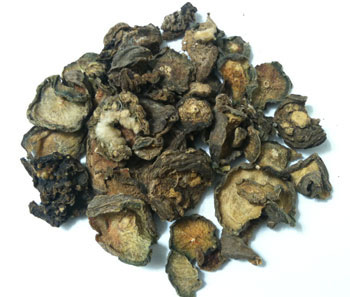
The crown of the peyote cactus crown has disc-shaped buttons. These peyote buttons consists of psychedelic alkaloids primarily mescaline, which is an alkaloid drug that has hallucinogenic effects on humans. People slice these buttons off of the cactus and dry them so they can be chewed or used to make a psychoactive tea. Peyote can also be smoked by rolling it in tobacco or a marijuana leaf.
Stem
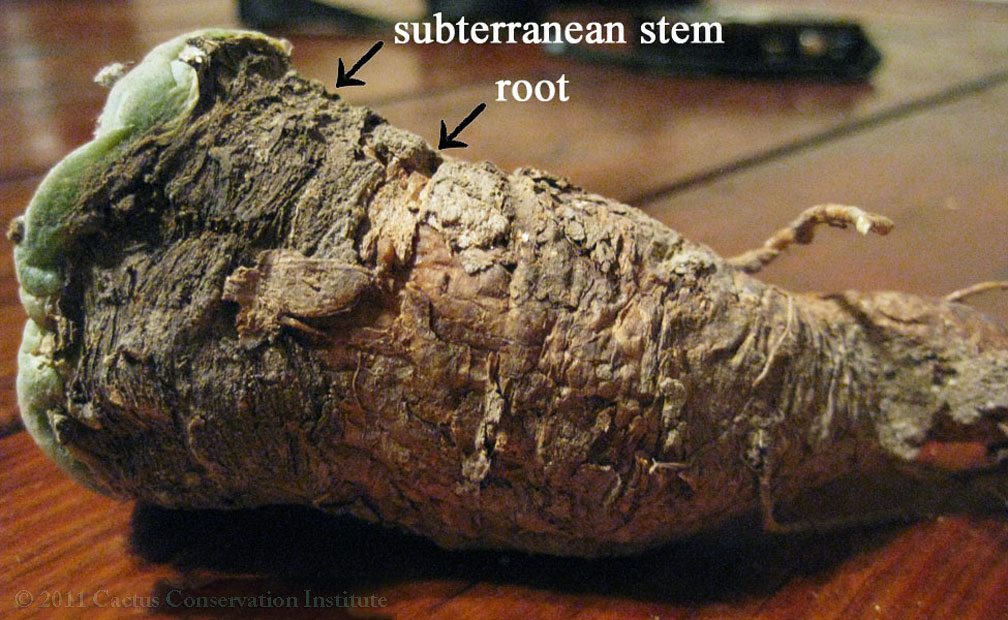
Stem is glaucous green, dull bluish or greyish green, very succulent, globular, top-shaped, or somewhat flattened up to 6 cm tall, 12 cm diameter, with a woolly top. The subterranean portion of the stem, which is as wide as the aerial portion, extends several cm below the surface of the ground and transitions smoothly (through a thin hypocotyl) into a large taproot which may extend over 25 cm below ground level.
Flowers
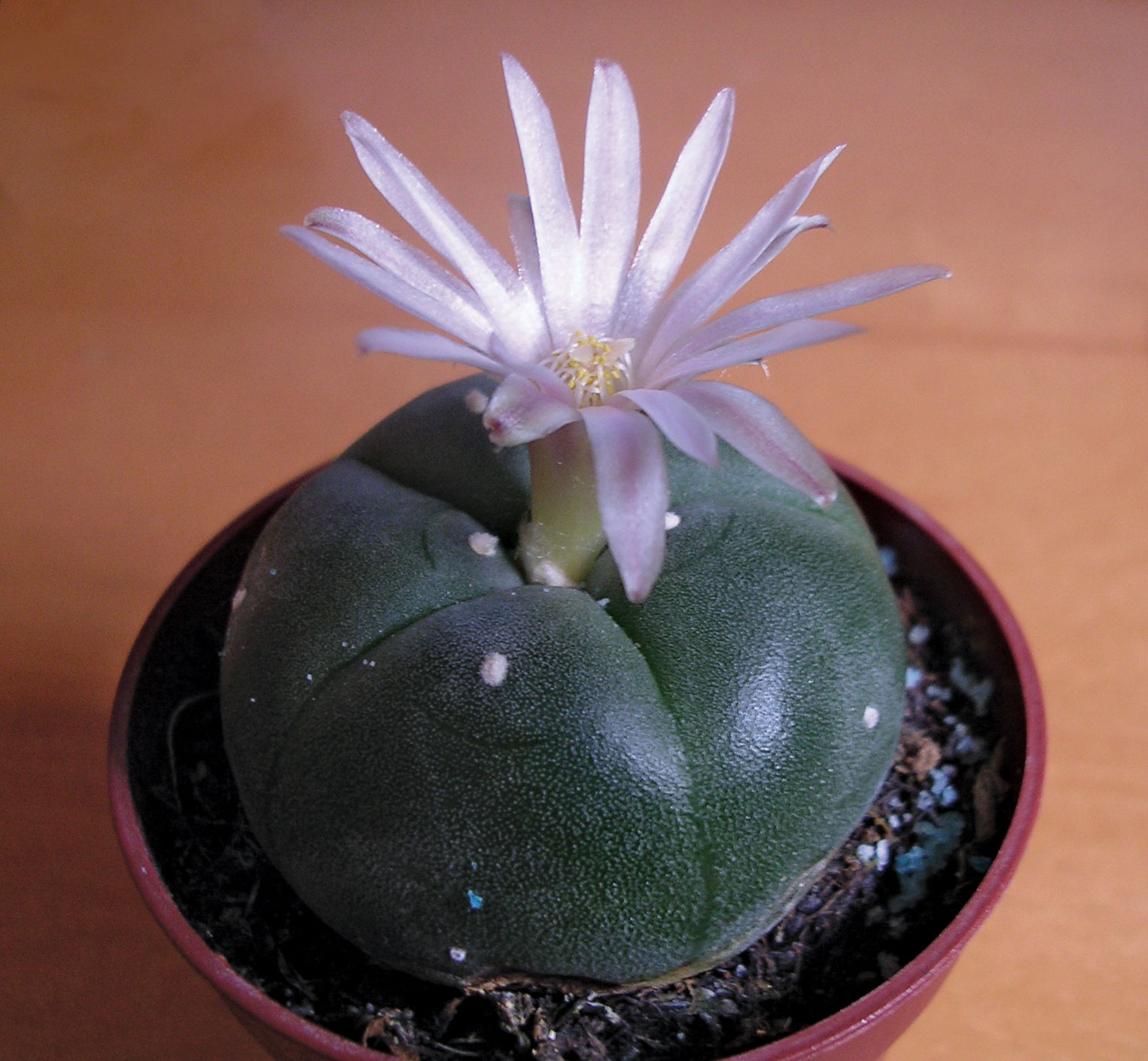
Flowers are solitary, campanulate, pink or white to slightly yellowish, sometimes reddish, up to 1 inch (2.5 cm) long, and up to 0.9 inches (2.2 cm) in diameter. They emerge from the mass of hairs at umbilicate center of crown each surrounded by a mass of long hairs. Stigma-lobes are 5-7, linear and pink. It flowers from March to May, and sometimes as late as September and open during the day. The flowers have thigmotactic anthers (like Opuntia).
Fruit
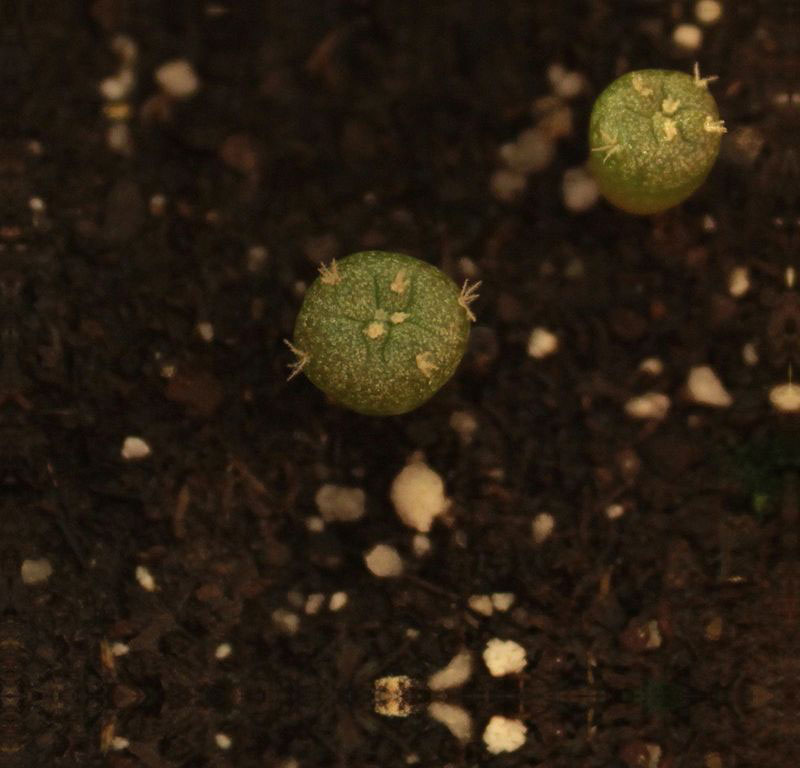
The cactus produces flowers sporadically; these are followed by small edible pink fruit. The club-shaped to elongated, fleshy fruits are bare and more or less rosy colored. At maturity, they are brownish-white and dry. The fruits do not burst open on their own and they are between 1.5 and 2 cm long. They contain black, pear-shaped seeds that are 1 to 1.5 mm long and 1 mm wide with broad basal hilum, tuberculate-roughened. The seeds require hot and humid conditions to germinate.
The cactus consists of several psychoactive alkaloids, the primary being mescaline, and upwards of 50 alkaloids that are derived from the amino acids tyrosine, phenylalanine. Most of the alkaloids are b-phenylethylamines, but a minor fraction is of the isoquinoline-structure. Many of the b-phenylethylamines are physiologically active, but mescaline is mainly responsible for the psychedelic effects. Fresh peyote contains 0.4 % mescaline per weight, dried buttons 2.74-3.7%.1
Traditional uses and benefits of Peyote
- They use peyote to treat several ailments like toothache, pain in childbirth, fever, breast pain, skin diseases, rheumatism, diabetes, colds, and blindness.
- Traditionally peyote was often used as analgesic, treating things including toothaches, asthma, and even cold symptoms.
- The Tarahumara, generally employed masticated (pulverized) peyote in the form of an external therapy for wounds, burn injuries, insect and snake bites as well as throbbing muscles.
- In some cases, Lophophora willamsii has been recommended by mental health professionals as a treatment of neurasthenia (nervous exhaustion).
- It works well to improve the symptoms of anxiety, headache, fatigue, and depressed mood associated with this condition.
- In the Native American Church, peyote ceremonies are used to treat a number of psychological, spiritual, and physiological issues.
- It’s also known for fostering compassion and gratitude and alleviating psychological disorders such as anxiety, depression, PTSD and addiction.
- Plant medicine was also used to treat a number of ailments, including snake bites, wounds, skin conditions, and general pain.
- Peyote is also used for treating fevers, in the form of an analgesic for easing symptoms of rheumatism and also to cure paralysis.
- This herb is also applied externally in the form of a poultice to treat wounds, fractures, and snake bite.
- Moreover, this plant is also used to encourage vomiting.
- Fleshy tissue of peyote can also be applied externally to enhance production of breast milk.
- It has been established that peyote works brilliantly to ease symptoms like nervousness, exhaustion, headache and depression, which are related to neurasthenia.
Popular Peyote Uses
Some people are said to use peyote for health concerns like fevers, joint pain, paralysis, fractures, wounds and snake bites. However, for all of these health concerns, there are much safer natural remedies that can be used medicinally for any these concerns. There are also no solid scientific studies to back up any of these uses.
Religious Ceremonies
As mentioned earlier, peyote is used to this day in the Native American Church. The ritualistic use of peyote is typically an all-night ceremony that occurs in a tepee around a fire and is led by a peyote “chief.” When eaten as part of a traditional ceremonial practice, peyote is supposed to allow the user to “commune with God and the spirits (including those of the departed) in contemplation and vision and so to receive from them spiritual power, guidance, reproof, and healing.”
In addition to sacramental consumption of peyote, there is also singing, prayer, and contemplation. Songs and chants used during the ceremonies can differ depending on the tribe.
Hallucinogenic Drug
One of the other most common uses of peyote is as a mind-altering hallucinogenic substance. This personal recreational use takes place in the U.S. even though using peyote outside of religious ceremonies is prohibited by federal law.
Peyote is sometimes intentionally (and illegally) taken, like LSD and other psychedelic drugs, to produce a temporarily altered state of existence. The effects of ingesting peyote are both physical and psychological and users often describe their experience as either a good or bad “trip.” The effects of peyote or a peyote trip can start within 20 to 90 minutes after ingestion and can last up to 12 hours, depending on how much is taken by the user. In general a peyote trip is an extremely unpredictable and potentially dangerous experience.
Substance Abuse and Addiction (Possible Use)
John H. Halpern, M.D., Assistant Professor of Psychiatry, Harvard Medical School, has been visiting the Navajo Nation for several years to study the effects of peyote. While he admits that psychedelics like mescaline are toxic substances, he also believes that the “mind-revealing power” of psychedelics could be used to help people suffering from alcoholism and addiction.
Precautions
- It may cause vomiting and headache.
- Peyote can also cause intense nausea and vomiting in users.
- Use of peyote led to death in one patient due to esophageal bleeding due to vomiting.
- Peyote has also been associated with serious changes in blood pressure, heart rate, and breathing.
- Peyote is known to cause nausea and vomiting, increased body temperature, hallucinations, altered perceptions of space and time, impaired motor coordination, euphoria, and anxiety.
References:
https://www.itis.gov/servlet/SingleRpt/SingleRpt?search_topic=TSN&search_value=503551#null
https://plants.usda.gov/core/profile?symbol=lowi
https://en.wikipedia.org/wiki/Peyote
https://davesgarden.com/guides/pf/go/55331/#b
https://gd.eppo.int/taxon/LOFWI