

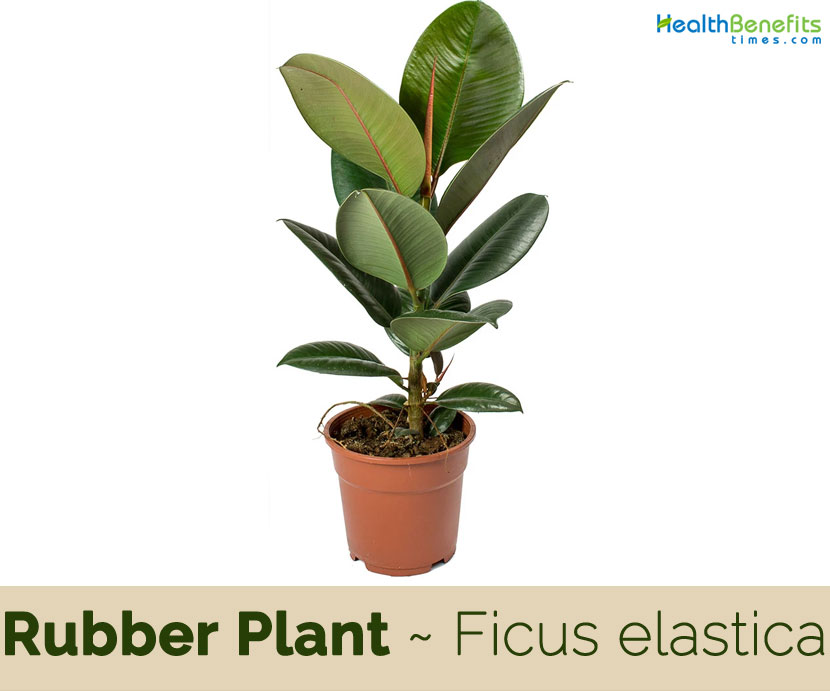
| Rubber Plant Quick Facts | |
|---|---|
| Name: | Rubber Plant |
| Scientific Name: | Ficus elastica |
| Origin | Indian Sub-continent (i.e. Bhutan, northern India and Nepal) and south-eastern Asia (i.e. Myanmar and Indonesia) |
| Shapes | 3-lobed, 3-seeded ellipsoidal capsule |
| Health benefits | Beneficial for wounds, cuts, sores, muscle and joint pain, constipation, insect bites and parasitic worms. |
| Name | Rubber Plant |
|---|---|
| Scientific Name | Ficus elastica |
| Native | Indian Sub-continent (i.e. Bhutan, northern India and Nepal) and south-eastern Asia (i.e. Myanmar and Indonesia). It has become naturalized in Sri Lanka, the West Indies, and the US State of Florida |
| Common Names | Indian rubber tree, rubber plant, rubber tree, Assam rubber, India rubber fig, Indian rubber plant, Indian rubber tree, rubber plant, Assam rubber tree, Caoutchoue tree, indian rubber fig, Karet-tree, Rubber Bush, rubber fig |
| Name in Other Languages | Afrikaans: Rubber, Rubberplant Albanian: Gomë Arabic: tayn mattatiin (تين مطاطي), fiks yalja (فيكس يلجا), Matat (مطاط), tayn maran (تين مرن) Assamese: Athā bara (অথা বৰ) Athabor, Attah Armenian: Rretin (ռետին) Azerbaijani: Rezin Basque: Gomazko, Kautxu-landare Belarusian: Guma (гума) Bengali: Bor, Rabāra (রবার) Bosnian: Guma Bulgarian: Kauchuk (каучук) Burmese: Ganoi, Kanoi, Nyaung kyetpaung Cameroon: Bikehi Caroline Islands: Gak’iynigoma Catalan: Goma d’esborrar, ficus del cautxú Cebuano: Rubber Chichewa: Mphira Chinese: Yin du rong (印度榕), Yìndù jiāo shù ( 印度胶树) , Yìndù xiàngpí shù (印度橡皮樹), Yìndù xiàngjiāoshù (印度橡胶树), Miǎn róng (缅榕), Miǎn shù (緬樹) , Xiàngjiāo ( 橡胶) Cook Islands: Rapa Croatian: Gumijevac, Fikus, guma Cuba: Goma elástica, hule, ule Czech: Guma, fíkovník pryžodárný Danish: Gummifigen, gummi, gummitræ Dominican Republic: Higuera Dutch: Rubber, Indische rubberboom, Indische gomelastiekboom English: Assam rubber tree, Caoutchoue tree, India rubber fig, indian rubber fig, Indian rubberplant, Indian rubber tree, Ornamental rubber tree, Rubber plant, Karet-tree, Rubberplant, Rubber Bush, rubber fig Esperanto: Kaŭĉuko Estonian: Kumm Filipino: Goma Finnish: Kumi, Kumiviikuna, huonekumipuu French: Arbre á caoutchouc, Caoutchouc, Figuier élastique, arbre du caoutchouc, arbre à la gomme, ficus à grandes feuilles, figuier caoutchouc, gommier, ficus commun, figuier ornamental Galician: Goma Georgian: Rezinis (რეზინის) German: Gummibaum, gummi, Gummi- Feigenbaum, indischer Gummibaum Ghana: Amanyedua Greek: Kaoutsoúk (καουτσούκ) Gujarati: Rabara (રબર) Haitian Creole: Kawotchou, caoutchouc Hausa: Roba Hebrew: גוּמִי, פיקוס הגומי Hindi: Bargad, Bor, rabar vrksh (रबर वृक्ष), atha bor, athabor, attah bar, bor, devak-araung, dewak-araung, diengjri, goli, goni, labor, nisatong, phrap ramkhet, phrapramkhet, rabbaru, rabracho-vad, sagubanka, sangria, shimayal, simamarri, simayal, simeyala Hmong: Roj hmab Hungarian: Gumi, Szobafikusz Icelandic: Gummi Igbo: Roba Indonesian: Karet, Karet kebo, kajai, rambung Indonesia/Sumatra: Kajoe aro karet, tuin bij de kampong Irish: Rubair Italian: Gomma da cancellare, Albero della gomma, Fico della gomma, gomma elastica Japanese: Assamugomu (アッサムゴム), Indogomunoki (インドゴムノキ) Indo gomu no ki, Gomu (ゴム) Javanese: Karet, Karèt kebo Kannada: Rabbar mara (ರಬ್ಬರ್ ಮರ), Rabra chovad, Rabbar (ರಬ್ಬರ್), Goli, Goni, Shimeala, India rubber mara Kazakh: Rezeñke (резеңке) Khasi: Diengjri Khmer: kawsaou (កៅស៊ូ) Korean: In do go mu na mu (인도고무나무), tanseong gomu(탄성 고무) Lao: Yang (ຢາງ) Lithuanian: Stambialapis fikusas Latin: Flexilis Latvian: Gumija Lithuanian: Guma Macedonian: Guma (гума) Malagasy: Fingotra Malay: Getah Malayalam : Inthyan rabbar (ഇന്ത്യന് റബ്ബര്), rabar (റബര്), Shimayal, Simayal Malaysia: Bunoh seteroh, nyatus Maltese: Gomma Maori: Rapa Marathi: Rabar (रबर), Rabracho-vad (रबराचो वड) Marshall Islands: Wojke-roba Micronesia, Federated states of: Komunoki, rapah, repah Mongolian: Ryezinen (резинэн) Myanmar: Bedi, ganoi, kanoi, moih-krat kanoi ganoi, nyaung-kyetpaung, rawbhar (ရော်ဘာ) Nepali: Rabar (रबर), labar Netherlands: Indische Gomelastiekboom Nicaragua: Palo de hule Norwegian: Gummi, gummifikentre Palau: Komunoki Persian: لاستیک, فیکوس Philippines: Balete Pohnpeian: Rapah, repah Polish: Gumowy, Figowiec sprężysty Portuguese: Arvore da goma elastica, Borracheira da India, Figueira da borracha, Borracha, Borracheira, Falsa-seringueira, Figueira-branca, Árvore-da-borracha, figueira-indiana, seringueira, seringueira-de-jardim Romanian: Cauciuc Russian: Lastik (ластик), Fikus kauchukonosnyĭ (Фикус каучуконосный), fikus elastika elastichnyy (фикус эластика эластичный) Samoa: Tagamimi palagi Sanskrit: Vat Serbian: Gumijevac, Tropska smokva, Fikus, Fikus zmajevac, guma(гума), kaučukovo drvo (каучуково дрво), tropska smokva (тропска смоква), fikus (фикус) Sesotho: Rabara Sinhala: Rabar (රබර්) Slovak: Guma Slovenian: Gumovec, gume Somali: Caag Spanish: Árbol del caucho, Gomero, Higuera cauchera, Higuera de la India, Planta del caucho, caucho, Cauchú comun, fisco, palo de goma Swahili: Mpira Swedish: Gummi, Fönsterfikus Tajik: Rezina (резина) Tamil: Cimaiyal (சீமையால்), Rappar (ரப்பர்), Cīmai (சீமை) Āl (ஆல்) Telegu: Rabbaru (రబ్బరు), Segubanka (సాగుబంక), Rabbaru, Sagubanka, Simamarri Thai: Yāng xindeīy (ยางอินเดีย) Yang india, Yāng (ยาง), lung, yang lop Turkish: Silgi, Kauçuk ağacı Ukrainian: Guma (гума) United States Virgin Islands: Indian rubber fig Urdu: ربڑ Uzbek: Rezina Vietnamese: Ða búp đỏ, cao su Welsh: Rwber Yapese: Gak’iynigoma Yoruba: Roba Yiddish: Gume (גומע) Zulu: Iraba |
| Plant Growth Habit | Large, evergreen tree |
| Growing Climates | Hill forest, particularly on cliffs and limestone hills, vegetation zones of tropical rainforest, woodland, shrub land, light tropical forest and as a cultivated plant indoors or in greenhouses elsewhere |
| Plant Size | About 30–40 meters (98–131 ft.) (rarely up to 60 meters or 200 feet) tall, with a stout trunk up to 2 meters (6.6 ft.) in diameter |
| Bark | Pale to dark brown with a smooth surface and the inner bark pale brown with abundant white or cream colored latex. |
| Trunk | Cylindrical, unbranched up a long way and then with much-branched leafy canopy, but frequently swollen towards the base |
| Leaf | Elliptic to oblong leaves 6-30 cm long and 5-15 cm wide, acuminate at apex, rounded at base, glabrous, smooth, leathery, gray to brown when dry; petioles 2.5-5 cm long, glabrous, yellowish-brown to black, stipules (0.4-) 5-15 cm long, glabrous to seríceas |
| Flower | Flowers are produced in the interior of an axillary inflorescence and they have a creamy white color |
| Fruit Shape & Size | 3-lobed, 3-seeded ellipsoidal capsule. Fruits burst open when ripe and the seeds are scattered up to 15 m from tree |
| Seed | Variable in size, 2.5-3 cm long, mottled brown, lustrous |
| Propagation | By seed, cuttings and air layering |
| Plant Parts Used | Rootlets, bark and latex |
| Health Benefits |
|
| Culinary Uses |
|
| Precautions |
|
Root
Rubber Plant is another typical epiphyte plant. It grows on the branches of various tropical tree species and develops aerial blastogenic roots that penetrate the soil. The aerial part of these roots becomes trunkish ‘strangling’ the host tree. In cultivation, it often develops an extensive surface root system.
Trunk
The trunk is cylindrical, unbranched up a long way and then with much-branched leafy canopy, but frequently swollen towards the base. The bark is pale to dark brown with a smooth surface and the inner bark pale brown with abundant white or cream colored latex. The trunk develops aerial and buttressing roots to anchor it in the soil and help support heavy branches.
| Trunk/branches | branches droop; not showy; typically one trunk; no thorns |
| Bark | brown, smooth, or slightly rough |
| Pruning requirement | needed for strong structure |
| Breakage | susceptible to breakage |
| Current year twig color | green |
| Current year twig thickness | Thick |
| Wood specific gravity | Unknown |
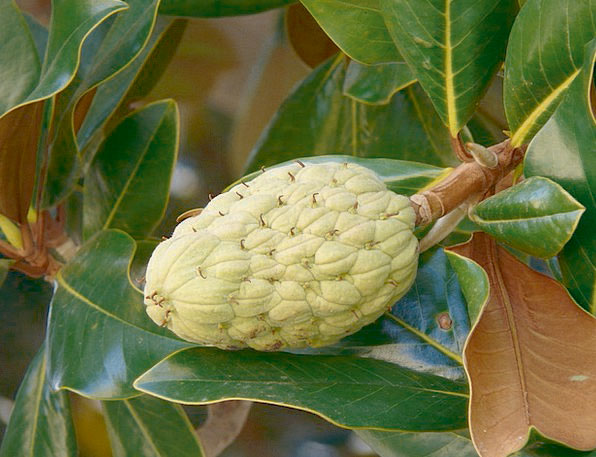 Fruit-of-Rubber-Plant
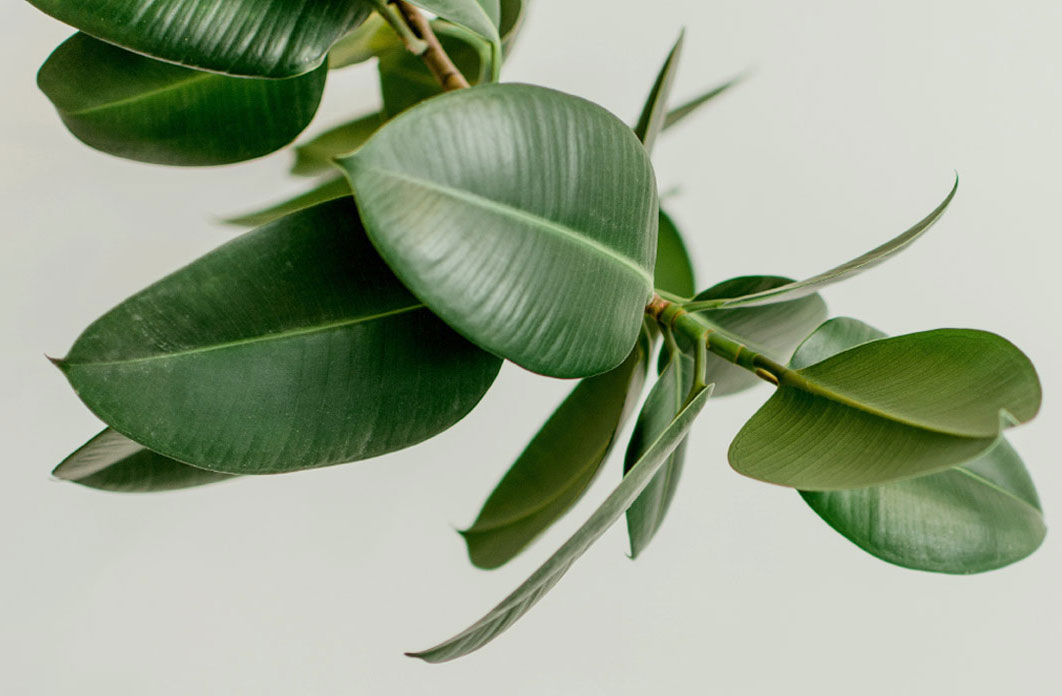 Leaves-of-Rubber-Plant
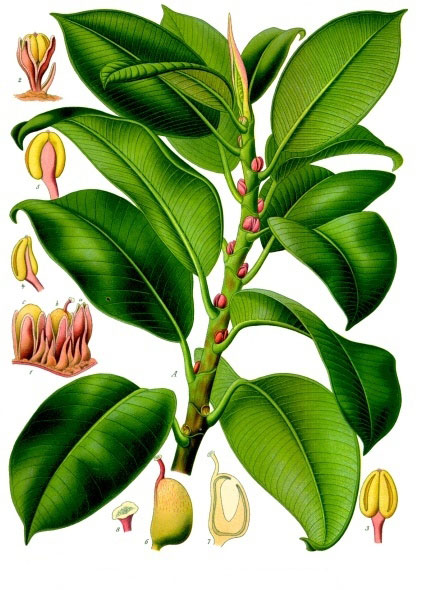 Plant-Illustration-of-rubber-plant
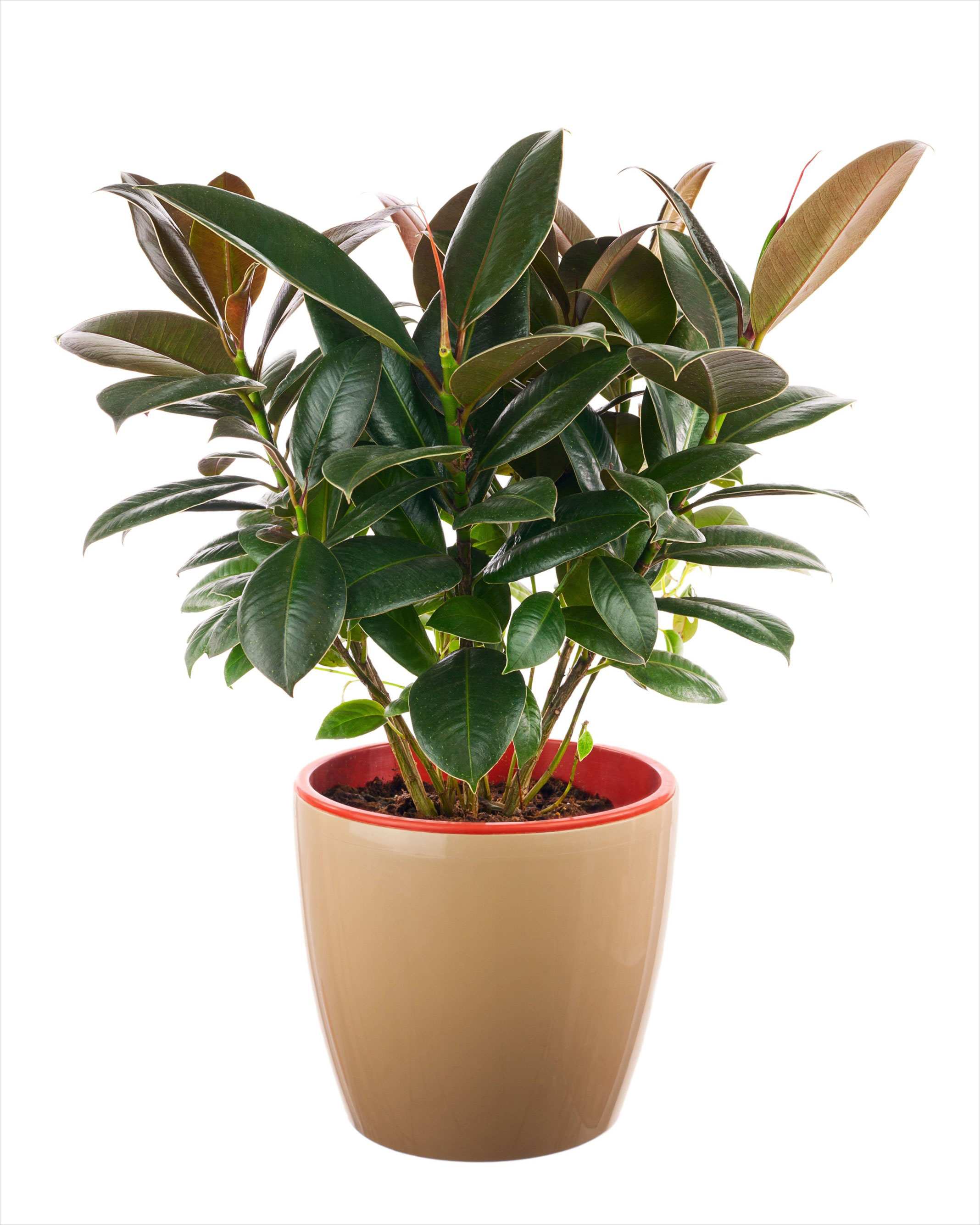 Rubber-Plant
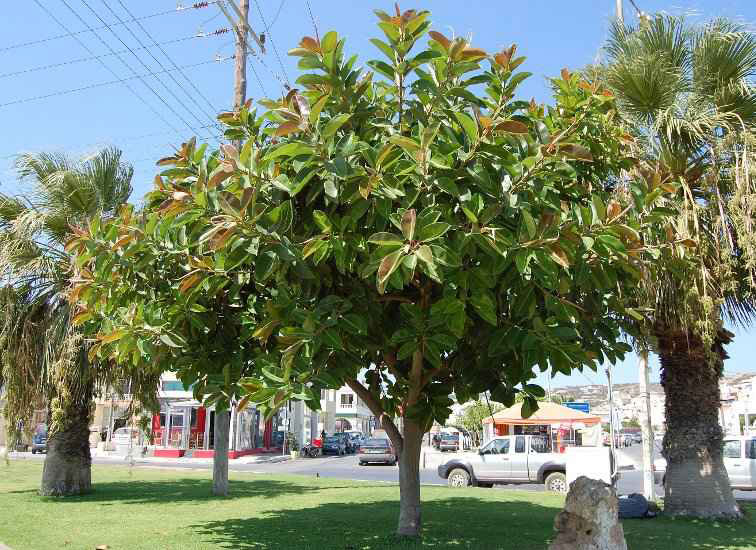 Rubber-Plant-grown-outdoor
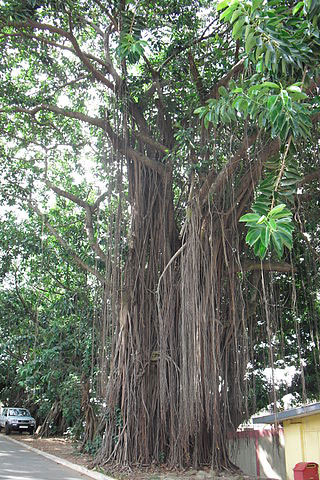 Rubber-plant-showing-the-aerial-roots
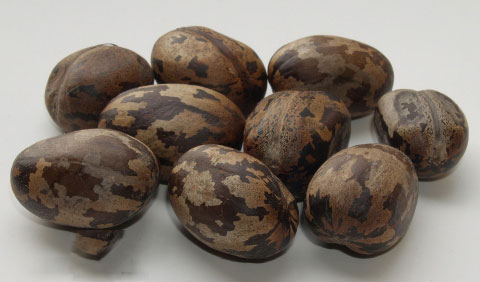 Seeds-of-rubber-plant
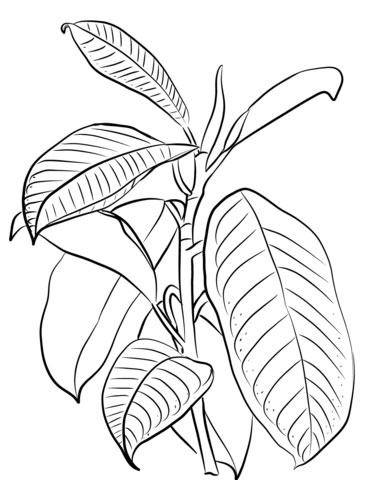 Sketch-of-Rubber-Plant
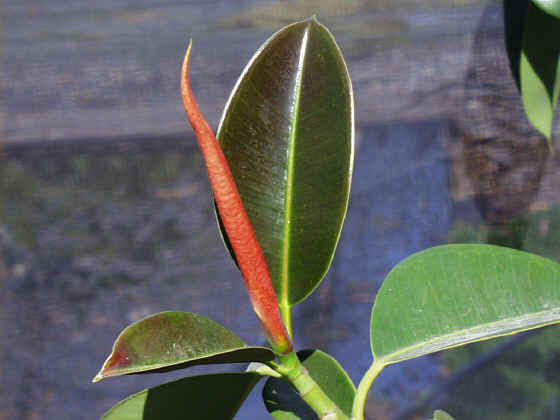 Young-leaf-of-Rubber-Plant
Leaves
Leaves are broad shiny oval 10–35 centimeters (3.9–13.8 in) long and 5–15 centimeters (2.0–5.9 in) broad. Leaf size is largest on young plants (occasionally to 45 centimeters or 18 inches long), much smaller on old trees (typically 10 centimeters or 3.9 inches long). The leaves develop inside a sheath at the apical meristem, which grows larger as the new leaf develops. When it is mature, it unfurls and the sheath drops off the plant. Inside the new leaf, another immature leaf is waiting to develop. They are relatively thick, acuminate at apex and have a round base. Their petioles are leathery, yellowish brown to black and have a length of 2.5 to 5 cm (1-2 in).
| Leaf arrangement | Alternate |
| Leaf type | Simple |
| Leaf Margin | Entire |
| Leaf shape | Elliptic (oval) |
| Leaf Venation | Pinnate, brachidodrome |
| Leaf type and persistence | Evergreen, broadleaf evergreen |
| Leaf blade length | 3 ½ to 12 inches |
| Leaf Color | Emerge red but turn dark glossy green |
| Fall Color | No color change |
| Fall Characteristics | Not showy |
Flowers
The flowers are produced in the interior of an axillary inflorescence and they have a creamy white color. The males consist of 4 sepals of ovate shape and bear a solitary stamen with ovoid anther. The females consist of 4 ovate-shaped sepals and have a short style with papillate stigma.
| Flower Color | Unknown |
| Flower Characteristics | not showy; emerge inside the fleshy fruit produced by this tree |
Fruit
Fertile flower are followed by 3-lobed, 3-seeded ellipsoidal capsule. Fruits burst open when ripe and the seeds are scattered up to 15 m from tree. Seeds are variable in size, 2.5-3 cm long, mottled brown, lustrous.
| Fruit shape | Egg-shaped |
| Fruit length | ½ inch |
| Fruit covering | fleshy fig |
| Fruit color | greenish-yellow |
| Fruit characteristics | does not attract wildlife; not showy; fruit/leaves a litter problem |
| Fruiting | Early Summer |
Range
The natural range of rubber ranges from Nepal in the north to Indonesia, Bhutan, northeastern India, Burma and China (Yunnan) and Malaysia. It has been widely introduced in most tropical regions of the world, including Hawaii and the West Indies. Finally, in Europe, it can be found in the sheltered gardens of the Côte d’Azur and on the Spanish and Italian coast.
Health Benefits of Rubber Plant
Listed below are few of the popular health benefits of Rubber Plant
1. Decreased Chances of Getting Allergies
One of the greatest health benefits of the Rubber Plant regarding air purification is its ability to minimize the chances of an individual getting respiration allergies such as asthma. Thanks to the fact that this plant also helps increase humidity within a room, it prevents pollutants and other unwanted particles to eventually turn into dust.
2. Natural Anti-Inflammation
Leaves of this plant have the power to cure skin rash. This can be done by frequently rubbing the affected area with mashed fresh leaves. Plant’s roots can also help cure rheumatic diseases. Combine 30-50 grams of its roots with 2 glasses of water and boil this until it remains just 1 glass of it. Let it cool down and drink the water.
3. Natural Analgesic
Leaves of the Ficus Elastica plant are also known to contain analgesic substances that can help cure inflammation. Simply mash the fresh leaves and rub the affected area with them. Besides using it on the skin, the plant can also be used to treat teeth inflammation. Instead of rubbing the mashed leaves, put them in a cup of water and gargle the mixture.
4. Promotes Stomach Health
Although it hasn’t been scientifically proven, many people use the leaves of this plant to keep their stomach healthy. Being a natural ingredient that does not contain any artificial chemicals, there is really no harm in using the Ficus Elastic. Nevertheless, it is never a bad idea to consult with your healthcare professional first.
Traditional uses and benefits of Rubber Plant
- Decoction of the aerial rootlets is used as a vulnera.
- Latex has been successfully used to treat five cases of trichuriasis.
- Fruit contains a substance called mucilage which is very helpful with a host of stomach problems such nausea, general pain or digestive problems.
- Dry and raw figs can be very beneficial for constipation.
- Dry fig water is a great mouth cleaner and helps to cure Mouth sores and inflammation.
- Mouth disorders can be healed with fig water.
- It can also help if you have a cough.
- Milky white material in the leaves can be applied to the insect bites.
- It can heal the bite rash and itching quickly.
- You can also apply the latex on warts and corns to heal them.
- Crushed aerial or adventitious rootlets are used for healing wounds, cuts and sores.
- Crushed bark is used to check bleeding of wounds.
- Latex is recommended in decoction, for parasitic worms.
- Decoction of aerial rootlets used as vulnerary for wounds, cuts, and sores in Philippines.
- Latex is used for parasitic worms (trichuris trichura) in panama.
- It is used as fertility enhancement in Northern Cameroon.
- It is used in the treatment of muscle and joint pain in West Africa.
- Kernels consist of oil, which is used in soap making, paints, varnishes, and is effective against houseflies and lice.
Control Methods
Physical control
F. elastica trees may grow very large and mechanical removal may only be possible with smaller trees.
Chemical control
Fig trees are mainly sensitive to triclopyr herbicides as a basal or cut-stump treatment. Trees found growing on concrete or rock structures should be treated with herbicide while young to avoid costly structural damage. Use extreme caution while applying herbicide to figs growing as epiphytes to ensure that the poison does not contact the host tree. When exotic figs germinate high in the branches of large trees in natural forest communities, it may be extremely difficult to get close enough to the fig to treat it.”
Biological control
Nadel et al. report several pests that could be looked at for biological control potential including various ants which were seen carrying off pollinator wasps from Ficus fruits, Hymenoptera and mites that may be parasites of the pollinator wasps, and staphylinids which were seen entering Ficus fruits and eating the pollinator wasps.
Cultural control
Pollinator wasps should be prevented from entering Hawai’i in order to prevent spread of F. elastica. Other native or non-harmful non-native trees could be planted.
Other Facts
- Latex is obtained from the bark of the stem and larger branches.
- It can be used for all applications of natural rubber, such as tyres, rubber components for cars and machines and consumer products such as footwear, sport goods, toys and gloves.
- Traditionally, latex is used to line baskets of split rattan, to make them watertight, and has sundry other applications.
- Latex of wild as well as planted trees can be collected by tapping the bark, generally only of the stem and larger branches, though root bark may also be tapped.
- Scrap and the coagulated latex are pressed into blocks, cakes or sheets before being traded.
- Latex showed toxicity to the juveniles of the nematode Meloidogyne javanica.
- Fibrous bark has been used for the manufacture of clothes and ropes.
- Wood is of poor quality, but is occasionally applied for boards, posts, boats and fuel.
- In the nineteenth and twentieth centuries it was heavily cultivated for commercial rubber production, but fell into disuse with the rise in production of the higher-quality ‘para’ rubber, Hevea brasiliensis.
- Trunk and stems exude a milky sap, or latex.
- Rubber Plant as ornamental lives from 25 to 50 years. When native to the tropical regions of the planet can reach up to the age of 200 – not at all bad performance.
- Fibrous bark has been used for the manufacture of clothes and ropes.
- Wood is of poor quality and occasionally applied for boards, posts, boats and fuel.
References:
https://www.itis.gov/servlet/SingleRpt/SingleRpt?search_topic=TSN&search_value=19085#null
https://npgsweb.ars-grin.gov/gringlobal/taxonomydetail.aspx?id=70291
https://pfaf.org/user/Plant.aspx?LatinName=Ficus+elastica
https://www.cabi.org/isc/datasheet/24090
http://www.missouribotanicalgarden.org/PlantFinder/PlantFinderDetails.aspx?kempercode=b597
http://www.hear.org/pier/species/ficus_elastica.htm
https://plants.usda.gov/core/profile?symbol=FIEL
https://davesgarden.com/guides/pf/go/718/#b
http://www.theplantlist.org/tpl/record/kew-2810307
https://gd.eppo.int/taxon/FIUEL
https://en.wikipedia.org/wiki/Ficus_elastica
https://edis.ifas.ufl.edu/st252
http://www.starrenvironmental.com/publications/species_reports/pdf/ficus_elastica.pdf
http://www.narc.gov.jo/gringlobal/taxonomydetail.aspx?id=70291
http://www.flowersofindia.net/catalog/slides/Rubber%20Tree.html