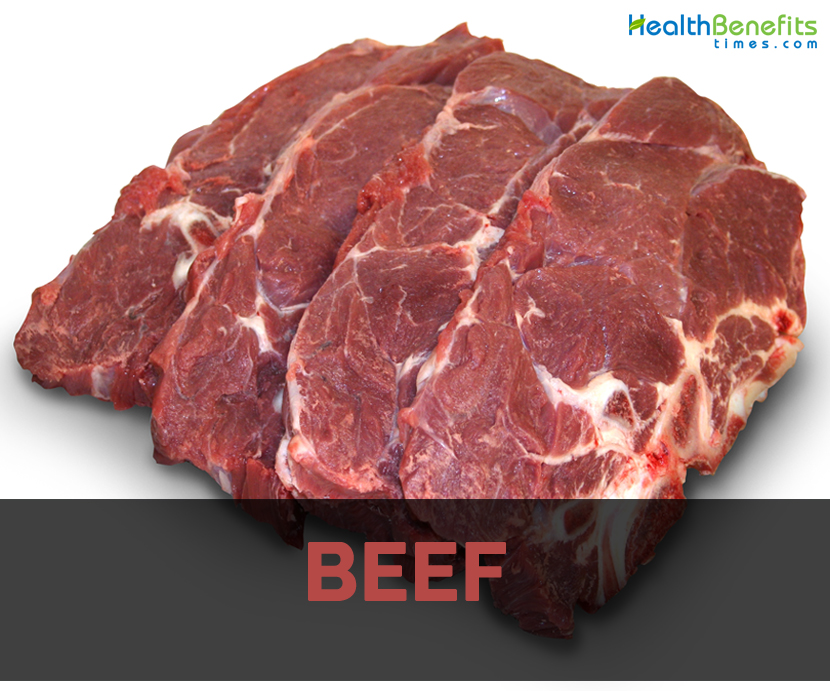
| Beef Quick Facts |
| Name: |
Beef |
| Origin |
The exact period of cooking beef is unknown. Cattle were used as draft animals and for milk in the Old world. Some breeds were cultured to enhance the texture of meat that raised Murray Grey, Wagyū and Angus. |
| Colors |
Red |
| Calories |
267 Kcal./cup |
| Major nutrients |
Total Fat (59.03%)
Histidine (53.08%)
Lysine (52.81%)
Tryptophan (51.82%)
Isoleucine (51.32%)
|
| Health benefits |
Maintains muscle mass, Enhance performance, Prevent anemia, Muscle health, Immunity power |
| More facts about Beef |
Beef is the cattle meat such as bulls, heifers, cows or steers. The muscle of the beef meat could be cut into short ribs, roasts or steak. The cuts are also used minced, ground or used in sausages. It is a source of food which differs in the various parts of the world. Blood is used to make the blood sausage. The beef of the heifers and steers are very much identical. Brazil, India and Australia are considered as the highest exporter of beef in the year 2015. The other economies who produce beef are Canada, Uruguay, Mexico, Paraguay, Belarus, Argentina and Nicaragua.
History
The exact period of cooking beef is unknown. Cattle were used as draft animals and for milk in the Old world. Some breeds were cultured to enhance the texture of meat that raised Murray Grey, Wagyū and Angus. Some breeds were used for both milk production and meat such as Brown Swiss.
Due to the development in Southwest, the business of beef was developed in United States. From the suspension of Plains Indians from grasslands and Midwest, the industry of American livestock started by taming the wild longhorn cattle. New York and Chicago got benefited from the development of stockyards and meat markets.
Nutritional value
In 114 grams of Beef, it covers 267 calories, 72.46 grams of moisture, 20.2 grams of protein, 20.66 grams of total fat and 0.93 grams of ash. It also grants 0.654 grams of histidine, 1.766 grams of lysine, 0.228 grams of tryptophan, 0.858 grams of isoleucine, 0.889 grams of threonine, 1.625 grams of leucine, 0.913 grams of valine, 20.2 grams of protein, 2.04 mg of iron, 71 mg of sodium and 7 mg of calcium.
Health Benefits of Beef
Beef is the flesh or meat of the animals which belongs to the family Bovidae. Heifer Beef, Cow Beef, Bull Beef and Steer Beef are the four types of beef which is found in the market. More than 800 beefs are found. It could be found in various cuts according to the need of recipes. Various cuts range in tenderness, texture and fat content. It is a red meat which contains high content of iron in comparison to fish and chicken. It is mostly consumed as steaks, ribs and roast.
- Maintains muscle mass
Beef is a great source of protein along with amino acids. The deficiency of protein raises the chances of muscle wasting and increases the chances of sarcopenia which is a health ailment mostly occur in elderly people. It helps to improve the intake of protein.
- Enhance performance
For the effective function of muscles it requires carnosine. It is formed with beta-alanine which is an amino acid that is found in adequate amounts in meat such as beef and fish. The high content of carnoisne is associated with lowering the chances of fatigue and enhances the performance. One should consume an adequate intake of beta-alanine or fish and meats to promote the exercise performance. The high content of protein lowers the chances of sarcopenia and also preserves the muscle mass.
- Prevent anemia
Anemia is caused due to the low presence of red blood cells and low ability to transport oxygen in the body. It is also caused due to the deficiency of iron and may cause the symptoms such as weakness and tiredness. It is an excellent source of iron. The meat raises the absorption of iron from the other foods. The intake of meat helps to lower the chances of anemia.
- Muscle health
Protein has a vital role in the coordination and contraction of muscles. The proteins could be found in the microfilaments and also maintains the structure of muscles. The growth of muscle relies upon the adequate amount of proteins in the body. There should be balance between the breakdown of muscle proteins and rate of muscle protein synthesis. (1) (2) (3) (4) (5)
- Immunity power
Protein is essential to enhance the immunity system. The antibodies in the body help to prevent from the diseases and infections and self-defense it. The antibodies eliminate the antigens with the production of limited antibodies. (6)
- Hair health
Protein is essential for the maintenance of hair health and prevents it from various damage. The study shows that protein plays a vital role in the growth of hair. Due to this beneficial effects, protein is also used to manufacture conditioners which is a hair care product. (7) (8)
- Great for skin
Protein provides a mechanical support and helps to strengthen tissues such as skin because it constantly suffers from wear and tear. It is a vital fibrous protein that strengthens the tissues, cells and organs. The high content of collagen protein found in the body helps to provide low wrinkled, healthy and youthful skin. (9) (10)
- Forms hemoglobin
Iron assists to form hemoglobin. It provides the shade of dark red to blood and assist in the transportation of oxygen to the cells in the body. Hemoglobin is essential as the body loses the blood in internal or external injuries. Women help to lose blood during menstruation so they have high chances of suffering from anemia. (11) (12)
- Brain health
Iron helps to increase the brain development. Iron helps to supply the oxygen to the brain health. It promotes the activity of brain and creates neural pathways which help to prevent the chances of cognitive ailments such as Alzheimer’s disease and dementia. (13)
- Regulates body temperature
Iron assists to regulate the temperature of the body. It helps to stabilize the temperature of the body. It assists in the metabolic and enzymatic functions. (14)
Varieties/Types
- Brisket:
It is a boneless cut along with fat. Flat half brisket, Point half brisket, Corned brisket and Whole brisket are cooked in liquid or braised.
- Chuck:
It is the cut of meat of shoulder, neck and arm of the cow. It has more connective tissue and is not tender. It contains boneless top blade steak, chuck eye roast, arm pot roast, cross rib pot roast, boneless shoulder pot roast, blade roast, flanken style ribs, short ribs and stew beef.
- Flank:
It is the cut part of belly. It is tender, flavorful and lean cut that suits for broiling. It is pan-broiled, braised and stir-fried. It should be cut into thin and sharp angle for making easy to chew.
- Foreshank:
It is the meat of front legs of steer which is tough and mostly used for ground beef and stew.
- Rib cuts:
It is tender. It is found as rib roast, rib roast, large end, rib-eye roast and small end. The roasts are also cut into steaks which are known as rib steaks and rib-eye steaks are called Delmonico steaks. The rib cuts are roasted, broiled and grilled.
- Round:
It has round bone and femur. It contains eye of round, round tip and top round. It could be roasted and braised. It also includes bottom round roast and boneless rump roast.
- Short loin:
It is the meat part of between lower ribs and pelvis.
- Short plate:
It is the tough and fatty meat. It contains skirt steak which could be braised, pan-broiled or broiled. The boneless cuts of beef are also derived from this part.
- Sirloin:
It is the lean and tender meat. It contains sirloin flat bone, sirloin pinbone, sirloin round bone and top sirloin. It is also ground. It is also broiled or roasted.
- Ground beef:
It is available in chuck, round or sirloin
- Beef liver:
Beef liver is a great source of riboflavin, vitamin B12, folate, vitamin B6, niacin, vitamin A, zinc and iron. It has low amount of fat.
Precautions
- It may increase the chances of Alzheimer’s or cardiovascular disease.
- The chances of colon cancer increases.
- The people allergic to beef should avoid its consumption.
How to Eat
- The meat of Beef muscle could be cut into roasts, steak or short ribs.
- Some cuts are mixed with other meat which is ground, minced and made sausages.
- The blood is used in blood sausages.
- Beef stock is made from the bones.
- It could be grilled, barbecued, broiled, griddle and roasted.
- It is also dried, smoked and cured.
- In United States, beef is used to make beef jerky which is dried, salted and smoked beef.
- In South Africa, Biltong is made from cured, salted and air dried beef.
Other Facts
- Beef is the third mostly consumed meat in the world.
- The United States, People’s Republic of China and Brazil are the highest consumers of beef.
- India, Australia and Brazil are the highest exporters of Beef.
- Texas produces high amount of beef and Missouri, Nebraska, South Dakota and Oklahoma follows it.
- Three ounces of beef provides adequate amount of protein.
- About 25% of the beef in the world is produced by United States.
- About 61.1 pounds was consumed annually in the year 2008.
- A cowhide produces much leather for the production of 12 basketballs, 18 volleyballs, 18 soccer balls and 20 footballs.
- In United States, it is added to the diet as the great source of zinc.
References:
https://authoritynutrition.com/foods/beef/
https://en.wikipedia.org/wiki/Beef
Comments
comments