

| Balsam Fir Quick Facts | |
|---|---|
| Name: | Balsam Fir |
| Scientific Name: | Abies balsamea |
| Origin | Most of eastern and central Canada and the northeastern United States |
| Colors | Dark Purple |
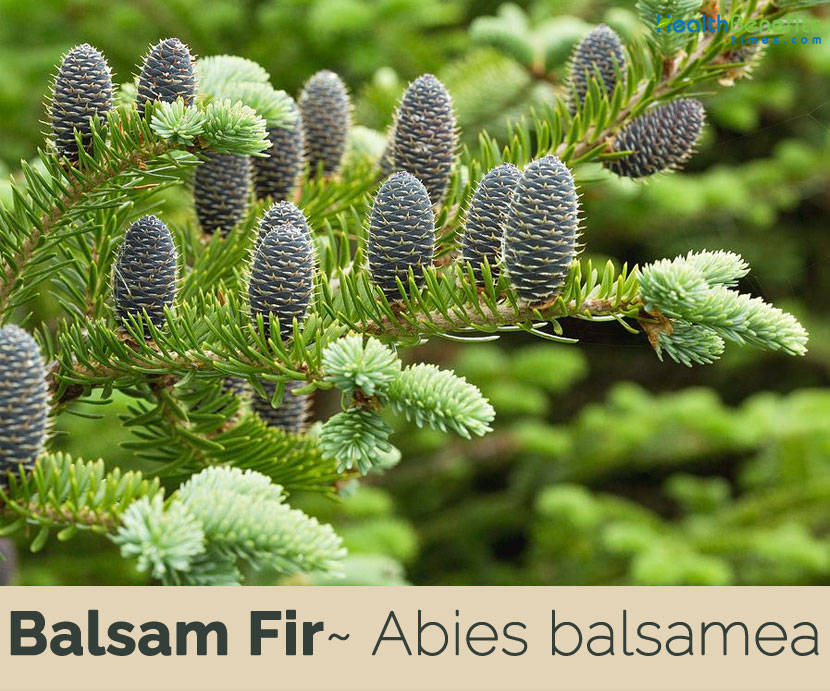
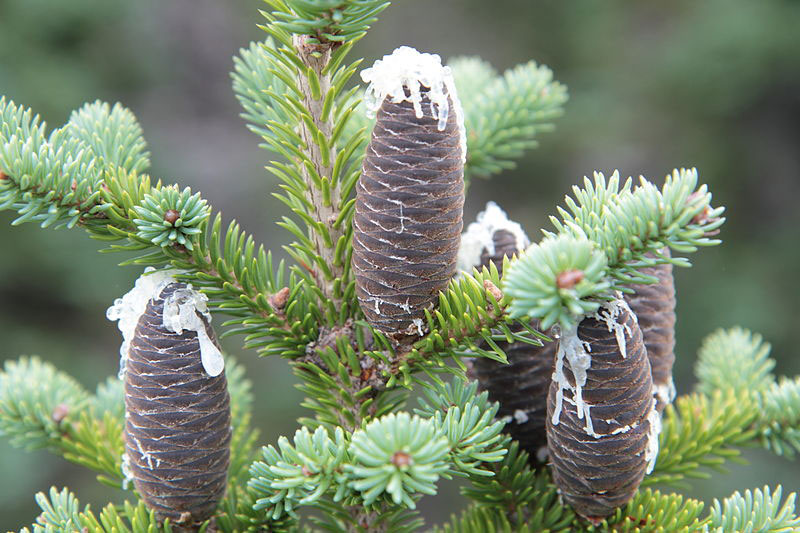
| Shapes | Erect cone 5 to 10 cm (2 to 4 in) long with short, round, irregularly notched scales and pointed tips |
| Taste | Acrid |
| Health benefits | Beneficial for cancers, corns, warts, coughs, diarrhea, rheumatism, scurvy, headache, wounds, cuts, burns, bruises, Asthma, Bronchitis |
| Name | Balsam Fir |
|---|---|
| Scientific Name | Abies balsamea |
| Native | Most of eastern and central Canada (Newfoundland west to central Alberta) and the northeastern United States (Minnesota east to Maine, and south in the Appalachian Mountains to West Virginia) |
| Common Names | Abies balsamea, Balm of Gilead, Balsam Canada, Balsam, Balsam Fir, Balsam Fir Canada, Balsam of Fir, Bálsamo de Canadá, Baume de Galaad, Baume de Galahad, Baume de Gilead, Baume du Canada, Canada Turpentine, Canadian Balsam, Eastern Fir, Fir Balsam, Gomme de Sapin, Pinus balsamea, Résine du Sapin Baumier, Térébenthine, Térébenthine du Canada |
| Name in Other Languages | Afrikaans: Balsem fir Albanian: Bredhi bredhi Amharic: Yebelesani fire (የበለሳን ፍሬ) Arabic: shawh bilasmi (شوح بلسمي), bilism altanuub Armenian: Yeghevin balasanayin (եղևին բալասանային), balzam yeghevni (բալզամ եղևնի) Atikamekw: Irinacit Azerbaijani: Ətirli ağ şam, balzam fir Basque: Baltsamo-izei Belarusian: Baltsamo-izei Bengali: Balasāma phāra (বলসাম ফার) Bokmal: Balsamgran Bulgarian: Balsamova ela (балсамова ела) Burmese: Bar lam htainn ruu (ဗာလမ်ထင်းရူး) Chinese: Xiang zhi leng shan (香脂冷杉) Cree: Napakâsîta Czech: Jedle balzámová Danish: Balsamgran Dutch: Balsemzilverspar, balsamspar, balsemspar, Canada-balsam, Canada-balsem Croatian: Balzamična jelka Czech: Jedle balzámu Danish: Balsam gran Dutch: Balsem spar English: Balsam fir, Canadian Fir, Balsam, Canada balsam, Balm of Gilead fir, Balsam fir, Canada balsam, Eastern fir, Fir balsam, bracted balsam fir, blister fir Esperanto: Balzama abio, abio de balzamo Estonian: Palsamnulg, palsam kuusk Filipino: Balsamo fir Finnish: Palsamipihta, balsam kuusen French: Sapin balsamier, Baumier, Sapin baumier, Sapin, baume du Canada, sapin du Canada Georgian: Balzamis nadzvi (ბალზამის ნაძვი) German: Balsam-Tanne Greek: Elato válsamou (Ελάτη η βαλσαμική) Gujarati: Malama phira (મલમ ફિર) Hausa: Balsam fir Hebrew: אשוח ריחני Hindi: Balasam phar (बलसम फर) Hungarian: Balzsamfenyő, Balzsamos jegenyefenyo Icelandic: Balsamþinur Indonesian: Balsam fir Irish: Fir balsam Italian: Abete balsamico, Abete balsamifero Japanese: Barusamumomi (バルサムモミ) Javanese: Balsam fir Kannada: Bālsām phar (ಬಾಲ್ಸಾಮ್ ಫರ್) Kazakh: Balzam şırını (бальзам шырыны) Komi: Bal’zam n’yv (Бальзам ньыв) Korean: Balsam jeonnamu (발삼 전나무) Kurdish: Balsam fir Lao: Balsam fir Latin: Abies pirorum Latvian: Balzama baltegle, balzama egle Lithuanian: Balzaminis kėnis, balzaminė eglė Macedonian: Balzam ela (балзам ела) Malagasy: Balsam fir Malay: Balsam cemara Malayalam: Balsam fir Maltese: Znuber tal-balzam Marathi: Sugandhī uṭaṇē tyācē lākūḍa (सुगंधी उटणे त्याचे लाकूड) Mongolian: Balsam gatsuur (Balsam гацуур) Nepali: Balasam phir (बलसम फिर) Netherlands: Balsamspar, canadabalsam Norwegian: Balsam-edelgran, balsamgran Ojibwa: Aninaandag, aninaandagoog, ingiigido’aag, ininaandag, ininaandagoog, Nimisenh, Nimisenyag, wadab, wadabiig Oriya: ବାଲସାମ ଫିର | Pashto: d bialsumi fyr (د بالسم فیر) Persian: نراد بالسام Polish: Jodła balsamiczna Portuguese: Abeto-do-bàlsamo-do-Canadà, abeto de balsam Punjabi: Bālasama aipha.Ā ī.Āra (ਬਾਲਸਮ ਐਫ.ਆਈ.ਆਰ) Romanian: Brad de balsam Russian: Pikhta bal’zamicheskaya (Пихта бальзамическая), bal zam pikhta (бальзам пихта) Serbian: Balzamasta jela (Балзамаста јела), balzamika jelka (балзамика јелка) Sindhi: Balm fir (بالم فير) Sinhala: Balsam fir Slovak: Jedla balzamová Slovenian: Balzamovec, balzamova jelka Spanish: Abeto de balsam, abeto balsámico, abeto de navidad Sundanese: Balsam fir Swedish: Balsamgran Tajik: Arsam balsam (арсам balsam) Tamil: Pālcam ḥpir (பால்சம் ஃபிர்) Telugu: Bālsam phir (బాల్సమ్ ఫిర్) Thai: Yā h̄m̀xng fexr̒ (ยาหม่องเฟอร์) Turkish: Balsam köknar Ukrainian: Yalytsya balʹzamichna (Ялиця бальзамічна), balʹzamova yalyna (бальзамова ялина) Urdu: بیلسم ایف آئی آر Uzbek: Balsam fir Vietnamese: Linh sam balsam Welsh: Ffynidwydd balsam Zulu: Ibhalsamu fir |
| Plant Growth Habit | Small to medium-sized, evergreen, coniferous, upright tree |
| Growing Climates | Mountain slopes, glaciated uplands as well as on alluvial flats, peat lands, swamps, forests and wetland margins |
| Soil | Grows on a wide range of inorganic and organic soils originating from glaciation |
| Plant Size | 4–20 meters (46–66 ft.) tall, occasionally reaching a height of 27 meters (89 ft.) |
| Root | Shallow root system that is mostly confined to duff and upper mineral soil layers |
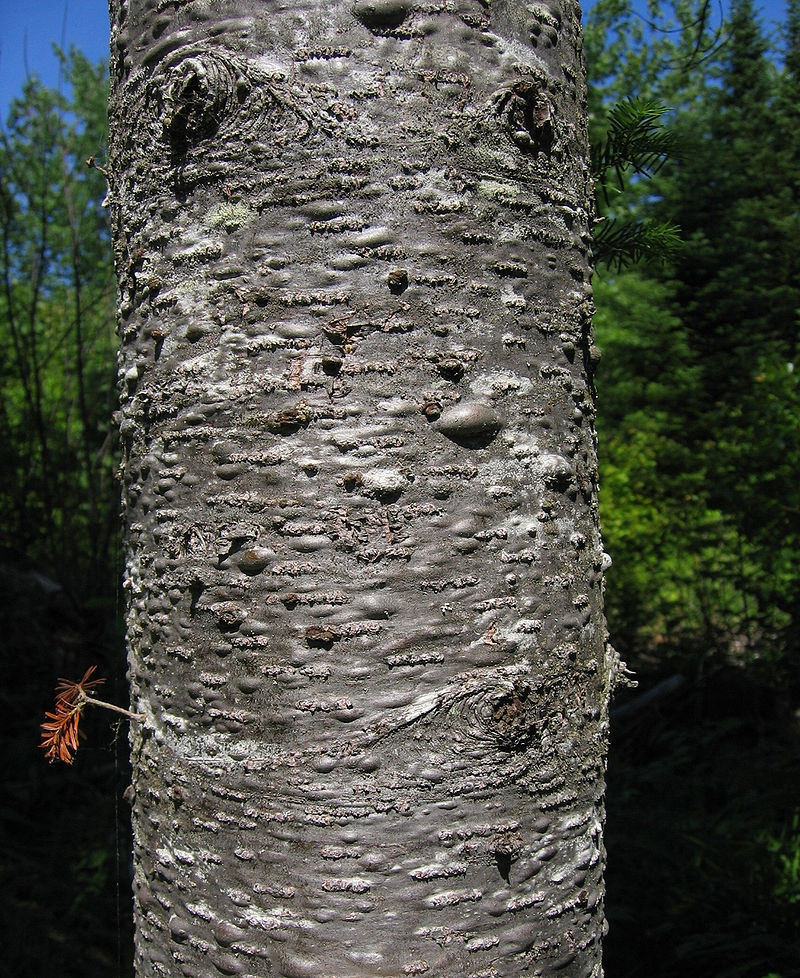
| Bark | Bark on young trees is smooth, grey, and with resin blisters (which tend to spray when ruptured), becoming brown, rough and fissured or scaly on old trees and are less than 0.5 inch (1.2 cm) thick |
| Twigs | Twigs pale green and pubescent when young, becoming gray, reddish, or purplish |
| Varieties |
|
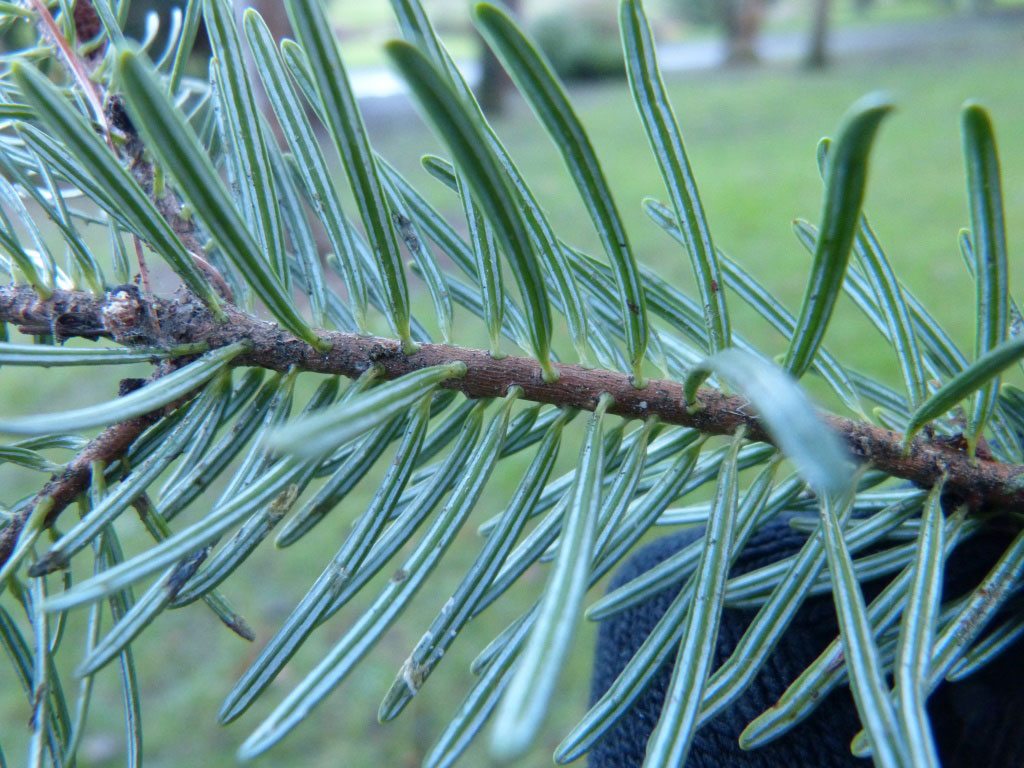
| Leaf | Flat and needle-like, 15 to 30 mm (5⁄8 to 1 1⁄8 in) long, dark green above often with a small patch of stomata near the tip, and two white stomatal bands below |
| Flowering season | May |
| Flower | At Maturity male flowers are about 3 mm (0.1 in) long; female flowers are about 25 mm (1.0 in) long |
| Fruit Shape & Size | Erect cone 5 to 10 cm (2 to 4 in) long with short, round, irregularly notched scales and pointed tips |
| Fruit Color | Dark Purple |
| Propagation | By seed |
| Plant Parts Used | Branches, bark, gum, twigs, leaves, resin |
| Seed | Seeds ovoid or oblong, acute at base, with thin wing and resinous vesicles, maturing in one summer |
| Taste | Acrid |
| Lifespan | About 200 years |
| Season | September to October |
Plant Description
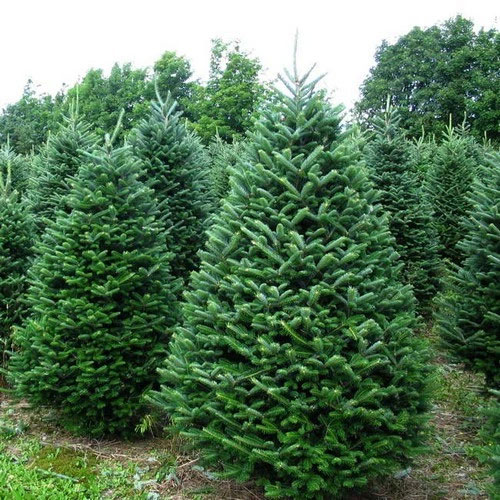
The balsam fir or balsam tree is a small to medium-sized, evergreen, coniferous, upright tree with a spire-like crown that normally grows about 4–20 meters (46–66 ft.) tall, occasionally reaching a height of 27 meters (89 ft.). The plant is found growing in mountain slopes, glaciated uplands as well as on alluvial flats, peat lands, swamps, forests and wetland margins. The plant can grow on a wide range of inorganic and organic soils originating from glaciation. The plant has shallow root system that is mostly confined to duff and upper mineral soil layers. Roots rarely penetrate more than 30 inches (75 cm) below the ground surface, except in sandy soils. The balsam fir possesses a trunk that is dotted all over with sticky vesicles. Twigs pale green and pubescent when young, becoming gray, reddish, or purplish. Bark on young trees is smooth, grey, and with resin blisters (which tend to spray when broken), becoming brown, rough and fissured or scaly on old trees and are less than 0.5 inch (1.2 cm) thick.
Leaves
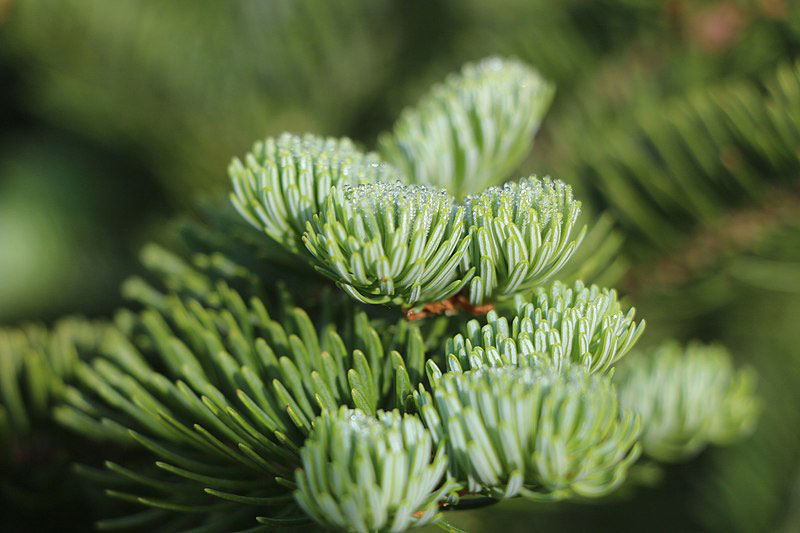
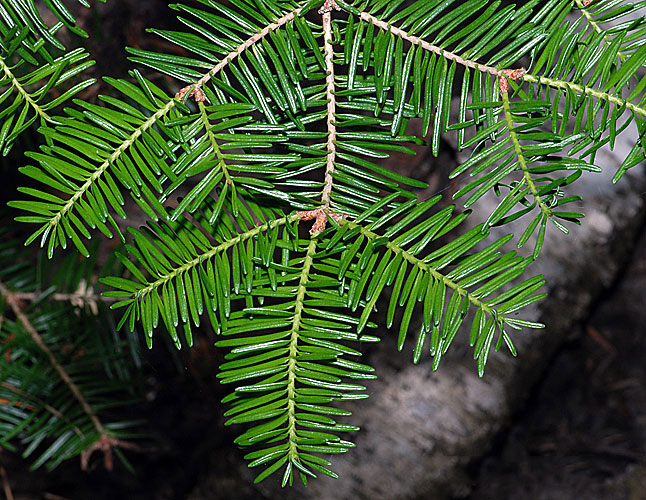
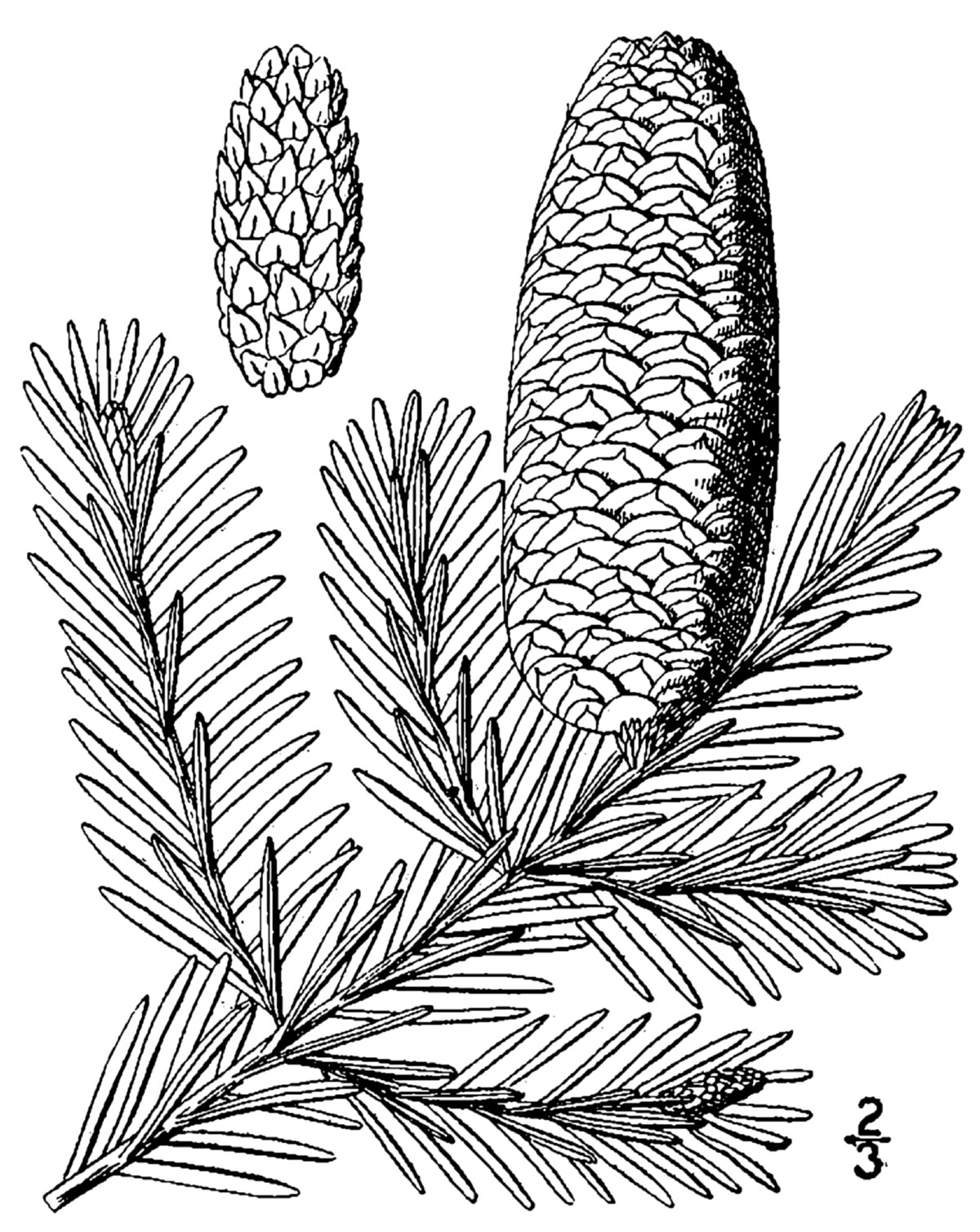
Resinous branches are densely clad with shiny, dark green needles (leaves). Leaves are flat and needle-like, 15 to 30 mm (5⁄8 to 1 1⁄8 in) long, dark green above often with a small patch of stomata near the tip, and two white stomatal bands below, and a slightly notched tip. They are arranged spirally on the shoot, but with the leaf bases twisted so that the leaves appear to be in two more-or-less horizontal rows on either side of the shoot. The needles become shorter and thicker the higher they are on the tree.
Flowers
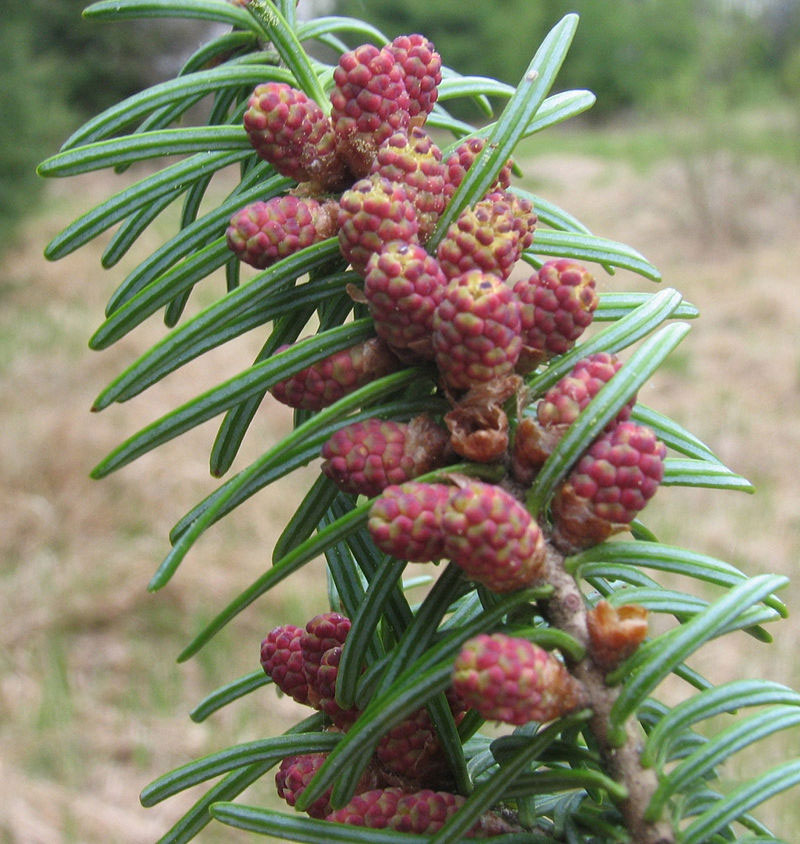
Balsam fir is monoecious. In spring, 1 year before pollination, male (staminate) and female (ovulate or pistillate) strobili differentiate from flower buds. The strobili are microscopically recognizable at this time. Male strobili usually are distinguishable before the female strobili because they initially develop more rapidly. Flower buds usually open in late May or early June before vegetative buds.
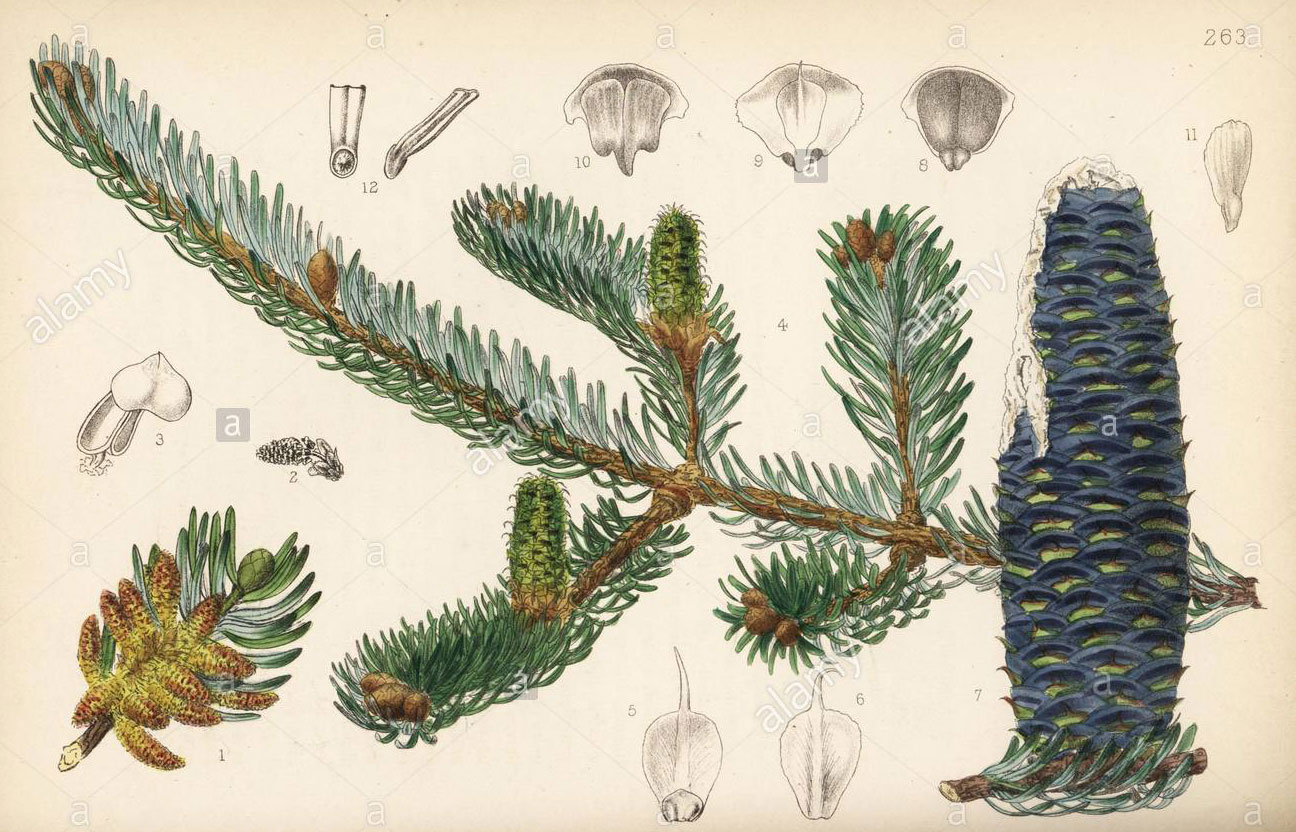
Male strobili are yellowish-red and tinged with purple; develop in the axils of leaves along the undersides of the 1-year-old twigs, usually in dense clusters. Their position in the crown is mostly within 5 m (15 ft.) of the top and is almost always below the female strobili. Female strobili are purplish and are found singly or in small groups, confined to the top 1.5 m (5 ft.) of the crown. They are located on the upper side of the twig and, like the male strobili, develop on the previous year’s twig. Flower production is best on the outer end of branches. At maturity, male flowers are about 3 mm (0.1 in) long; female flowers are about 25 mm (1.0 in) long.
Fruits
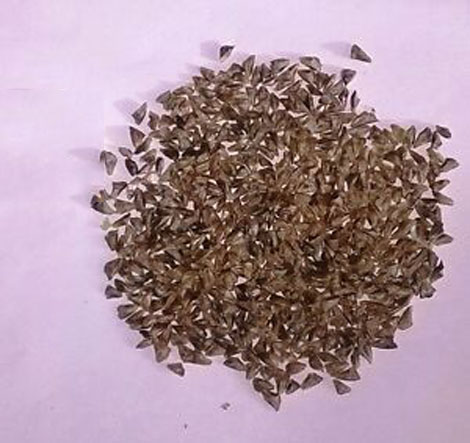
Fertile flowers are followed by erect cone 5 to 10 cm (2 to 4 in) long with short, round, irregularly notched scales and pointed tips. There are thin, closely overlapping fan-shaped scales near the center of the cone. The cone matures and ripens during the first fall in late August and early September. Cones are purple when young. As is distinctive with the firs, the cones appear upright on the branches. Cones disintegrate (scales drop) after the seeds ripen, often leaving only the erect central spike of the cone axis. Seeds ovoid or oblong, acute at base, with thin wing and resinous vesicles, maturing in one summer.
Traditional uses and benefits of Balsam Fir
- Resin obtained from the balsam fir has been used throughout the world and is a very effective antiseptic and healing agent.
- It is used as a healing and analgesic protective covering for burns, bruises, wounds and sores.
- It is also used to treat sore nipples and is said to be one of the best curatives for a sore throat.
- Buds, resin, or sap are used in folk remedies for treating cancers, corns, and warts.
- Resin is also anti-scorbutic, dia-phoretic, diuretic, stimulant and tonic.
- It is used internally in propriety mixtures to treat coughs and diarrhea, though taken in excess it is purgative.
- Warm liquid of the gummy sap was drunk as a treatment for gonorrhea.
- Tea made from the leaves is anti-scorbutic.
- It is used in the treatment of coughs, colds and fevers.
- Resin was used as an antiseptic healing agent applied externally to wounds, sores, bites etc.,
- It was used as an inhalant to treat headaches and was also taken internally to treat colds, sore throats and various other complaints.
- It has been used in diseases of the urinary tracts, but is said to possess no medicinal properties not found in other balsams.
- Tincture of them is useful for complaints of the chest, stomach, and kidneys, and for rheumatism and scurvy.
- Its paste is used to clean the teeth.
- Its resin, when inhaled with smoke, is effective for curbing headache.
- Cream and lotion prepared from Balsam Fir is a good herbal remedy for many skin problems. The resin is applied on wounds, cuts, burns, bruises, erysipelas and sores.
- Balsam Fir oil is quite effective for rheumatic pain and muscle pain.
- It is used in the preparation of herbal tea. This tea is used to treat many respiratory ailments like asthma, cough, and bronchitis etc.
- It is a good herbal remedy for constipation. Its cream or ointment is used for piles.
- An herbal tea was made from the inner bark of the balsam fir and was used as a remedy for the treatment of chest pains.
- Twigs steeped in water were used as a natural laxative.
- Root chewed is used for treating oral sores and other problems in the mouth.
- People taking the sweat baths would inhale the vapors to help in clearing up the congestion in the chest due to colds and persistent coughs.
- Herbal medications made from the tree have been traditionally used for disorders like congestion, to treat all kinds of chest infections including bronchitis.
- It is also used for the treatment of urinary tract conditions such as frequent urination and disorders like cystitis.
- Balsam fir based topical medications were also used in treating external problems, these medications were rubbed on the chest or even applied as a herbal plaster for treating respiratory infections of all kinds.
- Resin is supposed to be one of the best natural remedies for the treatment of a sore throat and is extensively used in the treatment of sore nipples by many women.
- Folk medicine makes use of the buds, the resin or the sap for the treatment of corns and warts and even to deal with serious disorders like cancer.
- Resin is normally consumed in the form of propriety mixtures for the treatment of persistent coughs and to treat digestive disorders like diarrhea.
- Gummy sap of the balsam fir was made into a warm liquid and traditionally drunk as a natural treatment for the sexually transmitted disease gonorrhea.
- Resin was also traditionally used as an antiseptic healing agent for external application to all kinds of bites, sores, wounds and injuries on the body.
- Resin was often inhaled in steam or smoke as a treatment for headaches.
- Balsam fir resin was also normally consumed to help in treating colds, in alleviating sore throats.
- Herbal decoction made from the mature branches will cure muscular spasms and soothe joint pain.
- Problems like gastrointestinal inflammation and problematic urinary infections are easily cured by an herbal decoction prepared from the inner bark of the balsam fir.
Ayurvedic Health benefits of Balsam Fir
- Cough, Constipation: Prepare a decoction made from the Bark of Balsam Fir. Take it two times a day.
- Toothache: Apply the gum of Balsam Fir to the affected tooth.
- Warts, Abscess: Apply the undiluted gum of Balsam Fir on the affected area. Wrap a bandage to prevent it from sticking to the clothes. Continue this treatment for a weak. Change the dressing on the site at least two times in a 24 hour period.
- Urinary Tract Infection: Put One tablespoon Inner bark of Balsam Fir in a cup of water and boil for 5 minutes. Strain. Drink 3 cups of this decoction, once before every meal daily.
- Wounds: Mix one tablespoon of Balsam fir and three tablespoon of Almond oil Or Grapes seed oil. Apply topically.
- Cough: Take 2 cups of water, 1/4 Kg Balsam Fir Shoots and One cup of Honey. Simmer the Balsam Fir Shoots in a covered pan for 15-20 minutes. Let it stand for an hour. Now add Honey and cook on low heat for 15 minutes. Bottle and store in a refrigerator. It is an excellent Cough Syrup. It can be used as it is or diluted in water. Consume within 3 Months.
- Muscular Pain: Mix 2 tablespoons of Liquid Balsam Fir with 8 tablespoons of Olive Oil. Use the mixture as a topical treatment for muscular pain.
- Piles: Mix 2 tablespoons Balsam Fir with 8 tablespoons of both Glycerin and Honey. Mix well and use as an ointment for Piles.
Culinary Uses
- Inner bark is usually dried, ground into a powder and then used as a thickening in soups etc. or mixed with cereals when making bread.
- An aromatic resinous pitch is found in blisters in the bark.
- When eaten raw it is delicious and chewy.
- An oleoresin from the pitch is used as a flavoring in sweets, baked goods, ice cream and drinks.
- Tips of young shoots are used as a tea substitute.
Dosing considerations for Balsam Fir
The appropriate dose of Balsam Fir for use as treatment depends on several factors such as the user’s age, health, and several other conditions. At this time there is not enough scientific information to determine an appropriate range of doses for Balsam Fir. Keep in mind that natural products are not always necessarily safe and dosages can be important. Be sure to follow relevant directions on product labels and consult your pharmacist or physician or other healthcare professional before using.
Other Facts
- It is used medicinally and in dentistry.
- Resin is also a fixative in soaps and perfumery.
- Leaves and young branches are used as a stuffing material for pillows etc. – they impart a pleasant scent.
- Thread can be made from the roots.
- Wood is used mainly for pulp; it is not used much for lumber except in the manufacture of crates etc.
- Wood is commercially valuable for timber even though it is relatively soft, weak, and perishable.
- Balsam fir is used in the US for timber and plywood, and is the mainstay of the pulp wood industry in the Northeast.
- Wood, which is rich in pitch, burns well and can be used as a kindling.
- Leaves are strongly aromatic of balsam when crushed.
- Tree is sometimes grown and used as a Christmas tree.
- Resin is also used in the manufacture of all kinds of glues and gums, in the making of candles and as a cementing substance in microscopes and slides.
- Young twigs and branch’s pleasant scent act as a repellent to moths and other insects.
- Roots of the balsam fir are used in the manufacture of thread and in rope making.
Precautions
- The oleoresin (Canada balsam) is reported to produce dermatitis when applied as perfume.
- The foliage has also induced contact dermatitis.
- Avoid use during pregnancy and breastfeeding.
References:
http://www.theplantlist.org/tpl1.1/record/kew-2609719
https://www.itis.gov/servlet/SingleRpt/SingleRpt?search_topic=TSN&search_value=18032#null
https://npgsweb.ars-grin.gov/gringlobal/taxonomydetail.aspx?id=635
https://pfaf.org/user/Plant.aspx?LatinName=Abies+balsamea
https://www.missouribotanicalgarden.org/PlantFinder/PlantFinderDetails.aspx?taxonid=284972
https://botanical.com/botanical/mgmh/b/balofg05.html
https://plants.usda.gov/core/profile?symbol=ABBA
https://www.srs.fs.usda.gov/pubs/misc/ag_654/volume_1/abies/balsamea.htm
http://dendro.cnre.vt.edu/dendrology/USDAFSSilvics/119.pdf
https://www.cabi.org/isc/datasheet/1880
https://gd.eppo.int/taxon/ABIBA
https://en.wikipedia.org/wiki/Abies_balsamea
https://www.fs.fed.us/database/feis/plants/tree/abibal/all.html
https://gobotany.nativeplanttrust.org/species/abies/balsamea/
https://hort.purdue.edu/newcrop/duke_energy/Abies_balsamea.html